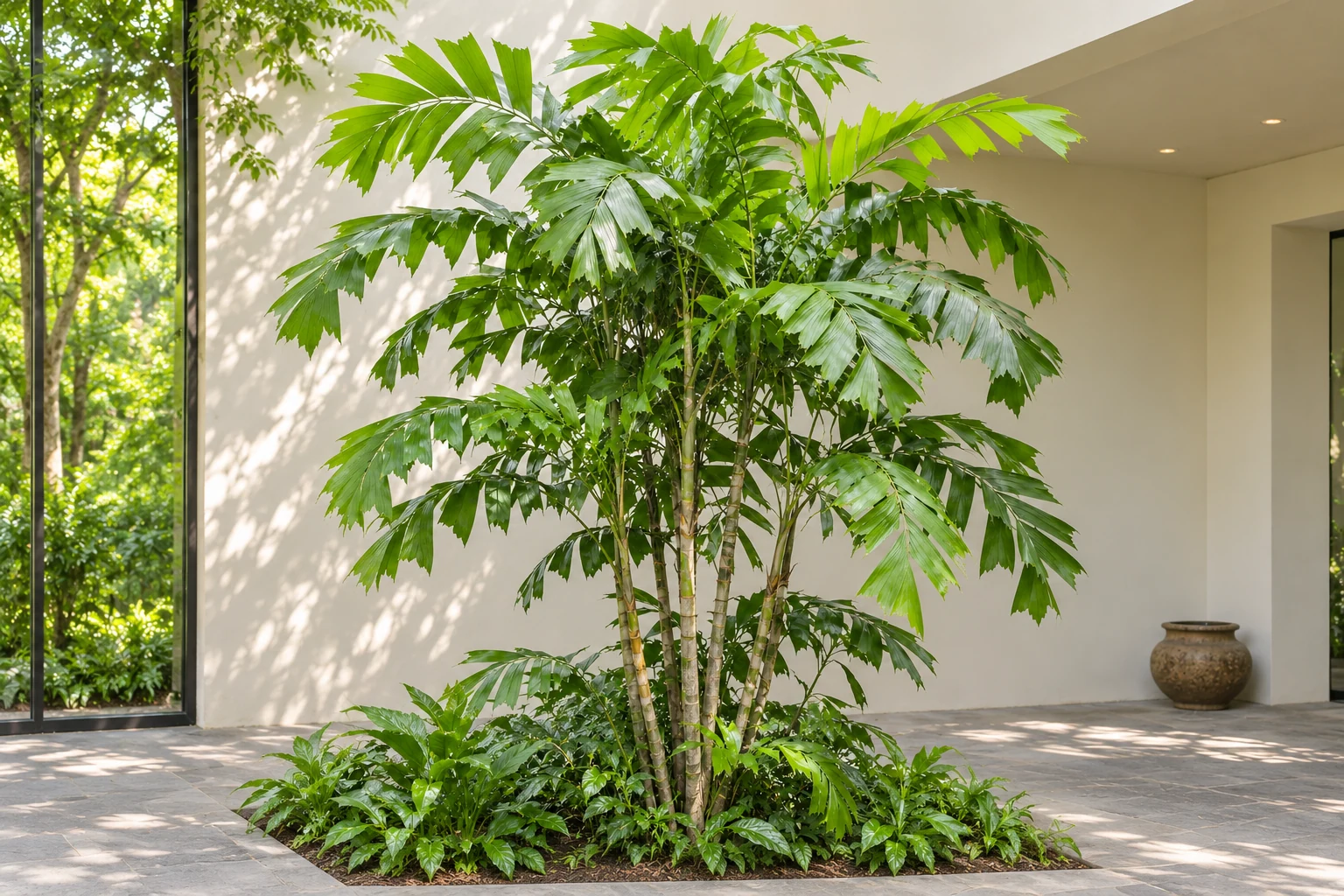
Browse general houseplant problems or use our diagnosis tool for Fishtail Palm.
Fishtail Palm problems
Use the guides below to diagnose and fix common issues on Fishtail Palm. Each problem page explains why it happens on this species and what to do first.
This profile covers Caryota mitis, a clumping palm that produces basal suckers. The Caryota genus also includes solitary-stemmed forms, so check the botanical label rather than relying on the shared common name.
Does each stem of Caryota mitis die after flowering?
Yes. A cane flowers progressively down its stem and dies after completing that cycle. The clump survives by producing new basal suckers, so remove only the spent cane and keep healthy stems.
How often should I water a Fishtail Palm?
Do not use a fixed weekly schedule. Check the upper 5–10 cm of mix, water thoroughly when that layer has dried, and let excess drain away. Water less often when growth slows in winter.
Are Fishtail Palm berries safe for cats and dogs?
No. NC State warns that the berries of Caryota mitis can harm pets and should not be eaten. The pulp contains calcium oxalate crystals and can cause severe mouth pain; keep fruit out of reach and call a veterinarian if a pet chews it.
Can a Fishtail Palm grow in a dark room?
It may tolerate some shade outdoors, but indoor guidance favors medium to bright filtered light. A dark indoor position slows growth and makes the soil dry more slowly, so choose a brighter location.
What light does Fishtail Palm need?
Fishtail Palm grows best in bright filtered light indoors; medium light is suitable. Outdoors, established palms grow in full sun to semi-shade in warm, sheltered locations. It also tolerates Medium indoor light, Partial shade outdoors, Full sun outdoors after gradual acclimation. Avoid dark indoor corners and abrupt exposure to strong midday sun after indoor culture.
How do I propagate Fishtail Palm?
Fishtail Palm propagates by basal sucker separation, clump division, seed. The easiest method is separate a rooted basal sucker from an established clump. New stems grow from the base of the clump. Division or careful separation of rooted suckers is practical for home growers; seed propagation requires warm conditions and patience.
How this Fishtail Palm problems guide is reviewed?
Written by Sai AnanthLead content writer at LeafyPixels. B.Pharmacy graduate from Andhra University with a background in pharmacognosy, turned indoor gardening writer after a long-time plant hobby became a research-led resource for home growers.View Sai Ananth's profile · Reviewed by LeafyPixels Review Board
This Fishtail Palm problems problem guide was researched and written by Sai AnanthLead content writer at LeafyPixels. B.Pharmacy graduate from Andhra University with a background in pharmacognosy, turned indoor gardening writer after a long-time plant hobby became a research-led resource for home growers.View Sai Ananth's profile. Problems symptoms on Fishtail Palm, lookalike causes, and step-by-step fixes are cross-checked against extension pest, disease, and care references before publication.
We prioritize sources that hold up under scrutiny:
University cooperative extension bulletins and fact sheets (Penn State, Clemson, UMD, NC State, and similar programs)
Botanical garden and horticultural society publications
Peer-reviewed plant science and veterinary toxicology references where pet safety matters (including ASPCA Animal Poison Control)
Established reference works on indoor plant culture
The LeafyPixels editorial team then reviews the draft for clarity, step-by-step usefulness, and fit with real apartment and home conditions-not ideal greenhouse setups. When guidance changes materially, we update the page and note the revision date.
NC State Extension Plant Toolbox (n.d.) Species identity, native region, clumping growth, flowering cycle, indoor light, watering, and fruit hazards. [Online]. Available at: https://plants.ces.ncsu.edu/plants/caryota-mitis/ (Accessed: 1 March 2024).
NParks Flora & Fauna Web (n.d.) Cultivation conditions, clumping habit, fruit-pulp irritant, and seed or sucker propagation. [Online]. Available at: https://www.nparks.gov.sg/florafaunaweb/flora/2/6/2607 (Accessed: 1 March 2024).
Royal Horticultural Society (n.d.) Clumping form, mature size, filtered indoor light, humidity, soil, and seasonal watering. [Online]. Available at: https://www.rhs.org.uk/plants/75193/caryota-mitis/details (Accessed: 1 March 2024).