Fishtail Palm Care: Light, Water and Fruit Safety
Caryota mitis
This guide covers the clumping palm Caryota mitis: provide bright filtered light, water when the upper soil partly dries, use a moist but well-drained mix, and keep its irritating berries away from children and pets.
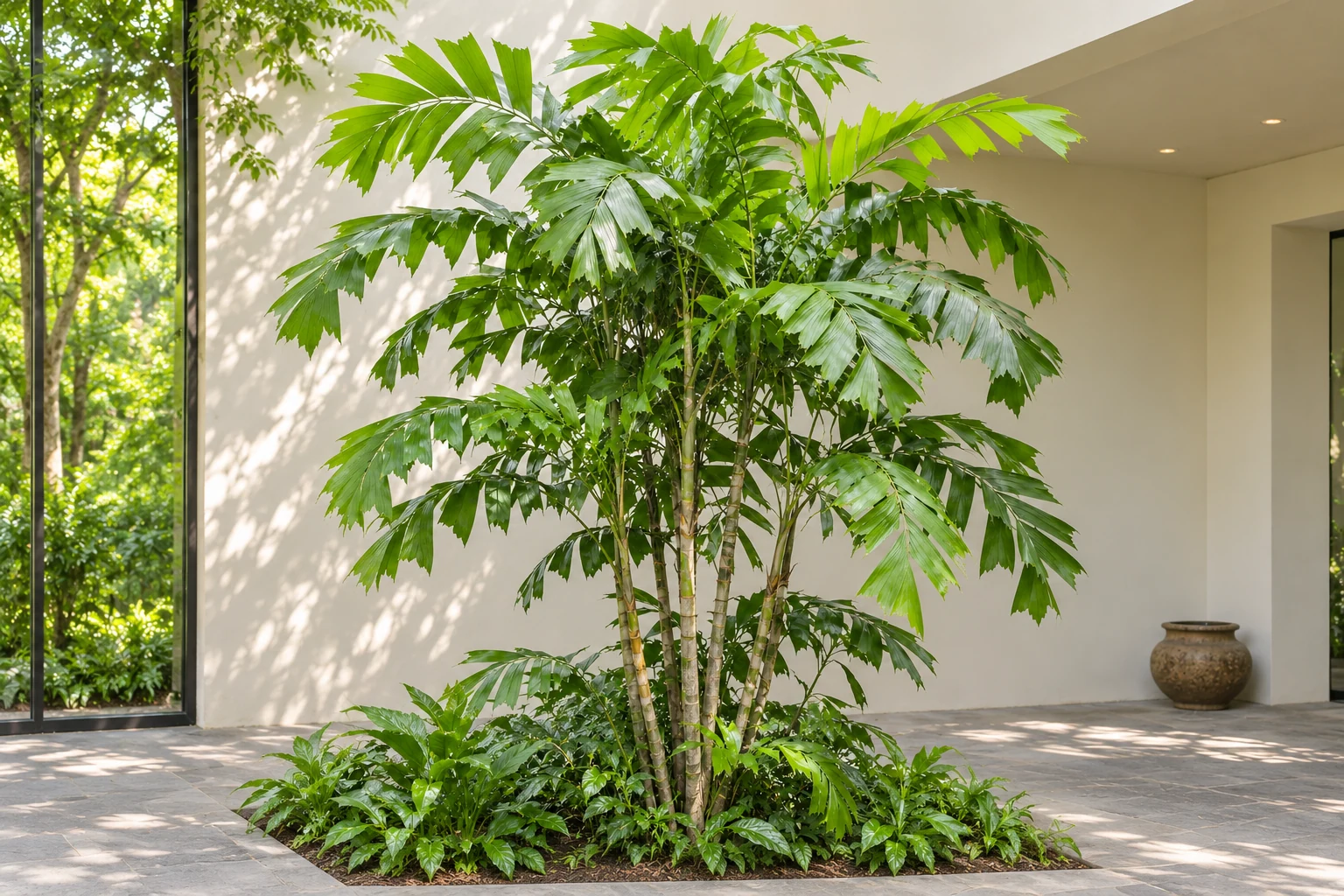
Fishtail Palm (Caryota mitis) Care Guide
Start with wateringThe most common care mistake for Fishtail PalmWatering guide →Fishtail Palm care essentials
Light
Bright filtered light indoors; medium light is suitable. Outdoors, established palms grow in full sun to semi-shade in warm, sheltered locations.
Water
Keep the mix evenly moist in active growth without leaving roots in standing water. For a pot, water thoroughly when the upper 5–10 cm has dried, then let excess drain; water less often in winter.
Soil
Use a rich, loam-based potting mix that holds some moisture but drains freely. A pot must have drainage holes.
Humidity
Moderate room humidity is usually workable; higher humidity can support good foliage, while sources differ on how high this palm needs indoors.
Temperature
Warm, stable conditions; keep the plant frost-free and away from cold drafts.
Fertilizer
Apply a balanced liquid fertilizer about monthly while it is actively growing.. Balanced liquid fertilizer diluted and applied according to its label.
About Fishtail Palm
Fishtail Palm is native to Tropical Asia, including southern China, Indo-China, India, the Philippines, and Malesia, typically reaches Around 4–8 m (13–26 ft) tall and 2.5–4 m (8–13 ft) wide in the RHS profile; NC State records potential heights to about 40 ft (12 m) in warm landscapes. Container plants stay smaller but still need room for a broad clump and long arching fronds. indoors, with medium growth. Fishtail Palm has a palm like growth habit and part of the Arecaceae family. It is also known as Burmese fishtail palm, clustering fishtail palm, clustered fishtail palm, and tufted fishtail palm.
| Detail | Information |
|---|---|
| Also known as | Burmese fishtail palm, clustering fishtail palm, clustered fishtail palm, tufted fishtail palm |
| Native region | Tropical Asia, including southern China, Indo-China, India, the Philippines, and Malesia |
| Mature size | Around 4–8 m (13–26 ft) tall and 2.5–4 m (8–13 ft) wide in the RHS profile; NC State records potential heights to about 40 ft (12 m) in warm landscapes. Container plants stay smaller but still need room for a broad clump and long arching fronds. |
| Growth rate | Medium |
| Growth habit | Palm Like |
| Scientific name | Caryota mitis |
| Family | Arecaceae |
How to care for Fishtail Palm?
How much light does Fishtail Palm need?
Bright filtered light indoors; medium light is suitable. Outdoors, established palms grow in full sun to semi-shade in warm, sheltered locations.. Medium indoor light. Partial shade outdoors. Full sun outdoors after gradual acclimation. direct sun
- Bright filtered light indoors - Bright filtered light indoors; medium light is suitable.
- medium light is suitable. Outdoors - Medium indoor light.
- established palms grow in full sun to semi-shade in warm - Outdoors, established palms grow in full sun to semi-shade in warm, sheltered locations..
- sheltered locations - Outdoors, established palms grow in full sun to semi-shade in warm, sheltered locations..
- Medium indoor light - Medium indoor light.
- Partial shade outdoors - Partial shade outdoors.
- Full sun outdoors after gradual acclimation - Full sun outdoors after gradual acclimation.
- direct sun - direct sun.
When should you water Fishtail Palm?
Keep the mix evenly moist in active growth without leaving roots in standing water. For a pot, water thoroughly when the upper 5–10 cm has dried, then let excess drain; water less often in winter.
- Feel the upper 5–10 cm of mix and check pot weight before watering. Water to runoff - For a pot, water thoroughly when the upper 5–10 cm has dried, then let excess drain; water less often in winter.
- empty the saucer - Keep the mix evenly moist in active growth without leaving roots in standing water.
- and wait for the upper layer to dry again - For a pot, water thoroughly when the upper 5–10 cm has dried, then let excess drain; water less often in winter.
- Drain excess water - For a pot, water thoroughly when the upper 5–10 cm has dried, then let excess drain; water less often in winter.
What soil works best for Fishtail Palm?
Use a rich, loam-based potting mix that holds some moisture but drains freely. A pot must have drainage holes.
- Peat-free loam-based potting compost - Use a rich, loam-based potting mix that holds some moisture but drains freely.
- Perlite, pumice, or fine bark if the mix needs more air space - Use a rich, loam-based potting mix that holds some moisture but drains freely.
- A container with open drainage holes - A pot must have drainage holes.
How to propagate Fishtail Palm?
New stems grow from the base of the clump. Division or careful separation of rooted suckers is practical for home growers; seed propagation requires warm conditions and patience.
- Basal sucker separation - Division or careful separation of rooted suckers is practical for home growers; seed propagation requires warm conditions and patience.
- Clump division - Division or careful separation of rooted suckers is practical for home growers; seed propagation requires warm conditions and patience.
- Seed - Division or careful separation of rooted suckers is practical for home growers; seed propagation requires warm conditions and patience.
Grower notes for Fishtail Palm
Confirm which fishtail palm you have
Caryota mitis is the clumping species: its unbranched canes rise together and new suckers form at the base. Caryota includes both clustered and solitary-stem forms, so the common name alone does not identify a plant. Check for the name Caryota mitis on the label; a single cane by itself is not enough to identify a different species because young plants may not yet show a mature clump.
Give it filtered light indoors
NC State describes medium light for indoor plants, and the RHS recommends bright filtered light under glass. Place the palm near a bright window where the fronds are not scorched by abrupt, strong midday sun. Outdoors, established plants tolerate full sun to semi-shade in warm, sheltered conditions.
Water by the soil, not the calendar
Keep the root zone moist but freely draining during active growth. Check the upper 5–10 cm before watering; once it has dried, water thoroughly and empty the saucer. A pot that stays wet in winter is a stronger warning than a missed day on a schedule.
Expect individual canes to finish
Caryota mitis flowers along a cane from its upper nodes downward. Once that cane completes flowering, it dies; the rest of the clump continues through basal suckers. Remove only a dead, spent cane and leave healthy green stems in place. Houseplants rarely flower.
Treat the berries as an irritant
The round fruits ripen from green toward red or dark tones. Their pulp contains calcium oxalate crystals and can cause severe mouth pain and skin irritation. Wear gloves when handling or cleaning up fruit, wash exposed skin, and keep berries away from children and pets. NC State notes that immature seeds are sold as canned delicacies; that is not a reason to eat unprocessed fruit from a houseplant.
Plan for a broad, slow-maturing palm
The RHS profile gives a mature spread of 2.5–4 m and a height of 4–8 m, with a long time to maturity. A container specimen stays smaller, but its arching fronds and basal suckers still need floor space. Avoid buying it for a narrow shelf or a cramped corner.
Fishtail Palm pet safety
Do not treat Caryota mitis as pet-safe. NC State warns that its berries can harm pets and should not be eaten; the documented hazard is the fruit, whose pulp can cause oral pain and skin irritation. Keep the palm and fallen fruit away from chewing pets, use gloves for cleanup, and contact a veterinarian if a pet chews it.
The species-specific sources document the fruit as the principal hazard: Caryota mitis berries contain calcium oxalate crystals, can cause severe mouth pain, and may irritate skin. NC State advises keeping the fruit away from pets and children. Do not generalize this evidence into a claim that every plant part has the same effect; prevent chewing and seek veterinary advice after exposure.
Watering Fishtail Palm
For Fishtail Palm, feel the upper 5–10 cm of mix and check pot weight before watering. Water to runoff, empty the saucer, and wait for the upper layer to dry again. and water no fixed interval; check the upper soil regularly and adjust for light, warmth, pot size, and season. Growth slows in winter; allow the mix to dry farther between waterings and avoid keeping the root ball saturated.
| Detail | Information |
|---|---|
| How often | No fixed interval; check the upper soil regularly and adjust for light, warmth, pot size, and season. |
| How to check | Feel the upper 5–10 cm of mix and check pot weight before watering. Water to runoff, empty the saucer, and wait for the upper layer to dry again. |
| Seasonal changes | Growth slows in winter; allow the mix to dry farther between waterings and avoid keeping the root ball saturated. |
Signs of overwatering
- Soil remains wet long after watering
- Yellowing lower fronds while the mix is still damp
- Stale or sour-smelling potting mix
Signs of underwatering
- A very light pot with dry mix well below the surface
- Limp or greying fronds after the root ball has dried
Soil & potting for Fishtail Palm
Use a mix of Peat-free loam-based potting compost, Perlite, pumice, or fine bark if the mix needs more air space, A container with open drainage holes for Fishtail Palm. Moist but well-drained; never leave the root ball sitting in water. Target soil pH around NParks lists a tolerated range of about pH 6.1–7.8; do not adjust pH unless a test shows a problem. Repot repot when roots fill the container, the clump becomes crowded, or the mix no longer drains reliably; avoid a rigid annual schedule., ideally in spring or early active growth, with minimal disturbance to the roots.
| Detail | Information |
|---|---|
| Recommended mix | Peat-free loam-based potting compost, Perlite, pumice, or fine bark if the mix needs more air space, A container with open drainage holes |
| Drainage | Moist but well-drained; never leave the root ball sitting in water. |
| Soil pH | NParks lists a tolerated range of about pH 6.1–7.8; do not adjust pH unless a test shows a problem. |
| Repotting frequency | Repot when roots fill the container, the clump becomes crowded, or the mix no longer drains reliably; avoid a rigid annual schedule. |
| Best season to repot | Spring or early active growth, with minimal disturbance to the roots. |
Signs it needs repotting
- Roots emerging from drainage holes
- The root ball drying unusually quickly
- Basal suckers crowding the container
Humidity & temperature for Fishtail Palm
Fishtail Palm prefers moderate room humidity is usually workable; higher humidity can support good foliage, while sources differ on how high this palm needs indoors., though normal home humidity is usually fine. Keep temperatures around warm, stable conditions; keep the plant frost-free and away from cold drafts. Avoid letting Fishtail Palm sit below Not cold-hardy; protect from frost and prolonged chill. This tropical palm is best in a warm room or heated conservatory; acclimate it gradually before any summer placement outdoors.
| Detail | Information |
|---|---|
| Humidity | Moderate room humidity is usually workable; higher humidity can support good foliage, while sources differ on how high this palm needs indoors. - normal home humidity is fine. |
| Ideal temperature | Warm, stable conditions; keep the plant frost-free and away from cold drafts. |
| Minimum temperature | Not cold-hardy; protect from frost and prolonged chill. |
| Temperature notes | This tropical palm is best in a warm room or heated conservatory; acclimate it gradually before any summer placement outdoors. |
Humidity tips
- Keep the fronds away from hot heaters and drying vents.
- If the room is persistently dry, raise humidity gradually and keep air moving.
Fertilizer & pruning for Fishtail Palm
Feed Fishtail Palm apply a balanced liquid fertilizer about monthly while it is actively growing. using balanced liquid fertilizer diluted and applied according to its label. The best feeding window is spring and summer growth; reduce or stop feeding when growth slows in winter. Do not compensate for poor light, waterlogged soil, or damaged roots with extra fertilizer.
| Detail | Information |
|---|---|
| Fertilizer schedule | Apply a balanced liquid fertilizer about monthly while it is actively growing. |
| Best season | Spring and summer growth; reduce or stop feeding when growth slows in winter. |
| Fertilizer type | Balanced liquid fertilizer diluted and applied according to its label. |
| What to avoid | Do not compensate for poor light, waterlogged soil, or damaged roots with extra fertilizer. |
Pruning (optional)
Remove dead or damaged fronds and cut out a cane only after that stem has finished flowering and died. Do not top living canes.