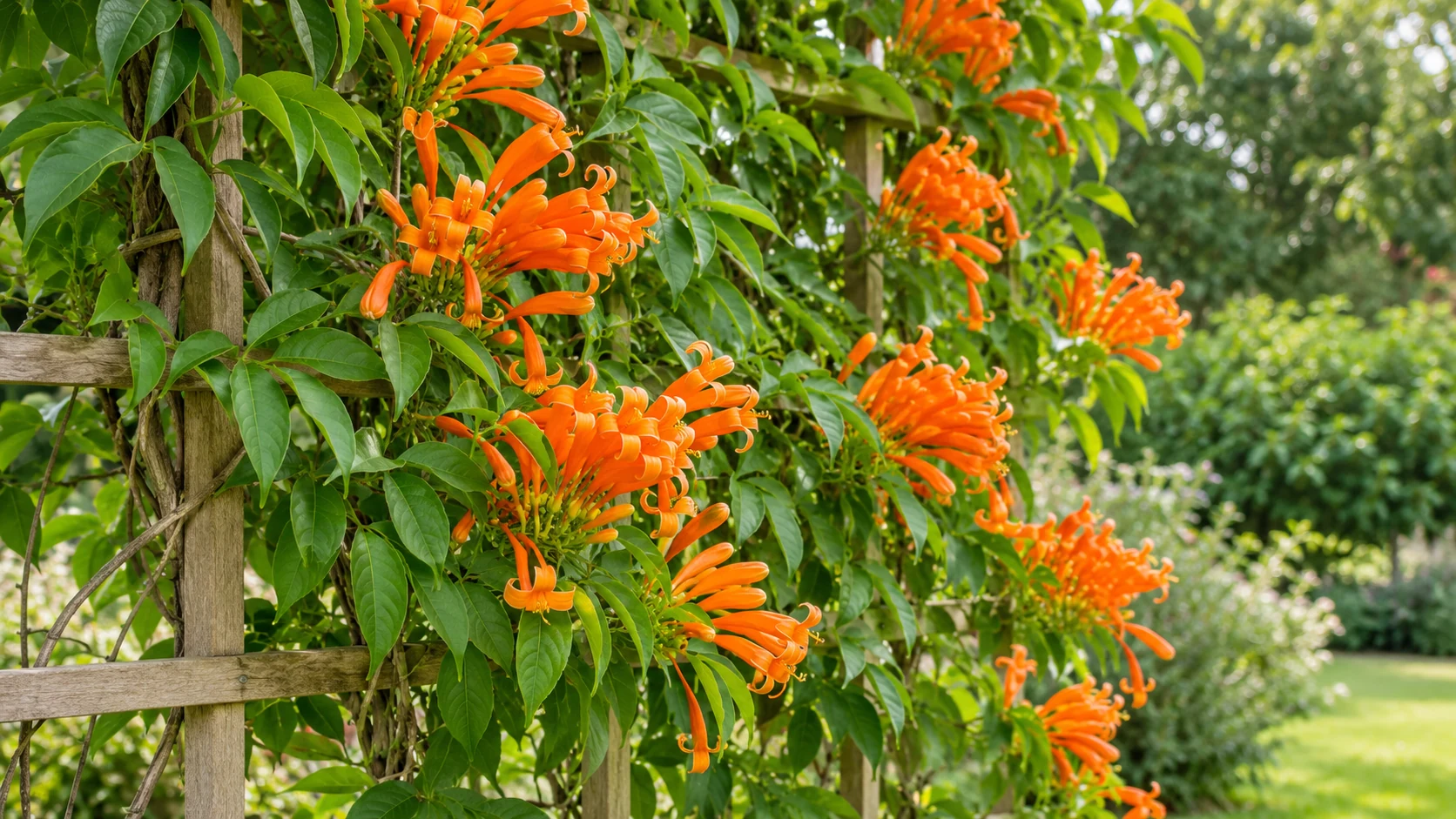
It covers Pyrostegia venusta, a South American evergreen climber in the Bignoniaceae family. Flame flower, flaming trumpet, and orange trumpet vine are also used as common names, so check the botanical name on the plant label.
How much sun does Flame Vine need?
Full sun is best for a heavy flower display. The vine tolerates partial shade, but flowering may be lighter there.
When does Flame Vine bloom?
The main display is in fall and winter and may last into early spring in warm areas. UF/IFAS notes that some plants flower lightly during summer.
Does Flame Vine need a trellis?
Yes. It climbs with tendrils and grows quickly, so provide a sturdy fence, arbor, or trellis. Keep it away from trees and prune it regularly so it does not overrun nearby plants.
Will Flame Vine survive frost?
It is a tender evergreen climber. The RHS recommends heated-glass culture in cool climates, and UF/IFAS describes it as most reliable in warm zones. Protect container plants from frost and do not assume an occasional zone-8b sighting means it is reliably cold-hardy.
Is Flame Vine invasive?
UF/IFAS rates Pyrostegia venusta as high invasion risk in Florida and applies a not-recommended conclusion there, while allowing specific approved management exceptions. Check local guidance outside Florida and do not let the vine escape its support.
Is Flame Vine safe for cats and dogs?
A species-specific toxicity classification was not confirmed in the sources reviewed. Treat the plant as unclassified rather than assuming it is safe, keep pets from chewing it, and contact a veterinarian after any ingestion.
Written by Sai AnanthLead content writer at LeafyPixels. B.Pharmacy graduate from Andhra University with a background in pharmacognosy, turned indoor gardening writer after a long-time plant hobby became a research-led resource for home growers.View Sai Ananth's profile · Reviewed by LeafyPixels Review Board
This Flame Vine problems problem guide was researched and written by Sai AnanthLead content writer at LeafyPixels. B.Pharmacy graduate from Andhra University with a background in pharmacognosy, turned indoor gardening writer after a long-time plant hobby became a research-led resource for home growers.View Sai Ananth's profile. Problems symptoms on Flame Vine, lookalike causes, and step-by-step fixes are cross-checked against extension pest, disease, and care references before publication.
We prioritize sources that hold up under scrutiny:
University cooperative extension bulletins and fact sheets (Penn State, Clemson, UMD, NC State, and similar programs)
Botanical garden and horticultural society publications
Peer-reviewed plant science and veterinary toxicology references where pet safety matters (including ASPCA Animal Poison Control)
Established reference works on indoor plant culture
The LeafyPixels editorial team then reviews the draft for clarity, step-by-step usefulness, and fit with real apartment and home conditions-not ideal greenhouse setups. When guidance changes materially, we update the page and note the revision date.
Roger's Gardens Plant Finder — Flame Vine (n.d.) Cultivar-independent garden profile, flowering season, support and pruning notes, and container watering considerations. [Online]. Available at: https://plants.rogersgardens.com/12290002/Plant/19636/Flame_Vine/ (Accessed: 1 March 2024).
Royal Horticultural Society — Pyrostegia venusta (n.d.) Botanical identity, family, native range, mature size, full-light position, well-drained soil, greenhouse culture, and pruning after flowering. [Online]. Available at: https://www.rhs.org.uk/plants/14215/pyrostegia-venusta/details (Accessed: 1 March 2024).
The Smarter Gardener — Norfolk Island Pines and Flame Vines (n.d.) Southern California field observation of winter flowering, vigorous height, and a sheltered east-facing trellis for frost-prone sites. [Online]. Available at: https://www.thesmartergardener.com/northfolk-island-pines-flame-vines/ (Accessed: 1 March 2024).
UF/IFAS Assessment of Non-Native Plants — Pyrostegia venusta (n.d.) Florida regional assessment, high invasion-risk predictive-tool result, and conservative recommendation; records assessment dates of 2007 and 2017. [Online]. Available at: https://assessment.ifas.ufl.edu/assessments/pyrostegia-venusta/ (Accessed: 1 March 2024).
UF/IFAS Extension — Pyrostegia venusta Flame Vine (FP496) (n.d.) Vine form, support-dependent height, fast growth, flowering, light and soil tolerance, and drought tolerance; its older invasion-status statement is not used for the current regional recommendation. [Online]. Available at: https://ask.ifas.ufl.edu/publication/FP496 (Accessed: 1 March 2024).