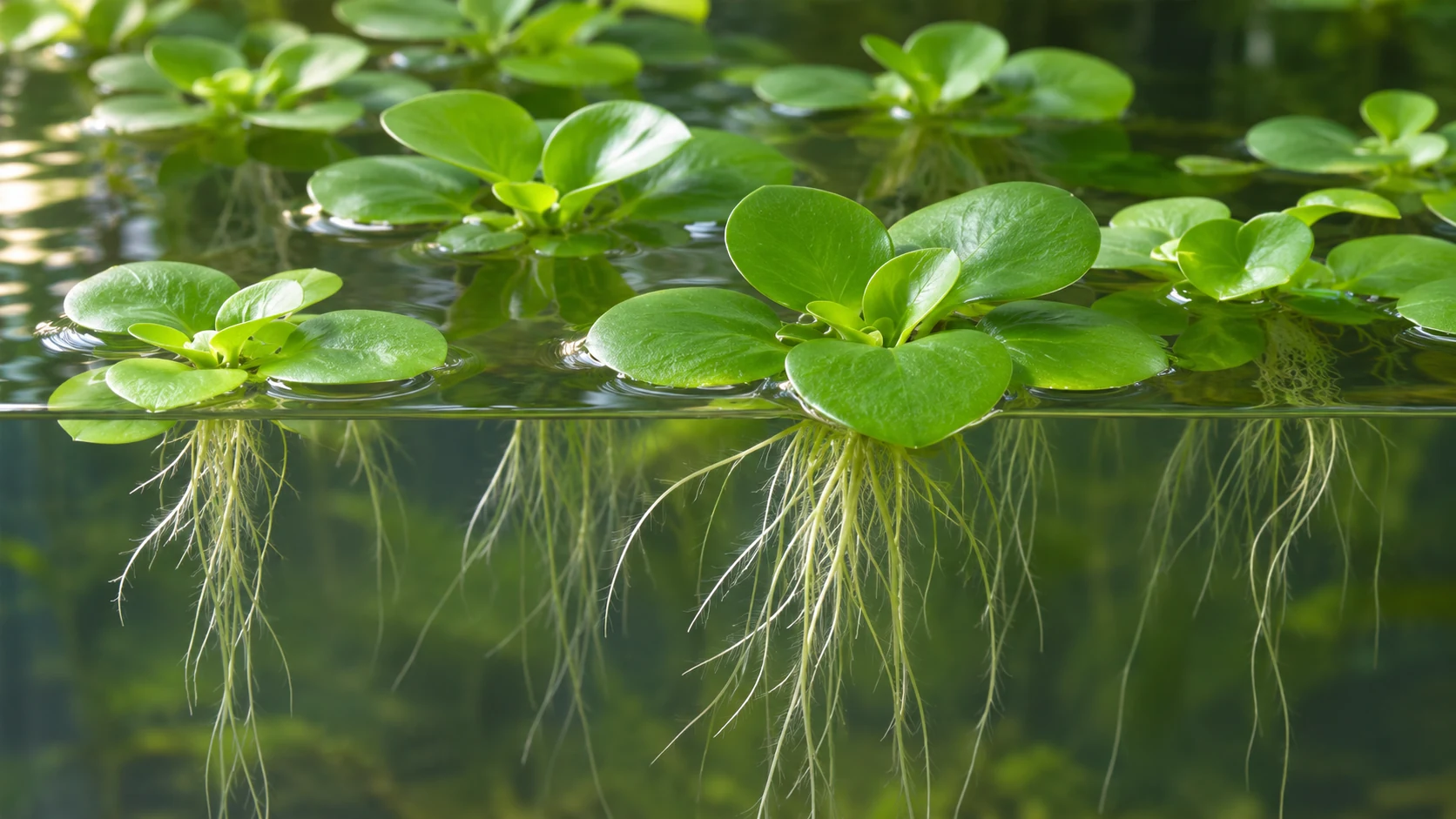
Is Amazon frogbit the same plant as European frogbit?
No. This guide covers Amazon frogbit, Limnobium laevigatum. European frogbit is Hydrocharis morsus-ranae, a different species. Check the scientific name on a plant label because the common name “frogbit” can refer to more than one floating plant.
Is Amazon frogbit the same as water lettuce?
No. Water lettuce is Pistia stratiotes, a different floating plant. Amazon frogbit is Limnobium laevigatum; compare scientific names when buying or identifying aquarium floaters.
Does frogbit need substrate or root tabs?
No. Keep it floating with the roots in the water. It takes up nutrients from the water column, so substrate is unnecessary for aquarium growth.
What light and water movement suit frogbit?
Moderate aquarium light and still to gentle surface movement are a reasonable starting point. Avoid strong splashing over the leaves, and thin the plant if its canopy shades plants below.
How do I keep frogbit from covering the whole aquarium?
Remove extra daughter rosettes as they develop on runners. Keep open areas at the surface for light, feeding, and tank maintenance; check filter intakes for roots while thinning.
Can I release extra frogbit into a pond or drain?
No. Bag and dispose of surplus plants under local guidance, and do not release aquarium water or plant fragments to outdoor waters. UF/IFAS documents spread outside cultivation and warns against aquarium releases.
Is Frogbit toxic to pets?
Frogbit is toxic to cats and dogs. Pet toxicity status not verified; do not use aquarium plants as pet food. Keep out of reach of curious pets and choose pet-safe alternatives for accessible spots.
Written by Sai AnanthLead content writer at LeafyPixels. B.Pharmacy graduate from Andhra University with a background in pharmacognosy, turned indoor gardening writer after a long-time plant hobby became a research-led resource for home growers.View Sai Ananth's profile · Reviewed by LeafyPixels Review Board
This Frogbit problems problem guide was researched and written by Sai AnanthLead content writer at LeafyPixels. B.Pharmacy graduate from Andhra University with a background in pharmacognosy, turned indoor gardening writer after a long-time plant hobby became a research-led resource for home growers.View Sai Ananth's profile. Problems symptoms on Frogbit, lookalike causes, and step-by-step fixes are cross-checked against extension pest, disease, and care references before publication.
We prioritize sources that hold up under scrutiny:
University cooperative extension bulletins and fact sheets (Penn State, Clemson, UMD, NC State, and similar programs)
Botanical garden and horticultural society publications
Peer-reviewed plant science and veterinary toxicology references where pet safety matters (including ASPCA Animal Poison Control)
Established reference works on indoor plant culture
The LeafyPixels editorial team then reviews the draft for clarity, step-by-step usefulness, and fit with real apartment and home conditions-not ideal greenhouse setups. When guidance changes materially, we update the page and note the revision date.
Sources used
Aggregated occurrence records of invasive European frog-bit (Hydrocharis morsus-ranae) across North America (n.d.) Confirms European frogbit is Hydrocharis morsus-ranae, a distinct species from Amazon frogbit.. [Online]. Available at: https://pmc.ncbi.nlm.nih.gov/articles/PMC8850361/ (Accessed: 1 March 2024).
Dennerle Plants, Limnobium laevigatum (n.d.) Aquarium profile, family, origin, temperature, light, growth, and runner propagation.. [Online]. Available at: https://dennerleplants.co.uk/products/limnobium-laevigatum (Accessed: 1 March 2024).
Fin & Stem, Amazon Frogbit (n.d.) Hobby aquarium guidance on free-floating growth, water-column feeding, trailing root length, low flow, and runner propagation.. [Online]. Available at: https://finandstem.com/plants/amazon-frogbit (Accessed: 1 March 2024).
UF/IFAS Assessment of Non-Native Plants in Florida's Natural Areas, Limnobium laevigatum (n.d.) Florida-specific invasion-risk assessment and regional caution.. [Online]. Available at: https://assessment.ifas.ufl.edu/assessments/limnobium-laevigatum/ (Accessed: 1 March 2024).
University of Florida IFAS Center for Aquatic and Invasive Plants, Limnobium laevigatum (n.d.) Native range, free-floating habit, identification features, spread, impacts, and advice never to release aquarium water into waterbodies.. [Online]. Available at: https://plant-directory.ifas.ufl.edu/plant-directory/limnobium-laevigatum/ (Accessed: 1 March 2024).