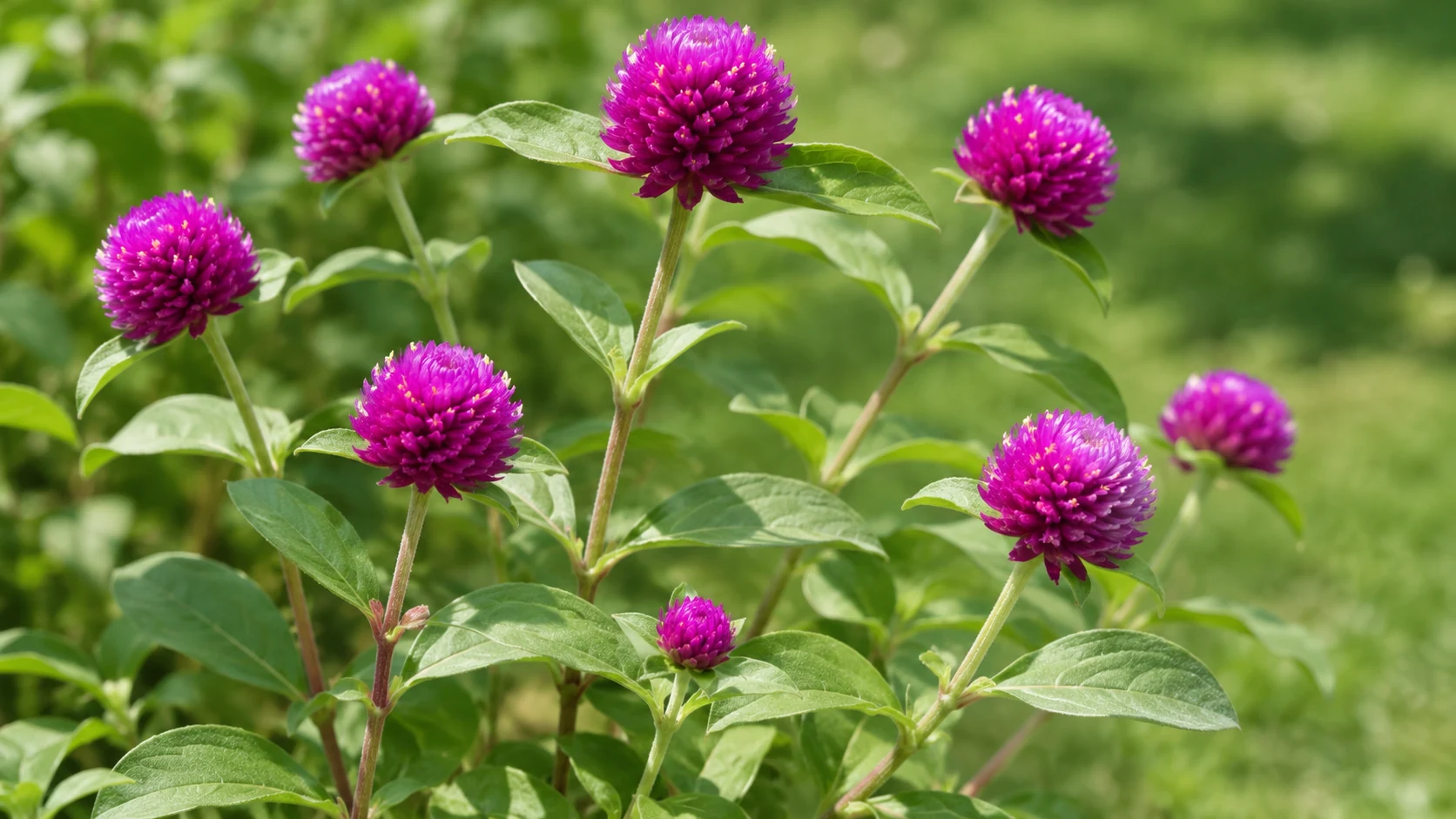
Globe amaranth is usually grown as a warm-season annual. NC State notes it may persist as a perennial in warmer zones, but it is normally replanted where winter frost kills tender growth.
How much sun does globe amaranth need?
Choose a sunny spot. Full sun is recommended by NC State, UF/IFAS, and RHS; light afternoon shade may help during extreme heat, but deep shade can reduce flowering.
How often should I water Gomphrena?
Check the soil rather than following a fixed schedule. Keep seedlings and transplants from drying out, then water established plants when the top layer begins to dry or during a prolonged hot, dry spell. Good drainage matters because the plant does not need constantly wet soil.
Can I grow Gomphrena from seed?
Yes. Start seed indoors about 6–8 weeks before the last frost or direct sow after the soil has warmed. Germination can be uneven, and soaking seed overnight is one option described by Wisconsin Horticulture.
Is Gomphrena safe for cats, dogs, or horses?
A species-specific safety classification was not found in the sources checked. The ASPCA plant list is not exhaustive, so its lack of a Gomphrena entry does not confirm safety. Keep the plant away from chewing pets and ask a veterinarian if an animal eats it.
What light does Gomphrena need?
Gomphrena grows best in full sun for compact growth and abundant flowers. It also tolerates Light afternoon shade. Avoid deep shade, which can reduce flowering and make stems stretch.
How do I propagate Gomphrena?
Propagate Gomphrena from healthy stem or root divisions during active growth.
Written by Sai AnanthLead content writer at LeafyPixels. B.Pharmacy graduate from Andhra University with a background in pharmacognosy, turned indoor gardening writer after a long-time plant hobby became a research-led resource for home growers.View Sai Ananth's profile · Reviewed by LeafyPixels Review Board
This Gomphrena problems problem guide was researched and written by Sai AnanthLead content writer at LeafyPixels. B.Pharmacy graduate from Andhra University with a background in pharmacognosy, turned indoor gardening writer after a long-time plant hobby became a research-led resource for home growers.View Sai Ananth's profile. Problems symptoms on Gomphrena, lookalike causes, and step-by-step fixes are cross-checked against extension pest, disease, and care references before publication.
We prioritize sources that hold up under scrutiny:
University cooperative extension bulletins and fact sheets (Penn State, Clemson, UMD, NC State, and similar programs)
Botanical garden and horticultural society publications
Peer-reviewed plant science and veterinary toxicology references where pet safety matters (including ASPCA Animal Poison Control)
Established reference works on indoor plant culture
The LeafyPixels editorial team then reviews the draft for clarity, step-by-step usefulness, and fit with real apartment and home conditions-not ideal greenhouse setups. When guidance changes materially, we update the page and note the revision date.
Sources used
ASPCA Animal Poison Control — Toxic and Non-Toxic Plants List (n.d.) Checked for a species-specific pet listing; the page states that its list is not all-inclusive, and no Gomphrena entry was found, so no safety classification was inferred. [Online]. Available at: https://www.aspca.org/pet-care/animal-poison-control/toxic-and-non-toxic-plants (Accessed: 1 March 2024).
NC State Extension Gardener Plant Toolbox — Gomphrena globosa (n.d.) Species identity, family, native range, size, full-sun preference, drought and heat tolerance, seed starting, cultivar variation, and potential plant disease issues. [Online]. Available at: https://plants.ces.ncsu.edu/plants/gomphrena-globosa/ (Accessed: 1 March 2024).
Royal Horticultural Society — Gomphrena globosa (n.d.) Species identity, full sun, soil range and drainage, size, frost timing, propagation, and ornamental uses. [Online]. Available at: https://www.rhs.org.uk/plants/142818/gomphrena-globosa/details (Accessed: 1 March 2024).
UF/IFAS Gardening Solutions — Common Globe Amaranth (n.d.) Full-sun use, moderately dry soil, heat tolerance, spacing, size, seed propagation, and the recommendation not to overwater. [Online]. Available at: https://ask.ifas.ufl.edu/publication/FP234 (Accessed: 1 March 2024).
University of Wisconsin Horticulture — Globe Amaranth, Gomphrena globosa (n.d.) Seasonal flowering, cultivar and species differences, seed starting, establishment, container growing, cutting, drying, and disease in damp weather. [Online]. Available at: https://hort.extension.wisc.edu/articles/globe-amaranth-gomphrena-globosa/ (Accessed: 1 March 2024).