Harlequin Pothos Care Guide: Protect Bold Variegation
Epipremnum aureum 'Harlequin'
Harlequin pothos care: protecting bold white-green variegation, bright light, slow growth, propagation from variegated nodes, reversion risk, pet toxicity.
Harlequin Pothos Care Guide: Protect Bold Variegation
Start with wateringThe most common care mistake for Harlequin PothosWatering guide →Harlequin Pothos care essentials
Light
bright indirect light
Water
Allow top 3–5 cm of soil to dry before watering - every 7–10 days in summer, every 10–14 days in winter. Well-draining soil prevents root rot.
Soil
Standard potting mix with 20–30 % perlite. Well-draining, airy. pH 6.0–6.5.
Humidity
40–60%
Temperature
18–29°C (65–85°F)
Fertilizer
Use balanced liquid fertilizer at half strength and stop if the plant is stressed, newly repotted, or not actively growing. Over-fertilizing; can burn the low-chlorophyll white sections.
About Harlequin Pothos
Harlequin Pothos is native to Cultivar of Epipremnum aureum (native to Mo'orea, French Polynesia), typically reaches Up to 2 m trailing indoors, with slow growth. Harlequin Pothos has a trailing growth habit and part of the Araceae family. It is also known as Harlequin Devil's Ivy.
| Detail | Information |
|---|---|
| Also known as | Harlequin Devil's Ivy |
| Native region | Cultivar of Epipremnum aureum (native to Mo'orea, French Polynesia) |
| Mature size | Up to 2 m trailing |
| Growth rate | Slow |
| Growth habit | Trailing |
| Scientific name | Epipremnum aureum 'Harlequin' |
| Family | Araceae |
Harlequin Pothos Care Guide: Protect Bold Variegation
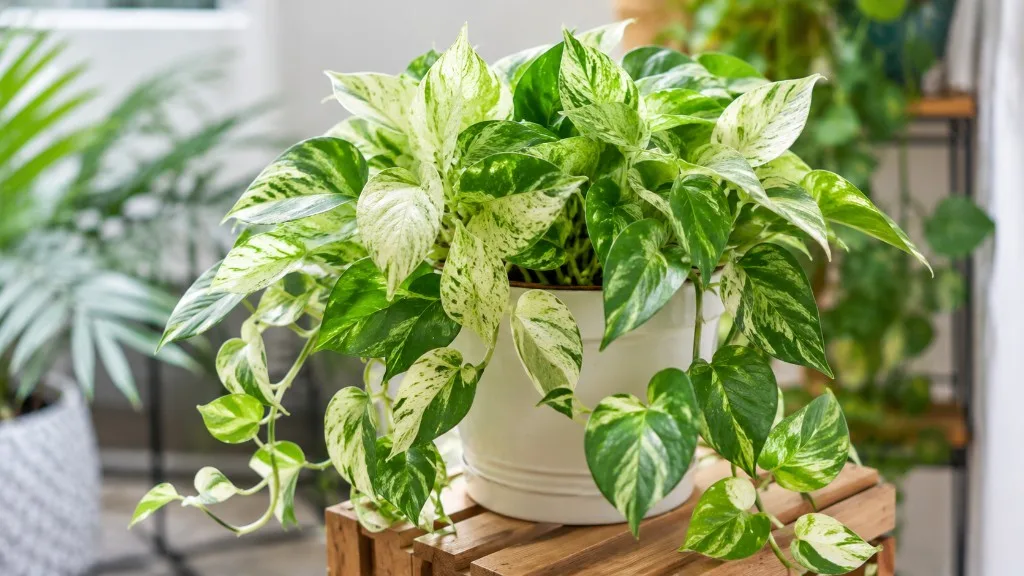
Harlequin Pothos (Epipremnum aureum ‘Harlequin’) is a collector tradename in the houseplant trade for pothos with bold sectoral variegation — large blocks of creamy white beside deep green on each heart-shaped leaf. Extension guides document Epipremnum aureum broadly but do not publish a separate profile for the Harlequin cultivar by name; judge plants by new leaf pattern, not marketing labels alone. Slow growth, quick reversion in shade, and sunburn on pale tissue are the trade-offs for one of the most dramatic pothos patterns you can grow indoors.
This guide covers what Harlequin actually is, how its care differs from greener pothos cultivars, where to place it in a real home, and how to keep new leaves opening with the white sectors you bought the plant for.
What Harlequin Pothos Actually Is
Harlequin Pothos is a cultivar of Epipremnum aureum, the species sold as Golden Pothos, Devil’s Ivy, and Taro Vine. The species climbs tree trunks in tropical forests across Southeast Asia — Clemson HGIC lists China, India, and parts of Southeast Asia — with cultivated introductions from the Society Islands. Wild pothos reach toward dappled canopy light; indoors, that translates to bright, filtered brightness rather than dim corners.
What sets Harlequin apart is sectoral variegation: each leaf carries distinct zones of white and green tissue, not the fine marbling of Marble Queen or the all-over speckling of Pearls and Jade. Those white sectors contain far less chlorophyll than green tissue, so the plant photosynthesizes less per leaf area. That biology drives slower growth, higher light demand, and faster reversion when conditions slip.
Harlequin shares the classic pothos habit — wiry stems, aerial roots at nodes, glossy heart-shaped juvenile leaves. Indoors, trailing vines commonly reach up to 2 meters over years, though growth is slow compared with Golden Pothos. You may also see it sold as Harlequin Devil’s Ivy or Variegated Pothos; confirm Epipremnum aureum on the label, then judge health by new leaves, not marketing names.
As an Araceae member, Harlequin prefers warmth, drainage, and stable indoor conditions. It contains calcium oxalate crystals that irritate mouths if chewed — relevant for pet placement even when toxicity is not the main topic of daily care.
Harlequin vs. Golden Pothos and Other Variegated Cultivars
Golden Pothos and Harlequin share one species but not one care profile. Treating Harlequin like a dim-hallway Golden Pothos is the most common reason collectors lose white sectors within a few leaf cycles.
Chlorophyll, Growth Speed, and Light Demand
Golden Pothos leaves retain generous green tissue with yellow-gold splashes. Even in moderate indirect light, enough chlorophyll remains for steady photosynthesis. Harlequin leaves often carry large white patches with little photosynthetic tissue. Clemson HGIC notes that variegated pothos cultivars lose coloring in lower light and that heavily white forms like Snow Queen need lots of bright, indirect light — Harlequin sits in that same high-light tier, not the shade-tolerant end Golden Pothos occupies.
Growth speed follows chlorophyll. Golden Pothos can push long runners in a bright summer. Harlequin often produces shorter internodes and smaller new leaves when light is marginal, and total vine length accumulates slowly even in good conditions. That is normal for a high-variegation sport — not a sign the plant is “weak” if new foliage keeps crisp sectoral patterning.
Harlequin vs. Snow Queen and Marble Queen
Snow Queen (E. aureum ‘Snow Queen’) is predominantly white with small green flecks and no large green patches — the whitest commonly sold pothos. Marble Queen has more green overall with cream marbling and grows faster than Snow Queen while still needing extra light.
Harlequin sits between them visually: bold sectoral blocks of white and green on each leaf, often more dramatic than Marble Queen marbling but with larger green sectors than Snow Queen. Light demand aligns with Snow Queen — both need among the brightest indirect placements in the pothos family. If your newest leaves arrive mostly green, compare against Harlequin Pothos light guide placement before assuming you have the wrong cultivar.
Mislabeling at resale is common. Check the last three leaves on each vine tip: sectoral white-green blocks suggest Harlequin; fine marbling suggests Marble Queen; mostly white with green speckles suggests Snow Queen.
Light Requirements for Sectoral Variegation
Light is the non-negotiable variable for Harlequin Pothos. Penn State Extension recommends moderate to bright light while avoiding direct sun for pothos generally; for Harlequin, interpret “bright” literally — the plant needs enough photons to sustain white tissue on new leaves.
The target is bright, indirect light for most of the day: strong ambient brightness without harsh sun on pale sectors. White tissue scorches faster than green. A few hours of unfiltered afternoon sun through south glass can brown white patches within days. Gentle morning sun through an east window is often fine after gradual acclimation.
Placement That Works in Real Homes
A practical starting point is within 1–2 meters of an east window or behind a sheer curtain at a south- or west-facing window. Harlequin generally needs roughly one brightness step more than Golden Pothos and similar placement to Snow Queen — see the dedicated Harlequin Pothos light guide for foot-candle bands and grow-light setup.
Good light signals: firm new leaves, moderate internode spacing, and visible white sectors on the newest foliage. Low-light signals: long bare stems, small leaves, and progressive greening on successive new leaves. If you see the latter, move the plant closer to the window or add a full-spectrum LED grow light 30–45 cm above the canopy for 12–14 hours daily. Older leaves will not regain lost white pattern; only new growth reflects improved light.
Rotate the pot weekly so both sides receive similar exposure. Trailing vines often look lush on the window side and sparse on the back.
Watering Without Saturating the Root Zone
Harlequin Pothos follows standard pothos watering logic — let the upper soil dry between drinks — but timing shifts with light, pot size, and season. LeafyPixels plant data and extension guidance converge on allowing the top 3–5 cm of soil to dry before watering again. In many homes that means roughly every 7–10 days in summer and every 10–14 days in winter, though the calendar is a hint, not a rule.
Clemson HGIC advises allowing soil to dry between waterings, then soaking until water reaches all roots. Chronic wet soil causes root rot — yellow leaves, soft stems, sour-smelling mix. Harlequin in strong light uses water faster than one in shade, so placement and watering stay linked. Full rhythm details live in the Harlequin Pothos watering guide.
Reading Dryness by Touch
The top 4–5 cm dry test is the most reliable home method. Insert your finger to the second knuckle; if the mix feels cool and damp, wait. If dry and light-colored, water. Lift the pot to learn its weight — a dry pot is noticeably lighter.
When you water, soak until runoff exits drainage holes, then empty the saucer within 30 minutes. Never let the pot sit in standing water. If the mix dries unevenly, the root ball may be hydrophobic or root-bound; Harlequin Pothos repotting guide into fresh airy mix usually restores an even dry-down cycle.
Soil, pH, and Pot Drainage
Harlequin Pothos is strict about drainage, not exotic ingredients. A standard peat- or coco-based potting mix with 20–30% perlite provides enough moisture retention for tropical roots and enough air space to prevent rot. LeafyPixels data targets pH 6.0–6.5, which most quality indoor mixes already provide. See the Harlequin Pothos soil guide for mix ratios and warning signs of dense or waterlogged media.
Avoid garden soil, outdoor mixes, or pots without drainage holes. Terracotta dries faster for heavy-handed waterers; plastic retains moisture longer in bright, warm rooms. Go up only one pot size at repotting — excess soil holds water the roots cannot use.
Humidity and Temperature
Harlequin adapts to average homes. Clemson HGIC lists a preferred humidity range of 50–70% and notes pothos tolerate typical indoor levels of 30–60%. LeafyPixels targets 40–60%, realistic without special equipment. Below 40%, brown papery leaf tips appear more often in winter when heating dries air — a pebble tray or small humidifier near the pot helps more reliably than misting.
Temperature comfort aligns with normal indoor living: 18–29°C (65–85°F). Clemson HGIC specifies 60–70°F nights and 70–85°F days. Keep the plant away from cold drafts below 10°C (50°F), blasting AC vents, and winter window glass that radiates chill.
Fertilizer Schedule and Strength
Fertilizer supports growth but cannot fix bad light or wet roots. Feed Harlequin monthly during spring through summer with a balanced liquid houseplant fertilizer at half strength, and pause in fall and winter when growth slows. Clemson HGIC suggests feeding every other month during spring and summer for pothos showing yellowing from low fertility — a lighter baseline that works for most homes.
Never fertilize dry, stressed, or newly repotted plants. Salts can burn roots and pale variegated leaf sections more readily than green tissue. Over-fertilizing shows as crispy brown margins and white crust on the soil surface. The Harlequin Pothos fertilizer guide covers dilution and seasonal pause rules in detail.
Pruning and Stopping Reversion
Reversion is when Harlequin produces solid green leaves instead of sectoral variegation, usually because light is too low to sustain white tissue. Reversion starts on new growth at vine tips. If successive leaves show shrinking white sectors or solid green, act before the stem fully converts.
The fix is two-part: move to brighter indirect light (or add a grow light), then prune reverted stems back to the last node with healthy variegation. Cut just above a node with clean scissors. Stems green for many nodes are better removed than left to dominate. Regular pruning also keeps the plant bushy — long bare runners with leaves only at the ends are almost always a light problem. See the Harlequin Pothos pruning guide for technique and timing.
Repotting When Roots Circle the Pot
Harlequin does not need frequent repotting. Every 1–2 years in spring is typical, or when roots circle the surface, emerge from drainage holes, or water runs straight through without soaking in. Repot one size up with fresh well-draining mix. Water lightly the first week while torn roots heal, then return to your dry-top-soil rhythm.
Do not repot on day one after purchase unless the mix stays wet for weeks or roots are clearly bound. A stable plant handles repotting well; a stressed one may shed leaves.
Propagation from Stem Cuttings
Harlequin propagates from stem cuttings with at least one node. Variegated cultivars retain their pattern through vegetative propagation — each cutting is a genetic clone. Clemson HGIC confirms pothos cuttings root in water or moist soil when a node contacts the medium.
Take a 10–15 cm cutting below a node, remove the lowest leaf, and place the node in water or moist mix in bright, indirect light. Roots typically appear in 2–3 weeks in water at warm room temperatures; NC State notes vines easily root in water before transplanting. Propagate from well-variegated stems, not reverted green sections — green cuttings root readily but produce green plants. Full steps are in the Harlequin Pothos propagation guide.
Toxicity to Pets and People
All parts of Harlequin Pothos — leaves, stems, and sap — are toxic if ingested because they contain insoluble calcium oxalate crystals. The ASPCA lists Epipremnum aureum as toxic to cats and toxic to dogs, and that applies to every cultivar including Harlequin.
Cats and Dogs
Chewing pothos tissue embeds microscopic crystals in the mouth and throat. The ASPCA lists signs as oral irritation, intense burning of the mouth, tongue and lips, excessive drooling, vomiting, and difficulty swallowing. Most exposures are painful but not life-threatening in healthy adult pets.
If ingestion is suspected, remove plant material from the mouth, rinse gently if tolerated, and call your veterinarian or the ASPCA Animal Poison Control Center at 888-426-4435. Harlequin belongs on a high shelf, in a hanging basket above jump height, or not at all in homes with plant-chewing pets.
Humans face similar oral irritation from chewing leaves or sap. Wear gloves if sap irritates skin, and wash hands after pruning.
Common Problems and Fixes
Most Harlequin problems trace to a short diagnostic list: soil moisture first, then light, then pests, then fertilizer history.
Yellow leaves often mean overwatering when several leaves yellow at once and stems feel soft. Check whether the mix stays wet for days. Leggy growth and small leaves point to insufficient light — move the plant or add a grow light before changing anything else. Loss of variegation on new leaves is a light problem until proven otherwise. Brown patches on white sectors usually mean direct sun scorch — relocate and trim damaged leaves. Brown crispy tips often mean low humidity, fertilizer burn, or inconsistent watering.
Wilting with dry soil is underwatering; wilting with wet soil is root damage. Mealybugs appear as cottony clusters in leaf axils. NC State Extension notes root rot and blackening leaf margins with overwatering. Fast-draining mix, drainage holes, and watering only when the top few centimeters are dry prevent more problems than any rescue product.
Buying and the First Month at Home
When shopping, choose plants with firm stems, clean leaf undersides, and new growth showing crisp sectoral variegation. Be cautious with widespread yellowing, sticky residue, collapsed vines, or sour-smelling soil in a dim store corner. Labels vary; healthy new leaves with bold white sectors matter more than perfect naming.
After purchase, quarantine two weeks if pests are a concern. Do not repot immediately unless the mix is clearly failing. Place in bright indirect light from day one — not the dim display spot where the pot looked photogenic. Learn how fast your pot dries before locking in a watering rhythm.
Watch the first month for yellowing, leggy growth, and wet-soil stagnation. Change one variable at a time — light, water, or pot — rather than repotting, fertilizing, and pruning simultaneously. Harlequin is settling in when it produces stable new variegated leaves at a steady pace, even if that pace is slower than Golden Pothos.
Conclusion
Harlequin Pothos rewards a clear contract: give it more light than Golden Pothos, water when the top 3–5 cm of soil are dry, plant it in well-draining mix with perlite, and prune reverted green growth before it takes over the vine. The sectoral white patches are not decoration independent of biology — they are a photosynthesis trade-off that makes the plant slower, hungrier for photons, and quicker to revert in shade.
If you have a bright east or filtered south window, a hanging basket or high shelf away from pets, and patience for slow growth, Harlequin is among the most striking pothos cultivars you can grow. If your best spot is a dim interior room or a floor pot within reach of a chewing dog, a greener pothos cultivar — or a pet-safe species — is the more honest choice.
When to use this page vs other Harlequin Pothos guides
- This overview — Species identity, full care summary, cultivar comparisons, and how Harlequin fits in a real home.
- Harlequin Pothos light — Window placement, grow lights, and variegation warning signs in depth.
- Harlequin Pothos watering — Dry-down tests, seasonal rhythm, and overwatering recovery.
Related Harlequin Pothos guides
How to care for Harlequin Pothos?
How much light does Harlequin Pothos need?
bright indirect light
- bright indirect light - bright indirect light.
When should you water Harlequin Pothos?
Allow top 3–5 cm of soil to dry before watering - every 7–10 days in summer, every 10–14 days in winter. Well-draining soil prevents root rot.
- Top 4–5 cm dry test - Allow top 3–5 cm of soil to dry before watering - every 7–10 days in summer, every 10–14 days in winter.
- Drain excess water - Allow top 3–5 cm of soil to dry before watering - every 7–10 days in summer, every 10–14 days in winter.
What soil works best for Harlequin Pothos?
Standard potting mix with 20–30 % perlite. Well-draining, airy. pH 6.0–6.5.
- potting mix - Standard potting mix with 20–30 % perlite.
- perlite - Standard potting mix with 20–30 % perlite.
Grower notes for Harlequin Pothos
What matters most with Harlequin Pothos
Harlequin Pothos is forgiving, but its variegation and leaf size tell you whether the placement is actually working. Long bare vines usually mean the plant needs pruning, stronger light, or a support, not just more fertilizer. In practice, the care checkpoint is simple: bright indirect light. Pair that with standard potting mix with 20–30 % perlite. Well-draining, airy; pH 6.0–6.5, and avoid changing water, pot size, and placement all at once.
Best placement in a real home
Harlequin Pothos belongs where bright indirect light is realistic for most of the day, not only where the pot looks good. Allow top 3–5 cm of soil to dry before watering - every 7–10 days in summer, every 10–14 days in winter. Well-draining soil prevents root rot. If the pot stays wet longer than expected, move the plant into better light or reassess the mix before watering again. Humidity target: 40–60%. Temperature comfort zone: 18–29°C (65–85°F).
Before you buy this plant
Choose Harlequin Pothos with firm new growth, clean leaf undersides, and soil that does not smell sour or feel compacted. Be cautious if you see yellow-leaves, sticky residue, collapsed crowns, or a pot that is wet in poor light. Cosmetic old-leaf damage is less worrying than weak roots or active pests.
First month after bringing it home
Do not repot Harlequin Pothos on day one unless the mix is failing or pests are obvious. Quarantine it, learn how fast the pot dries, and keep care boring while it adjusts. Watch especially for yellow-leaves, leggy-growth, and root-rot. If problems appear, correct the condition first rather than stacking fertilizer, repotting, and pruning together.
Safety note for Harlequin Pothos
Harlequin Pothos is not a plant to keep within reach of pets or children. The database flags it for cats and dogs. Use gloves if sap or plant tissue is irritating, and pick a pet-safe alternative for floor pots or low shelves.
How to tell Harlequin Pothos is settling in
Also sold as Harlequin Devil's Ivy and Variegated Pothos, this plant should be judged by stable new growth rather than label names alone. If you plan to multiply it later, common methods include Stem cuttings in water and Stem cuttings in soil. Repot only when you see circling roots and rapid water drainage. If leggy-growth shows up early, inspect light, watering, and roots before assuming the plant is permanently weak.
Is Harlequin Pothos safe for pets?
Harlequin Pothos is toxic to cats and dogs. Calcium oxalate crystals cause oral irritation and vomiting. Keep out of reach of all pets.
All Epipremnum aureum varieties contain insoluble calcium oxalate crystals. Ingestion by cats or dogs causes oral irritation, excessive drooling, difficulty swallowing, and vomiting.
Watering Harlequin Pothos
For Harlequin Pothos, top 4–5 cm dry test and water every 7–14 days. Reduce in winter.
| Detail | Information |
|---|---|
| How often | Every 7–14 days |
| How to check | Top 4–5 cm dry test |
| Seasonal changes | Reduce in winter |
Signs of overwatering
- yellow leaves
- mushy stems
- root rot
Signs of underwatering
- wilting
- dry curling leaves
Soil & potting for Harlequin Pothos
Use a mix of potting mix, perlite for Harlequin Pothos. Good. Target soil pH around 6.0–6.5. Repot every 1–2 years, ideally in spring.
| Detail | Information |
|---|---|
| Recommended mix | potting mix, perlite |
| Drainage | Good |
| Soil pH | 6.0–6.5 |
| Repotting frequency | Every 1–2 years |
| Best season to repot | Spring |
Signs it needs repotting
- circling roots
- rapid water drainage
Humidity & temperature for Harlequin Pothos
Harlequin Pothos prefers 40–60%, though normal home humidity is usually fine. Keep temperatures around 18–29°C (65–85°F).
| Detail | Information |
|---|---|
| Humidity | 40–60% - normal home humidity is fine. |
| Ideal temperature | 18–29°C (65–85°F) |
Fertilizer & pruning for Harlequin Pothos
Use use balanced liquid fertilizer at half strength and stop if the plant is stressed, newly repotted, or not actively growing. Over-fertilizing; can burn the low-chlorophyll white sections. for Harlequin Pothos.
| Detail | Information |
|---|---|
| Fertilizer type | Use balanced liquid fertilizer at half strength and stop if the plant is stressed, newly repotted, or not actively growing. Over-fertilizing; can burn the low-chlorophyll white sections. |
Common problems on Harlequin Pothos
Yellow Leaves
MediumLikely cause: Common on this plant type; confirm with recent watering, light, and root checks.
Quick fix: Inspect the plant and correct the most likely care stressor before stacking treatments.
Full fix guide →Brown Tips
MediumLikely cause: Common on this plant type; confirm with recent watering, light, and root checks.
Quick fix: Inspect the plant and correct the most likely care stressor before stacking treatments.
Full fix guide →Root Rot
MediumLikely cause: Common on this plant type; confirm with recent watering, light, and root checks.
Quick fix: Inspect the plant and correct the most likely care stressor before stacking treatments.
Full fix guide →Overwatering
MediumLikely cause: Common on this plant type; confirm with recent watering, light, and root checks.
Quick fix: Inspect the plant and correct the most likely care stressor before stacking treatments.
Full fix guide →Underwatering
MediumLikely cause: Common on this plant type; confirm with recent watering, light, and root checks.
Quick fix: Inspect the plant and correct the most likely care stressor before stacking treatments.
Full fix guide →Spider Mites
MediumLikely cause: Common on this plant type; confirm with recent watering, light, and root checks.
Quick fix: Inspect the plant and correct the most likely care stressor before stacking treatments.
Full fix guide →Mealybugs
MediumLikely cause: Common on this plant type; confirm with recent watering, light, and root checks.
Quick fix: Inspect the plant and correct the most likely care stressor before stacking treatments.
Full fix guide →Aphids
MediumLikely cause: Common on this plant type; confirm with recent watering, light, and root checks.
Quick fix: Inspect the plant and correct the most likely care stressor before stacking treatments.
Full fix guide →Leggy Growth
MediumLikely cause: Common on this plant type; confirm with recent watering, light, and root checks.
Quick fix: Inspect the plant and correct the most likely care stressor before stacking treatments.
Full fix guide →Slow Growth
MediumLikely cause: Common on this plant type; confirm with recent watering, light, and root checks.
Quick fix: Inspect the plant and correct the most likely care stressor before stacking treatments.
Full fix guide →Wilting
MediumLikely cause: Common on this plant type; confirm with recent watering, light, and root checks.
Quick fix: Inspect the plant and correct the most likely care stressor before stacking treatments.
Full fix guide →Drooping Leaves
MediumLikely cause: Common on this plant type; confirm with recent watering, light, and root checks.
Quick fix: Inspect the plant and correct the most likely care stressor before stacking treatments.
Full fix guide →Low Humidity
MediumLikely cause: Common on this plant type; confirm with recent watering, light, and root checks.
Quick fix: Inspect the plant and correct the most likely care stressor before stacking treatments.
Full fix guide →Not Enough Light
MediumLikely cause: Common on this plant type; confirm with recent watering, light, and root checks.
Quick fix: Inspect the plant and correct the most likely care stressor before stacking treatments.
Full fix guide →Fungus Gnats
MediumLikely cause: Common on this plant type; confirm with recent watering, light, and root checks.
Quick fix: Inspect the plant and correct the most likely care stressor before stacking treatments.
Full fix guide →Mold on Soil
MediumLikely cause: Common on this plant type; confirm with recent watering, light, and root checks.
Quick fix: Inspect the plant and correct the most likely care stressor before stacking treatments.
Full fix guide →