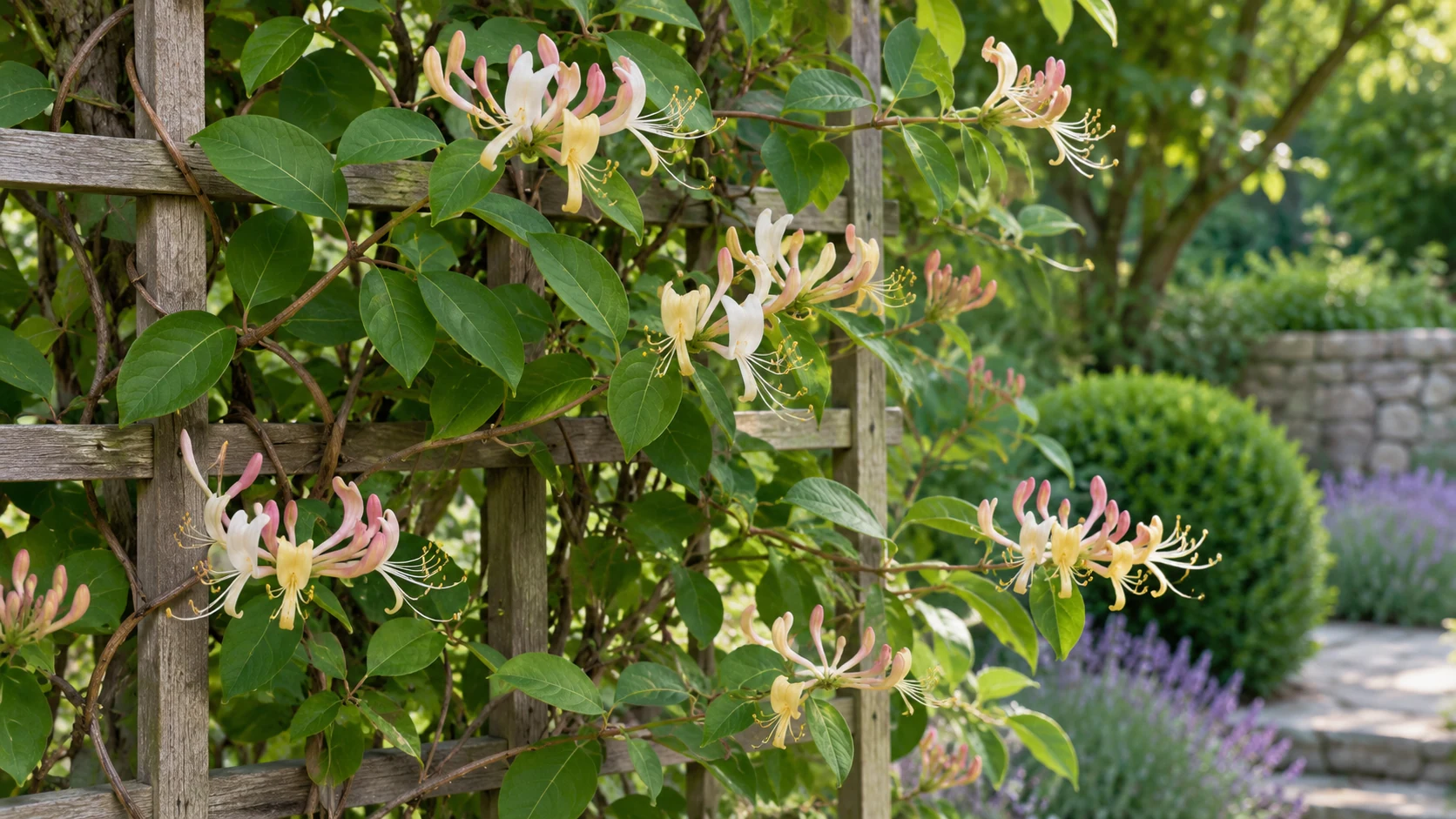
Many climbing honeysuckles flower well in dappled or partial shade. They can tolerate brighter positions when the root zone stays moist, but deep shade can reduce flowering and exposed hot walls can stress foliage. Check the needs of the exact species or cultivar.
How often should I water honeysuckle?
Water new plantings regularly through their first spring and summer. Once established, most climbing types need an occasional deep soak in hot, dry weather. Check vines beside walls or fences even after rain because those areas can stay dry.
When should I prune a honeysuckle vine?
It depends on flowering time. Many early-flowering types bloom on the previous season’s growth and are pruned after flowering; later-flowering types often bloom on current-season shoots and are lightly pruned in spring. Confirm the cultivar before making a hard cutback.
Can honeysuckle grow in a pot?
Many climbing types can grow in a large container with drainage, a sturdy support, and regular checks for drying. Containers need more frequent watering than established garden vines, and compact shrubby types may be easier to manage in a pot.
Is Japanese honeysuckle invasive?
Lonicera japonica is listed as invasive in regions including Tennessee and can spread beyond cultivation there. Invasive status is regional and species-specific; check local guidance before planting. Do not apply the Japanese honeysuckle warning to every Lonicera species.
Are honeysuckle berries edible?
Only particular species, such as honeyberry (Lonicera caerulea), are grown for edible fruit. Many ornamental honeysuckles also produce berries, so do not taste fruit unless the species has been identified and confirmed edible.
What light does Honeysuckle need?
Honeysuckle grows best in dappled or partial shade, with enough light for flowering. It also tolerates Full sun when the root zone stays cool and evenly moist, Light shade. Avoid deep shade, which can suppress flowering, and hot, dry reflected heat against a wall without regular root-zone moisture.
Written by Sai AnanthLead content writer at LeafyPixels. B.Pharmacy graduate from Andhra University with a background in pharmacognosy, turned indoor gardening writer after a long-time plant hobby became a research-led resource for home growers.View Sai Ananth's profile · Reviewed by LeafyPixels Review Board
This Honeysuckle problems problem guide was researched and written by Sai AnanthLead content writer at LeafyPixels. B.Pharmacy graduate from Andhra University with a background in pharmacognosy, turned indoor gardening writer after a long-time plant hobby became a research-led resource for home growers.View Sai Ananth's profile. Problems symptoms on Honeysuckle, lookalike causes, and step-by-step fixes are cross-checked against extension pest, disease, and care references before publication.
We prioritize sources that hold up under scrutiny:
University cooperative extension bulletins and fact sheets (Penn State, Clemson, UMD, NC State, and similar programs)
Botanical garden and horticultural society publications
Peer-reviewed plant science and veterinary toxicology references where pet safety matters (including ASPCA Animal Poison Control)
Established reference works on indoor plant culture
The LeafyPixels editorial team then reviews the draft for clarity, step-by-step usefulness, and fit with real apartment and home conditions-not ideal greenhouse setups. When guidance changes materially, we update the page and note the revision date.
Homes & Gardens — 10 best honeysuckles to grow (n.d.) Editorial examples of climbing and shrubby forms, cultivar differences, mature size, edible honeyberry, and pruning approaches.. [Online]. Available at: https://www.homesandgardens.com/gardens/best-honeysuckles (Accessed: 1 March 2024).
Royal Horticultural Society — How to grow climbing honeysuckle (n.d.) Climbing habit, support, light, planting, establishment watering, mulch, pruning timing by flowering season, and layering.. [Online]. Available at: https://www.rhs.org.uk/plants/honeysuckle/climbing/growing-guide (Accessed: 1 March 2024).
Royal Horticultural Society — Lonicera periclymenum (n.d.) A species-specific example of native region, mature climbing size, flowering, berries, light and soil preferences, and the warning that fruit is ornamental and not to be eaten; this is not a genus-wide toxicity classification.. [Online]. Available at: https://www.rhs.org.uk/plants/10508/lonicera-periclymenum/details (Accessed: 1 March 2024).
Royal Horticultural Society — Lonicera sempervirens (n.d.) A second species-specific example showing that growth habit, evergreen behavior, growing conditions, and berry warnings differ within Lonicera.. [Online]. Available at: https://www.rhs.org.uk/plants/91239/lonicera-sempervirens/details (Accessed: 1 March 2024).
U.S. Forest Service — Lonicera japonica, Japanese honeysuckle (n.d.) Japanese honeysuckle identification, ecology, and its regional spread in the United States; not a genus-wide invasive classification.. [Online]. Available at: https://research.fs.usda.gov/feis/species-reviews/lonjap (Accessed: 1 March 2024).