Curling Leaves on Hoya: Causes, Checks & Fixes
Quick answer
A Hoya leaf that curls is showing a change, not naming the cause. First lift the pot and check moisture in the upper half of the mix before watering: a dry, light pot and soft leaves point one way, while a heavy wet pot calls for a root check. Then compare new and mature leaves, because Hoya species differ in natural leaf shape and leaf distortion can follow interrupted growth.
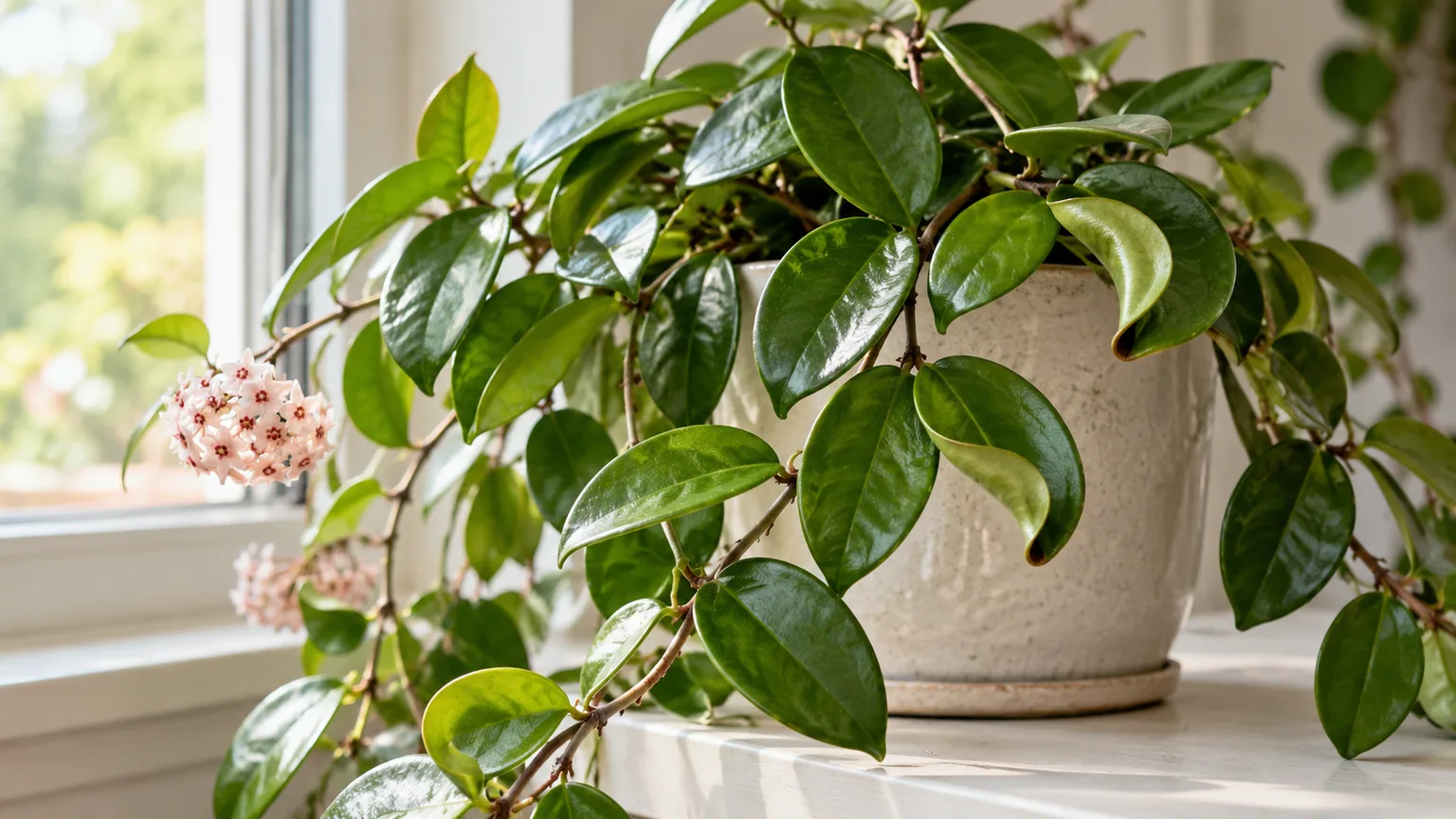
Curling Leaves on Hoya: Causes, Checks & Fixes
This guide covers curling leaves on Hoya. See also the general Curling Leaves guide, watering, and light pages for this plant.
Curling Leaves on Hoya: Causes, Checks & Fixes
Quick answer
A curled Hoya leaf is a clue, not a diagnosis. Before you water, lift the pot and check the mix through its upper half. A very light pot with dry mix points toward a dry root zone; a heavy pot that stays wet calls for a drainage and root check instead. Then compare affected leaves with healthy ones on the same vine: did the curl start on new growth, follow a move to a brighter window, or appear across the whole plant at once?
First step: check pot weight and moisture at depth, and hold off watering until you know whether the mix is dry or wet. Hoya leaves can be thick and waxy, so curl alone does not tell you that the plant needs water. For general symptom patterns, see the curling-leaves guide; this article focuses on how to investigate a Hoya.
What curling leaves look like on Hoya
Hoya is a genus, not one uniform leaf shape. A common Hoya carnosa has thick, waxy leaves on a climbing or trailing vine; other species have small, slender, heart-shaped, or variegated foliage. NC State’s overview shows that range across Hoya species, while its wax-plant profile describes Hoya carnosa’s thick leaves and epiphytic habit (NC State Hoya overview; NC State Hoya carnosa profile). Epic Gardening’s variety guide also illustrates how differently Hoya cultivars can grow and look (Epic Gardening’s Hoya varieties). A slightly cupped or angled leaf is not automatically a problem. The stronger clue is a recent change from the plant’s own normal shape.
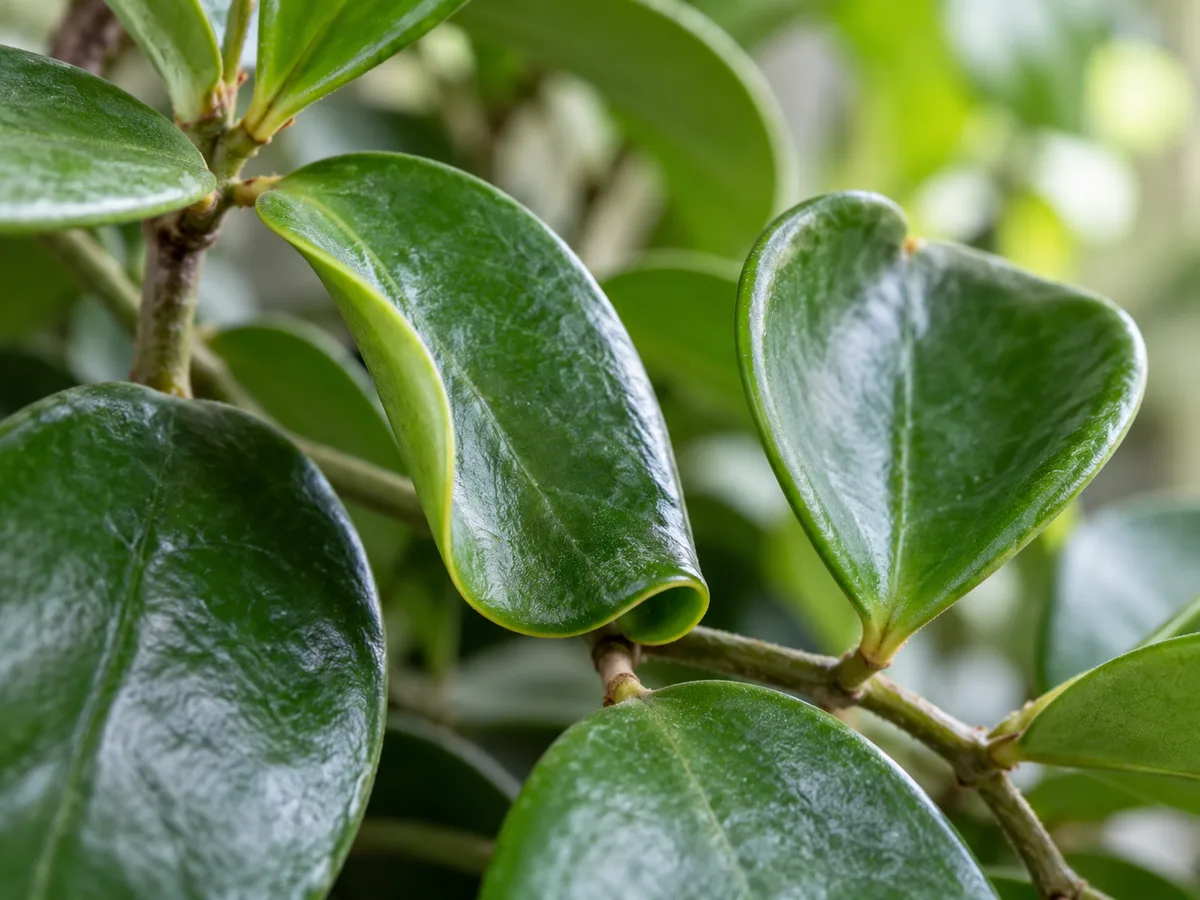
Compare the curled leaf with other leaves on the same Hoya; a change in texture or spread helps distinguish stress from the plant’s normal form.
Look for the pattern before trying a fix:
| What you see | What to check next |
|---|---|
| Several mature leaves curl and feel softer or less firm | Check whether the root zone is dry, or whether it is wet and the roots may be struggling. |
| Only the newest leaves are crinkled, cupped, or folded | Review temperature swings and whether watering was irregular while those leaves were forming. |
| Curl is strongest on the window-facing side | Check for direct hot sun, warm glass, or a grow light placed too close. |
| Curl comes with tiny pale dots or fine webbing | Inspect leaf undersides for spider mites before treating. |
| One leaf has a stable shape that matches other leaves on the same vine | Confirm the Hoya’s species or cultivar before classifying it as stress damage. |
RHS notes that crinkled or creased leaves can follow stop-start development, often from irregular watering during leaf formation or temperature swings. It also describes inward or outward curling in particular plant groups under dry, bright, or cold conditions; these are general houseplant patterns, not a proven Hoya-specific rule (RHS leaf-damage guide). The direction of curl can guide inspection, but it cannot replace checking the plant and its mix.
Why Hoya’s thick leaves make curl easy to misread
Many hoyas have leathery, semi-succulent leaves that store water. They also grow as climbers or trailers, and many species naturally encounter airy root conditions rather than dense, constantly wet soil. RHS describes these traits alongside a bright position and moderate watering; NC State likewise recommends a loose, well-drained medium for Hoya carnosa (RHS Hoya growing guide; NC State Extension). That plant context matters because a curled leaf is not a reliable moisture meter.
A Hoya’s firm leaves may not react immediately to a change in the root zone. On the other hand, curled or softened foliage on wet mix does not prove that the plant is thirsty: roots affected by prolonged wet conditions may be unable to take up water normally. House Plant Journal’s Hoya kerrii case study describes soft, wrinkled leaves alongside a small, poorly watered root system and recommends thorough watering only after considering the plant’s medium and root condition (House Plant Journal’s Hoya case). That example is useful for the diagnostic method, but it is not a universal watering schedule for every Hoya.
Dry root ball in a Hoya’s airy, epiphytic mix
If the pot is light and the mix is dry well below the surface, dehydration is plausible. Curl may appear with soft or wrinkled leaves, a vine that has lost firmness, or soil that has pulled away from the pot edge. A surface-only check can mislead: the top may look dry while the center is still damp, or water can run down the sides of old mix and leave a dry core. Use a clean wooden skewer or finger near the pot edge to check deeper than the surface, and compare pot weight with how it feels after a full watering.
When the root zone is dry and stems remain firm, water it evenly and thoroughly until water drains from the bottom, then empty the saucer or cachepot. Avoid giving repeated sips to the surface. In a Hoya kerrii example, House Plant Journal distinguishes between waiting until the medium is nearly dry and actually wetting the whole root zone; it cautions against small pours that leave the medium unevenly watered (House Plant Journal). A Hoya obovata grower likewise uses both soil feel and pot weight rather than a fixed schedule, a practical method that should be adapted to your species and pot (Ohio Tropics Hoya obovata guide).
If water races down the pot wall but the center remains dry, check for old compacted mix or roots that have filled the container. Do not move straight to a much larger pot: Hoya often prefers a snug root zone, and a large volume of damp mix can take longer to dry. Repot only if the mix has broken down, the plant dries unusually fast because roots fill the pot, or the current medium will not rewet. Use the Hoya soil guide to evaluate the mix and the Hoya repotting guide if those signs are present.
Wet mix: curling can accompany root trouble, not thirst
If the pot is heavy and the mix remains cool and wet, do not water just because the leaves are curled. Check whether water is trapped in a cachepot, whether drainage holes are open, and whether the plant sits in dim light where the medium dries slowly. Hoya’s epiphytic habit and preference for drainage make persistent wetness a concern; NC State notes that both overly wet and overly dry soil can stress Hoya and cause leaf drop (NC State Hoya carnosa). Curl on a wet pot does not confirm root rot, but it is a reason to investigate before adding more moisture.
If the stem base is firm and there is no sour odor, stop watering and let the medium approach its usual dry-down point. If roots are soft or decaying, the stem base darkens, or leaves keep declining while the pot stays wet, follow the Hoya root-rot guide. For the difference between dry-side stress and wet-root stress, compare underwatering on Hoya with overwatering on Hoya. These are separate branches; do not use the curled leaf by itself to choose one.
Read curl along a Hoya vine, not one leaf at a time
A curl that affects only the newest leaves has a different pattern from several mature leaves rolling inward together. Check whether the Hoya experienced uneven watering while new leaves were developing, or a sharp change between warm days and cold nights. RHS associates crinkling or creasing with interrupted development and temperature variation, and recommends avoiding sudden temperature shifts and extremes between soggy and bone-dry compost (RHS leaf deformation guidance). Because this source discusses houseplants generally, use it as a reason to review the history around new growth rather than as proof of a specific Hoya disorder.
Do not pry open a folded Hoya leaf or tug on it to make it flatten. Check that the vine has stable conditions, adequate light, and a root zone that is not swinging between prolonged dryness and wetness. If the leaf is still soft and developing, leave it in place and watch for normal expansion. If it has already hardened with a crease, the shape may remain; the next leaves are a better measure of whether conditions improved.
Light, heat, and dry indoor air
Hoyas generally need a bright position, but a sudden move from dim light to strong direct afternoon sun can be rough on leaves that were not acclimated. Look for curl or edge roll concentrated on the side facing the window or lamp, particularly if the leaves also feel warmer or show pale, bleached patches. RHS recommends bright light while keeping Hoyas out of hot summer sun, and NC State lists bright indirect light for Hoya carnosa (RHS Hoya guide; NC State Hoya carnosa). Move the plant a little farther from harsh exposure or filter the light; do not put it in a dark corner as a permanent response.
Dry air is possible but should be a secondary suspect until the root zone and light are checked. Hoyas tolerate a range of indoor conditions, and a Hoya kerrii grower’s case study argues that routine misting did not solve soft, wrinkled foliage when the underlying issue was how the root medium was watered (House Plant Journal). If the room is extremely dry, a humidifier can stabilize the environment, but misting the leaves will not rehydrate dry roots or repair wet-root damage. Avoid placing a Hoya directly beside a heater or cold draft while troubleshooting.
Check for pests when the curl is uneven or the new growth is distorted
Inspect leaf undersides, the midrib, and stem joints if the curl appears alongside pale speckling, webbing, or a gradual loss of vigor. UC IPM describes spider-mite feeding as stippling and recommends checking undersides for mites when stippling or webbing appears (UC IPM spider-mite guide). NC State also lists spider mites and mealybugs among pests that may affect Hoya carnosa (NC State Extension). A curled leaf alone is not enough to identify a pest.
If you find mites, mealybugs, or another insect, isolate the plant and use the Hoya-specific spider-mites guide or mealybugs guide to confirm next steps. Do not apply an oil, soap, or pesticide without confirming the pest and checking the product label for indoor plant use. Treating a Hoya that is already dehydrated or exposed to heat can add stress, and an unnecessary spray will not fix water or light problems.
A Hoya curl check you can do in ten minutes
Use these observations in order so that one ambiguous leaf does not trigger several changes:
- Compare leaves. Is the curl on one leaf, several mature leaves, or only the newest growth? Compare similar leaves on the same vine rather than with a different Hoya species.
- Lift the pot. Note whether it feels unusually light or remains heavy days after watering. Pot weight is most helpful when compared with the same pot at a known dry and watered state.
- Check the upper half of the mix. Use a finger or clean skewer at the edge of the pot. Record whether it is dusty dry, lightly damp, or wet and clinging.
- Look at drainage. Empty standing runoff and make sure the container has open holes. If the mix is wet, hold water while you check for smell or root decline.
- Review recent changes. Recall a move to direct sun, a cold transport, a heater vent, repotting, or a change in watering method. Recent changes can help explain why new leaves differ from older ones.
- Inspect the leaf undersides. Check for stippling, webbing, insects, or residue. If those are present, identify the pest before treating.
Then choose one correction based on the evidence. A dry root zone gets one thorough watering; a wet root zone gets a pause and a drainage or root check; one-sided heat or sun exposure gets a gentler position; a confirmed pest gets a targeted pest response. If you cannot match the curl to any of those patterns, leave the plant stable for a few days and record whether the condition spreads. Do not fertilize, prune, repot, and spray all at once.
Recovery: watch the next leaves, not just the curled one
A curled or creased leaf may stay curled after the cause is corrected. The aim is to stop the change from spreading and give new growth stable conditions. If the plant was dry, it may take time for leaf firmness to return; if roots were damaged by prolonged wetness, recovery depends on how much healthy root remains. House Plant Journal’s Hoya case notes that root recovery can take weeks or longer, but that is an individual case rather than a promise for every plant (House Plant Journal). Avoid measuring progress by an exact number of days.
Do not cut off a firm leaf just because its edge curves. Remove a leaf only if it is mostly dead, detached, or concealing a confirmed pest or disease issue. Escalate to root inspection if the pot stays wet, stems soften, or multiple leaves become limp and decline quickly. A healthy firm stem can sometimes be saved as a cutting if the base is failing, but a fully soft or decayed vine may not be recoverable.
Preventing another curl episode
Keep the Hoya in a consistent bright spot, protect it from hot direct sun and cold drafts, and let the plant’s pot—not the calendar—set watering intervals. Water thoroughly when checks show the mix has reached its Hoya-appropriate dry-down, then let excess drain away. Use a container with drainage and a medium that does not remain soggy. For routine adjustments, the Hoya overview links to the watering guide, light guide, and soil guide.
When a new leaf is developing, avoid repeatedly moving the plant or letting the mix swing between bone dry and saturated. Check the same pot weekly during active growth, then check less often when the room is cool and the medium dries slowly. Keep a simple note of watering, window exposure, and when a new leaf started to curl; that record makes the next diagnosis more useful than a one-time humidity or fertilizer change.
When to use this page vs other Hoya guides
Use this guide when a change in leaf shape is the main symptom and you need to distinguish moisture stress, light exposure, new-growth deformation, or pests. If the plant is mainly limp or hanging, compare drooping leaves on Hoya and wilting on Hoya. If you see brown damage instead of a shape change, use brown leaves on Hoya or the focused brown-tips guide. Yellowing is a separate clue; see yellow leaves on Hoya.
If the mix is dry, follow underwatering on Hoya; if it remains wet, use overwatering on Hoya or root rot on Hoya when roots or stems show decay. The low-humidity guide is for dry-air concerns after moisture and light have been checked. The Hoya problems hub routes to other plant-specific symptoms; use the Hoya overview if you need to revisit the plant’s normal care baseline.
Related Hoya guides
- Hoya overview — baseline care and differences across the plant group.
- Hoya watering — set a dry-down routine for the current pot and season.
- Hoya light — adjust exposure if the curl followed a move into brighter light.
- Hoya soil — check drainage and how evenly the root zone rewets.
- Hoya repotting — use only if the medium or root fit is failing.
- Hoya problems — compare other Hoya-specific symptoms.
Related tool
Use the Plant Problem Diagnosis Tool to record the curled-leaf pattern and the pot conditions you checked before changing care.