Distorted Leaves on Hoya: Causes, Checks & Fixes
Quick answer
Misshapen Hoya leaves usually record what happened while that leaf was forming; the shape alone does not identify the cause. First inspect the newest growth and leaf undersides with a magnifier for thrips, aphids, or other pests, and isolate the plant if you find insects. If pests are not evident, check moisture, drainage, recent temperature changes, and light before changing care.
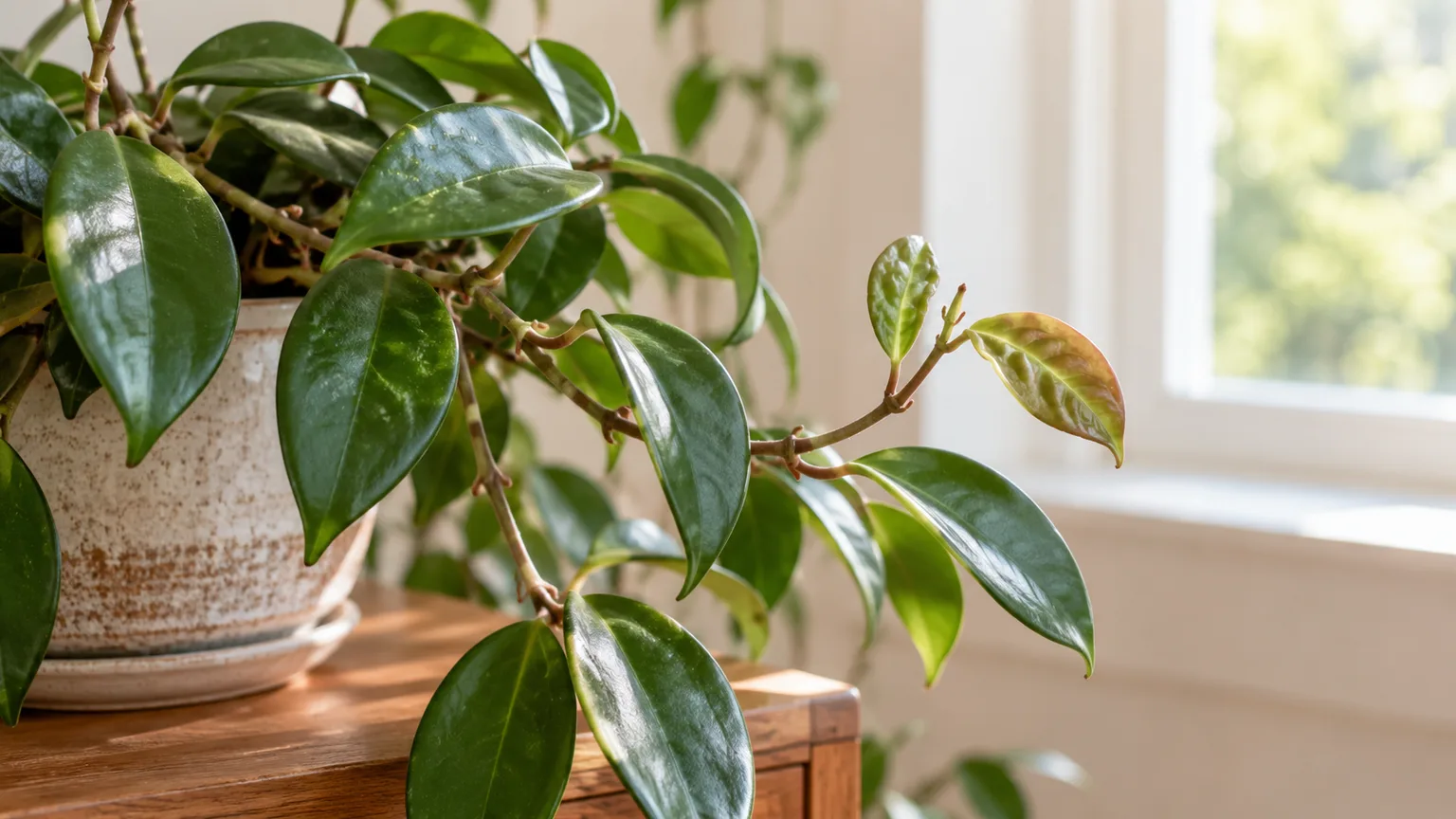
Distorted Leaves on Hoya: Causes, Checks & Fixes
This guide covers distorted leaves on Hoya. See also the general Distorted Leaves guide, watering, and light pages for this plant.
Distorted Leaves on Hoya: Causes, Checks & Fixes
Quick answer
Distorted leaves on a Hoya are a record of what happened while that leaf was forming, not a diagnosis by themselves; general houseplant guidance also links deformity to interruptions during leaf development (RHS leaf-damage guide). If the newest leaves are twisted, puckered, narrow, or scarred, first inspect the shoot tip and leaf undersides with a magnifier. Look for tiny insects, silvery marks, black specks, webbing, or sticky residue. If you find live pests, isolate the plant while you confirm the insect. If you find none, check the mix at depth and review recent changes in light, temperature, and watering before treating.
First action: inspect the newest growth and leaf undersides for pests; do not spray or fertilize until you have evidence. For general symptom patterns, see the distorted-leaves guide. This page focuses on the way a Hoya’s leaves and growth habit change the diagnosis.
What distorted leaves look like on Hoya
Hoya is a genus with many species and cultivars, so “normal” leaf shape is not identical across every plant. Hoya carnosa commonly has thick, waxy leaves on a climbing or trailing vine, while other Hoya species have narrower, rounder, heart-shaped, variegated, or textured foliage. NC State’s Hoya overview lists that range, and its Hoya carnosa profile describes the wax plant’s thick leaves and epiphytic growth habit (NC State Hoya overview; NC State Hoya carnosa profile). Compare the affected leaf with other leaves on the same vine or cultivar rather than with a different Hoya.
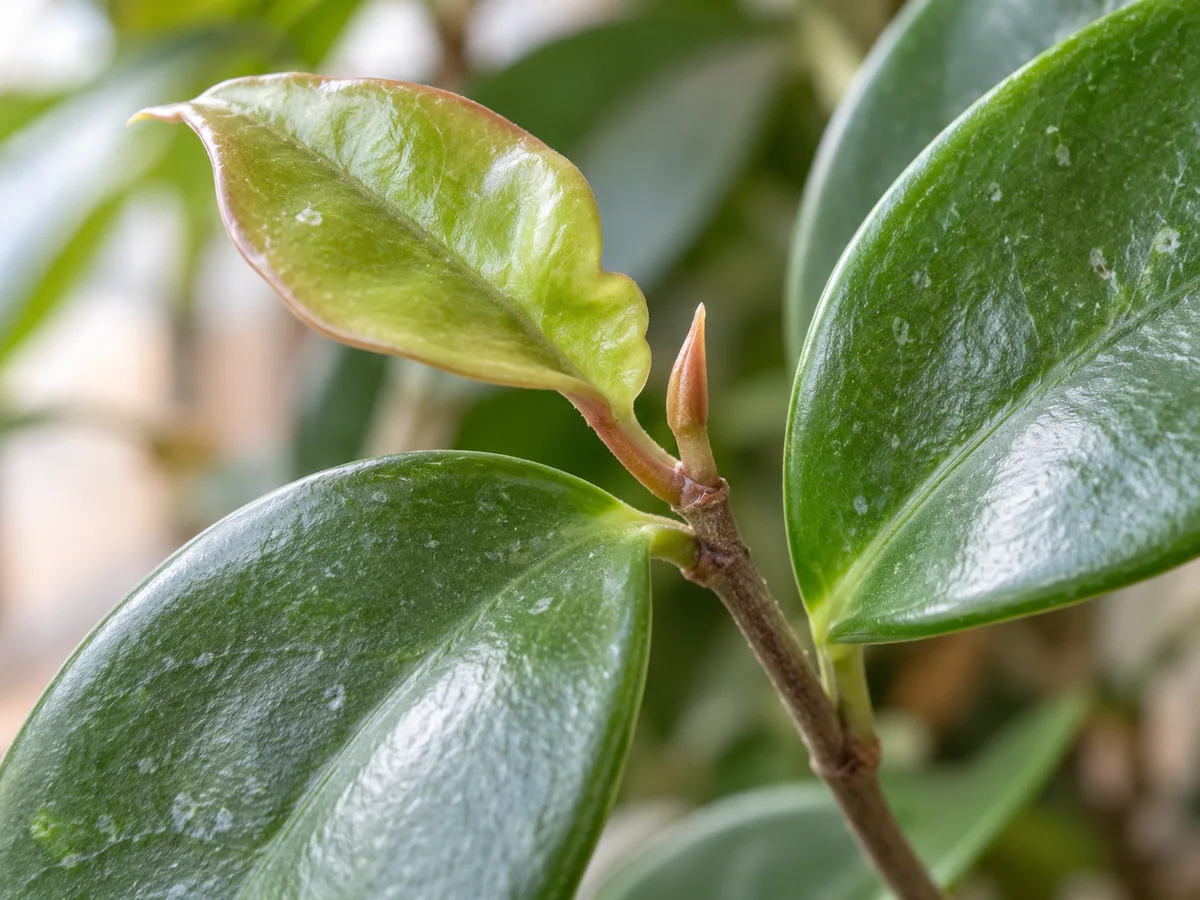
Check the newest leaf and the shoot tip first; feeding damage or an interruption during expansion can leave marks that remain after the cause is gone.
A true change usually affects leaves that were growing at the same time. You may see a new leaf that is crinkled or asymmetrical, a shoot tip that looks bent or stunted, or several leaves with marks that appear together. A single older leaf with a fixed shape may be an old injury, a cultivar trait, or damage from handling. Note whether the change begins at the growing tip or appears randomly along older parts of the vine; that pattern helps decide whether to inspect pests, new-leaf conditions, or the root zone.
Distorted new growth: inspect for thrips and aphids first
Thrips are a strong possibility when fresh Hoya leaves are distorted and show silvery scarring, pale flecks, or dark specks. They are tiny and often feed in buds and shoot tips, so the damage can be visible before the insects are easy to find. UC IPM describes thrips as causing scarred or distorted plant parts and recommends confirming that the pest is present before taking control action (UC IPM thrips guide). Inspect the folding leaves and stem tip with a hand lens. You can also tap a suspected shoot over white paper and watch for small moving insects; a sticky trap can monitor flying adults but does not prove the plant tissue is being damaged by them.
Aphids tend to gather in clusters on soft new growth. Look for small pear-shaped insects, cast skins, and sticky honeydew; aphid feeding can curl leaves, according to UC IPM (UC IPM aphid guide). This is particularly useful when distortion is concentrated at the newest tip and nearby leaves feel otherwise firm. If you see webbing or fine pale stippling instead, check for spider mites on the leaf undersides; UC IPM identifies stippling and webbing as mite clues (UC IPM spider-mite guide). NC State also lists aphids, mealybugs, and spider mites among possible Hoya carnosa pests (NC State Extension).
If a pest is confirmed, isolate the Hoya before you treat it. Keep the plant away from other houseplants and inspect neighboring foliage, especially where vines touch. Use the relevant Hoya guides for aphids, spider mites, or mealybugs to choose a targeted next step. Do not spray a pesticide or oil on the basis of misshapen leaves alone. UC IPM cautions that weather, poor care, pathogens, and other organisms can produce similar damage, so confirm the pest before choosing control (UC IPM thrips guide).
When a Hoya’s new leaf is crinkled without visible pests
If the new leaf is folded, creased, or puckered but you cannot find insects, review the conditions during the weeks when it was expanding. RHS notes that leaf deformation can follow stop-start development, often from irregular watering during new growth or changes in day-to-night temperature. That guidance is general to houseplants, not proof of one Hoya-specific disease (RHS leaf-deformation guidance). Think back to missed watering followed by heavy watering, a cold delivery, a window draft, or a move from a stable room to a brighter or hotter spot.
Hoyas have semi-succulent, leathery leaves that store some water, and many grow as epiphytes with roots that need a well-drained medium. RHS recommends bright light, moderate watering, and a free-draining mix for the genus (RHS Hoya growing guide). That means a calendar schedule is a poor diagnostic tool. Check the top half of the mix and lift the pot instead. If the mix is dry and the pot is very light, water thoroughly and let excess drain. If the mix is still heavy or wet, do not water just because a new leaf looks stressed; check the drainage and roots first.
A Hoya kerrii case study by House Plant Journal shows why checking the medium and how water reaches the roots matters: the plant’s leaves stayed soft and wrinkled even though its owner had started giving frequent small pours and misting (House Plant Journal’s Hoya kerrii case). That case does not prove that a curled Hoya leaf is caused by drought, and its watering interval should not be copied across species. It does support a practical rule: read the pot and roots, not just the leaf shape. A Hoya obovata grower similarly recommends checking both soil feel and pot weight instead of watering by a fixed day (Ohio Tropics Hoya obovata guide).
Hoya growth habit: compare leaves along the same vine
Because Hoya trails or climbs, you can compare a new leaf at the tip with older leaves lower along the same vine. If only one growing point is distorted, inspect that tip closely for insects or physical damage. If several new leaves on different vines are affected at the same time, a shared change in watering, temperature, light, or a pest that has spread through the plant is more plausible than a single damaged leaf. Epic Gardening also describes Hoya as a diverse group with different vine and foliage forms, so a shape difference between two cultivars is not automatically a disorder (Epic Gardening Hoya guide).
Look at the stem as well as the leaf. A bent but firm stem may have been pressed against a support or caught during handling; a soft or dark stem base is a more urgent root-zone concern. If distortion is paired with yellowing or limp growth, use the Hoya overwatering guide or underwatering guide after you confirm whether the mix is wet or dry. If the stem is firm and only one leaf is affected, leave it in place and monitor the next leaf before you repot or prune.
How light and temperature affect new Hoya leaves
A sudden change to hot direct sun can scorch Hoya foliage, while a cold draft or temperature swing can disrupt a leaf that is still expanding; the RHS notes that day-to-night temperature changes can contribute to houseplant leaf deformation (RHS leaf-damage guide). Check whether the distortion is strongest on the window-facing side or began soon after a move, transport, or heater change. Hoya care guidance favors a bright position while protecting the plant from hot summer sun; NC State lists bright indirect light for Hoya carnosa (RHS Hoya guide; NC State Extension). Avoid moving the plant abruptly from a dim room to hard afternoon sun. If it needs a brighter position, make the change gradually and keep its moisture routine consistent while new growth develops.
Light is not the only cause of deformation, and a darker corner is not a cure for pests or root stress. If Hoya leaves grow smaller or paler over time as well as misshapen, check the plant’s overall light conditions with the Hoya light guide. If the plant is otherwise healthy and only the newest leaf has a crease after a cold or dry spell, keep the location stable and wait for the next growth flush before deciding that the whole plant has a chronic problem.
Check roots and soil when distortion comes with decline
Root-zone trouble is more likely when distorted leaves appear together with yellowing, stalled growth, soft stems, a pot that remains heavy, or roots that smell sour or feel mushy. A Hoya can show leaf stress while the soil is wet if damaged roots cannot take up water normally. NC State describes Hoya carnosa as an epiphytic vine that needs good drainage and notes that both overly wet and overly dry soil can cause stress (NC State Hoya carnosa). The Hoya soil guide covers mix and drainage; use the root-rot guide if you find decaying roots or a soft stem base.
Do not unpot a firm Hoya solely because one leaf is misshapen. A root inspection is more useful when the pot stays wet for an unusually long time, the plant is declining across multiple leaves, or there is a sour smell at the drainage hole. If the roots look healthy and the mix dries normally, leave the plant undisturbed and focus on the leaf’s development history. The Hoya repotting guide is for a mix or pot problem, not for a cosmetic mark by itself.
A careful inspection you can do today
Use this sequence so that the first correction is tied to evidence:
- Photograph the affected tip. Take a close photo and a whole-vine photo. Note whether the damaged leaf is new, mature, on one vine, or repeated across the plant.
- Check for pests. Use a magnifier on the underside, leaf axils, and shoot tip. Look for thrips, aphids, mites, webbing, silvery scars, pale stippling, or sticky residue.
- Isolate only if pest evidence appears. If you find live insects or fresh feeding signs, keep the Hoya separate while you identify the pest. If you do not, do not treat it as an infestation based on distortion alone.
- Check the root zone. Lift the pot, feel the mix through its upper half, and check that drainage holes are open. Do not add water if the pot is still heavy and wet.
- Review recent changes. Think about watering swings, cold transport, drafts, direct sun, a grow-light move, or support changes during the period the leaf was expanding.
- Choose one correction. Treat a confirmed pest, correct a clear water or light problem, or simply stabilize conditions when the cause is not yet clear. Leave fertilizer and repotting for a diagnosed need.
For pests, confirm the organism before taking action; for culture issues, adjust one condition and watch new growth. This avoids stacking an insecticide, a repot, and a watering change on the same day, which makes it difficult to tell what helped and can add stress to the Hoya.
What recovery looks like
Once a leaf has hardened with a crease, scar, or uneven shape, it may keep that appearance. A successful correction means the distortion stops spreading, the vine remains firm, and later leaves develop more normally. UC IPM notes that pesticides do not restore the appearance of injured plant tissue; damaged leaves remain marked until they fall or are pruned, while new growth provides the clearer recovery signal (UC IPM thrips guidance). Do not prune a healthy Hoya vine just to make one old leaf look tidy.
If one tip is damaged but the stem is firm, keep it and monitor. If the growing tip is dead or there is a confirmed pest, remove only the affected tissue when it helps the chosen control plan, using clean snips. If the base is soft or roots are extensively decayed, recovery is less certain; see root rot on Hoya and preserve a firm, healthy cutting only if there is sound growth above the damaged area.
Preventing distorted Hoya leaves
Keep the Hoya in a stable bright position, protect it from hot direct sun and cold drafts, and water according to the pot’s dry-down rather than a calendar. Use a draining container and airy medium. Check leaf undersides and new tips during routine watering, especially after bringing a new plant home or moving one near other plants. The Hoya overview links to the watering guide, light guide, and soil guide for those separate care decisions.
When a new leaf is expanding, avoid letting the root ball go bone-dry for a long stretch and then saturating it repeatedly. Keep temperature and placement steady while the leaf forms. Do not fertilize more heavily to force out a clean leaf; excess feeding can create another stress variable. If your next leaf is still distorted, compare it with the photo you took and repeat the pest and moisture checks before changing the routine again.
When to use this page vs other Hoya guides
Use this page when a new or mature Hoya leaf looks misshapen and you need to separate pest feeding, environmental changes, and root-zone stress. If the main issue is a curled leaf without other distortion, see curling leaves on Hoya. If the leaf is limp or hanging, compare drooping leaves and wilting on Hoya. Brown patches or dry margins belong with brown leaves on Hoya or brown tips on Hoya; widespread yellowing has a separate guide at yellow leaves on Hoya.
If you find insects, use aphids, spider mites, or mealybugs based on the pest you confirmed. For wet or dry root-zone problems, use overwatering on Hoya, underwatering on Hoya, or root rot. The Hoya problems hub lists the wider set of plant-specific symptoms.
Related Hoya guides
- Hoya overview — baseline care and the genus’ variation.
- Hoya watering — calibrate dry-down for this pot and season.
- Hoya light — review exposure after a move or new lighting.
- Hoya soil — check drainage and root-zone structure.
- Hoya repotting — use only when the mix or root fit is failing.
- Hoya problems — route to a different primary symptom.
Related tool
Use the Plant Problem Diagnosis Tool to record what the newest leaves look like and which checks you completed before changing care.