Leaf Miners on Hoya: Confirm Trails Before You Treat
Quick answer
Leaf miners are larvae that feed inside leaf tissue, leaving a winding pale trail or blotch. A Hoya-specific host record is not established in the sources consulted, so confirm an internal mine before treating a pale mark as leaf miners. First isolate the plant, backlight the leaf, and watch for a tunnel that lengthens or widens. If an active mine is confirmed, remove only the affected leaf when needed and preserve healthy Hoya foliage.
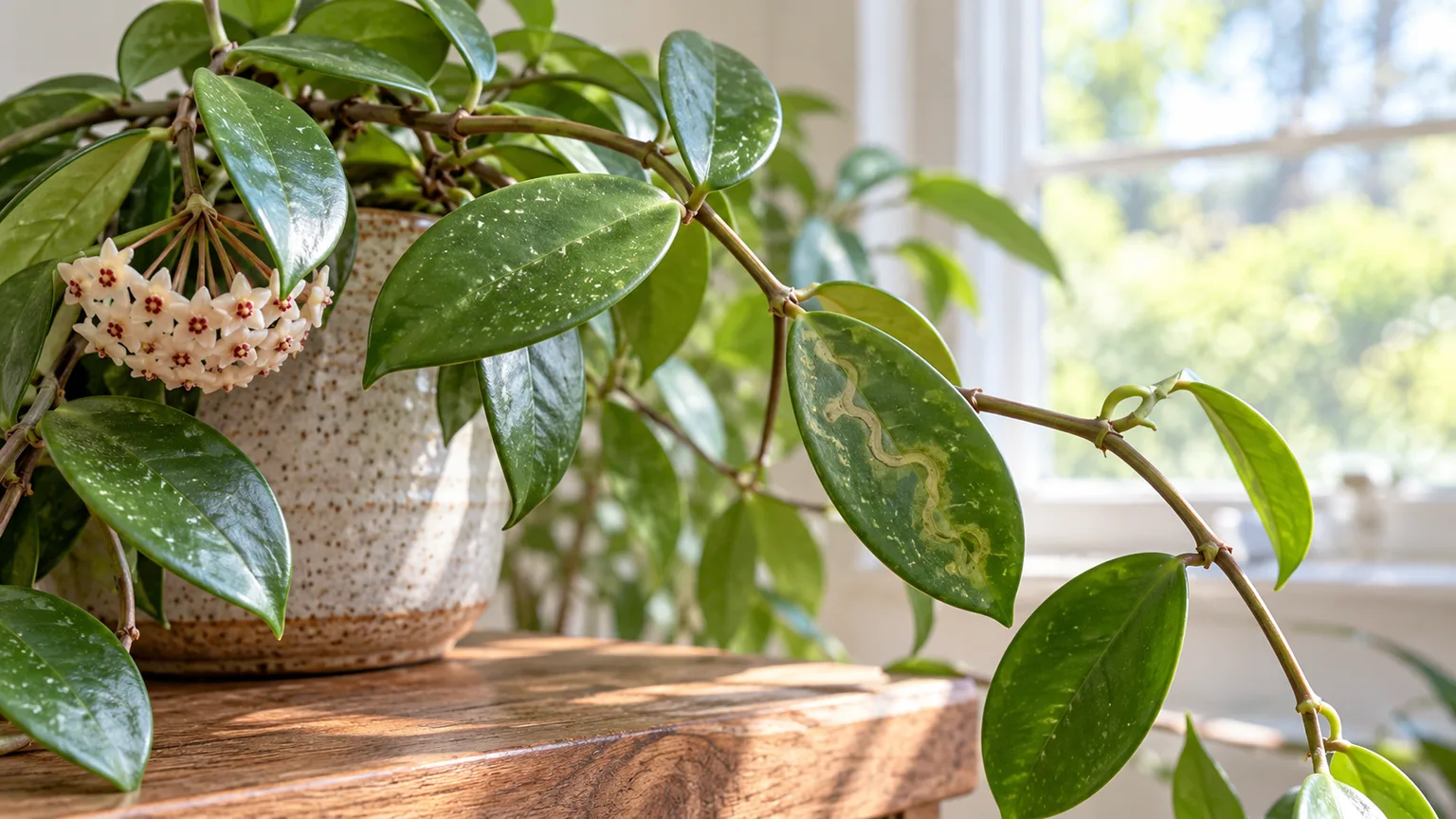
Leaf Miners on Hoya: Identify Tunnels and Protect Healthy Leaves
This guide covers leaf miners on Hoya. See also the general Leaf Miners guide, watering, and light pages for this plant.
Leaf Miners on Hoya: Identify Tunnels and Protect Healthy Leaves
Quick answer
A leaf miner is a larva feeding inside a leaf, not a mark sitting on its surface. The damage is usually a pale winding trail or an irregular blotch between the upper and lower leaf surfaces. On a Hoya, that sign should be treated as possible rather than assumed: leaf-miner species can be host-specific, and the extension references checked for this guide do not name Hoya as a common host. For the general life cycle and symptom pattern, see the leaf miners guide; this page focuses on confirming a mine on a Hoya and protecting the rest of its foliage.
First action: isolate the Hoya and backlight the marked leaf before you cut, spray, or change its care. Take a photo with the date. If a pale trail is inside the leaf and is lengthening or widening, remove only that leaf when the mine is still active. If it is flat, dry, or unchanged, keep the leaf and investigate a lookalike instead.
What a real leaf mine would look like on Hoya
Hoya is a varied genus, so compare the affected leaf with healthy leaves on the same plant or cultivar. Hoya carnosa has thick, waxy leaves and a climbing or trailing habit, while other hoyas can have quite different shapes and textures; compare within the same vine rather than deciding that an unusual leaf from another Hoya is automatically abnormal (NC State Hoya carnosa profile; RHS Hoya growing guide).
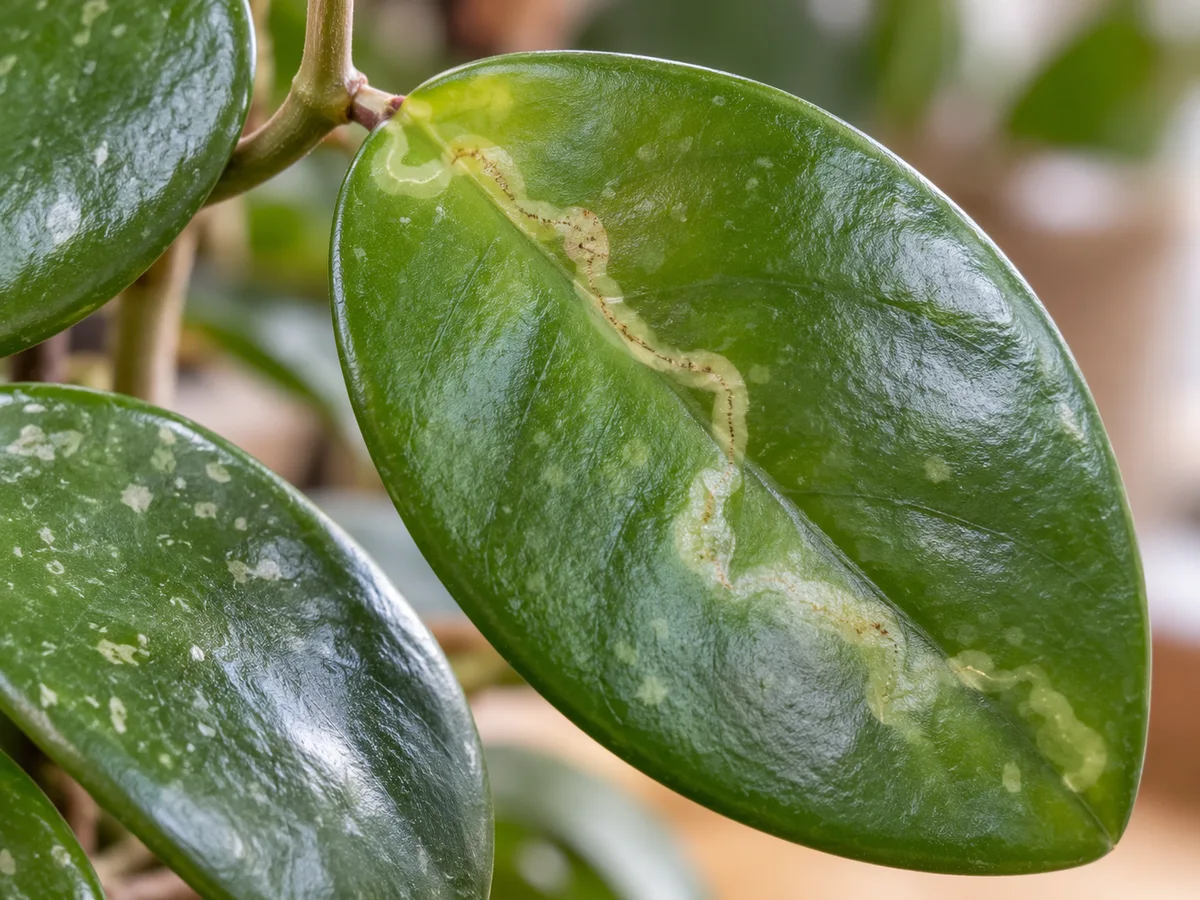
A real mine runs within the leaf blade; compare the marked area with the unaffected waxy tissue around it before removing the leaf.
Leaf-miner larvae feed between a leaf’s surfaces. Their movement can leave a winding, translucent, whitish, tan, or brown path, and some species make a broader blotch instead of a narrow serpentine trail. As the larva grows, a serpentine mine can widen; a dark frass line or a pale larva may sometimes be visible inside the damaged tissue (UConn Extension leafminer guide; Colorado State Extension on mine patterns; Utah State University Extension).
The key clue is that the damage sits inside the leaf rather than looking like a scratch, residue, or a spot on the surface. Extension sources describe larvae feeding under the leaf surface and mines that may lengthen as the larva feeds (UC IPM leafminer identification). Gardeners’ World summarizes the same basic sign as insect larvae making tunnels in leaves (Gardeners’ World leaf-damage guide), and Gardening Know How also illustrates winding trails as a visible clue (Gardening Know How identification guide). On Hoya’s thicker leaves, hold the blade toward a window or phone light and tilt it. Backlighting may make a translucent internal path easier to separate from a superficial blemish; it is a useful visual check, not a species identification test.
Confirm the tunnel before treating a Hoya
Start with the leaf that looks worst, but do not cut it open while it is still attached. Photograph both sides, then hold the leaf against a bright background. A true mine follows a winding or blotchy path inside the blade, often with the surrounding tissue becoming pale or brown. If the mark crosses veins and changes shape over several days, that is stronger evidence than a single fixed discolored patch. Colorado State Extension notes that mines can resemble fungal or abiotic leaf spots; a mine has a hollowed or tunneled area that may reveal insect remains or frass, while a leaf-spot injury does not form a tunnel (Colorado State Extension).
Check the underside too. Female leafminers of some species puncture leaves to feed or lay eggs, but tiny dots alone do not prove that a larva is mining inside the Hoya. Some mines contain a pale yellow or white larva; others may already be empty because the larva has left to pupate. UC IPM describes larvae feeding within the leaf and then leaving to pupate, while UConn Extension notes that the life cycle and timing vary among species (UC IPM leafminer life cycle; UConn Extension).
Use three checks before calling it leaf miners:
- Is the mark internal? Tilt the leaf in transmitted light. A surface scrape or dust residue will not form a tunnel within the blade.
- Is it changing? Take a second photo after several days. A growing larva may extend or widen a mine, while old scarring and sun damage usually stay in place.
- Can you see a larva or frass? A pale larva or dark waste inside the path strengthens the diagnosis, but absence does not rule out an old or empty mine.
Do not press on the entire leaf or dissect several leaves to search for larvae. A Hoya leaf is a useful water store; repeated squeezing or cutting can turn a small diagnostic question into avoidable tissue loss. If the tunnel is not clearly internal, leave the leaf in place and compare the other clues below before acting.
Why leaf miners on an indoor Hoya need a cautious diagnosis
Leaf miners are not one insect species. The name covers larvae from different insects, including flies, moths, and other groups, and their host ranges vary. UConn Extension describes greenhouse leafminers as species that can be host-specific, and NC State’s account of the American serpentine leafminer lists particular ornamental and vegetable hosts without identifying Hoya (UConn Extension; NC State Extension’s American serpentine leafminer profile). That is not proof that no leafminer could ever use a Hoya; it means a general tunnel photo is not enough to claim Hoya is a usual host.
If a Hoya really has an active mine, consider where it has been. A newly purchased plant, a summer spent outside, or a position near open windows and other foliage creates a plausible route for an adult insect or infested tissue to reach it. Adult females of some leafminer flies puncture leaves and place eggs in leaf tissue; larvae then feed inside the leaf (NC State American serpentine leafminer; UConn Extension greenhouse-crop guide). These references describe particular leafminer species, not a proven Hoya infestation pathway, so use the history to guide inspection rather than to diagnose by itself.
Hoyas grow as climbers or trailers, and many have thick leaves that store water. Their care is tied to a free-draining medium and a measured dry-down, not to spraying, watering, or repotting in response to a single blemish (RHS Hoya growing guide; NC State Hoya carnosa). If the mine is confirmed, treat the leaf damage as a leaf-level pest problem. If the Hoya is also limp or yellowing, separately inspect its pot and roots rather than assuming the larva caused every symptom. Use the Hoya watering guide when the mix is too wet or dry, and the Hoya soil guide if the medium stays wet or drains poorly.
First fix for a confirmed active mine
If the tunnel is growing and you can still see a larva or fresh pale tissue, isolate the Hoya from other plants while you deal with that leaf. Move it to a separate spot, not to a dark corner or a cold porch. Keep its normal bright, indirect light and watering rhythm steady; a pest diagnosis does not make the roots need extra water. The Hoya light guide can help you keep the plant’s light stable while it is isolated.
Remove only the leaf that has an active mine when the evidence is clear. Use clean scissors at the petiole, place the leaf straight into a bag, seal it, and discard it with household waste. Do not leave mined tissue on the potting surface or add it to a home compost pile where a larva or pupa could remain. University of California IPM and UConn Extension recommend removing infested leaves as part of cultural management, especially before larvae leave the leaves to pupate (UC IPM; UConn Extension; Utah State University Extension).
Do not strip every Hoya leaf that has an old pale mark. UC IPM says leaf-miner damage is often cosmetic on established plants and rarely kills them, while UConn notes that damage is generally aesthetic and plants are rarely killed (UC IPM; UConn Extension). Those observations are from garden and greenhouse hosts, not a controlled Hoya trial, but they support a conservative response to a small, otherwise healthy indoor vine. Keep an older leaf with an empty, inactive mine if removing it would leave the Hoya with very little healthy foliage.
After pruning one active leaf, inspect the Hoya and its neighbors again in a week. Look at new leaves and the undersides of foliage rather than treating the soil. Yellow sticky cards can help monitor flying adults in greenhouse scouting, but they do not show whether a Hoya leaf contains larvae and are not a cure for a mine already inside tissue (UConn Extension scouting guidance). If you find more expanding mines, keep the plant isolated and remove only confirmed, actively affected leaves. If no new damage appears, return it to its normal growing spot after a short observation period.
Why a surface spray is usually the wrong first move
A larva inside a leaf is physically protected by the tissue around it. Colorado State Extension explains that contact insecticides do not reach active larvae within mines, and UC IPM says insecticides are not very effective for vegetable leafminers (Colorado State Extension; UC IPM). UConn also notes that some greenhouse leafminer species have developed resistance to particular insecticides, which is one reason its guidance emphasizes scouting and cultural controls (UConn Extension). Those sources concern specific crops and pests, but they make a strong case against spraying a Hoya because of a pale line alone.
Epic Gardening’s practical overview likewise explains that larvae are shielded inside leaves, limiting the effect of surface sprays (Epic Gardening leaf-miner guide). Do not assume that neem oil, soap, or a generic houseplant spray will reach the larva. A wrong spray can leave the mine in place and add residue or stress to thick Hoya leaves without confirming the pest. For a persistent, widespread infestation that cannot be managed by selective removal, ask a local cooperative extension service to identify the leafminer and advise whether any control is appropriate for an indoor ornamental.
Separate leaf miners from Hoya lookalikes
A pale mark on a waxy Hoya leaf can have several causes. Use the pattern, not just the color, to choose the next step.
| What you see | More useful interpretation | Hoya-specific next step |
|---|---|---|
| A pale winding or blotchy trail inside the leaf that expands | Possible active mine; confirm an internal tunnel and larva or frass before removal | Follow the inspection and removal steps on this page |
| Silvery surface scarring, tiny black specks, or distorted new growth | Possible thrips feeding or another surface injury; not a leaf mine | Compare fresh growth and inspect with a magnifier; avoid pesticide on a guess |
| Fine pale stippling with webbing on the underside | More consistent with spider mites than an internal mine | Use the Hoya spider-mites guide if mites or webbing are present |
| Sticky residue and small clustered insects on soft tips | More consistent with aphids or another sap-feeding insect | Compare the Hoya aphids guide and Hoya mealybugs guide |
| A round dry spot, scorch mark, or torn edge with no internal track | Possible sun, handling, or leaf-spot damage | See brown leaves on Hoya or holes in Hoya leaves for those patterns |
The table is a triage aid, not a substitute for identifying an insect. If there is no winding or blotchy path inside the leaf, the label “leaf miners” is not yet supported. Take a photo, keep the plant stable, and compare the mark again before pruning. The Hoya problems hub can route you to another plant-specific symptom if the pattern points away from mining.
Recovery: protect Hoya’s healthy foliage
The mined part of a leaf will not become smooth and green again. It may remain pale or brown after a larva has left, because the damaged tissue itself does not rebuild. UC IPM notes that mines are a type of feeding injury and can persist as visible damage even when the leafminer is no longer present (UC IPM leafminer damage). Judge success by whether the mine stops changing, no new leaves develop tunnels, and the remaining vine stays firm.
Hoya’s thick, fleshy leaves store water, so a healthy leaf remains useful even when one neighboring leaf carries an old mark. Avoid pruning a whole vine for appearance, and do not fertilize heavily to force replacement growth. NC State and RHS describe Hoya’s fleshy foliage and climbing or trailing habit, which makes selective care more sensible than stripping leaves from the plant (NC State Hoya carnosa; RHS Hoya guide). If one small vine is badly mined but the rest is firm and clean, keep the undamaged vines and monitor. If several stems decline, roots smell sour, or the pot stays wet, investigate root health separately with the Hoya root-rot guide rather than attributing general decline to leaf miners.
A Hoya that is otherwise firm and growing does not need to be repotted because of a mine. Repot only when the mix or roots show a real problem; use the Hoya repotting guide if the pot has failed, drainage is poor, or roots have outgrown the container. Keeping the plant’s care stable makes it easier to tell whether new damage is still occurring.
Prevent another Hoya leaf-miner episode
Inspect a new Hoya before it joins the collection. Look for active winding trails, small pale punctures, or larvae in the leaves, and keep the new plant apart while you observe it. UConn Extension includes incoming-plant inspection in greenhouse scouting; applying that careful check to a small indoor collection is a practical precaution, not a claim that Hoya is a common leafminer host (UConn Extension scouting guidance). If a Hoya spends summer outdoors, check it before bringing it back inside, especially if it sat near vegetable beds, flowering annuals, or other plants that are known hosts for a particular leafminer species.
Keep the plant in its normal bright position and let the mix dry according to the pot, not a calendar. Hoya’s trailing stems can touch nearby plants, so leave enough space to inspect both sides of the leaves and avoid placing a suspect plant where its foliage overlaps healthy plants. Use the plant’s usual light and dry-down routine only when the pot or roots show a real mismatch.
Make a quick photo record if a mark appears. One dated image, a second image several days later, and notes on whether the Hoya was indoors or outdoors often answer the first question: is the damage actively advancing? If the mark does not change and there is no tunnel or larva, leave the leaf and continue normal care rather than repeating sprays or cutting healthy tissue.
When to use this page vs other Hoya guides
Use this page when a pale, winding or blotchy path appears to run inside a Hoya leaf and you need to determine whether it is an active mine. If there is no internal tunnel, use the pattern to choose a better match: webbing and stippling can indicate mites, clustered insects or honeydew can indicate aphids, and cottony insects can indicate mealybugs. A dry brown patch or a torn leaf belongs with brown leaves on Hoya or holes in Hoya leaves.
If the leaves look limp or broadly yellow but have no mines, first check the pot. Use the Hoya watering guide for a wet-versus-dry diagnosis and the Hoya root-rot guide if roots or stems are soft. For general light and plant-shape context, start with the Hoya overview and the Hoya light guide.
Related Hoya guides
- Hoya overview — baseline care and normal leaf variation.
- Hoya soil — use when drainage or mix structure is genuinely failing.
- Hoya spider mites — use for webbing and fine stippling, not internal tunnels.
- Hoya aphids — use for visible insects and honeydew on soft tips.
- Hoya problems hub — route to another plant-specific symptom when no mine is present.
Related tool
Use the Plant Problem Diagnosis Tool to record whether the mark is internal, whether it changed between photos, and which other signs you found before removing a leaf.