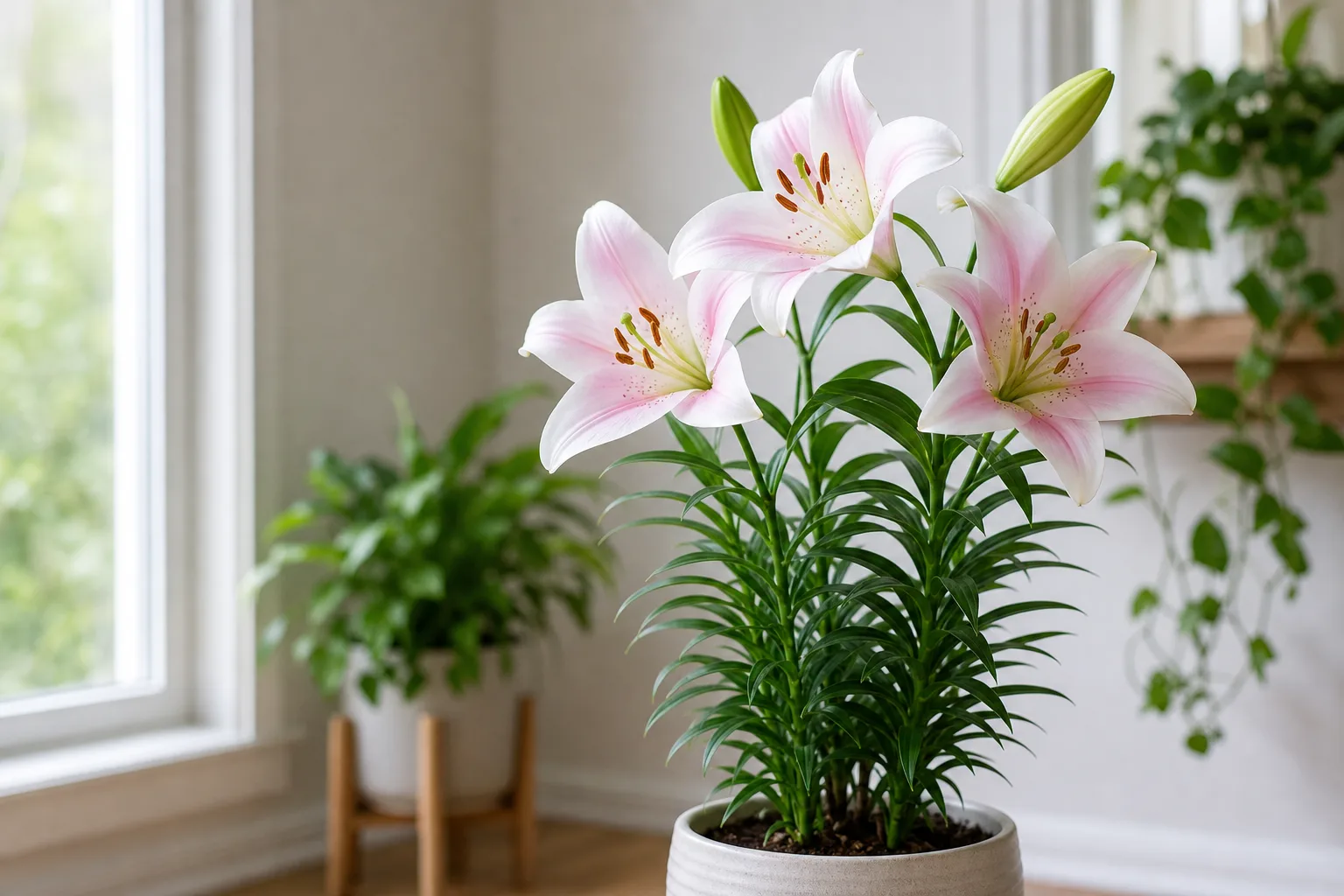
This page covers true lilies in the botanical genus Lilium, which grow from bulbs. It does not cover daylilies, peace lilies, lily-of-the-valley, or Peruvian lilies, despite the shared common name.
How much sun do true lilies need?
Most garden lilies grow in full sun or light shade, with their roots kept cool. Woodland groups such as Martagon lilies tolerate dappled shade, but deep shade is unsuitable for most types.
Do all lilies need acidic soil?
No. Oriental lilies prefer acidic soil, Asiatic hybrids prefer or tolerate more alkaline conditions, and several other groups grow in a wider range of soils. Check the cultivar label.
How often should I water Lilium?
Keep soil lightly and consistently moist while shoots grow and bloom, but never waterlog it. Check the root zone and water when it starts to dry; containers usually need more frequent checks than beds.
Should I cut lily foliage back after flowering?
Remove spent flowers if you do not want seed, but leave green stems and leaves until they yellow and die naturally. The foliage helps replenish the bulb for the next season.
Are true lilies safe for cats and dogs?
True lilies are a serious cat hazard: ASPCA says all parts, pollen, and vase water can cause severe kidney injury. ASPCA also warns about dogs, while NC State lists Lilium as non-toxic to dogs, so the dog-specific classification needs review. Keep lilies away from both pets.
What light does Lily need?
Lily grows best in full sun or light shade, with the root zone kept cool. It also tolerates Partial shade, Dappled shade for woodland groups such as Martagon lilies. Avoid deep shade and exposed, hot root zones.
Written by Sai AnanthLead content writer at LeafyPixels. B.Pharmacy graduate from Andhra University with a background in pharmacognosy, turned indoor gardening writer after a long-time plant hobby became a research-led resource for home growers.View Sai Ananth's profile · Reviewed by LeafyPixels Review Board
This Lily problems problem guide was researched and written by Sai AnanthLead content writer at LeafyPixels. B.Pharmacy graduate from Andhra University with a background in pharmacognosy, turned indoor gardening writer after a long-time plant hobby became a research-led resource for home growers.View Sai Ananth's profile. Problems symptoms on Lily, lookalike causes, and step-by-step fixes are cross-checked against extension pest, disease, and care references before publication.
We prioritize sources that hold up under scrutiny:
University cooperative extension bulletins and fact sheets (Penn State, Clemson, UMD, NC State, and similar programs)
Botanical garden and horticultural society publications
Peer-reviewed plant science and veterinary toxicology references where pet safety matters (including ASPCA Animal Poison Control)
Established reference works on indoor plant culture
The LeafyPixels editorial team then reviews the draft for clarity, step-by-step usefulness, and fit with real apartment and home conditions-not ideal greenhouse setups. When guidance changes materially, we update the page and note the revision date.
Sources used
ASPCA Poison Control — Which Lilies Are Toxic to Pets? (n.d.) Distinguishing Lilium from other plants called lily and describing cat and dog exposure risks. [Online]. Available at: https://www.aspca.org/news/which-lilies-are-toxic-pets (Accessed: 1 March 2024).
Gardeners' World — How to Grow Lilies (n.d.) Bulb planting depth, group-specific soil, post-flowering foliage care, division timing, and lily beetle observations. [Online]. Available at: https://www.gardenersworld.com/how-to/grow-plants/how-to-grow-lilies/ (Accessed: 1 March 2024).
NC State Extension Gardener Plant Toolbox — Lilium (n.d.) Botanical identity, family, native range, perennial bulb habit, height, bloom season, light, soil, drainage, cultural groups, and pet-safety plant tags. [Online]. Available at: https://plants.ces.ncsu.edu/plants/lilium/ (Accessed: 1 March 2024).
Royal Horticultural Society — How to Grow Lilies (n.d.) Lily-group soil preferences, planting season, sun and shade, drainage, bulb care, and cat-safety guidance. [Online]. Available at: https://www.rhs.org.uk/plants/lilies/how-to-grow-lilies (Accessed: 1 March 2024).
Royal Horticultural Society — Lilies: Growing in Containers (n.d.) Container suitability, deep-pot guidance, and examples of Lilium species grown in pots. [Online]. Available at: https://www.rhs.org.uk/container-gardening/lilies (Accessed: 1 March 2024).
Solaris Farms — Lilium Culture and Care (n.d.) Professional grower context on Lilium bulb habit, cultivar variation, and seasonal flowering. [Online]. Available at: https://solarisfarms.com/culture-care/lilium/ (Accessed: 1 March 2024).