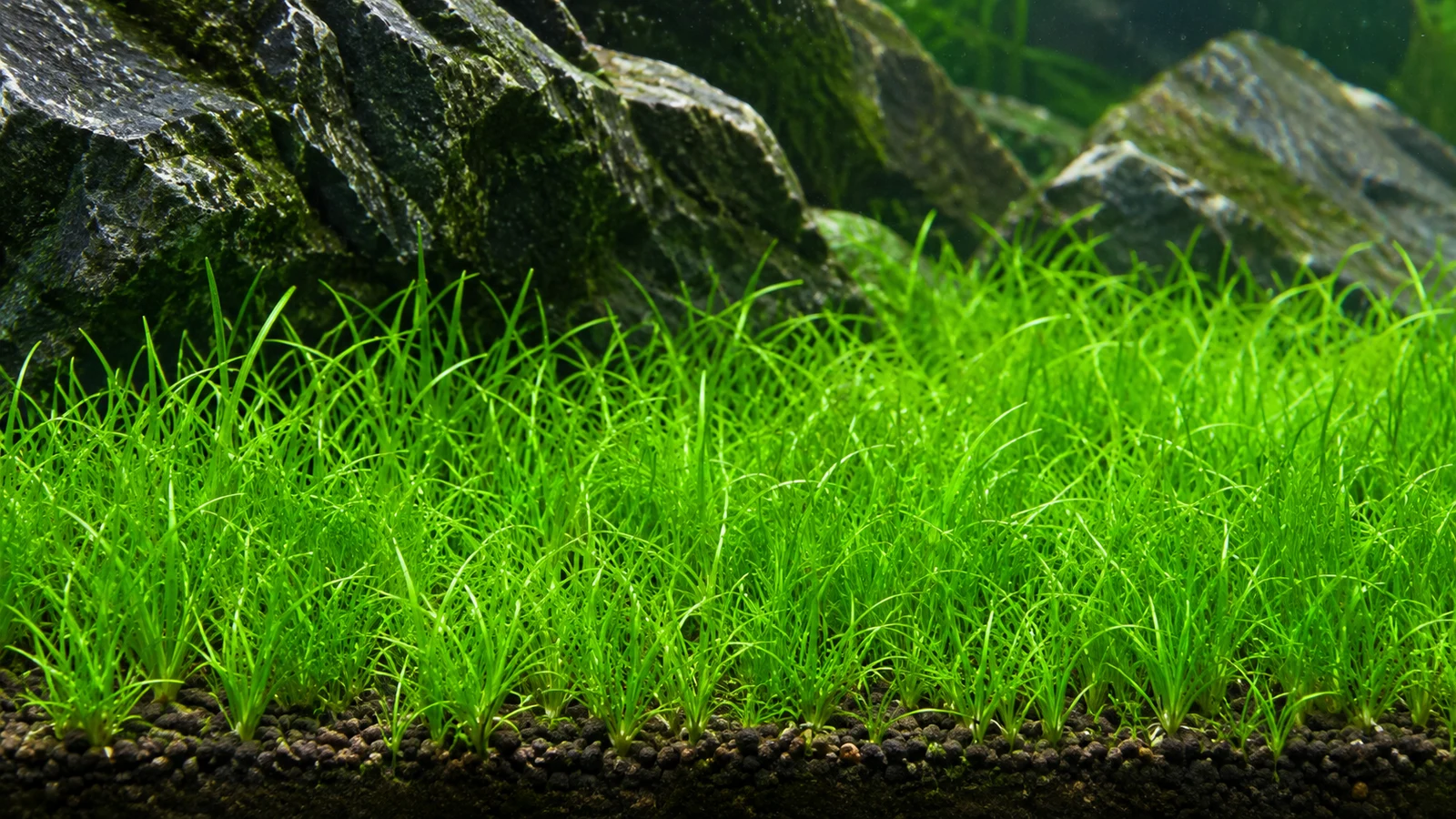
Is Micro Sword the same plant as Lilaeopsis brasiliensis?
Aquarium plant growers and suppliers commonly use Lilaeopsis brasiliensis for Micro Sword. World Flora Online lists that name as a synonym of Lilaeopsis minor, while the NZ Plant Conservation Network and Tropica use L. brasiliensis. The name is not fully harmonized across references, so check the label and source.
Does Micro Sword need high light?
It can grow under lower light, but it grows slowly. Tropica says a compact, 4–7 cm lawn needs strong light and an open, unshaded position. Moderate light can support growth without producing the same dense carpet.
Does Micro Sword need CO2 injection?
CO2 is not always required. Aquarium plant references rate its CO2 demand from low to medium; stable light, root nutrition and time matter too. Match any CO2 change to the needs of the fish and other plants in the aquarium.
How should I plant a new Micro Sword pot?
Remove the nursery material, gently divide the plant into small rooted clumps, and set each clump a few centimetres apart. Bury the roots in the substrate while leaving the leaf bases and growing points uncovered.
How does Micro Sword spread?
It sends out stolons or runners that form new plantlets. Once a plantlet has roots, it can be separated and replanted to extend the foreground carpet.
Is Micro Sword safe for pets?
The research sources reviewed did not provide a species-specific veterinary toxicity classification. Its use in aquariums is not proof that it is safe for pets to chew, so its ingestion status remains unverified.
How often should I water Micro Sword?
Keep Micro Sword submerged in stable freshwater aquarium conditions. This is an aquatic plant, not a terrestrial plant that should dry between waterings. In practice, water continuous submersion; maintain the aquarium’s normal water level and routine water changes. Check for firm green leaves, healthy rooted clumps, and new runners. In a slow-growing carpet, also watch for algae coating the leaves or repeated uprooting. Growth responds to the tank’s light and temperature cycle. Avoid abrupt changes to lighting or water conditions; adjust one factor at a time while watching new growth.
Written by Sai AnanthLead content writer at LeafyPixels. B.Pharmacy graduate from Andhra University with a background in pharmacognosy, turned indoor gardening writer after a long-time plant hobby became a research-led resource for home growers.View Sai Ananth's profile · Reviewed by LeafyPixels Review Board
This Micro Sword problems problem guide was researched and written by Sai AnanthLead content writer at LeafyPixels. B.Pharmacy graduate from Andhra University with a background in pharmacognosy, turned indoor gardening writer after a long-time plant hobby became a research-led resource for home growers.View Sai Ananth's profile. Problems symptoms on Micro Sword, lookalike causes, and step-by-step fixes are cross-checked against extension pest, disease, and care references before publication.
We prioritize sources that hold up under scrutiny:
University cooperative extension bulletins and fact sheets (Penn State, Clemson, UMD, NC State, and similar programs)
Botanical garden and horticultural society publications
Peer-reviewed plant science and veterinary toxicology references where pet safety matters (including ASPCA Animal Poison Control)
Established reference works on indoor plant culture
The LeafyPixels editorial team then reviews the draft for clarity, step-by-step usefulness, and fit with real apartment and home conditions-not ideal greenhouse setups. When guidance changes materially, we update the page and note the revision date.
Sources used
Aquarium Care Basics — Micro Sword Plant: Care, Carpet Grass, Lighting & Algae (n.d.) Common aquarium trade names, careful small-clump planting, fine roots, runner propagation, and algae management. [Online]. Available at: https://www.aquariumcarebasics.com/aquarium-plants/micro-sword-plant/ (Accessed: 1 March 2024).
New Zealand Plant Conservation Network — Lilaeopsis brasiliensis (n.d.) Name and authority, Apiaceae family, South American/Brazilian distribution, semi-submerged sand-and-silt habitat, and aquarium trade introduction. [Online]. Available at: https://www.nzpcn.org.nz/flora/species/lilaeopsis-brasiliensis/ (Accessed: 1 March 2024).
World Flora Online — Lilaeopsis brasiliensis taxon record (n.d.) Botanical name treatment and synonym relationship to Lilaeopsis minor; record attribution to Tropicos. [Online]. Available at: https://www.worldfloraonline.org/taxon/wfo-0001251137 (Accessed: 1 March 2024).