Dry Hydrophobic Soil on Mogra: How to Rewet It Safely
Quick answer
If water beads on Mogra’s mix or runs down the pot wall while the center stays dry, rewet the root ball slowly in several passes and let excess water drain. Do not compensate with fertilizer or daily watering; first confirm the mix is wet through and the pot is not staying soggy.
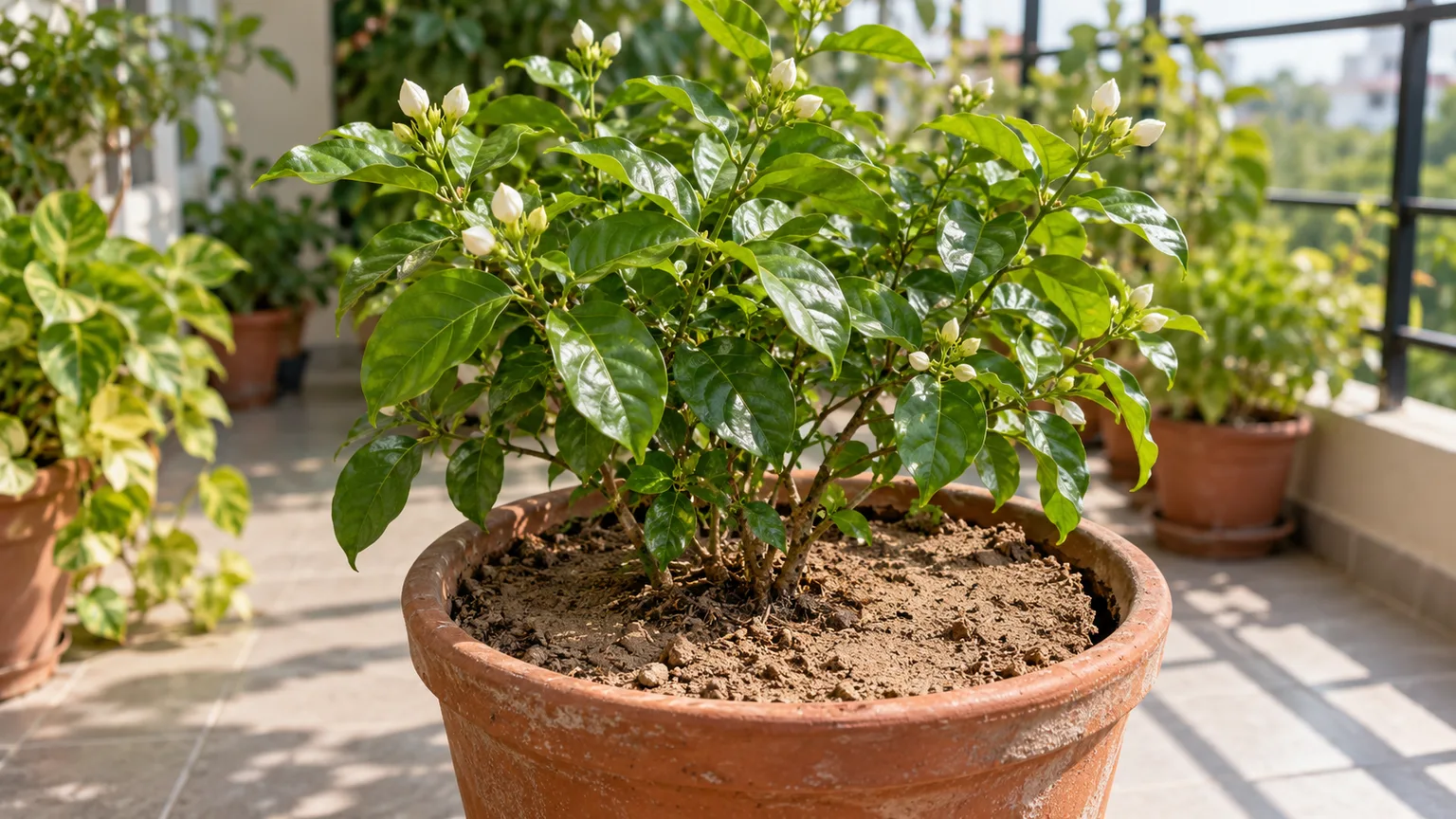
Dry Hydrophobic Soil on Mogra: Causes, Checks & Fixes
This guide covers dry hydrophobic soil on Mogra. See also the general Dry Hydrophobic Soil guide, watering, and light pages for this plant.
Dry Hydrophobic Soil on Mogra: Causes, Checks & Fixes
Quick answer
If water beads on Mogra’s potting mix or disappears down the gap beside the root ball while the center remains dry, rewet the mix gradually. Pour a small amount over the whole surface, wait for it to soak in, and repeat until a wooden skewer or finger shows moisture in the center. Let the pot drain completely. Mogra needs a root zone that stays moderately moist but drains well; repeated runoff is a reason to inspect the mix, not to add fertilizer or keep watering on a fixed daily schedule. For the plant’s baseline, compare your routine with the Mogra care guide and its watering guidance.
What dry hydrophobic soil looks like on Mogra
The clearest sign is a mismatch between watering and the root ball: water beads on the surface, runs down the inside wall, or leaves through the drainage holes quickly, yet the middle of the mix still feels dusty. Compare the pot’s weight before and after a full watering to see whether water has reached the root ball. Mogra’s leaves may look stressed, but leaf posture alone does not prove that the mix itself is hydrophobic; surface beading or pooling instead of absorption is a common sign of water-repellent soil (The Spruce’s hydrophobic-soil guide). Arabian jasmine needs consistently moist, well-drained soil (The Spruce’s Arabian jasmine guide).
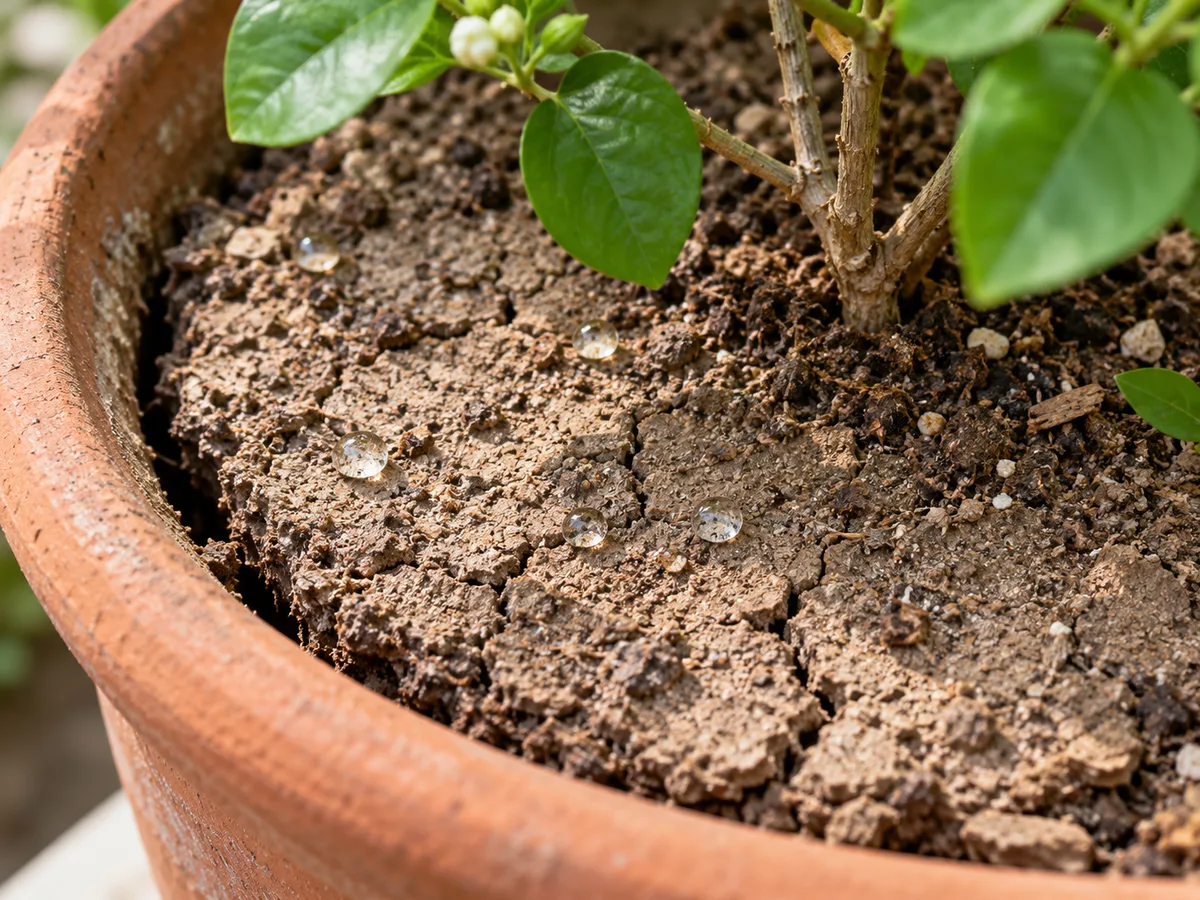
Dry mix can pull away from a pot wall and shed water; check below the surface before deciding that the whole root ball is wet.
Arabian jasmine, or Mogra (Jasminum sambac), is an evergreen shrub with glossy leaves and fragrant white flowers. Its growing medium should be moist but well drained, and the RHS lists loam as a suitable soil type for the species. That balance matters here: a uniformly dry root ball interrupts the steady moisture Mogra uses while growing and flowering, while a mix that stays waterlogged can create a different root problem. The RHS Mogra profile describes the plant’s soil and growing conditions.
For the general meaning and causes of water-repellent mix, see the dry hydrophobic soil guide. The checks below focus on whether Mogra’s own root ball is actually dry and what to do about it.
Confirm the root ball is dry before changing care
Check more than the visible surface. Push a clean wooden skewer about halfway between the stem and pot edge, then remove it. A dry, clean skewer from the center while the surface beads or darkens only in patches suggests uneven wetting. Compare that result with the pot’s weight and with a second spot near the edge; a dry-looking crust over moist mix is not the same problem.
Next, water a small test area slowly. If the water pools, runs toward the pot rim, or drains before the central mix darkens, pause and repeat in a few minutes. If the center becomes evenly moist and the pot feels heavier, the issue was likely a dry root ball that can still accept water. The RHS advises checking container compost below the surface and watering when it is dry roughly 2–3 cm down; it also recommends watering slowly enough for water to soak into the root ball. Use those checks as a guide, not as a calendar rule (RHS watering guidance).
A second possibility is that Mogra’s pot is root-bound rather than hydrophobic. A root-bound plant can dry very quickly even when water penetrates the mix. Look through the drainage holes for roots, then slide the root ball out only if the quick-dry pattern persists. Dense roots circling the outside, with little visible mix, support repotting; a few roots at a hole by themselves do not prove that the pot is too small. Penn State Extension also lists rapid drying and roots emerging from drainage holes among signs to check before repotting (Penn State’s houseplant repotting guide).
Separate uneven wetting from Mogra’s other water problems
| What you find | More likely explanation | Best next check |
|---|---|---|
| Surface beads or sheds water, center remains dry, pot stays light | Uneven wetting or a water-repellent root ball | Rewet slowly, then probe the center again |
| Mix is evenly damp below the surface, but a few older leaves yellow | The leaf pattern alone does not confirm hydrophobic soil | Check whether new leaves are healthy and review the Mogra watering guide |
| Mix remains heavy and wet, stems soften, or leaves yellow after watering | Drainage or root stress deserves a check | Check the drainage hole and whether the cover pot holds water; compare with Mogra’s compacted-soil guide |
| The pot dries very quickly and roots form a dense ring | Root crowding may be making the pot dry quickly | Inspect the root ball and choose a slightly larger pot only if the roots are crowded |
Drooping alone is not enough to tell whether Mogra needs water. Overwatering can also cause root problems for Arabian jasmine, so check the soil before adding more (The Spruce’s Arabian jasmine guide). A persistently wet pot calls for a drainage check; adding more water to an already damp center can make root stress worse. The Mogra soil guide is the better route when the mix feels dense or remains wet, while this page is for a root ball that is dry through the center and difficult to wet.
Why Mogra’s potting mix can dry unevenly
A sunny Mogra balcony changes how quickly the pot dries
Mogra is commonly grown in containers, including on sunny balconies and patios. A small pot exposed to bright light, warm air, or wind can lose moisture faster than a larger pot in a sheltered spot. The RHS notes that container plants dry faster than plants in garden soil (RHS watering guidance), while The Spruce’s Arabian jasmine guide recommends regular moisture and checking container soil after the upper few inches dry. That is why a pot that was comfortable in a cooler room may need closer inspection after moving outdoors or into stronger seasonal sun (The Spruce’s Arabian jasmine guide).
Do not respond by watering Mogra every day without checking the root zone. If only the top layer dries while the center is moist, wait. If the center is dry but the outside remains damp, water has not reached the whole root ball evenly. Either way, the probe and pot weight give a better answer than a fixed interval.
Mogra’s flowering shoots need moisture, but not a saturated pot
Mogra flowers in summer and may flower sporadically at other times, while the RHS profile advises sparing watering in winter (RHS Mogra profile). During active growth, check the root zone before watering rather than letting repeated dry-downs leave new shoots short of moisture. A heavy mix or blocked drainage can keep roots wet after watering, so confirm that the container drains freely and reduce watering as growth and light decline. Do not force the summer routine through a cool, low-light rest period.
This seasonal balance is specific to a flowering evergreen shrub: keep enough moisture available for active shoots, then let the plant’s actual dry-down set the next watering. If Mogra looks stressed but the center of the pot is damp, do not assume the cause is thirst; check light, root condition, and recent changes too. Mogra also needs suitable light to support flowering (The Spruce’s Arabian jasmine guide), so compare the location with its light-care guide before increasing water.
Mogra’s potting mix must hold some moisture without staying wet
Container media are designed to balance water-holding capacity and air space. Penn State Extension notes that potting mixes commonly combine ingredients such as peat, perlite, vermiculite, and compost, and that peat-based mixes may contain wetting agents to help water absorption (Penn State on potting media). Mogra needs a mix that holds some moisture while draining; a very coarse blend can dry too quickly, while dense, compacted material can stay wet in one area and dry in another.
Unglazed terracotta also loses water through its porous sides, while plastic retains moisture longer (Penn State’s houseplant repotting guide). Neither material is automatically wrong for Mogra. If a terracotta pot dries rapidly in full sun, adjust the watering check or move it out of harsh afternoon exposure rather than switching to a much larger pot. A pot without a clear drainage hole is a separate concern: excess water must be able to leave after rewetting.
First fix: rewet Mogra’s mix slowly
When the center of the root ball is dry and the mix is shedding water, apply a slow, even stream over the surface rather than pouring a large amount into one spot. Stop when the surface begins to darken, wait several minutes, then make another light pass. Check the center with a skewer after the second pass. This gives dry mix time to take up water and shows whether the root ball is responding.
If the water still races out while the center remains dry, take the nursery pot out of any decorative cover and make sure its drainage holes are clear. If careful surface watering still fails, set the nursery pot in a shallow basin or sink of water for 15–30 minutes, then remove it and let it drain fully; The Spruce recommends this brief immersion for severely dehydrated container mix (The Spruce’s hydrophobic-soil guide). Do not leave the pot standing in water. The aim is to restore even moisture, not saturate Mogra’s roots.
Once the root ball is evenly damp, return the plant to its usual bright position and wait for the top 2–3 cm to dry before watering again. Avoid pruning, fertilizing, and repotting all at once. The first recovery step should change only the moisture level so you can see whether leaves regain firmness and the next growth stays healthy.
When Mogra needs fresh mix instead
Rewetting is a reasonable first step when the mix is dry but still loose and the roots are not crowded. Repot only when the medium has become dense, water cannot move through it evenly after careful watering, the pot lacks drainage, or the roots are tightly circling and the plant dries very quickly. The Spruce notes that compacted, worn potting mix may be better replaced than repeatedly rewet (The Spruce’s hydrophobic-soil guide). Penn State recommends a soilless potting mix for houseplants rather than garden soil and advises moistening fresh mix before repotting so it absorbs water evenly (Penn State’s repotting guide).
Choose a container with drainage holes that is only slightly larger than the root ball. Avoid moving Mogra into a much bigger pot just because the soil dried once. The Spruce recommends a pot only an inch or two wider when repotting Arabian jasmine and a moist, well-drained mix (The Spruce’s Arabian jasmine guide).
Use a loose, moisture-retentive but draining mix rather than heavy garden soil. The Mogra care profile calls for a blend that drains while retaining some moisture; the RHS also lists moist, well-drained loam for Jasminum sambac (RHS Mogra profile). Coarse material such as perlite or sand can help keep a container mix open. Moisten the blend before filling the pot, set the root ball at its previous depth, and water once to settle the mix. Repotting is easiest during active spring growth after flowering, not during a cold, low-light pause unless the existing medium has failed (Penn State’s houseplant repotting guide).
Recovery: what should improve and what will not
A Mogra that was simply too dry may regain leaf firmness after water reaches the roots. Leave partly green leaves in place while the plant recovers; remove only tissue that is fully dry or clearly dead. Judge progress by whether fresh growth stays firm rather than waiting for old damaged tissue to look perfect again.
Judge progress by the next few watering checks: the root ball should take water more evenly, the pot should gain weight after watering and lighten as it dries, and new leaves should stay firm. Do not expect the old leaves to erase every sign of stress. If the soil becomes wet but the plant continues to wilt, smells sour, or develops soft stems, stop adding water and inspect drainage and roots before changing the mix.
If Mogra remains limp after the root ball is evenly damp, do not pour on more water; inspect the mix and roots before deciding whether the plant can be saved. Avoid feeding a plant that is still wilted or has just been repotted; fertilizer will not correct the moisture or drainage problem.
Prevent the problem through Mogra’s seasonal care
Before watering, check below the surface rather than relying on the calendar. For Mogra in active growth, use the top 2–3 cm as a starting point, then adjust for the pot material, weather, and how quickly the center dries. In winter, check less often because growth slows and the RHS species profile recommends sparing watering; The Spruce also recommends keeping Arabian jasmine evenly moist but not soggy and reducing water in winter (The Spruce’s Arabian jasmine guide).
Keep the pot in bright light suited to Mogra, but reassess it during heat waves and when a balcony becomes windy or exposed. Container soil can dry faster than ground soil, and Mogra’s glossy foliage is a useful cue only when read together with the root-zone test. If the pot dries very quickly each time, check for root crowding rather than compensating with repeated shallow splashes.
When repotting, start with fresh mix that is lightly moistened before it goes around the roots. Use a container with a drainage hole and empty the cover pot after watering. Leslie Land’s jasmine-care notes also recommend free-draining mix, keeping the soil evenly moist, and letting the surface dry slightly between waterings (Leslie Land on fragrant jasmine).
Related Mogra guides
When to use this page vs other Mogra guides: Use this page when the root ball remains dry after watering or water runs around the mix instead of soaking in. If the pot stays heavy and wet, start with Mogra’s compacted-soil guide and its drainage checks. If leaves remain limp while the center is moist, use the Mogra watering guide to compare the whole watering pattern; yellowing can have other causes. For broader diagnosis, visit the Mogra problems hub, where each guide separates a different symptom pattern.
Related tool
Use the Plant Problem Diagnosis Tool to compare dry mix with other possible causes before changing Mogra’s care.