Scale Insects on Monstera Adansonii: How to Confirm
Quick answer
Scale insects on Monstera adansonii look like fixed tan, brown, or pale shell-like bumps attached to stems or leaf undersides. Sticky honeydew can point to soft scale, but its absence does not rule out armored scale. First isolate the plant, then inspect and remove visible scales without scraping the thin leaves.
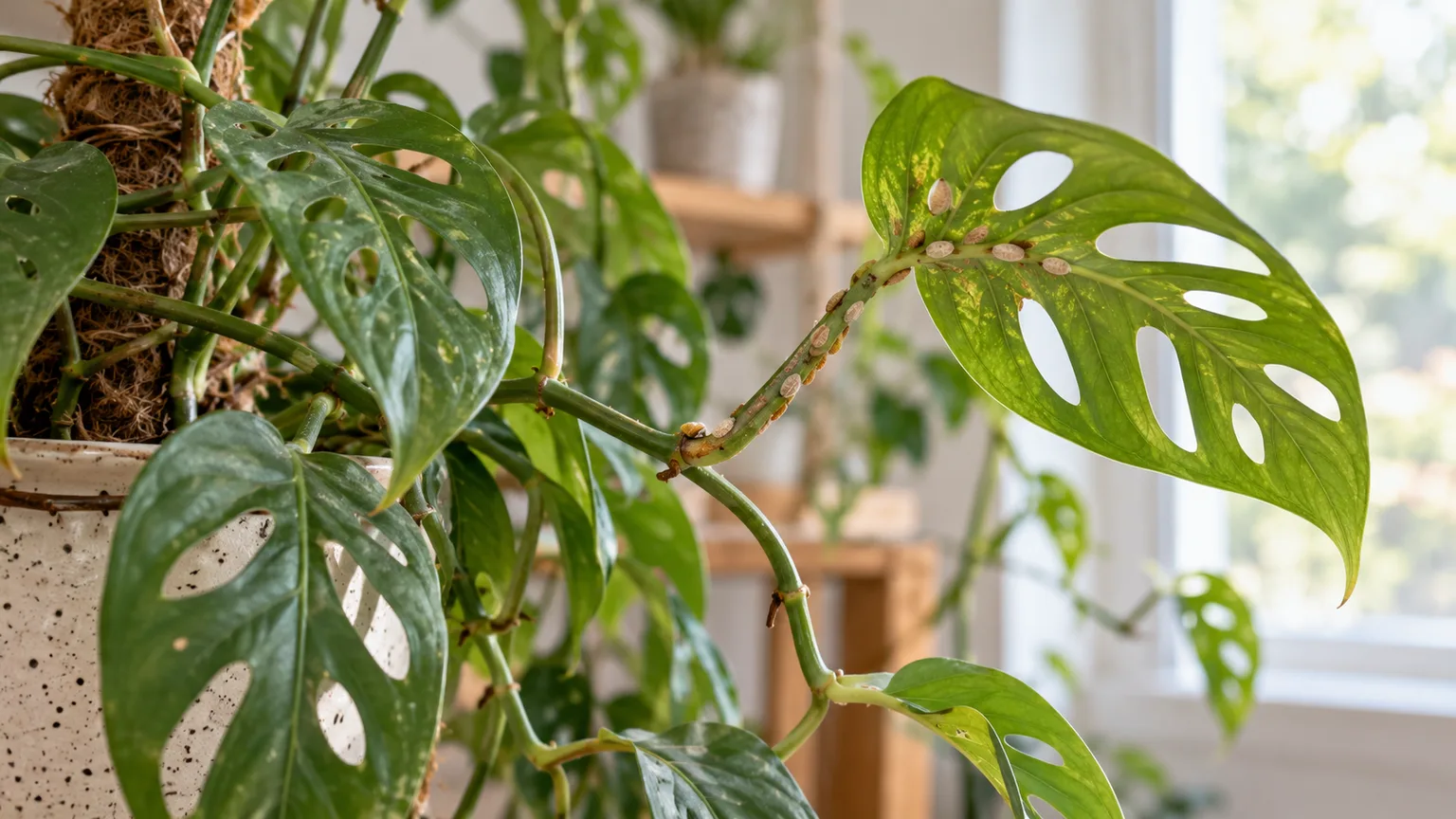
Scale Insects on Monstera Adansonii: How to Confirm and Treat Them
This guide covers scale insects on Monstera Adansonii. See also the general Scale Insects guide, watering, and light pages for this plant.
Scale Insects on Monstera Adansonii: How to Confirm and Treat Them
Quick answer
Scale insects on Monstera adansonii appear as small, fixed tan, brown, gray, or pale bumps attached to a stem, petiole, or leaf underside. The bump may resemble a scab more than a recognizable insect. Many indoor scales gather near the midrib or main veins beneath a leaf, while others settle along stems. Some types excrete sticky honeydew and may be followed by black sooty mold; armored scales do not produce honeydew, so clean leaves do not rule out scale. Indoor scale guidance from the RHS describes both their sheltered locations and the different signs sap feeders can leave.
First action: isolate the Monstera adansonii from nearby plants. This limits the chance that mobile young crawlers reach another pot while you inspect the vine. Then identify a live scale before applying a treatment. The plant’s characteristic oval leaf openings and climbing stems give you a practical inspection route, but the fenestrations themselves are not evidence of a pest problem. Scale diagnosis rests on finding an insect attached to plant tissue, not on a change in humidity, watering, or light.
For a general explanation of scale types and their life cycle, see the scale insects symptom hub. This guide focuses on finding them on a slender, perforated Monstera vine and treating the plant without tearing its leaves or leaving hidden stem sections unchecked.
What scale insects look like on Monstera adansonii
A scale cover is usually oval or round and may be tan, light brown, dark brown, gray, cream, or nearly translucent. It can look like a raised spot that has been glued to the plant. On Monstera adansonii, check the underside of a leaf near its main vein, the point where a petiole joins the stem, and the joints where the vine produces leaves or aerial roots. The Royal Horticultural Society describes scale as shell-like bumps on stems and leaf undersides; honeydew and poor growth can occur with some infestations, but not every scale species leaves the same residue. RHS identification notes are useful when the bump is too small to identify at a glance.
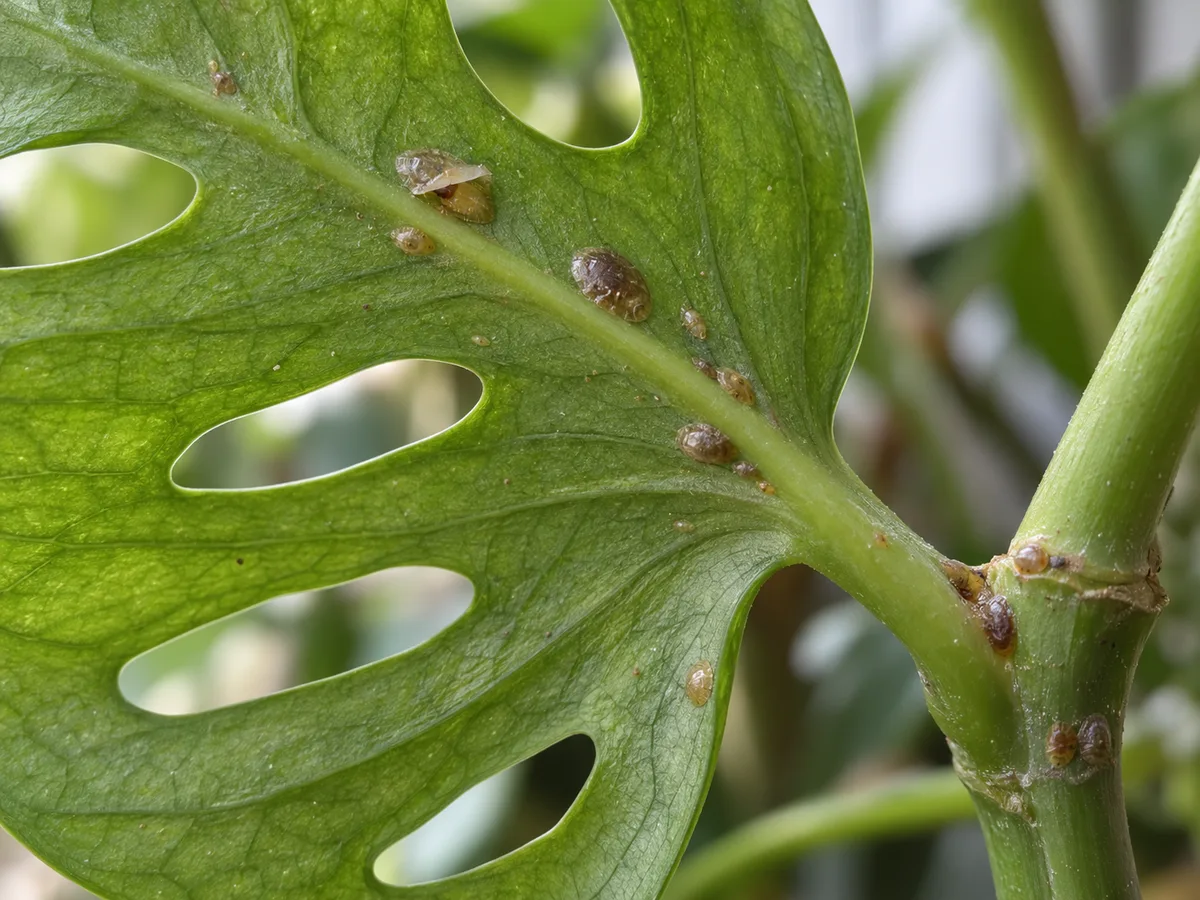
Scale covers can sit along the underside vein and continue onto the petiole or stem; inspect the whole joint before you stop.
The two broad groups most relevant to a home inspection are armored and soft scales. Armored scale has a separate cover that may lift away from the insect body and does not excrete honeydew. Soft scale is generally more rounded and its cover is the insect’s body wall; many soft scales excrete honeydew. Those differences explain why a sticky leaf can support a soft-scale diagnosis, while the lack of stickiness cannot exclude armored scale. UC IPM’s scale identification guidance distinguishes these groups and cautions that identifying the type can affect management.
Scale is not diagnosed by a yellow leaf alone. A heavily fed plant may yellow, drop leaves, or grow more slowly, but those symptoms can also follow root or watering problems. If you see yellowing without attached bumps, compare the pattern with the Monstera’s yellow-leaves guide and check the root zone before assuming insects are responsible. If you find an actual scale cover, record where it sits and whether it is on one leaf or repeated across the vine.
Where to inspect on a climbing Monstera
Monstera adansonii is a vining climber with aerial roots and perforated leaves; it can trail from a basket or climb a support. North Carolina State Extension’s plant profile describes that climbing habit and the plant’s use of aerial roots. For scale inspection, that means the pot is not the only place to look. A long vine may hang behind the basket, overlap another stem, or disappear against a moss pole. A quick look at the upper canopy can miss the underside of a leaf or a scale cluster tucked into a joint several nodes lower down.
Start at the soil line and trace each stem upward to its growing tip. Turn the pot slowly and inspect the sections facing the wall, window, or pole. At each leaf, look underneath from the petiole toward the tip, paying attention to the central vein and the tissue around the fenestrations. Look at both surfaces around each opening: a scale insect attached near a hole may be hidden by the leaf edge when viewed from above. Hold the leaf gently by its midrib rather than pulling on a thin lobe.
At every node, check where the petiole meets the stem and where an aerial root or new growth point begins. If the plant climbs, part only the outer leaves and inspect the contact points along the support. Do not tear apart a moss pole or unwind a rooted vine just because one scale is present; first find out whether the insects are limited to exposed tissue. If the Monstera trails, lift the hanging stems onto a clean surface or support them in sections so you can see the shaded undersides without bending the vines sharply.
Indoor scale may sit near the midrib or main veins on the underside of leaves, and adult females do not fly or travel far once settled; treat those spots as starting points, not the full search area (RHS indoor sap-feeder guidance). Young crawlers can move before settling, so inspect adjacent leaves and the full connected stem (UC IPM’s crawler-stage notes). A hand lens helps distinguish a scale cover from specks of soil or dried plant residue, especially on a narrow green stem.
How to confirm scale rather than a lookalike
Use a small, localized check rather than scraping several leaves. Select one suspect bump on a sturdy stem or a leaf that is already damaged. With a cotton swab or the edge of a fingernail, gently test whether the bump is attached as a separate cover. A true scale may lift to reveal a soft insect body or a dry, papery underside. Avoid digging into the leaf surface. A cotton swab is also used as a practical inspection aid in Epic Gardening’s scale guide; here, use it gently and keep the check to one or two suspects so you do not create fresh wounds.
| What you find | What it suggests | Next check |
|---|---|---|
| Fixed oval bump that lifts from a stem or leaf | Scale is likely | Look beneath the cover for an insect body and inspect nearby joints |
| Sticky, clear film on leaves or the shelf below | Honeydew from a sap feeder may be present | Find attached scales, aphids, or mealybugs before treating |
| Cottony white clumps in a leaf axil | More consistent with mealybugs | Compare with the Monstera adansonii mealybugs guide |
| Fine pale stippling or webbing, with no shell-like bumps | More consistent with spider mites | Inspect leaf undersides with a hand lens and use the spider-mites guide |
| Silvery scarring or distorted new growth, but no attached bumps | Consider thrips or another cause | Compare with the Monstera adansonii thrips guide |
| Black, dusty film on a leaf with sticky residue | Sooty mold may be growing on honeydew | Trace the residue back to a sap-feeding insect rather than wiping only the mold |
Honeydew helps narrow the diagnosis but is not a required sign. Soft scales and some other sap feeders produce it; armored scales do not. Sooty mold can grow on the sugars in honeydew, but a black mark with no sticky residue or visible insects is not enough to confirm scale. The same caution applies to an isolated brown spot: it may be old physical damage, a dried drop, or normal stem texture rather than an insect.
If you cannot lift or identify the bump without damaging a healthy leaf, leave that spot alone and inspect a second one on the stem. Photographing the same node from the same angle can help you compare whether the bump changes or whether new ones appear. If the only sign is sticky leaves and there are no attached insects, use the sticky-leaves guide to check other sap feeders and non-pest residue before choosing a pesticide.
First fix: isolate the vine
Move the pot far enough from other plants that leaves and stems do not touch. Keep it in stable bright, indirect light while you inspect; do not move it into harsh sun or change its watering routine as a pest treatment. Isolation is the first step because new indoor plants are a common route by which scale enters a collection, and crawling young stages can move between plants. Inspect and quarantine new purchases, then monitor indoor plants so a population is noticed before it becomes damaging (RHS indoor pest advice).
Before carrying the pot, check the underside of the basket, the saucer, and any pole or trellis that will travel with it. Do not shake the vine over other plants. Keep pruning scraps and anything used to wipe the plant separate from clean plants until the inspection is finished.
If the plant is too large to move, create a temporary gap around it and keep its leaves from brushing neighboring foliage. You can work over a washable surface or a sheet of paper so dislodged insects and fragments are easier to collect. This is containment, not a treatment: the scale still needs to be identified and removed or managed. Avoid spraying the entire room or neighboring plants “just in case,” since that adds exposure without confirming a pest on those plants.
Remove visible scale without damaging thin leaves
Once the Monstera is isolated, remove accessible scales one at a time. Use a damp cotton swab or soft cloth on a smooth, sturdy section of stem; lift only the cover that releases with light pressure. Support a leaf from underneath with your palm and wipe gently along the vein rather than bending its lobes or pushing through a fenestration. If an insect is tightly attached to a delicate leaf, do not scrape until the tissue tears. It is better to leave one hard-to-reach scale for a later targeted treatment than to turn a cosmetic infestation into a torn leaf and an open wound.
Work from the top down or from the soil line up, but keep a clear record of which stems you have finished. On a climbing plant, inspect behind every leaf base and around any point where an aerial root meets the support. On a hanging specimen, lift the vine in manageable lengths so a hidden lower section is not mistaken for a clean section. Use a fresh swab when it becomes dirty, and place used swabs and removed material in a sealed household waste bag rather than dropping them into the pot or compost.
Prune only when a short section is densely covered, badly damaged, or impossible to inspect without repeated handling. Before cutting, identify the nearest clean node and the direction of healthy growth so you remove only tissue that cannot be checked or treated. Because Monstera adansonii climbs and forms aerial roots, a cut can expose additional hidden stem junctions; inspect the retained vine and its support before returning it to the collection. Bag prunings immediately, wipe the cutting tool, and inspect the next node before making another cut.
Do not remove every leaf with a single bump. A leaf with a few removable scales may still support the vine, and heavy pruning can reduce the plant’s leaf area at the same time it is trying to recover. Remove leaves or stem sections only when the infestation is widespread on that tissue or the damage has made inspection and treatment impractical. Bag prunings immediately, wipe the cutting tool, and inspect the next node before making another cut.
When manual removal is not enough
Manual removal is a sensible first treatment when you find only a few accessible scales. It may not reach small crawlers, eggs, or insects tucked where a petiole meets the stem. After the first pass, inspect the whole plant again on a regular schedule and remove any newly visible live scales. Indoor scale can breed throughout the year, and dead scales can remain firmly attached; a brown cover that stays in place is not, by itself, proof that treatment failed (RHS indoor sap-feeder guidance).
For an infestation that continues to produce live scales, consider a contact product only after manual removal and only if the label allows use on indoor ornamental plants and the pest. Insecticidal soaps and horticultural oils act on exposed insects, so coverage matters and hidden scales can escape a spray. UC IPM’s treatment guidance emphasizes thorough coverage, repeat applications when needed, and following the product label. Its examples cover multiple hosts and outdoor situations; do not transfer a landscape dose or calendar directly to a potted Monstera.
Read the whole product label before spraying. Use only a ready-to-use or properly diluted product as directed for indoor use; do not increase the concentration to “make it stronger,” mix products, or substitute dish soap for a labeled insecticidal soap. Test a small, inconspicuous area first and wait the interval specified by the label before treating the full plant. If the leaf changes color, becomes translucent, or develops a new mark, rinse according to the product directions and stop using that product on this specimen.
When the product is suitable, move the Monstera away from direct sun and other plants, then treat only the affected plant according to the label. Reach the undersides, petiole joints, stem nodes, and support-contact areas without flooding the potting mix. Keep the foliage out of direct light for the period stated on the product label. Reapply only at the label interval; contact treatments may need repeat applications because a later crawler stage can appear after the first pass, but the product label is the controlling schedule for that formulation. Never apply a pesticide indoors if its label excludes indoor ornamentals or the room cannot be used as directed.
Avoid using a systemic houseplant insecticide as a shortcut unless the product is specifically registered and labeled for the plant, pest, setting, and location where it will be used. Scale groups differ in their response to insecticides, and the pest’s identity may be uncertain without a close inspection. A broad claim that one active ingredient will remove every scale is not reliable. If treatment labels are unclear or the infestation is advancing across many stems, ask a local extension service or qualified horticulture professional to identify the pest and help select a legal, labeled product.
Recovery: judge the new vine, not old covers
In the first days after removal, the visible covers may still be present if they were not easy to lift, and dead scales can remain attached even after control. Look for signs of activity rather than expecting every mark to vanish: fresh honeydew, new crawlers, an expanding cluster, or new bumps on previously clean nodes suggest the infestation is still active. If you use a contact product, record the treatment date and recheck at the interval on its label.
Over the following weeks, use a consistent route: underside of each leaf, central vein, petiole base, node, and any part touching the pole or basket. Check the neighboring plants as well, because an early crawler may have moved before the first pot was isolated. If you find one live scale, remove it and continue the treatment plan; do not assume the whole vine is lost. If several stems keep producing new scales despite careful coverage, reassess the identification and whether a hidden section or connected support was missed.
A yellowed leaf or old feeding mark may remain after the pest is gone. Recovery means that no new live scales appear during repeated checks, honeydew stops accumulating, and leaves continue to open without fresh colonies near their bases. Monstera adansonii grows from vine tips and nodes, so clean new growth is more useful than waiting for an old leaf to become flawless. If the plant’s growth slows while the pest signs stop, compare its placement and root-zone care with the slow-growth guide instead of repeating pesticide treatments without evidence.
When to prune heavily or replace the plant
A small infestation on one or two accessible stems is usually easier to manage than a plant with scales on nearly every node. Consider a limited pruning cut if a single runner is densely covered and removal will expose otherwise clean growth. Keep the cuts selective: preserve healthy tissue where possible and continue quarantine while you inspect the retained vine. A cut does not make the remaining vine pest-free; inspect the nodes on both sides and any stem touching the support.
If the plant has widespread scale, repeated fresh honeydew, several leaves declining, or live insects returning after a careful treatment cycle, weigh the time and effort of continued treatment against replacement. Heavily affected indoor plants may be simpler to replace than to eliminate completely (RHS indoor sap-feeder guidance). Discarding is also reasonable when the plant is already failing and cannot be kept separate from a vulnerable collection. Seal the plant and growing medium before disposal; do not place infested vine sections in an indoor compost container.
Do not decide to discard based on a row of old brown covers alone. Scale covers can remain stuck to the plant after the insect dies, so confirm activity on a sample and inspect for new signs before escalating. If most of the vine is clean and new leaves continue opening, targeted removal plus monitoring may be preferable to cutting back every stem. If the infestation is hidden in a dense pole-grown center and cannot be treated safely, removing the plant may protect the rest of the collection.
Prevent scale from returning to Monstera adansonii
Inspect new plants before placing them on the same shelf as the Monstera. Look at the undersides of leaves, midribs, petiole joints, stem nodes, and the area around the pot rim. Keep a new plant separate long enough to notice developing eggs or young insects; adult females may stay close to the place they settled, but early stages can move. Once a plant has passed quarantine, keep the support and vine accessible so the next inspection can cover the same hidden joints.
Make the vine easy to inspect during normal care. Turn a trailing basket occasionally so the wall-facing leaves are not always hidden. If the plant climbs, avoid fastening every leaf tightly against a damp, dense support where you cannot see the stem. Leave enough room to part the foliage and check nodes without untying the entire vine. Treat the plant’s form as an inspection map, not evidence that Monstera adansonii is uniquely susceptible to scale.
When you water, use that moment to scan a few leaves and nodes rather than checking only the soil. The Monstera’s watering needs still depend on how quickly its mix dries; changing watering frequency will not remove a scale insect. Use the Monstera adansonii watering guide to keep moisture decisions separate from pest identification. If you find scale, note the date, affected stem, and treatment so you can tell whether fresh bumps are appearing rather than confusing old covers with new ones.
Clean sticky residue from the shelf after identifying the source, and inspect the plants that were touching the vine. If you find a cluster on a neighboring pot, isolate that plant as well and compare its signs with the registered Monstera adansonii problems hub. Do not spray unaffected plants automatically. After the infestation has cleared, continue checking the undersides and nodes during routine grooming, especially after adding a new plant to the room.
When to use this page vs other Monstera Adansonii guides
Use this page when you find a fixed shell-like bump that lifts from a leaf or stem and reveals an insect beneath. A sticky film can support that diagnosis when soft scale is involved, but it is not enough by itself. If you see cottony clusters instead, follow the mealybugs guide; if you see stippling or webbing without attached covers, compare with spider mites. For silvery scarring or distorted new growth without scale covers, check thrips.
If the main problem is sticky residue and you cannot find an insect, use the sticky-leaves guide to distinguish honeydew from other residue. If leaves turn yellow or drop after you remove scale, compare the pattern with yellow leaves and leaf drop; these symptoms can persist or have another cause even after the pest is controlled. The Monstera adansonii overview and plant problems hub provide the wider care context.
Related Monstera Adansonii guides
- Mealybugs is for white cottony clusters in leaf axils; this page is for attached shell-like bumps.
- Sticky leaves helps when tacky residue is the main clue and no scale has been confirmed.
- Yellow leaves and leaf drop cover those symptoms when no live scale is visible or the damage continues after treatment.
- Slow growth is the relevant guide when the vine remains stalled after repeated pest checks find no live insects.
- Monstera adansonii watering explains dry-down and watering decisions, which should be assessed separately from scale treatment.
Related tool
If the bump is too small to identify or looks different from the scale covers described here, use the Pest Identifier Tool to compare likely pests before choosing a treatment.