Thrips on Monstera Adansonii: How to Confirm and Treat Them
Quick answer
First, isolate the Monstera adansonii from nearby plants. Then confirm active thrips by finding a slender moving insect with fresh silvery scarring or dark fecal specks; oval leaf holes alone are normal fenestrations, not a diagnosis. Rinse or wipe a small confirmed infestation, and use only a product labeled for indoor ornamentals and thrips if activity continues.
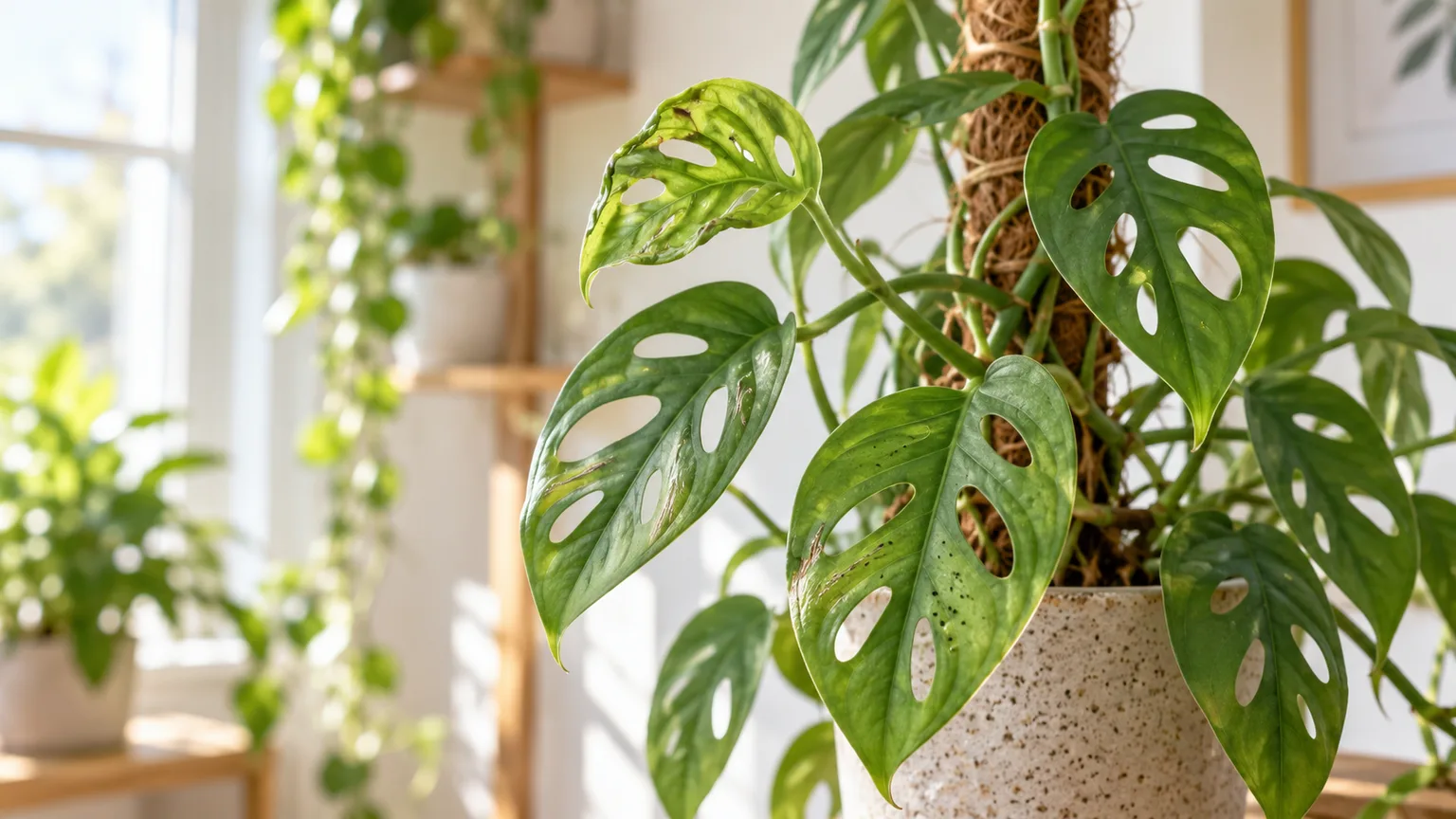
Thrips on Monstera Adansonii: Causes, Checks & Fixes
This guide covers thrips on Monstera Adansonii. See also the general Thrips guide, watering, and light pages for this plant.
Thrips on Monstera Adansonii: Causes, Checks & Fixes
Search Intent
Readers want to know whether silvery or misshapen leaves on their Monstera adansonii are from thrips, what to inspect before spraying, and how to keep a treatment from spreading through an indoor plant collection.
SEO Title Planning
- Curiosity-driven: Why Your Monstera Adansonii Has Silvery Leaf Marks
- Straightforward: Thrips on Monstera Adansonii: How to Confirm and Treat Them
- Benefit-driven: Stop Thrips on Monstera Adansonii and Protect New Leaves
Best title: Thrips on Monstera Adansonii: How to Confirm and Treat Them makes the pest and plant explicit while promising the two decisions a grower needs to make.
Meta Description Planning
- Confirm thrips on Monstera adansonii by checking silver scars, dark specks, and live insects. Isolate the vine, treat carefully, and protect new leaves.
- Learn how to tell thrips damage from normal Monstera adansonii holes, inspect a climbing vine, and choose a careful first response.
- Find out what to do when thrips mark Monstera adansonii leaves, how to avoid misdiagnosis, and when to escalate treatment.
Best description: Confirm thrips on Monstera adansonii by checking silver scars, dark specks, and live insects. Isolate the vine, treat carefully, and protect new leaves. It is specific, diagnostic, and action-oriented.
Primary and Supporting Keywords
- Primary: thrips on Monstera adansonii
- Supporting: Monstera adansonii thrips damage; thrips on Swiss cheese vine; silver marks on Monstera adansonii; black specks on Monstera leaves; distorted Monstera adansonii leaves; thrips identification on houseplants; how to inspect Monstera adansonii for thrips; thrips treatment for indoor plants; thrips on new Monstera leaves; normal Monstera adansonii holes; prevent thrips on a vining Monstera
NLP Entities
Monstera adansonii, Swiss cheese vine, thrips, Thysanoptera, feeding scars, silvering, stippling, frass, larvae, prepupa, pupa, fenestrations, leaf axil, leaf underside, emerging leaf, white-paper tap test, isolation, contact insecticide, insecticidal soap, label directions, sticky card, indoor ornamental.
People Also Ask Questions
- What does thrips damage look like on Monstera adansonii?
- Are the holes in Monstera adansonii leaves caused by thrips?
- How do I check a hanging Monstera adansonii for thrips?
- Should I isolate a Monstera adansonii with thrips?
- Can water remove thrips from a Monstera?
- Do thrips live in potting mix as well as on leaves?
- Will thrips-damaged Monstera leaves heal?
- How often should I repeat a thrips treatment?
E-E-A-T Signals
The guide separates a live-pest confirmation from a visual suspicion, distinguishes natural fenestrations from new feeding scars, cites extension and university sources for pest biology and treatment limits, and avoids a Monstera-specific susceptibility claim unsupported by the plant record.
Featured Snippet Opportunities
- Paragraph: the single first action when thrips are suspected
- List: five places to inspect on a trailing or supported vine
- Table: thrips marks versus fenestrations and common lookalikes
- List: signs that show control is working
Helpful Content Checklist
This page adds a Monstera-specific inspection route for thin, perforated leaves and vining stems. It helps readers confirm the pest before choosing a response, explains why rinsing alone may not clear protected life stages, and warns against treating normal fenestrations or changing care routines without evidence.
- Why Your Monstera Adansonii Has Silvery Leaf Marks
- Thrips on Monstera Adansonii: How to Confirm and Treat Them
- Stop Thrips on Monstera Adansonii and Protect New Leaves
Thrips on Monstera Adansonii: How to Confirm and Treat Them
- Confirm thrips on Monstera adansonii by checking silver scars, dark specks, and live insects. Isolate the vine, treat carefully, and protect new leaves.
- Learn how to tell thrips damage from normal Monstera adansonii holes, inspect a climbing vine, and choose a careful first response.
- Find out what to do when thrips mark Monstera adansonii leaves, how to avoid misdiagnosis, and when to escalate treatment.
Confirm thrips on Monstera adansonii by checking silver scars, dark specks, and live insects. Isolate the vine, treat carefully, and protect new leaves.
- H1: Thrips on Monstera Adansonii: Causes, Checks & Fixes
- H2: Quick answer
- H2: What thrips look like on Monstera Adansonii
- H3: Normal fenestrations versus fresh feeding injury
- H2: Why the shape of an adansonii vine changes the inspection
- H2: How to confirm thrips before treating
- H3: Tap-test leaves over white paper
- H3: Trace the vine from new growth to older nodes
- H2: First fix: isolate the plant
- H2: Remove and treat thrips in stages
- H3: Rinse or wipe a small infestation
- H3: Use a labeled contact product only when needed
- H2: Care checks that matter during treatment
- H2: Lookalikes on Monstera Adansonii
- H2: Recovery: what will and will not improve
- H2: Prevent thrips from returning to the vine
- H2: When to escalate or stop trying to save the plant
- H2: When to use this page versus other Monstera Adansonii guides
- H2: Related Monstera Adansonii guides
Thrips on Monstera Adansonii: Causes, Checks & Fixes
Quick answer
First, move the Monstera adansonii away from other plants. Then confirm that the marks are fresh feeding damage and that live thrips are present. A pair of oval holes in an otherwise normal leaf is part of this vine’s fenestrated shape; it does not prove an infestation. A more convincing pattern is a scraped silver or pale streak, a distorted new leaf, dark pinpoints of frass (insect waste), and a tiny slender insect that moves when disturbed. Thrips feeding can scar leaf surfaces and distort growing tissue, but other pests and nonliving disorders can look similar (UC IPM’s thrips guide). If you see only discoloration without an insect or fresh feeding pattern, keep the plant isolated while you check rather than spraying it automatically.
For the general indoor-pest pattern, see the thrips symptom hub; this guide applies those signs to Monstera adansonii’s thin, naturally perforated leaves and climbing stems. Those features change where you look; they do not prove that this plant is more susceptible to thrips. Do not infer a diagnosis from the plant name, a curled leaf, or a change in watering alone.
What thrips look like on Monstera Adansonii
Thrips are small enough that the first clue is often the leaf, not the insect. Look for a narrow, pale-to-dark moving insect and a patch of tissue that has been scraped, silvered, or stippled. A feeding site may look dull or papery compared with the surrounding green blade. Dark, varnish-like specks may be thrips frass, but dark specks alone are not conclusive because other invertebrates can leave similar marks (UAF indoor-pest guide also notes black specks on leaf undersides).
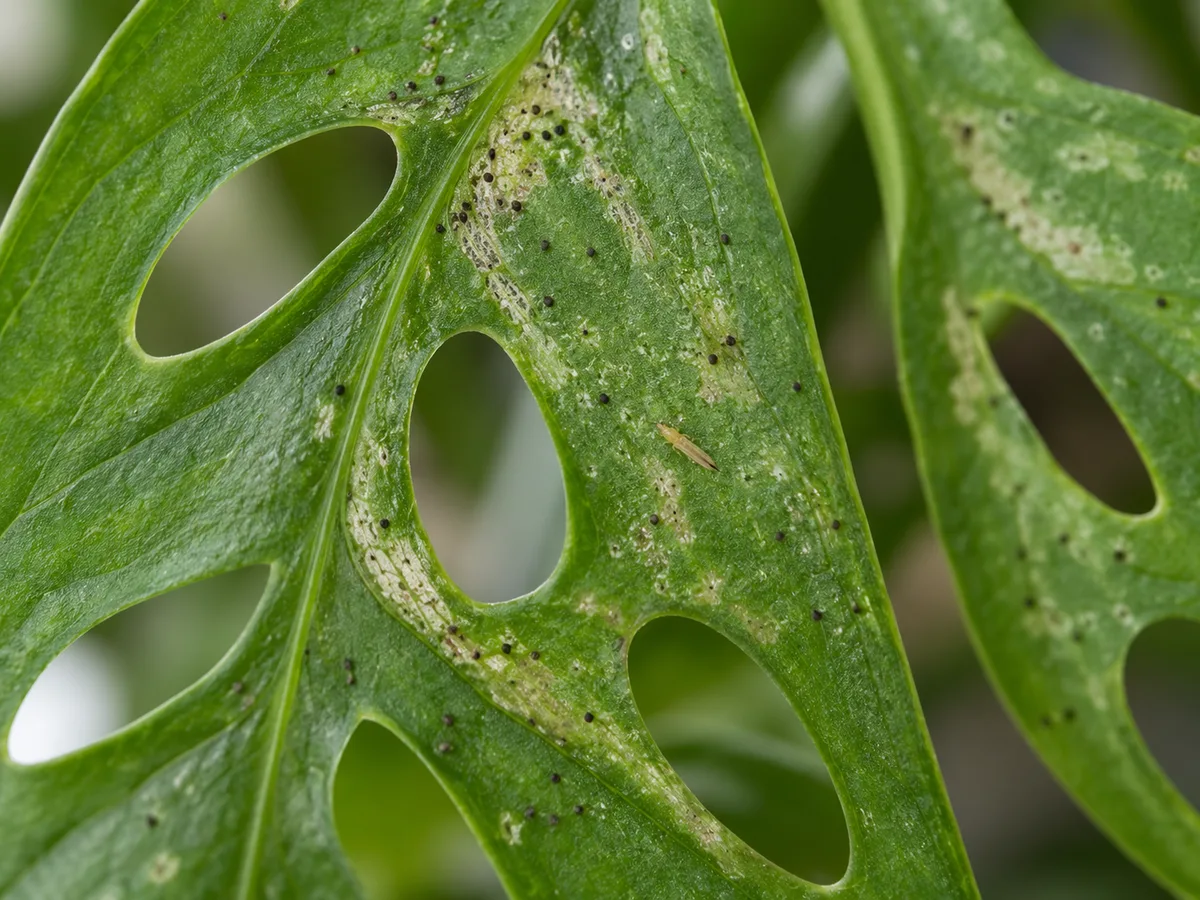
Silvered feeding marks and dark specks deserve a closer look; confirm moving insects before treating.
On an adansonii, compare each mark with the plant’s normal openings. Fenestrations are oval holes in the leaf blade; they are not a symptom that needs treatment. Thrips feeding does not create the regular, clean-edged pattern of the species’ natural holes. Instead, the damage usually appears as additional surface scarring, pale patches, scattered stippling, or a distorted edge on a leaf that is still unfolding. A ragged tear from handling may have a sharp split but no adjacent feeding marks or dark specks.
The newest leaf deserves particular attention because it emerges folded and expands over time. If that leaf opens with a crease or twist, do not label it thrips damage by shape alone. Check for a live insect, fresh silvering, and specks on the same tissue; compare it with the previous leaf and with a healthy section of the vine. A one-time kink can happen during unfurling or contact with a support, while a repeated pattern on successive leaves plus active insects makes a pest explanation more plausible.
Normal fenestrations versus fresh feeding injury
Hold the leaf toward soft light and distinguish a hole from a surface mark. A natural fenestration is an opening through the blade; a feeding scar remains on the leaf tissue and may look silvery, pale, or rough. Thrips feeding can occur before the leaf has expanded, so damage can become easier to see only as a new leaf opens. That timing can make the mark seem to have appeared overnight even if the insect fed earlier. UC IPM notes that thrips often feed in buds or shoot tips and that growers may notice injury before they see the insects (UC IPM’s identification notes).
This distinction matters because a Monstera adansonii already has holes by design. A grower who treats every opening as insect damage may prune healthy leaves or spray repeatedly without addressing the actual cause. Photograph the same leaf from the same angle after inspection. Record whether a pale streak lengthens, whether dark specks reappear, and whether a live insect is found; those observations are more useful than counting holes.
Why the shape of an adansonii vine changes the inspection
Monstera adansonii’s thin leaves and vining habit create a specific inspection problem: the visible surface is only part of the plant. A trailing basket can hang over a shelf so that the upper leaves are easy to see while the undersides and the inner portion of the vine face the wall. A supported vine may have leaves overlapping at a pole, trellis, or tie. These are practical blind spots, not proof that thrips prefer adansonii or any particular support.
Inspect the plant by moving one stem at a time, rather than turning the whole hanger and hoping to catch an insect. Check both sides of each leaf, the petiole where it meets the stem, the area around each fenestration, and the tender tip where the next leaf is forming. Use a small flashlight and magnifier if your eyes cannot resolve moving specks. Do not pull on an unfurling leaf to expose the inside; tearing the blade can create a mark that later resembles feeding damage.
Adansonii leaves are naturally delicate, so handle them by the petiole or support the blade from below while examining them. That helps keep an inspection from creating splits around the holes. If you prune one badly damaged leaf, make a clean cut rather than tugging the leaf away from the node. The goal is to remove a confirmed, heavily affected piece when it is useful to do so, while leaving sound foliage in place to support the vine.
A climbing plant also has more than one place to check. Follow the stem from the newest tip down through several nodes, especially where leaves overlap or rest against a support. Adult thrips can move, while younger stages may be found on feeding tissue; a single clean leaf at the top does not clear the entire vine. The reverse is also true: one insect on an unrelated nearby plant does not, by itself, prove the adansonii is infested. Confirm signs on the plant you plan to treat.
How to confirm thrips before treating
Start by separating two questions: is there insect activity on this Monstera, and are the marks consistent with thrips feeding? The strongest home confirmation is a combination of a slender moving insect and fresh silvering, stippling, distortion, or dark fecal specks on the same leaves. A symptom without a pest can be an old injury, light or handling damage, a different pest, or another plant disorder. UC IPM specifically advises checking that pest thrips are present before taking control action because other invertebrates and nonliving conditions can resemble their injury (UC IPM’s confirmation advice).
Tap-test leaves over white paper
Hold a sheet of white paper under one suspect leaf and tap the petiole or stem gently. Watch the paper for several seconds for tiny moving lines or dots. Thrips are slender and can be pale, yellowish, brown, or dark; immature stages lack wings, so not every individual will fly away. A magnifier makes this check easier, but movement plus the matching leaf pattern is more persuasive than color alone. Color is not enough to identify a thrips species, and a homeowner’s inspection generally should not claim a precise species diagnosis; species-level identification can require expert examination (UC IPM’s species-identification notes).
Repeat the check under more than one marked leaf and on the newest growth. If the only things falling are bits of potting mix, dust, or immobile flecks, do not count that as a positive result. If you do find a moving insect but no clear damage, keep watching the plant and compare the insect with an extension identification guide before choosing a pesticide. Some thrips are not plant-feeding pests, and the presence of an insect does not always mean that it is causing the marks (UC IPM on thrips identification).
A small yellow or blue sticky card near the vine can help detect flying adults over time, but it is a monitor, not a stand-alone diagnosis or a treatment plan (UC IPM’s monitoring advice). It may catch insects from other pots or from an open window. Place it near, not against, the foliage, and still inspect the leaves for larvae and feeding injury. UC IPM describes sticky traps as a way to monitor adult thrips; it also cautions that trap counts alone do not establish that damage is occurring.
Trace the vine from new growth to older nodes
Inspect the folded leaf and shoot tip first, then work downward. Thrips often feed in protected buds and shoot tips, which can make the newest leaf a useful place to look, though the plant’s particular leaf position does not identify the pest by itself. Check the undersides of older leaves too, since adult and immature thrips can occur away from the active growing point. On a hanging adansonii, spread the stems apart so that the inner leaves are visible; on a supported plant, look at the places where stems and foliage press against the support.
Keep a short record: date, where you saw fresh marks, whether live insects moved on the paper, and whether the newest leaf was still folded or had opened. Take a photo of one marked leaf. The next inspection can then tell you whether a lesion is simply the same old scar or whether new damage is appearing elsewhere. This prevents unnecessary treatment for a mark that remains unchanged after the original cause is gone.
If you cannot see an insect, but the damage is severe or spreading, keep the plant isolated and seek a better identification before choosing an active ingredient. Use the Pest Identifier Tool to narrow the possibilities, then compare the result with the physical signs. The tool can guide the next check; it cannot confirm an insect that was never observed or substitute for a laboratory identification when that level of certainty matters.
First fix: isolate the plant
Move the Monstera adansonii away from neighboring plants now. Isolation is the first action because thrips can move between plants or arrive on an infested purchase, outdoor-return plant, or cut flowers (UC IPM on thrips movement). Put it on a separate surface with no leaves touching other pots. If you cannot move it to another room, increase the gap around it and keep its foliage from brushing nearby plants while you inspect.
Then look over plants that shared its shelf, hanger, or windowsill. Do not spray the whole collection just because one plant has marks; check each plant for live insects and fresh damage first. The University of Alaska Fairbanks recommends isolating an affected indoor plant and checking surrounding plants (UAF’s isolation guidance). Keep the adansonii apart through any treatment period and until repeated inspections show no new live activity or fresh injury.
Isolation does not mean the plant needs to be repotted, stripped of leaves, or moved into a dark corner. Keep its normal stable placement and watering pattern while you diagnose it. A thrips problem is a foliage-pest question; sudden changes in light, water, and fertilizer at the same time make it harder to tell whether new leaves are responding to pest control or to care stress.
Remove and treat thrips in stages
Once you have found active thrips or a persuasive combination of fresh feeding injury and live insects, reduce what is physically present before reaching for a spray. If you have only a few affected leaves, move the pot to a sink or tub and rinse both surfaces of the foliage with a gentle, controlled stream. Support the thin blades around their fenestrations and do not direct a forceful jet at a folded leaf or tender tip. Water can dislodge some insects from a small infestation, and expert horticulture guidance recommends washing or manually removing visible thrips as an early measure (Martha Stewart’s expert guidance).
After rinsing, let excess water drain from leaves and the pot before returning the vine to its usual bright indirect light. Do not leave the pot standing in water. Inspect the plant again when the leaves are dry, then repeat the white-paper tap on the same areas. A rinse removes exposed insects; it does not show that every egg or protected stage is gone. Avoid rubbing hard across the leaf surface, because friction can tear the thin tissue or spread damage around a hole.
If one leaf is heavily scarred and still contains visible insects, you may remove that leaf with clean shears and discard it in a closed bag; selective pruning is a practical cleanup measure (The Spruce’s pruning guidance). Be selective: removing every marked older leaf will leave fewer leaves for the vine without guaranteeing that the rest of the infestation is cleared. Check adjacent leaves and the next unfurling leaf before you decide that pruning is enough. Do not use a cutting from a plant with active thrips as propagation material; a cutting can carry pests or damaged tissue into another pot.
Use a labeled contact product only when needed
If live thrips remain after physical removal, choose a pesticide only if its current label names the intended indoor ornamental use and the pest you are treating. An insecticidal soap or horticultural oil may be an option when the label permits it, but do not assume that a household detergent, homemade oil mixture, or outdoor-only product is equivalent. Product registration and directions vary by country and formulation. Follow the label for dilution, coverage, protective steps, whether the product is safe on your plant, and the earliest permitted repeat application. Contact sprays depend on thorough coverage of the plant parts where thrips feed, and repeated applications may be needed when the label allows (UC IPM’s spray-coverage guidance).
For this vine, coverage means checking the upper and lower leaf surfaces, petioles, overlapping stems, and growing tip without soaking a plant beyond label directions. A spray that reaches only the upper surfaces may miss the insects you are trying to contact. Do not combine multiple products or increase the dose to make up for a missed area. Test a small area only if the product label supports that practice, and stop if the plant shows unexpected injury.
Thrips eggs are laid on or in plant tissue by many plant-feeding species; larvae feed, and later nonfeeding stages may shelter in soil, litter, or plant crevices. In warm conditions, some species can complete an egg-to-adult cycle in about two weeks. These protected stages help explain why one visible-insect removal may be followed by new activity later (UC IPM life-cycle guidance). They do not prove that Monstera adansonii’s potting mix is the source or that the plant needs an immediate soil drench. Do not treat the soil unless a product label specifically supports that use and the diagnosis calls for it.
Care checks that matter during treatment
Keep routine care steady while you work through the pest cycle. Monstera adansonii’s documented care uses a top-layer dry-down check and a free-draining aroid mix; a pest sighting alone is not a reason to water on a new schedule. If the pot is unusually heavy or the mix is staying wet, address that as a separate root-zone issue using the Monstera adansonii watering guide and soil guide. Do not pour extra water through the pot to try to drown thrips; the plant’s leaves and growing points are where you need to inspect and clean.
Keep the vine in its usual bright indirect light. If it has just been moved from shade to direct sun, a new pale or scorched patch could be environmental rather than pest injury. Compare the damaged side with the side facing away from the window and check for insects before changing placement. The Monstera adansonii light guide can help you assess whether the plant is receiving a stable amount of light; it should not be used as a substitute for checking for active thrips.
Do not fertilize as a response to silvering or distorted leaves. Thrips feeding and nutrient symptoms are not interchangeable diagnoses, and adding fertilizer will not remove an insect. Wait until the vine is growing normally and the pest is under control before reconsidering feeding. Avoid repotting unless you find a separate problem such as failing mix or damaged roots; unnecessary disturbance can add stress without reaching insects on the foliage.
Lookalikes on Monstera Adansonii
| What you notice | What it may mean | The useful distinction on this vine |
|---|---|---|
| Natural oval openings with clean, stable edges | Normal adansonii fenestrations | The holes are part of the leaf shape; look for separate surface scars, specks, or live insects. |
| Silvered streaks or stippling, dark specks, and a slender moving insect | Thrips are plausible | Confirm the insect and fresh damage on the same plant before treating. |
| Fine webbing or clusters of moving specks with pale stippling | Check the spider-mite guide | Webbing points you toward mites; do not treat a mite pattern as thrips without seeing thrips. |
| A few yellow lower leaves with no silver scars or insects | Check the yellow-leaves guide | A care issue can yellow a leaf without producing thrips frass or moving insects. |
| A leaf that is twisted as it opens, with no insects or feeding marks | Check handling and unfurling conditions; compare with curling leaves on Monstera adansonii | One misshapen leaf is not enough to identify a pest. |
| A narrow trail or blotch inside the leaf rather than a surface scrape | Compare with leaf miners on Monstera adansonii | The location and shape of the injury differ; confirm the cause before using a pesticide. |
UC IPM notes that mites, some true bugs, abiotic disorders, and pathogens can produce injury resembling thrips. The comparison table is a sorting tool, not a promise that every Monstera mark fits neatly into one category. If two possible causes remain, continue isolating the vine, photograph the damage, and get a closer look at the insects rather than treating several pests at once.
Recovery: what will and will not improve
A thrips scar is damage to the leaf surface, not a temporary color that the plant can simply repaint. A marked leaf may remain silvered, pale, or rough after the insects are gone. UC IPM notes that pesticides do not restore the appearance of injured tissue; the plant improves by holding healthy leaves and producing new, unblemished growth (UC IPM’s injury guidance). Do not judge treatment by whether an old scar disappears.
For a Monstera adansonii, inspect the next leaf as it unfolds and the next few leaves after that. Success looks like no new silvered patches or black specks, no live insects on repeated paper taps, and new leaves opening without fresh distortion. Some damage may only become obvious as a previously folded leaf expands, so compare dates and photos instead of treating every late-revealed scar as a new outbreak. If one previously injured leaf remains stable while newer leaves are clean, that is more encouraging than an old leaf turning green.
The pace depends on how quickly your plant is actively growing and on the pest’s life cycle in your conditions. In warm conditions, some thrips can complete a generation in roughly two weeks, while cooler or less active conditions can change the pace. Keep checking weekly for several weeks and follow only the repeat interval allowed by the product label. A single inspection the day after rinsing is too early to conclude that the problem is gone.
Signs that the problem may still be active include a newly appearing silver streak, fresh dark frass, an insect moving on a tap test, or a new leaf opening with a new area of feeding injury. If the plant shows only old, unchanged scars but no active insects across repeated checks, do not automatically intensify treatment. Keep it separate a little longer and keep records. The aim is to stop new damage, not to erase the plant’s history.
Prevent thrips from returning to the vine
Inspect new Monstera adansonii purchases before they join the collection and keep them apart while you check their leaf undersides and growing points. A quarantine period gives you a chance to notice small pests before leaves from different pots touch. Plants that spend part of the year outdoors or cut flowers brought inside can also introduce hitchhiking insects, so take a quick look at the foliage when they return indoors. University of Alaska Fairbanks recommends checking incoming plants and routinely monitoring indoor foliage (UAF’s incoming-plant advice).
Make the inspection fit the shape of this plant. During weekly care, lift the hanging stems or turn the support enough to see the undersides, petioles, and the newest leaf. Spend extra time after a new leaf opens or when the plant has been moved between indoor and outdoor spaces. A monthly check is easy to skip on a dense vine; a brief, repeated look at a few leaves is more reliable than waiting for widespread silvering.
Keep leaves free of dust with a gentle wipe or rinse when the plant needs cleaning, and avoid crowding the vine against neighboring plants. This is a monitoring and collection-management routine, not a claim that dust or a particular humidity level causes Monstera adansonii to become susceptible. Do not mist or raise humidity as a thrips cure. If you adjust humidity for the plant’s general care, treat that as a separate care decision and continue to check for live insects.
Record each inspection and any treatment on the same day: where the marks appeared, whether insects moved on paper, what product was used, and when the label permits a repeat. If new activity appears, that record helps you distinguish a missed section of the vine from a fresh introduction. It also prevents accidental over-application when several products or advice sources suggest different schedules.
When to escalate or stop trying to save the plant
Ask a local cooperative extension service, qualified horticulturist, or plant-health professional for help if you cannot distinguish thrips from another pest, if new damage keeps appearing despite label-compliant coverage, or if several nearby plants are affected. A professional can help identify a pest more closely; positive species-level identification may require expertise beyond what a home magnifier can provide. Do not assume that every tiny insect is a pest thrips or that every silver mark is active feeding.
If the infestation is limited to a few leaves and the vine still has firm, healthy growth, repeated inspection and careful treatment are usually more reasonable than discarding it. If most of the foliage and growing tips are failing, you cannot isolate or treat it consistently, or the infestation continues to spread through the collection, removal may be the most practical way to protect other plants. Bag discarded plant material rather than shaking it over the collection, and clean the shelf or support before placing another plant there.
A compromised Monstera adansonii is not automatically beyond recovery because of one damaged leaf. Conversely, do not keep an almost leafless vine in the collection indefinitely if it remains a source of live pests and there is no realistic way to complete treatment. Make that decision from the amount of clean living growth, the continued presence of insects, and the ability to keep other plants protected.
When to use this page versus other Monstera Adansonii guides
Use this guide when fresh silvered or pale surface scars, dark fecal specks, and live slender insects point to thrips on the Monstera adansonii itself. If you have distorted new growth but cannot find an insect, isolate and repeat the inspection before deciding that thrips are confirmed. The Monstera adansonii problems hub is the better starting point when the symptom is unclear or several leaves are changing for different reasons.
If a pot remains wet, roots smell sour, or the plant is generally limp without feeding scars, start with the overwatering guide and the watering and soil guides instead. If there is fine webbing rather than silver feeding scars, the spider-mite differential may fit better. For changes in placement or a broader care review, begin with the Monstera adansonii overview. These routes keep a suspected pest from becoming a catch-all explanation for every mark on a thin leaf.
Related Monstera Adansonii guides
- Start with the Monstera adansonii overview for whole-plant care context and a route to the plant’s care topics.
- Use the Monstera adansonii problems hub when the marks do not include a confirmed pest or when multiple symptoms need sorting.
- Check the watering guide and soil guide if the pot stays wet or dries unusually quickly; those conditions call for a root-zone diagnosis, not automatic thrips treatment.
- Use the spider-mite guide when fine webbing or mite-like moving specks accompany pale stippling.
- Read the curling-leaves guide when a leaf is twisted but you cannot find thrips or feeding scars.
FAQ 1 Question: How can I tell thrips damage from Monstera adansonii fenestrations? Answer: Fenestrations are the plant’s natural oval openings; they are not holes chewed by thrips. Look for separate silvered surface scars, dark specks, and a slender moving insect on or near the damaged leaf before treating.
FAQ 2 Question: What should I do first if my Monstera adansonii may have thrips? Answer: Isolate the pot from other plants, then inspect its leaf undersides and newest growth over white paper. Keep its normal care steady while you confirm whether insects are active.
FAQ 3 Question: Will a damaged Monstera adansonii leaf recover? Answer: Old feeding scars usually remain visible even after the pest is controlled. Look for clean new leaves and no fresh damage rather than expecting an injured leaf to become perfect again.
FAQ 4 Question: When should I escalate thrips treatment on Monstera adansonii? Answer: Get help identifying the pest if you cannot find live thrips or if new damage continues despite following a product label. Escalate sooner if nearby plants also show active insects or the vine’s new growth is failing.
FAQ 5 Question: How can I prevent thrips from returning to Monstera adansonii? Answer: Inspect new plants before grouping them with your collection, and check the undersides and new tips of this vine during routine care. Keep the stems from brushing neighboring foliage so early signs are easier to spot.