Monstera Albo Fertilizer Guide: When & How Much to Feed
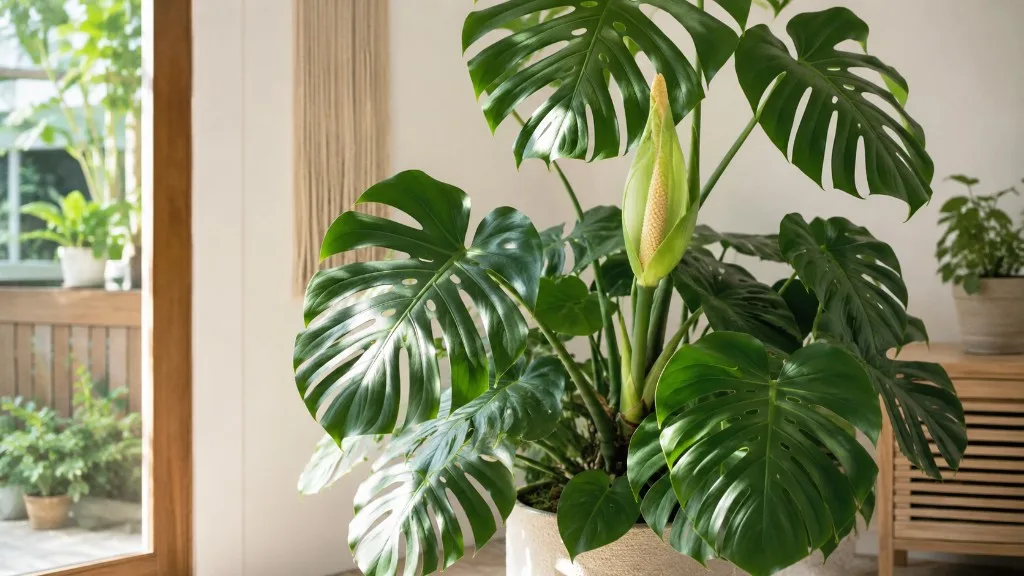
Monstera Albo Fertilizer Guide: When & How Much to Feed
Monstera Albo Fertilizer Guide: When & How Much to Feed
Monstera Albo fertilizer decisions start with one biological fact collectors forget: Monstera deliciosa ‘Albo Variegata’ is the same climbing evergreen aroid as green Swiss cheese plant — but white sectors contain little chlorophyll, so the plant photosynthesizes less per leaf and grows slower than solid-green deliciosa. NC State Extension notes variegated cultivars such as ‘Albo Variegata’ need more sunlight than darker green forms because pale tissue is less efficient — yet that extra light need does not translate into permission to feed heavier. Slow Albo growth usually reflects light and variegation biology, not hunger.
The practical goal for most home growers is conservative half-strength liquid feeding during active growth, applied to already-moist soil, with a clear winter pause unless strong grow lights keep new leaves unfolding. Penn State Extension recommends fertilizing every two weeks through the growing season and monthly through winter with balanced houseplant fertilizer for M. deliciosa generally. Wisconsin Horticulture Extension advises fertilizing regularly from spring until fall. LeafyPixels reconciles those sources below with an Albo-specific conservative default — because variegated white margins show salt burn first when feeding outpaces uptake.
By the end, you should know whether this month calls for a light feed, a pause, a plain-water flush, or a lighting fix before any fertilizer goes near the roots.
Why Fertilizer Is Not the Fix for Slow Albo Growth
Collectors pay premium prices and expect premium leaf production. Biology pushes back:
Less chlorophyll per leaf means less energy from the same photon budget. Albo pushes fewer leaves per season than green deliciosa in identical conditions.
Variegation stability depends on filtered brightness and stem genetics — not nitrogen.
Fenestrations require age, bright indirect light, and a moss pole — see the Monstera Albo overview.
When Albo stalls, the diagnostic order is light → moisture → roots → pests → fertilizer — not the reverse. Wisconsin Horticulture Extension ties poor leaf perforation to inadequate light, not nutrient gimmicks.
Less Chlorophyll Means Lower Nutrient Demand Per Leaf
Each new Albo leaf pulls nitrogen for green tissue, but white sectors contribute little photosynthetic return because white variegated tissue lacks normal chlorophyll function, as the RHS light guide explains. A plant building fewer, smaller leaves per year simply uses less fertilizer than a vigorous green deliciosa on the same moss pole. Interpreting slow growth as “underfed” and doubling dose is how collectors salt the mix while the plant still cannot use the excess — Penn State Extension describes over-fertilization in containers as high soluble salts that can damage roots and show as crust, lower-leaf yellowing or wilting, and brown leaf tips and margins.
Fenestrations and Variegation Answer to Light First
Splits and holes track maturity, climbing support, and adequate filtered light — same as green deliciosa, only slower on Albo. Fertilizer supports existing growth; it does not trigger fenestrations on juvenile solid leaves or restore white sectors on reverting stems. If new leaves stay small and solid despite feeding, check Monstera Albo light and watering before escalating NPK.
Quick-Reference Feeding Card
| Setting | LeafyPixels home default for Albo | Penn State extension schedule (green deliciosa) |
|---|---|---|
| Spring–summer active growth | Balanced liquid at half strength, every 4–6 weeks (monthly for average light; every 3–4 weeks only if bright light + steady new leaves + no salt crust) | Every 2 weeks with balanced houseplant fertilizer |
| Fall taper | Last half-strength feed when growth slows; pause by late fall | Continue but growth naturally slows |
| Winter | No fertilizer for typical indoor setups | Monthly balanced fertilizer |
| Application rule | Moist soil only — never dry roots | Water thoroughly; let top dry between waterings |
| Salt management | Flush with plain water once mid-season if feeding regularly | Not specified |
| Skip feeding when | Dry soil, stress, pests, or 0–6 weeks after repot | Same practical exclusions apply |
Half-strength dilution example: If the label says 1 teaspoon per gallon for houseplants, mix ½ teaspoon per gallon (or 1 teaspoon per 2 gallons). Water the plant normally the day before, then pour the solution until a little drains and empty the saucer.
When to Fertilize Monstera Albo
Feed only when Albo is actively producing new leaves with firm petioles, roots are healthy, and the pot dries on a normal rhythm between waterings.
Good times to feed:
- Late spring through summer — peak indoor growth window for temperate homes
- After 4–6 weeks post-repot when new growth stabilizes
- When new leaves emerge firm with stable green-and-white variegation balance
Do not feed:
- Fall and winter when growth slows sharply — salts accumulate unused in cool, dim rooms
- First 4–6 weeks after repot — fresh mix often contains starter nutrients; roots are healing
- During root rot recovery, pest treatment, or major relocation — wait until new growth confirms stability
- Fresh propagation cuttings in water or sphagnum — roots only for the first weeks
Spring and Summer Active Growth Window
Start feeding when you see fresh growth: new leaves with firm texture, aerial roots attaching to a moss pole, and the pot drying predictably. Wisconsin Horticulture Extension recommends fertilizing regularly from spring until fall while the plant is actively growing. During peak summer, half-strength balanced liquid every four to six weeks suits most container Albo in average home light. A specimen in very bright filtered light with steady new leaves may sit at the four-week end — still at half strength, still watching white margins for burn.
When to Pause Feeding Entirely
Pause when no new leaves unfurl for several weeks, soil stays wet longer in winter, or the plant shows stress signals: yellow lower leaves on wet mix, limp petioles, or recent repotting. Royal Horticultural Society guidance for M. deliciosa aligns with reduced watering and feeding in cooler months — doubly important when Albo growth is already slow.
Seasonal Feeding Calendar
Use this temperate-climate framework; adjust to your plant’s new-leaf cadence and room conditions.
| Month | Growth phase | Feeding guidance |
|---|---|---|
| March–April | Waking up, new shoots | Resume half-strength liquid when active growth is visible |
| May–August | Peak leaf production | Every 4–6 weeks default; bright specimens may feed every 3–4 weeks at half strength |
| September | Slowing slightly | Reduce to every 6–8 weeks or taper off |
| October | Wind-down | Final light feed if still growing, then pause |
| November–February | Low growth indoors | No fertilizer for typical setups |
| Grow-light winter exception | Continuous new leaves under 10–12 hr supplemental light | Optional half-strength feed every 6–8 weeks; watch for salt crust |
| After repot | Recovery | Wait 4–6 weeks |
| Propagation cuttings | Root establishment | Wait until established in soil |
Pair with seasonal watering reduction in winter — wet mix plus unused fertilizer damages Albo roots that already recover slowly from stress.
Penn State Biweekly vs. Conservative Monthly for Variegated Albo
The grower debate is not whether to feed Albo — it is how often without salt damage on white tissue. Penn State Extension states: fertilize every two weeks through the growing season and monthly through winter with balanced houseplant fertilizer. Most indoor practice for temperate homes — including LeafyPixels’ conservative Albo default — recommends lighter feeding with a winter pause, because short days and cooler rooms reduce uptake even when old variegated leaves look fine.
Why both can be “correct”: Penn State’s guidance reflects a vigorous floor plant in active growth with consistent watering and adequate light. A dim-corner Albo or a plant in an oversized pot that stays wet longer will accumulate salts on biweekly feeding; Clemson HGIC notes that indoor plants in low-light interior conditions have reduced fertilizer requirements. LeafyPixels’ recommended home default is half-strength balanced liquid every four to six weeks from spring through early fall, then pause through winter, with a mid-season plain-water flush if you feed monthly or more. Move toward Penn State’s biweekly interval only when the plant shows steady new leaves, bright filtered light per NC State variegated-cultivar guidance, chunky aroid mix, and no white salt crust on the pot rim — and still use half label strength.
Best Fertilizer Type and N-P-K for Monstera Albo
The best Monstera Albo fertilizer for most homes is a complete water-soluble balanced or foliage-weighted houseplant formula with micronutrients on the label. Nitrogen supports green leaf tissue; phosphorus supports roots at moderate levels; potassium supports overall vigor. A formula slightly higher in nitrogen — such as 9-3-6 or balanced 10-10-10 — suits leaf-size goals better than a high-phosphorus bloom booster, because deliciosa rarely flowers indoors.
Avoid shopping by the word “Monstera” on the bottle unless you trust the brand’s dosing. Standard 20-20-20 at half strength remains common across extension houseplant guidance. Skip slow-release pellets in small pots unless you also skip liquid feed for two to three months — stacking both concentrates salts unpredictably on variegated margins.
Variegated tissue caveat: Feed at the same half-strength dose as green deliciosa. Do not increase nitrogen to “fix” slow variegated growth in low light — that path leads to salt burn on pale sectors while reversion continues.
Half-Strength Dilution Math
Worked example: Label recommends 1 teaspoon (5 ml) per gallon of water for indoor plants. For half strength, use ½ teaspoon per gallon — roughly 2.5 ml per 3.8 liters. If your watering can holds 2 gallons, that is 1 teaspoon total for the full batch, not 1 teaspoon per gallon twice. Stir, apply to moist soil after a normal watering cycle.
Never double dose because Albo growth is slow — slow growth on variegated tissue is normal, not a hunger signal.
How to Apply Fertilizer Step by Step
- Check soil moisture — top 3–5 cm should be moist from a recent watering, not soggy and not bone dry.
- Mix at half label strength in a watering can; use a measuring spoon for consistency.
- Pour slowly across the soil surface, avoiding concentrated pour on the stem base.
- Water until a small amount drains; discard saucer runoff.
- Mark the date and watch the next one to two new leaves for tip burn or healthy firm growth.
- Flush with plain water mid-season if you feed monthly or more — run water through the pot until runoff moves freely, then repeat later the same day or the next day if salt crust is obvious, following Penn State’s leaching guidance for excess soluble fertilizer.
Never foliar-feed as routine on Albo — residue on glossy leaves and white sectors creates uneven burn patterns without improving root nutrition.
Feed the soil root ball only; do not pour concentrate on moss poles. Aerial roots on moist supports absorb some moisture; they are not a separate fertilizer target.
Frequency by Light, Pot Size, and Growth Rate
| Scenario | Suggested interval (half strength) | Notes |
|---|---|---|
| Young Albo, moderate light, 6-inch pot | Every 6–8 weeks spring–summer | Small volume salts quickly; lean is safer |
| Mature plant, bright filtered light, moss pole | Every 4 weeks; up to 3–4 weeks if growth is steady and no salt crust | Closest to Penn State biweekly intent — still half strength |
| Large floor specimen, 12-inch pot, moderate light | Every 4–6 weeks spring–summer | Larger volume buffers salts slightly; still flush mid-season |
| Dim corner, slow or no new leaves | Do not feed until light improves | Fertilizer will not replace photons or fix reversion |
| Fresh repot (0–6 weeks) | Pause | Repot stress plus starter charge in new mix |
| Hard tap water + frequent feeding | Extend interval; flush more often | Mineral load stacks with fertilizer salts |
Reading Plant Response — Enough vs. Too Much
Healthy feeding signals: new leaves unfurl firm with stable variegation; deep green zones look healthy; soil surface stays free of heavy white crust; growth is steady but not explosive through summer without leaf drop after feeding.
Over-fertilizing signals: Penn State Extension describes fertilizer crust on the soil surface, yellowing and wilting lower leaves, and browning leaf tips and margins as signs of over-fertilization in potted plants. On Albo, brown tips are easily confused with underwatering or low humidity — check for salt crust and whether tips appeared within one to two weeks of feeding.
Under-fertilizing signals: persistent pale green zones on new leaves despite adequate filtered light, proper watering, and healthy roots — but rule out light and water first, because those cause pale stretch on Albo far more often than true nutrient deficiency indoors.
Salt Buildup and White Tissue Margins
Variegated margins show tip burn first when salts accumulate from hard tap water plus over-feeding. White sectors lack masking green — burn looks worse on Albo than on green deliciosa at the same salt level. Fix:
- Flush pot with plain water until runoff runs clear — once or twice per growing season
- Reduce strength to half or skip next dose
- Use filtered or rainwater if crust returns quickly on the pot rim
If pale growth persists after one season of light correction and conservative feeding, consider scheduled repot with fresh mix before doubling fertilizer.
Feed, Pause, Flush, or Fix Light?
| What you see | Most likely action | Why |
|---|---|---|
| Firm new leaf, bright filtered light, no salt crust, pot drying normally | Feed half strength | Active growth can use a light nutrient pulse |
| No new leaf for several weeks, dim room, or winter dry-down slowing | Pause | Clemson HGIC’s reduced-fertilizer point for low-light interiors applies strongly to slow Albo |
| White crust, brown tips soon after feeding, or lower leaves yellowing while soil is moist | Flush, then skip the next feed | Penn State lists crust, lower-leaf yellowing or wilting, and brown tips/margins as over-fertilization signs |
| Solid-green new leaves or small leaves despite feeding | Improve light and support | Wisconsin links poor perforation to inadequate light; fertilizer does not fix reversion or immature growth |
| Recently repotted, rooted cutting, pest treatment, or root-rot recovery | Wait | Damaged or establishing roots need oxygen and steady moisture before fertilizer |
Fertilizer vs. Reversion and All-White Leaves
Reversion — solid green new leaves on an otherwise variegated stem — is not solved by fertilizer. Increase filtered light; prune to variegated nodes if needed.
All-white new leaves lack enough chlorophyll to sustain themselves. Feeding does not save them. Prune back to stem tissue with green sectors.
Do not interpret slow Albo growth as automatic hunger — verify light meets variegated requirements per NC State Extension first.
How Feeding Connects to Light, Water, and Soil
Fertilizer only works when the rest of the system is in range. Albo in bright filtered light photosynthesizes more and can use nutrients faster — but still slower per leaf than green deliciosa. In dim light, the same feed sits unused and becomes salt. In soggy soil with poor drainage, roots absorb water slowly while salts concentrate — a common path to rot compounded by feeding. Pair feeding with active growth, chunky well-draining mix, and the dry-down rhythm from the watering guide.
Hard tap water adds calcium and magnesium that accumulate over time. If you feed monthly on Albo and use hard water, a mid-season flush matters more than switching to a specialty “variegated Monstera” product.
Common Monstera Albo Fertilizer Mistakes
Feeding weekly at full strength because the plant is expensive and “should grow fast.”
Fertilizing dry soil after forgetting to water — root burn on stressed variegated roots.
Winter feeding in a dim room — salt accumulation with no growth to use nutrients.
Bloom booster for leaf variegation — wrong formula priority for foliage aroids.
Assuming yellow lower leaf means feed — often overwatering on Albo.
Stacking feed + repot + light move the same weekend — the plant-detail hub warns against changing multiple variables at once on expensive Albo.
Chasing fenestrations with nitrogen — splits require maturity, light, and climbing support.
Adding cal-mag without diagnosis on white margin browning — distinguish salt burn and light burn first.
Albo vs. Green Deliciosa Feeding Differences
Both are Monstera deliciosa; feeding chemistry is the same at half-strength balanced liquid. What changes is uptake rate and error visibility:
Green deliciosa grows faster in moderate light, transpires more in summer, and tolerates slightly more frequent feeding when vigorous on a moss pole — see Monstera deliciosa fertilizer for the green-species schedule tiers.
Monstera Albo uses nutrients more slowly per leaf because of reduced chlorophyll, yet is often kept brighter to preserve variegation — a mixed signal that tempts owners to over-feed. White tissue shows salt and burn damage sooner. When in doubt on Albo, skip a month rather than double dose.
Neither cultivar benefits from lean succulent-style starvation, but Albo punishes salt excess on pale margins faster than green blades mask.
Conclusion
Monstera Albo fertilizer should be light, seasonal, and conditional — half-strength balanced liquid every four to six weeks in spring and summer on moist soil, paused in winter and stress. Variegation, fenestrations, and growth speed answer to bright filtered light and chunky well-drained mix first. Use fertilizer to support an already healthy Albo, not to rescue reversion, burn, or rot — white tissue makes over-feeding mistakes visible and expensive. When in doubt, skip a month rather than escalate dose.
When to use this page vs other Monstera Albo guides
- This page — When to feed, what N-P-K to use, dilution, seasonal calendar, salt flush, and overfeed recovery on variegated tissue.
- Monstera Albo light — Brightness targets, white-sector burn, reversion triggers — not feeding schedule.
- Monstera Albo watering — Moisture checks and rot prevention — feed only on healthy, appropriately moist roots.
- Monstera Albo overview — Full variegation biology, buying checks, and whole-plant context.