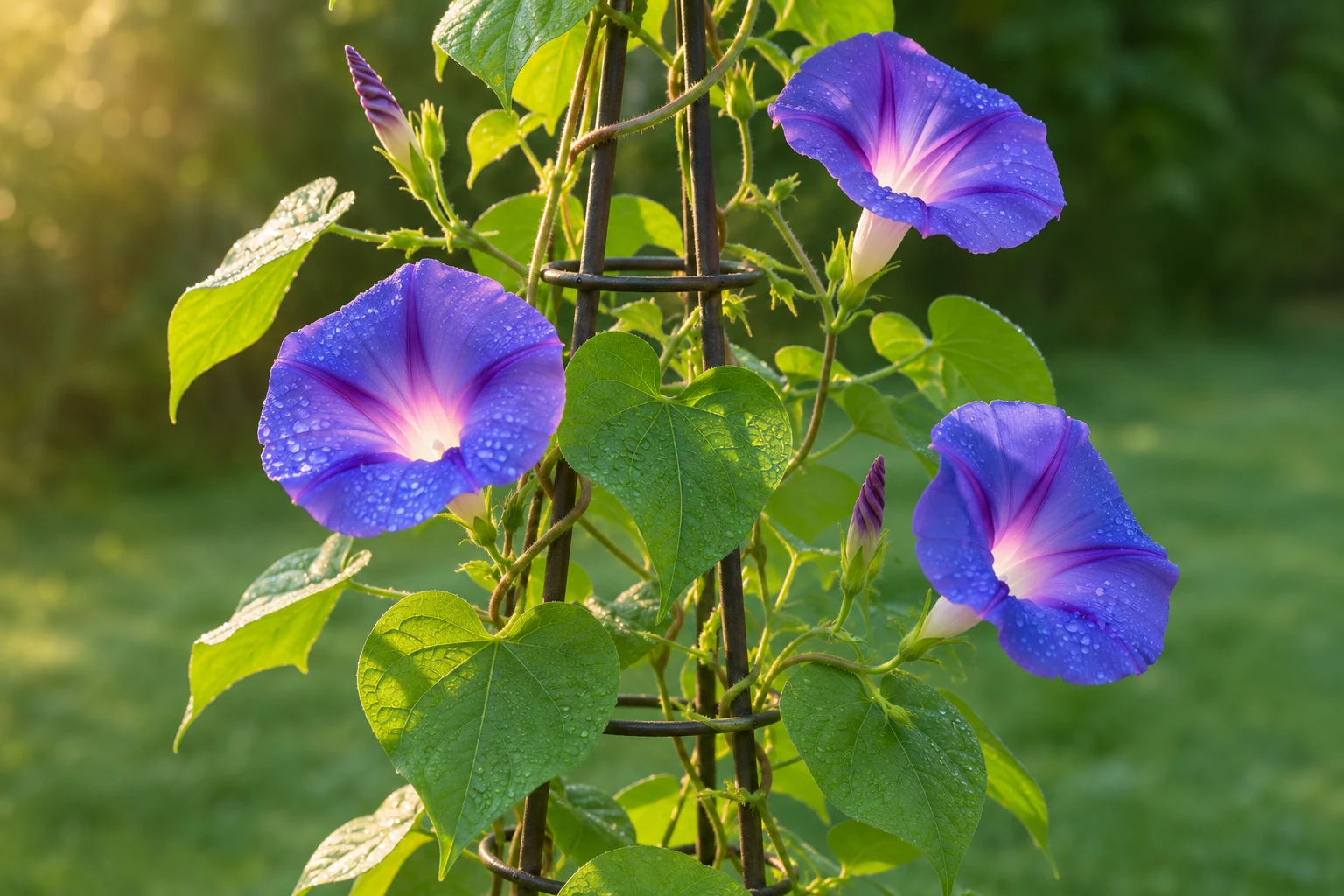
Browse general houseplant problems or use our diagnosis tool for Morning Glory.
Morning Glory problems
Use the guides below to diagnose and fix common issues on Morning Glory. Each problem page explains why it happens on this species and what to do first.
It covers ornamental climbing Ipomoea vines, especially Ipomoea purpurea and common garden cultivars such as Heavenly Blue. Moonflower (Ipomoea alba) and edible sweet potato (Ipomoea batatas) are related plants but are not interchangeable with every care detail in this profile.
Does Morning Glory need full sun?
Full sun gives most common garden morning glories the best flowering. They tolerate some light afternoon shade, particularly in hot climates, but deep shade often means fewer flowers and stretched growth.
How often should I water Morning Glory?
Keep seedlings evenly moist, then water established vines when the upper 1–2 inches of soil begin to dry. About an inch of weekly water is a useful starting point during active growth, adjusted for rainfall, heat, and faster-drying containers.
Does Morning Glory need a trellis?
Most ornamental morning glories are vigorous twining vines. Give them a sturdy trellis, fence, or arch before they begin climbing; a large pot also needs a secure support or room for the stems to trail.
Is Morning Glory toxic to pets?
ASPCA lists Ipomoea species as toxic to cats, dogs, and horses. It notes vomiting and says large amounts of seeds may cause hallucinations. Keep the plant and seeds away from pets and contact a veterinarian or animal poison control if ingestion occurs.
What light does Morning Glory need?
Morning Glory grows best in full sun, ideally at least 6 hours daily, for the strongest flowering. It also tolerates Light afternoon shade in hot climates, Bright conditions with some dappled shade. Avoid deep shade, which encourages leafy or stretched growth and fewer flowers.
How do I propagate Morning Glory?
Propagate Morning Glory from healthy stem or root divisions during active growth.
How this Morning Glory problems guide is reviewed?
Written by Sai AnanthLead content writer at LeafyPixels. B.Pharmacy graduate from Andhra University with a background in pharmacognosy, turned indoor gardening writer after a long-time plant hobby became a research-led resource for home growers.View Sai Ananth's profile · Reviewed by LeafyPixels Review Board
This Morning Glory problems problem guide was researched and written by Sai AnanthLead content writer at LeafyPixels. B.Pharmacy graduate from Andhra University with a background in pharmacognosy, turned indoor gardening writer after a long-time plant hobby became a research-led resource for home growers.View Sai Ananth's profile. Problems symptoms on Morning Glory, lookalike causes, and step-by-step fixes are cross-checked against extension pest, disease, and care references before publication.
We prioritize sources that hold up under scrutiny:
University cooperative extension bulletins and fact sheets (Penn State, Clemson, UMD, NC State, and similar programs)
Botanical garden and horticultural society publications
Peer-reviewed plant science and veterinary toxicology references where pet safety matters (including ASPCA Animal Poison Control)
Established reference works on indoor plant culture
The LeafyPixels editorial team then reviews the draft for clarity, step-by-step usefulness, and fit with real apartment and home conditions-not ideal greenhouse setups. When guidance changes materially, we update the page and note the revision date.
BBC Gardeners' World Magazine — Ipomoea purpurea (n.d.) Seasonal flowering, annual cultivation, full sun or light shade, moist but well-drained soil, seed growing, and the species identity of common morning glory. Its horse-toxicity note conflicts with ASPCA and NC State and is not used as the horse-safety classification. [Online]. Available at: https://www.gardenersworld.com/plants/ipomoea-purpurea/ (Accessed: 1 March 2024).
NC State Extension Plant Toolbox — Common Morning Glory (Ipomoea purpurea) (n.d.) Species identity, family, native range, twining annual habit, mature size, full sun, moderately fertile moist well-drained soil, flowers, cultivars, seed propagation, common pests, human poison severity, pet-risk tags, and seed-related symptoms. [Online]. Available at: https://plants.ces.ncsu.edu/plants/ipomoea-purpurea/ (Accessed: 1 March 2024).
NC State Extension Plant Toolbox — Ipomoea tricolor (n.d.) A common cultivated Ipomoea type and cultivar-level distinctions from common morning glory. [Online]. Available at: https://plants.ces.ncsu.edu/plants/ipomoea-tricolor/ (Accessed: 1 March 2024).
The Spruce — How to Grow Morning Glories (n.d.) Practical guidance on sunlight, soil moisture and drainage, weekly water as a starting reference, containers, seed scarification, warm-season growth, and trellis support. [Online]. Available at: https://www.thespruce.com/how-to-grow-morning-glories-4125567 (Accessed: 1 March 2024).