How to Prune Mosambi: When, Where & What to Cut
How to Prune Mosambi: When, Where & What to Cut
How to Prune Mosambi: When, Where & What to Cut
First, remove any shoots growing from below the graft union — these rootstock suckers will not produce your Mosambi scion and will steal vigor from the sweet-lime top. Cut them flush at their point of origin with clean bypass pruners or loppers. Do not start canopy shaping until suckers, dead wood, and obvious water sprouts are addressed. For whole-plant context — sun needs, grafted nursery stock, and thorn caution — see the Mosambi overview.
Quick answer
Mosambi (Citrus limetta), the Indian sweet lime, needs far less canopy pruning than many ornamental plants. Mature citrus does not require regular canopy cuts for health or fruiting, and unnecessary pruning often reduces yield (UF/IFAS). The safest routine work is removing rootstock suckers below the graft, dead or diseased wood, and vigorous vertical water sprouts that shade productive branches. Time major shaping for just before bloom or just after fruit set, or do light thinning after harvest; avoid heavy late-season cuts that push frost-tender or monsoon-soft new growth (UC IPM). Wear thick gloves and eye protection — Mosambi twigs commonly carry sharp thorns — and bag trimmings away from pets because citrus foliage contains essential oils and psoralens that can cause problems if chewed.
What pruning does for Mosambi
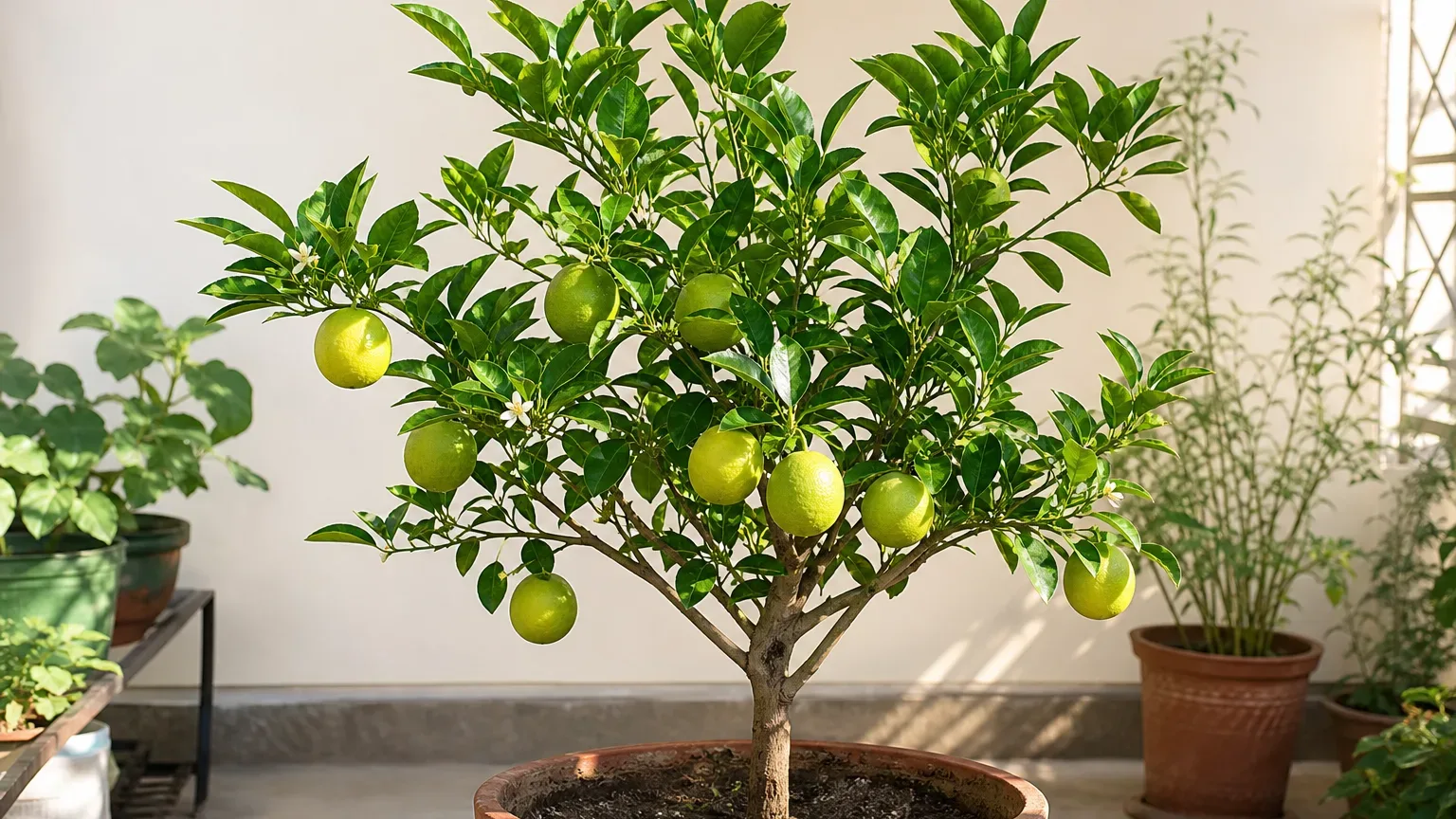
Most Mosambi trees arrive as grafted specimens: the named sweet-lime cultivar is budded onto a separate rootstock chosen for vigor, soil adaptation, or container performance. Left alone, Mosambi naturally forms a rounded evergreen canopy with fragrant white flowers and oval green fruit that ripens yellow with mild, low-acid flesh. Owners prune when suckers erupt below the graft, when a terrace tree outgrows its pot, when leggy growth needs tightening after a dull monsoon, or when crossing branches rub and invite disease.
Pruning on Mosambi serves four practical jobs:
Sucker control removes rootstock growth that will never produce true sweet lime and can overtake the scion if ignored. Cleanup takes out dead, damaged, or diseased wood whenever you see it. Canopy management opens the center slightly, removes crossing limbs, and reins in wild vertical shoots. Size control shortens leggy sideshoots on container trees so the canopy stays balanced on a terrace pot.
What pruning cannot do is replace poor fundamentals. A tree in deep shade, chronically wet soil, or repeated drought stress will not fruit better because you cut it back. Fix light placement and watering rhythm before expecting structural cuts to improve yield.
Cleanup vs shaping vs sucker removal
These are separate decisions. Sucker removal is urgent whenever shoots appear below the graft — do it immediately, regardless of season. Cleanup of dead or clearly diseased branches is also time-flexible. Shaping and size-control cuts are the ones to schedule around flowering and fruit load, because citrus flowers and sets fruit on the tips of new sideshoots. Removing too much flowering wood in one session means fewer blossoms next cycle.
When to prune Mosambi
The ideal window for moderate canopy work is just before bloom or just after fruit set, when the tree can adjust its crop during natural fruit drop (UC IPM). In frost-free Indian climates with year-round growth, that often means late winter through early spring as swelling buds show the next flush coming — roughly February to March on many terraces before the main spring bloom.
A second useful pass is after harvest, when you have picked mature yellow sweet limes and want to thin overcrowded branches or shorten a few leggy shoots before the next flowering wave. In cooler regions where trees move indoors for winter, February is a traditional time to thin crowded growth and shorten sparse stems by up to two-thirds on individual branches that need rejuvenation (RHS).
Minor cleanup — one dead twig, a single sucker, a water sprout — can happen whenever you spot it. Summer pinching of overly vigorous shoots back within the crown can encourage branching on actively growing container trees, but keep it light.
Avoid scheduling heavy shaping during peak monsoon when soil stays wet and fungal pressure is high unless you are only removing clearly dead wood. Wet weather plus large fresh wounds adds unnecessary stress.
When not to prune
Skip heavy shaping when the tree is drought-stressed, recently repotted, or recovering from a hard move between indoor and outdoor positions. A newly purchased Mosambi should get two to four weeks to settle before anything beyond sucker and dead-wood removal.
Avoid late-season hard pruning before cool nights or unseasonal cold snaps. Fresh cuts can stimulate tender growth that cold damages (UC IPM). Do not prune heavily while the tree is covered in small developing fruit unless you accept a lighter crop. Sweet lime in cultivation needs very little pruning overall — when in doubt, cut less.
What to check before cutting
Walk the tree slowly and answer these questions before touching live canopy wood:
- Where is the graft union? On most nursery Mosambi it appears as a slight ridge or color change low on the trunk. Everything below it is rootstock territory.
- Are there suckers, water sprouts, or normal sideshoots? Suckers emerge from below the graft or from roots. Water sprouts shoot straight up through the canopy with few leaves. Productive sideshoots carry glossy mid-green leaves at a moderate angle.
- Is any wood dead, cracked, or diseased? Dead twigs snap dry; diseased patches may show dark lesions or oozing bark.
- How much flowering wood would you remove? Buds and tiny fruit clusters sit on newer growth tips.
- Is the tree stable in its pot or planting site? Severe top pruning on a newly repotted tree adds stress on top of root disturbance. See the repotting guide if roots were recently disturbed.
If the canopy looks leggy and thin, check whether the tree is reaching for light before you cut for shape. Leggy citrus often needs more direct sun, not more scissors.
The first cut to make
Remove rootstock suckers and shoots below the graft union first. Trace each unwanted shoot to its base and cut it flush with the trunk or root surface — do not leave stubs, because stubs can rot and invite decay organisms into the trunk (UF/IFAS). If a sucker is pencil-thick or larger, use loppers and make a single clean cut rather than hacking partially and leaving a jagged collar.
Only after suckers are gone should you remove clearly dead wood. Live canopy shaping comes last.
How to prune Mosambi step by step
Work in this order on a typical maintenance day:
- Remove suckers below the graft.
- Cut out dead, damaged, or diseased branches.
- Remove water sprouts that shade the interior.
- Thin crossing or inward-growing branches.
- Shorten leggy sideshoots if size control is still needed.
Removing rootstock suckers below the graft
Suckers often look more vigorous than the scion — faster growth, different leaf shape, or thornier, upright habit. They may appear from soil level, the lower trunk, or even from the root ball in containers. Because they are the rootstock variety, they will not produce your named Mosambi and will compete for water and nutrients.
Cut each sucker at its origin. On young trees, check the base every few weeks during the growing season; suckers can appear quickly after repotting or a wet spring. Persistent regrowth from the same spot may need repeated removal until the rootstock exhausts those buds.
Cutting water sprouts and wild vertical shoots
Water sprouts are strong upright shoots that grow slowly into bearing wood and shade productive limbs (UF/IFAS). Remove them at the branch they sprouted from, cutting flush without leaving a stub. On container trees overwintered indoors or kept in partial shade, a single dominant vertical shoot sometimes dominates — shortening it by one-third to one-half during active growth can redirect energy to sideshoots, but do not remove more than one major upright branch per year on a stressed tree (RHS).
Thinning crowded or crossing branches
Open the center slightly so light and air reach inner leaves. Remove branches that rub, cross through the middle, or grow inward toward the trunk. For terrace trees, you may also raise the skirt slightly so you can walk under the canopy — take the smallest amount needed.
Shortening leggy sideshoots
If a sideshoot stretched toward a window or stretched between indoor and outdoor seasons, shorten it back into live wood during active growth. Cut just above a leaf node or side branch facing the direction you want new growth to take. Sparse stems can be cut back by up to two-thirds in late winter on an otherwise healthy tree, but only on the branches that actually need it — not the entire canopy at once.
Where to cut on citrus wood
Make cuts flush with the trunk or branch collar when removing whole limbs. Stubs invite rot organisms that can damage the tree (UF/IFAS). When shortening a shoot, cut just above a node or outward-facing bud so the next leaf points away from the center.
Avoid tearing bark on larger branches — use three-cut method with a pruning saw if the limb is thicker than your thumb. On grafted container trees, never cut below the graft trying to “restart” the tree; the scion is everything above the union.
How much you can safely remove
Think in terms of minimal canopy removal, not a hard rejuvenation prune. The more severe the canopy cut, the greater the reduction in cropping (UF/IFAS). A practical ceiling for one session on a healthy mature Mosambi is roughly one-quarter of the live canopy, and often less is wiser.
Hard rejuvenation — cutting one leggy branch back hard to stimulate new shoots — is only appropriate on an otherwise healthy tree, and limiting hard renewal to one branch per year is safer than stripping multiple limbs at once. Container growers with a badly stretched specimen sometimes get better results by improving light and root space through timely repotting than by stripping half the top at once.
What not to cut
Do not remove:
- The grafted scion trunk trying to change tree height in one dramatic chop
- Every flowering tip when the tree is about to bloom or carrying young fruit you want to keep
- Healthy productive scaffold branches just to make the silhouette rounder
- Green fruit unless you are deliberately thinning an excessive set
- New flush leaves during active growth unless they are clearly damaged — those leaves feed the roots
Never confuse a thorny rootstock sucker with scion growth. If leaves below the graft look different from the rest of the canopy, those shoots go first.
Pruning damaged, yellow, or dead growth
Dead wood is always safe to remove — cut back to live tissue where the cambium is green under a light scratch. Broken branches from wind or fruit weight should be trimmed cleanly immediately so tears do not spread.
Yellow leaves are not automatically pruned away. One or two yellowing leaves on an otherwise green tree may reflect normal leaf turnover, overwatering, or cold stress. Fix the underlying watering or temperature issue before mass-removing foliage. If a branch is fully dead or shows canker-like lesions, remove that branch entirely and disinfect tools before the next cut.
Tools, thorns, and sanitation
Use bypass pruners for twigs up to about 1 cm (⅜ in) thick, loppers for larger suckers and scaffold branches, and a curved pruning saw for anything too thick to lop cleanly. Keep blades sharp — crushed citrus stems heal slowly and leak sap.
Wear thick gloves and eye protection. Mosambi and other citrus are frequently spiny, with sharp thorns on twigs. Bag prunings promptly and keep them away from cats, dogs, and horses — related citrus plant material can cause vomiting, diarrhoea, or skin irritation if chewed because of essential oils and psoralens.
Disinfect tools when moving between trees or after cutting diseased wood (UC IPM). A 10% bleach solution or 70% isopropyl alcohol wipe works for home growers.
If large limbs expose previously shaded bark to intense sun, paint exposed areas with a 50:50 mix of white interior latex paint and water to prevent sunburn (UC IPM).
Aftercare and recovery
After pruning, return the tree to stable care — do not repot, heavily fertilize, or move it into harsh new sun on the same day. Water according to your normal watering schedule so the root ball stays evenly moist but not saturated. Hold off on strong fertilizer until you see active new flush unless the tree was already on a regular feeding program and shows no stress.
Recovery timeline
- Sucker removal: little visible change beyond a cleaner base; regrowth may appear in weeks if buds remain.
- Light thinning: new sideshoot tips within 4–8 weeks during warm active growth.
- Moderate shortening: canopy fills back over one to two growing seasons on a healthy outdoor tree.
- Hard renewal of one branch: that limb may take a full season to reflower; do not hard-prune additional branches until it recovers.
Terrace trees in full monsoon humidity recover leaf flush faster than shaded indoor specimens, but wet soil during recovery still raises root-rot risk — keep drainage sound and avoid overwatering “to help” the tree.
Signs pruning worked
- New flush leaves emerge glossy green from nodes below shortening cuts
- Interior of canopy stays lightly dappled with light, not shaded solid green
- Sucker regrowth slows after repeated flush cuts at the base
- Next flowering cycle produces normal fragrant blooms on outer sideshoots
- Tree stops losing healthy leaves and holds fruit without sudden drop
Signs you pruned too hard or too late
- Widespread leaf drop one to three weeks after a heavy session
- Only vegetative water sprouts return, with few flowers the next season
- Sunscald on bark where large limbs were removed without paint protection
- Persistent sucker explosion below the graft because the scion was weakened
- Root stress symptoms after heavy pruning combined with wet monsoon soil
If you see these signs, pause further cuts, stabilize light and water, and let the tree rebuild for at least one full growth cycle.
Can you propagate from pruning cuttings?
Semi-ripe cuttings from healthy sideshoots can root, but named Mosambi is usually sold as grafted trees because rootstock affects vigor, disease resistance, and container performance. A rooted cutting clones the scion but lacks the rootstock advantages of nursery grafted stock. See the propagation guide if you want to try cuttings from trimmings — choose firm, non-flowering shoots and treat them as a separate project from routine pruning cleanup.
Common Mosambi pruning mistakes
- Topping the scion like a hedge and wondering why fruit disappeared the next year
- Leaving rootstock suckers until they dominate the pot
- Stub cuts that rot and invite trunk decay
- Pruning heavily just before monsoon on an already wet, stressed tree
- Stripping the canopy on a tree already stressed by poor drainage or dim light
- Bare-handed pruning on thorny wood
- Leaving toxic trimmings where pets can chew them
- Confusing pinching for hard pruning — light tip work is not the same as removing a quarter of the canopy
Related Mosambi guides
- Mosambi overview — whole-plant context, graft checks, and thorn caution
- Mosambi light — fix stretch before structural cuts
- Mosambi watering — stable moisture after pruning
- Mosambi soil — drainage and pH for recovery
- Mosambi fertilizer — when to resume feeding after cuts
- Mosambi propagation — using healthy trimmings as cuttings
- Mosambi repotting — separate root work from heavy canopy removal
Conclusion
Mosambi pruning is mostly subtraction of the wrong wood, not artistic shaping. Remove rootstock suckers below the graft first, then dead branches and water sprouts, and only then decide whether the canopy truly needs thinning. Citrus bears on newer sideshoot tips, so aggressive routine pruning costs sweet-lime fruit. Match your cuts to the season, protect bark from sunburn, wear gloves against thorns, and keep pet-toxic trimmings out of reach. When the silhouette still looks wrong after minimal cuts, improve sun and root conditions before taking another pass.