Mosambi Care Guide: Growing Citrus limetta
Citrus limetta
Grow Mosambi (Citrus limetta) in full sun and well-draining, mildly acidic soil. Learn watering, potting, fruiting, pet oil, and thorn safety basics.
Mosambi Care Guide: Growing Citrus limetta
Start with wateringThe most common care mistake for MosambiWatering guide →Mosambi care essentials
Light
Water
Water deeply when the top 3–5 cm of soil is dry. Keep young and container trees evenly moist without leaving the root ball waterlogged; allow established trees a little more drying between soaks.
Soil
Fertile, well-draining sandy loam or a loose citrus potting mix with compost and coarse aeration material. Avoid dense clay and stagnant water.
Humidity
Temperature
Fertilizer
About Mosambi
Mosambi is native to Southern Iran; long cultivated across India and other tropical and subtropical regions, typically reaches 6–12 m tall in the ground; usually maintained at 1.5–3 m in a large container indoors, with moderate; faster in warm weather with full sun and regular moisture growth. Mosambi has a tree like growth habit and part of the Rutaceae family. It is also known as Sweet Lime, Sweet Lemon, Mousami, Musambi, Mausambi, and Limetta.
| Detail | Information |
|---|---|
| Also known as | Sweet Lime, Sweet Lemon, Mousami, Musambi, Mausambi, Limetta |
| Native region | Southern Iran; long cultivated across India and other tropical and subtropical regions |
| Mature size | 6–12 m tall in the ground; usually maintained at 1.5–3 m in a large container |
| Growth rate | Moderate; faster in warm weather with full sun and regular moisture |
| Growth habit | Tree Like |
| Scientific name | Citrus limetta |
| Family | Rutaceae |
Mosambi Care Guide: Growing Citrus limetta
Mosambi is a sun-loving evergreen fruit tree, not a foliage plant for a dim room. Citrus limetta — the Indian sweet lime — belongs to the Rutaceae family and is widely grown across warm Indian gardens, terraces, and courtyards for mild, low-acid juice and fragrant white flowers. In the right site it produces glossy evergreen leaves and pale yellow fruit, but only when light, drainage, and root-zone management work together.
The first priorities are simple: place the tree in strong direct sun, use a free-draining root zone, water deeply after the upper mix begins to dry, and buy a correctly grafted tree when fruit quality matters. Extra fertilizer cannot replace six to eight hours of usable sunlight or compensate for chronically wet roots.
Mosambi care at a glance
Give Mosambi full sun with at least six to eight hours of direct light on most days. UF/IFAS notes that citrus tolerates light shade but is more productive in full sunlight, and acid-type citrus such as limes generally need less heat to mature fruit than many oranges, as UC IPM explains.
Water until the full root ball is wet and excess drains freely, then check again only after the top 3–5 cm has started to dry. Use fertile, slightly acidic, well-drained soil around pH 5.5–6.5 and never bury the graft union. Feed modestly during warm active growth with a complete citrus fertilizer, protect container roots from frost, and keep thorny, oil-bearing plant material away from pets and narrow foot traffic.
Know the tree you are growing
Sweet lime is an acid citrus grown for juice rather than dessert sweetness. Unlike tart nimbu (Citrus limon) or sour lime, Mosambi fruit is mild and low in acid, which is why it is prized for fresh juice across South Asia. Most citrus varieties, including typical sweet limes, are self-fruitful and do not require a second tree for pollination, though insects still help set and hold fruit.
What Citrus limetta is
Mosambi is the common Indian name for Citrus limetta, also called sweet lime, mousami, musambi, or mausambi. Nursery labels that give the botanical name are more reliable than “sweet lime” alone, because that phrase can also describe other low-acid citrus such as Palestinian sweet lime (Citrus limettioides) or loosely marketed plants that are not true Mosambi.
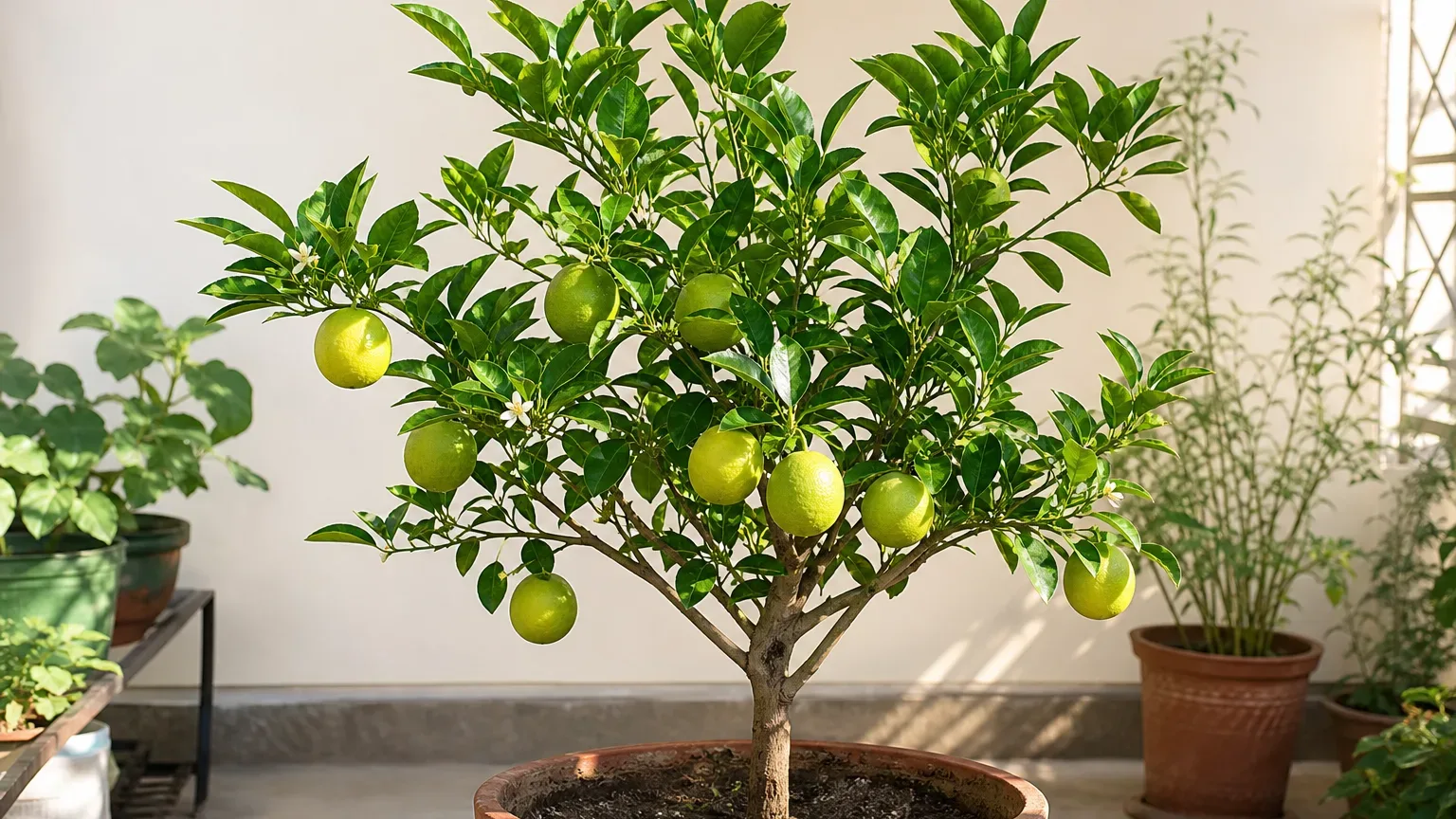
The tree is an evergreen with glossy leaves, fragrant white flowers, and round to oval fruit that ripens pale yellow. Some shoots carry sharp thorns, which are normal on many citrus types rather than a sign of poor health. Do not confuse Mosambi with Persian lime, Key lime, or lemon; juice character, acidity, and nursery labeling differ even when the plants look broadly similar at a glance.
Growth habit and realistic size
In the ground, a well-grown Mosambi can reach roughly 6–12 m with a spreading canopy when root space and sun are ample. Container culture restricts size, yet the canopy can still become broad and top-heavy if light is strong and feeding is steady. Do not expect a naturally miniature shrub unless you choose deliberate root restriction, selective pruning, and a manageable grafted cultivar.
Growth is moderate in warm weather and slows in cool periods. A tree that looks static in winter may simply be resting; forcing feed or heavy pruning during that pause often creates more stress than growth. Judge a young plant by firm new leaves and a stable root zone before expecting a heavy crop.
Choose a warm, sunny placement
Place Mosambi on the sunniest wind-sheltered spot you can offer: an open terrace, south- or west-facing balcony, courtyard edge, or garden bed where walls and taller plants do not steal light for most of the day. UC IPM recommends a well-drained site with full sun most of the day and protection from strong winds. Rotate a container every week or two if one side faces a parapet, because an uneven canopy becomes harder to balance as the tree matures.
Acclimate nursery foliage gradually when moving from shade net or indoor light into harsh terrace sun. Begin with morning exposure, then lengthen outdoor hours while watching for pale, crisp patches on tender leaves. Glass-filtered light behind a window is not equivalent to open sky on an Indian terrace.
Full-sun targets for fruit and compact growth
Strong light drives sturdy shoots, flower buds, and fruit sizing. A tree parked in bright indirect light may survive as foliage, but it will rarely behave like a productive fruit tree. If your balcony receives fewer than six hours of direct sun, treat the plant as experimental rather than expecting reliable sweet-lime harvests. The dedicated Mosambi light guide covers window placement, sunburn after glass culture, and realistic limits for shaded sites.
Can Mosambi grow well in a container?
Yes, provided the pot behaves like a managed root zone. UF/IFAS recommends container-grown nursery trees because they establish more predictably than bare-root field stock in home settings, and large containers are a standard way to grow citrus where ground space is limited.
Start only one pot size wider than the nursery root ball, ensure several unobstructed drainage holes, and choose a stable container that will not topple as the canopy broadens. A huge pot around a small root system stays wet too long; a severely rootbound pot can dry within hours and shed flowers or young fruit. Plan for periodic Mosambi repotting once the largest movable size is reached.
Water by the root zone, not the calendar
Check moisture 3–5 cm deep with a finger or wooden skewer. If that layer is approaching dry and the pot feels noticeably lighter, soak slowly until water runs from every drainage hole, then empty the saucer. Do not water on a fixed weekday schedule; heat, wind, pot size, and recent rain all change the interval.
UF/IFAS Home Citrus stresses that watering is critical from planting through fruiting years and that newly planted trees need the root zone kept moist without waterlogging during establishment. If you receive about half an inch of rain in one event, skip irrigation for a couple of days because the soil may already be wet enough. That rainfall logic applies equally to monsoon weeks on an Indian terrace, when roof runoff and saturated saucers are common failure points.
Young container trees in hot pre-monsoon weather may need checking every few days, though not necessarily watering every day. During cool slow-growth periods, lengthen the interval and always account for rain before adding more water. For finger-test detail, seasonal examples, and overwatering diagnosis, use the Mosambi watering guide.
Build a fertile but fast-draining soil mix
Mosambi tolerates many in-ground soils when drainage is good, but containers are less forgiving because roots cannot escape a wet or compacted pocket. A practical mix combines quality potting soil with coarse pine bark and perlite or pumice so the blend wets evenly, drains promptly, and still holds enough moisture to prevent the root ball from lurching from soaked to dust-dry.
UF/IFAS gives an optimum soil pH range of 5.5–6.5 for citrus in the home landscape. High-pH mix can show up as pale new leaves with greener veins, while chronically wet roots can yellow leaves even when fertilizer is plentiful. Do not bury the trunk or pile mulch against the bark; keep the graft union and root flare visible. The Mosambi soil guide explains mix recipes, drainage warning signs, and pH-related yellowing in more detail.
Feed for steady growth, not salt buildup
Feed only a rooted, actively growing tree. In a container, use a complete citrus fertilizer with micronutrients such as iron, magnesium, and zinc at the label’s container rate, divided into modest applications through warm growth rather than one heavy dose. UC IPM notes that mature citrus usually needs regular nitrogen and that micronutrient deficiencies such as zinc or iron can appear on new spring growth.
Flush the pot with plain water periodically, because fertilizer salts have nowhere else to go in a confined root zone. Avoid feeding drought-stressed or waterlogged trees. Field-grove schedules are not safe container recipes. Start conservatively and use the Mosambi fertilizer guide before correcting a suspected deficiency.
Prune lightly and watch the graft union
Mature Mosambi trees need little routine canopy pruning compared with many ornamentals. Remove dead, crossing, damaged, or rootstock-sucker growth, and shape lightly after harvest if needed. UF/IFAS cautions that unnecessary pruning can reduce fruit production because flowers and fruit form on productive shoots you may remove if you shear too hard.
During early development, remove suckers from the base of the tree. These shoots are likely the rootstock variety, will not produce desirable fruit, and can overtake the grafted Mosambi if ignored. Wear gloves and eye protection around thorny twigs, disinfect tools between unhealthy plants, and make cuts flush with the branch collar. The dedicated Mosambi pruning guide covers timing, sucker removal, and size control without stripping fruiting wood.
Start with the right planting material
For home fruit, buy a healthy grafted Mosambi with a visible sound graft union, dark-green leaves, and no scale colonies or sticky honeydew on the stems. Reject trees with woody roots circling the trunk, sour saturated mix, dieback, or vigorous shoots emerging below the graft.
Seed is interesting for experimentation but unreliable for home fruit production. Seedlings vary from the parent, take longer to bear, and lack the deliberate rootstock pairing that commercial grafted plants provide. For a terrace sweet lime with known juice traits, start with a reputable grafted tree labeled Citrus limetta. The Mosambi propagation guide compares grafted plants, cuttings, and seed when you want a second tree or backup cultivar.
Support flowering and fruit development
Sun, mature new growth, and a functioning root system matter more than any flower booster. Avoid drought while flowers open and fruit enlarges, but do not keep the pot wet in an attempt to prevent drop. Some blossom or young-fruit loss after a move, repot, or sudden light change is normal; repeated drop alongside pale leaves, stalled shoots, or sour wet soil calls for root-zone diagnosis.
Do not combine repotting, hard pruning, and heavy feeding when a tree is flowering. Each intervention changes the balance between roots and canopy, and stacking them creates avoidable stress. Fruit may take months to reach harvest color even after set, and trees moved outdoors in late spring often benefit from natural pollination. Sweet-lime fruit is valued for juice rather than long storage, so harvest when flavor is mild and the rind has yellowed rather than forcing early picking for color alone.
Adjust Mosambi care through Indian seasons
During hot pre-monsoon weather, check pots frequently, shade only the container wall if black plastic overheats the roots, and ensure drainage holes stay open. During monsoon, move pots away from roof sheets that pour concentrated runoff into the mix, pause irrigation while rain keeps the root zone wet, and improve airflow around the canopy to reduce fungal leaf issues.
During a cooler or drier winter, growth may slow, so lengthen the interval between watering and reduce feeding. In frost-prone north Indian locations, move a portable tree beside a warm wall under cover and protect the root ball overnight; citrus is subtropical and UC IPM notes that trees are generally damaged below about -4°C (24°F). Resume stronger feeding and structural pruning only when warmth and visible new growth return.
Pet safety, thorns, and household placement
Mosambi foliage, peel, and other plant material are not pet-safe even though the juicy pulp is a human food. The ASPCA lists orange as toxic to cats, dogs, and horses, with essential oils and psoralens as the toxic principles and reported signs that include vomiting, diarrhea, depression, and possible dermatitis. ASPCA does not provide a dedicated Citrus limetta page, so treat related Citrus guidance as cautionary rather than species-specific proof.
Keep the tree, fallen peel, and concentrated citrus oils out of reach of pets. Site thorny pots away from narrow paths where children or guests brush past the canopy, and wear gloves when pruning or moving the tree. Contact a veterinarian if a pet chews leaves, twigs, or peel and develops symptoms.
Read common warning signs correctly
Yellow leaves plus slow-drying, sour-smelling soil point first toward excess moisture or poor aeration. Yellow new leaves in a draining pot may instead indicate high-pH iron chlorosis. Limp new growth in genuinely dry soil suggests drought, while limp growth above a wet root ball requires inspection before any more water.
Brown leaf margins can follow severe dry-down, salt accumulation, or hot desiccating wind. A tree that grows vigorously but does not flower may be too young, shaded, overfed with nitrogen, or repeatedly stressed by repotting. Vigorous shoots from below the graft are a rootstock problem, not a nutrient deficiency. Diagnose the whole pattern—soil moisture, light, graft height, and recent treatment—rather than treating one symptom in isolation.
When to use this page vs other Mosambi guides
- Use this overview to understand Mosambi’s whole growing system and decide whether your site can support a sun-loving fruit tree.
- Use Mosambi light to assess a balcony, terrace, or garden position and acclimate foliage safely.
- Use Mosambi watering when leaves wilt, soil stays wet, or seasonal frequency is unclear.
- Use Mosambi soil for container recipes, drainage problems, and pH-related yellowing.
- Use Mosambi fertilizer before choosing a product or correcting a suspected nutrient deficiency.
- Use Mosambi repotting when roots circle, the tree becomes unstable, or the pot dries within a day.
- Use Mosambi propagation to compare grafted plants, cuttings, and seed.
Related Mosambi guides
- Mosambi plant hub — species profile, key care facts, and the complete care cluster.
- Mosambi pruning — sucker removal, thorn safety, and light shaping after harvest.
- Mosambi light — direct-sun targets and sun-stress diagnosis.
- Mosambi watering — root-zone checks for pots, gardens, and monsoon weather.
- Mosambi soil — free-draining mixes and pH management.
- Mosambi fertilizer — feeding through active growth and fruiting.
- Mosambi repotting — pot sizing and aftercare.
- Mosambi propagation — methods that preserve cultivar traits.
Conclusion
Successful Mosambi care begins with accepting what the plant is: a subtropical evergreen fruit tree that wants open sun, active roots, and room for a branching, often thorny canopy. In the ground, choose a non-flooding site with wind shelter; in a container, make drainage, gradual pot sizing, and graft-union hygiene non-negotiable. Water deeply after the upper root zone begins to dry, then adjust the interval to heat, rain, pot size, and fruit development.
For an Indian terrace or garden, the biggest seasonal shift is from rapid dry-down before monsoon to prolonged moisture during it. Watch the root zone instead of the calendar, protect a young plant from unusual cold, and make only one major intervention at a time. With a suitable grafted Citrus limetta and realistic expectations, Mosambi can remain manageable while producing healthy growth, fragrant flowers, and eventually mild sweet-lime fruit.
How to care for Mosambi?
When should you water Mosambi?
Water deeply when the top 3–5 cm of soil is dry. Keep young and container trees evenly moist without leaving the root ball waterlogged; allow established trees a little more drying between soaks.
- Test 3–5 cm below the surface - Water deeply when the top 3–5 cm of soil is dry.
- then soak until water drains freely from the pot - Keep young and container trees evenly moist without leaving the root ball waterlogged; allow established trees a little more drying between soaks.
- Drain excess water - Water deeply when the top 3–5 cm of soil is dry.
What soil works best for Mosambi?
Fertile, well-draining sandy loam or a loose citrus potting mix with compost and coarse aeration material. Avoid dense clay and stagnant water.
- 50% quality potting mix - Fertile, well-draining sandy loam or a loose citrus potting mix with compost and coarse aeration material.
- 25% compost or well-rotted organic matter - Fertile, well-draining sandy loam or a loose citrus potting mix with compost and coarse aeration material.
- 25% coarse perlite, pumice, or pine bark - Fertile, well-draining sandy loam or a loose citrus potting mix with compost and coarse aeration material.
Grower notes for Mosambi
What matters most with Mosambi
Mosambi is a subtropical evergreen fruit tree, not a low-light houseplant. Give it at least 6–8 hours of direct sun, warm conditions, and a root zone that drains promptly after a deep watering. UF/IFAS notes that citrus tolerates light shade but is more productive in full sun and performs best around soil pH 5.5–6.5. In a pot, steady moisture is useful; permanently wet compost is not.
Best placement in a real home
Use a sunny terrace, courtyard, balcony, or garden position with room around the canopy. A large container can limit size, but a ground-grown Citrus limetta can become a 6–12 m tree. Protect it from freezing weather and cold, drying wind. Keep the pot where runoff can escape, and turn a container tree periodically so all sides receive light.
Before you buy this plant
Choose a named, grafted Mosambi from a reputable citrus nursery. Look for a healthy graft union, dark green leaves, firm new shoots, and roots that are not circling into a solid mat. Reject trees with sticky leaves, scale insects, blackened roots, cankers, or shoots emerging below the graft. Confirm the label says Citrus limetta rather than a sour lime or a different sweet-lime species.
First month after bringing it home
Keep Mosambi in strong sun after gradual acclimation, check the root ball rather than only the surface, and water thoroughly when the top 3–5 cm dries. Do not bury the graft union or repot on arrival unless drainage is failing. New trees need more regular moisture while roots establish; UF/IFAS recommends frequent deep watering for newly planted citrus, then less frequent irrigation as the root system expands.
Pet and thorn safety
Do not let pets chew Mosambi leaves, twigs, peel, or fallen fruit. ASPCA identifies essential oils and psoralens as the toxic principles in orange, a related Citrus species, and notes that fruit pulp is edible while skins and plant material can cause problems. Citrus limetta peel is also an essential-oil source, so never apply or diffuse concentrated Mosambi oil around pets. Branches may carry sharp thorns; wear gloves and place the tree away from narrow paths, play areas, and eye level.
How to tell Mosambi is settling in
Healthy adjustment shows as firm, glossy new leaves and shoots that mature without repeated wilt. Fragrant white flowers and green fruit that ripens yellow come only after the tree has enough sun and maturity, so do not judge a young plant by immediate fruiting. Remove only shoots from below the graft and dead or crossing growth; heavy canopy pruning reduces the fruiting wood.
Is Mosambi safe for pets?
Do not treat Mosambi as pet-safe. ASPCA attributes toxicity in a related Citrus species to essential oils and psoralens; skins and plant material can cause vomiting, diarrhoea, depression, or dermatitis. Keep foliage, twigs, peel, and concentrated citrus oil away from pets.
ASPCA has no dedicated Citrus limetta page in the source reviewed for this hub. Its orange listing identifies essential oils and psoralens as toxic principles and says fruit is edible while skins and plant material can cause problems. Because Mosambi peel contains essential oil, keep peel, leaves, stems, and extracts away from cats, dogs, and horses. Do not diffuse or apply concentrated Mosambi oil around animals. Sharp thorns are an additional physical hazard even without ingestion.
Watering Mosambi
For Mosambi, test 3–5 cm below the surface, then soak until water drains freely from the pot and water check every 3–5 days in hot weather and every 7–14 days in cooler months; water according to soil dryness, not a fixed calendar. Increase during summer heat, flowering, and fruit development; reduce in cool or cloudy weather while keeping the root ball from drying completely.
| Detail | Information |
|---|---|
| How often | Check every 3–5 days in hot weather and every 7–14 days in cooler months; water according to soil dryness, not a fixed calendar |
| How to check | Test 3–5 cm below the surface, then soak until water drains freely from the pot |
| Seasonal changes | Increase during summer heat, flowering, and fruit development; reduce in cool or cloudy weather while keeping the root ball from drying completely |
Signs of overwatering
- yellowing leaves while soil remains wet
- leaf drop
- sour-smelling potting mix
- dark or soft feeder roots
Signs of underwatering
- curling or wilting leaves
- dry leaf margins
- flower or young fruit drop
- a root ball pulling away from the pot
Soil & potting for Mosambi
Use a mix of 50% quality potting mix, 25% compost or well-rotted organic matter, 25% coarse perlite, pumice, or pine bark for Mosambi. Fast drainage with enough moisture retention to keep fine roots from repeatedly drying out. Target soil pH around 5.5–6.5. Repot every 2–3 years while young; refresh the upper mix annually on large established container trees, ideally in late winter to early spring, just before active growth.
| Detail | Information |
|---|---|
| Recommended mix | 50% quality potting mix, 25% compost or well-rotted organic matter, 25% coarse perlite, pumice, or pine bark |
| Drainage | Fast drainage with enough moisture retention to keep fine roots from repeatedly drying out |
| Soil pH | 5.5–6.5 |
| Repotting frequency | Every 2–3 years while young; refresh the upper mix annually on large established container trees |
| Best season to repot | Late winter to early spring, just before active growth |
Signs it needs repotting
- roots circling densely or emerging from drainage holes
- water running around a shrunken root ball
- pot drying within a day in warm weather
- stalled growth despite adequate sun and feeding
Humidity & temperature for Mosambi
Fertilizer & pruning for Mosambi
Common problems on Mosambi
Yellow Leaves
MediumLikely cause: Common on this plant type; confirm with recent watering, light, and root checks.
Quick fix: Inspect the plant and correct the most likely care stressor before stacking treatments.
Full fix guide →Brown Tips
MediumLikely cause: Common on this plant type; confirm with recent watering, light, and root checks.
Quick fix: Inspect the plant and correct the most likely care stressor before stacking treatments.
Full fix guide →Root Rot
MediumLikely cause: Common on this plant type; confirm with recent watering, light, and root checks.
Quick fix: Inspect the plant and correct the most likely care stressor before stacking treatments.
Full fix guide →Overwatering
MediumLikely cause: Common on this plant type; confirm with recent watering, light, and root checks.
Quick fix: Inspect the plant and correct the most likely care stressor before stacking treatments.
Full fix guide →Underwatering
MediumLikely cause: Common on this plant type; confirm with recent watering, light, and root checks.
Quick fix: Inspect the plant and correct the most likely care stressor before stacking treatments.
Full fix guide →Spider Mites
MediumLikely cause: Common on this plant type; confirm with recent watering, light, and root checks.
Quick fix: Inspect the plant and correct the most likely care stressor before stacking treatments.
Full fix guide →Mealybugs
MediumLikely cause: Common on this plant type; confirm with recent watering, light, and root checks.
Quick fix: Inspect the plant and correct the most likely care stressor before stacking treatments.
Full fix guide →Aphids
MediumLikely cause: Common on this plant type; confirm with recent watering, light, and root checks.
Quick fix: Inspect the plant and correct the most likely care stressor before stacking treatments.
Full fix guide →Leggy Growth
MediumLikely cause: Common on this plant type; confirm with recent watering, light, and root checks.
Quick fix: Inspect the plant and correct the most likely care stressor before stacking treatments.
Full fix guide →Slow Growth
MediumLikely cause: Common on this plant type; confirm with recent watering, light, and root checks.
Quick fix: Inspect the plant and correct the most likely care stressor before stacking treatments.
Full fix guide →Wilting
MediumLikely cause: Common on this plant type; confirm with recent watering, light, and root checks.
Quick fix: Inspect the plant and correct the most likely care stressor before stacking treatments.
Full fix guide →Drooping Leaves
MediumLikely cause: Common on this plant type; confirm with recent watering, light, and root checks.
Quick fix: Inspect the plant and correct the most likely care stressor before stacking treatments.
Full fix guide →Low Humidity
MediumLikely cause: Common on this plant type; confirm with recent watering, light, and root checks.
Quick fix: Inspect the plant and correct the most likely care stressor before stacking treatments.
Full fix guide →Not Enough Light
MediumLikely cause: Common on this plant type; confirm with recent watering, light, and root checks.
Quick fix: Inspect the plant and correct the most likely care stressor before stacking treatments.
Full fix guide →Fungus Gnats
MediumLikely cause: Common on this plant type; confirm with recent watering, light, and root checks.
Quick fix: Inspect the plant and correct the most likely care stressor before stacking treatments.
Full fix guide →Mold on Soil
MediumLikely cause: Common on this plant type; confirm with recent watering, light, and root checks.
Quick fix: Inspect the plant and correct the most likely care stressor before stacking treatments.
Full fix guide →