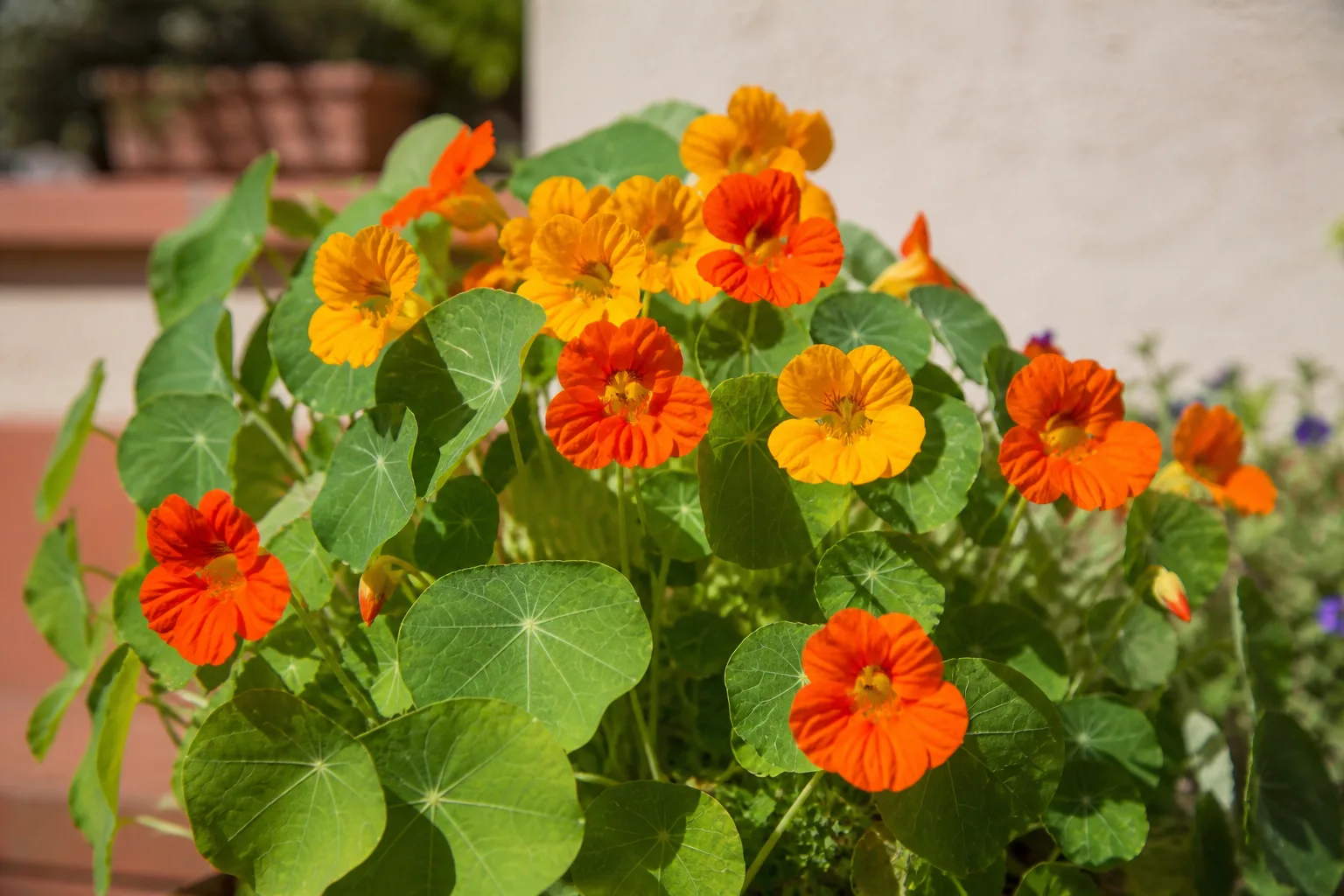
Which plant does this Nasturtium care guide cover?
It covers common garden nasturtium, Tropaeolum majus. Watercress is a different plant, Nasturtium officinale, and compact T. minus cultivars may have a different mature size and habit.
How much sun does garden nasturtium need?
Full sun usually produces the best flowering. In very hot weather, light afternoon shade can ease heat stress, while deep shade tends to reduce blooms.
How often should I water nasturtium?
Check below the soil surface and water when the root zone begins to dry. Established plants tolerate some dry soil, while containers may need more frequent checks; do not keep the mix saturated.
Can nasturtium grow in a container?
Yes. Compact forms fit pots and window boxes, and trailing forms can spill from hanging baskets. Choose a container with drainage holes and check its soil more often than a garden bed.
Does nasturtium come back every year?
It is generally grown as a warm-season annual in climates with frost. It may persist as a tender perennial in very mild climates and can reseed in a suitable garden, but seedlings are not guaranteed to return.
Are nasturtium flowers and leaves edible?
Extension sources describe the flowers and leaves of correctly identified garden nasturtium as edible. Harvest only plants grown without unsuitable pesticide treatments, and do not eat the roots.
Is Tropaeolum majus safe for pets?
ASPCA lists it as non-toxic to cats, dogs, and horses. NC State Extension also gives the species general problem-for-pets tags without detailing the reason, so identify the plant carefully and contact a veterinarian or animal poison-control service about concerning symptoms.
Written by Sai AnanthLead content writer at LeafyPixels. B.Pharmacy graduate from Andhra University with a background in pharmacognosy, turned indoor gardening writer after a long-time plant hobby became a research-led resource for home growers.View Sai Ananth's profile · Reviewed by LeafyPixels Review Board
This Nasturtium problems problem guide was researched and written by Sai AnanthLead content writer at LeafyPixels. B.Pharmacy graduate from Andhra University with a background in pharmacognosy, turned indoor gardening writer after a long-time plant hobby became a research-led resource for home growers.View Sai Ananth's profile. Problems symptoms on Nasturtium, lookalike causes, and step-by-step fixes are cross-checked against extension pest, disease, and care references before publication.
We prioritize sources that hold up under scrutiny:
University cooperative extension bulletins and fact sheets (Penn State, Clemson, UMD, NC State, and similar programs)
Botanical garden and horticultural society publications
Peer-reviewed plant science and veterinary toxicology references where pet safety matters (including ASPCA Animal Poison Control)
Established reference works on indoor plant culture
The LeafyPixels editorial team then reviews the draft for clarity, step-by-step usefulness, and fit with real apartment and home conditions-not ideal greenhouse setups. When guidance changes materially, we update the page and note the revision date.
Bob Vila — How to Grow Nasturtium (n.d.) Practical sowing, container, watering, low-fertility, and seasonal heat guidance. [Online]. Available at: https://www.bobvila.com/lawn-and-garden/nasturtium-care/ (Accessed: 1 March 2024).
Epic Gardening — How to Plant, Grow, and Care for Nasturtium (n.d.) Common-name distinction from watercress, cultivar habits, container suitability, and warm-weather care. [Online]. Available at: https://www.epicgardening.com/growing-nasturtium/ (Accessed: 1 March 2024).
North Carolina Extension Gardener Plant Toolbox — Tropaeolum majus (n.d.) Scientific identity, family, native region, annual habit, growth forms, size, light, soil, edibility, and pet-safety tag context. [Online]. Available at: https://plants.ces.ncsu.edu/plants/tropaeolum-majus/ (Accessed: 1 March 2024).
University of Wisconsin–Madison Extension — Nasturtium (Tropaeolum majus) (n.d.) Species and cultivar distinctions, habit, flowering, light, soil, water, fertilizer, propagation, edible leaves and flowers, and self-seeding. [Online]. Available at: https://hort.extension.wisc.edu/articles/nasturtium-tropaeolum-majus/ (Accessed: 1 March 2024).