Leggy Growth on Philodendron Gloriosum: Causes, Checks &
Quick answer
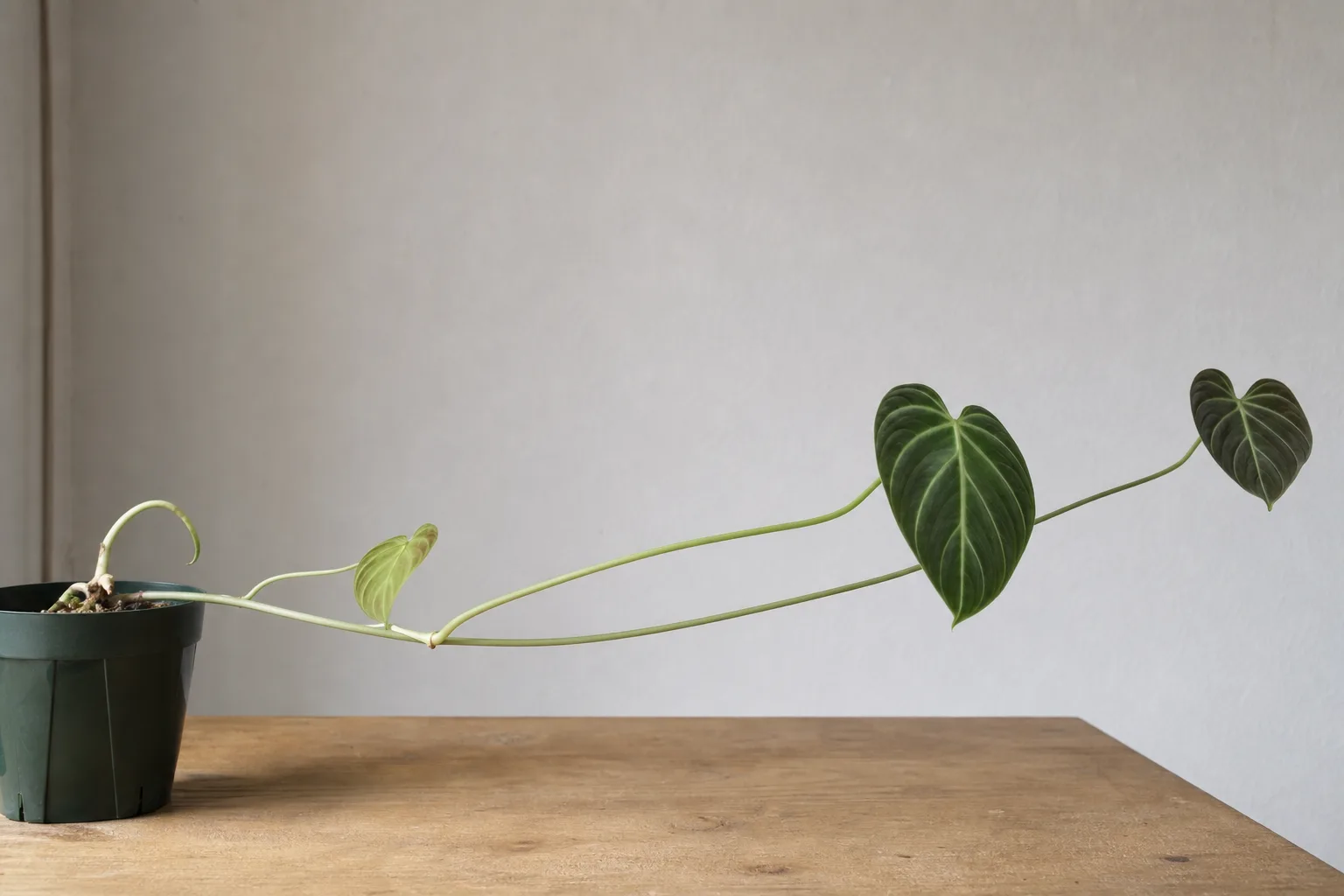
Leggy growth on Philodendron Gloriosum is etiolation-long thin petioles and small pale leaves reaching toward a window. First step: move to bright indirect light (or add a grow light) without direct hot sun on velvet foliage.
Leggy Growth on Philodendron Gloriosum: Causes, Checks & Fixes
This guide covers leggy growth on Philodendron Gloriosum. See also the general Leggy Growth guide, watering, and light pages for this plant.
Leggy Growth on Philodendron Gloriosum: Causes, Checks & Fixes
Quick answer
Leggy growth on Philodendron Gloriosum is etiolation-the plant stretching toward usable light. You will see long thin petioles, smaller pale velvet blades on the newest leaf, and a lean toward the brightest window. First fix: move the wide pot to bright indirect light within 1–2 meters (3–6 feet) of an east window or filtered south/west exposure, or add a grow light if the room has no usable window.
Use this page when you can compare sequential leaves and see petioles getting longer with blades getting smaller-the classic stretch pattern. Use the not-enough-light guide instead when the rhizome has produced no new leaf for four or more warm-season months and you need full window-placement and acclimation depth beyond stretch diagnosis alone.
Philodendron gloriosum is a creeping terrestrial philodendron that crawls horizontally on a rhizome-not a vining climber. “Leggy” on a crawler means weak individual leaves on elongated petioles, not bare leafless vines. For full species context, see the Gloriosum overview.
What leggy growth (etiolation) looks like on a gloriosum crawler
Healthy Gloriosum in good light holds firm petioles that support expanding velvet hearts; sequential leaves may arrive slowly but stay proportionally sized. Leggy etiolation shows a trend across the newest leaves:
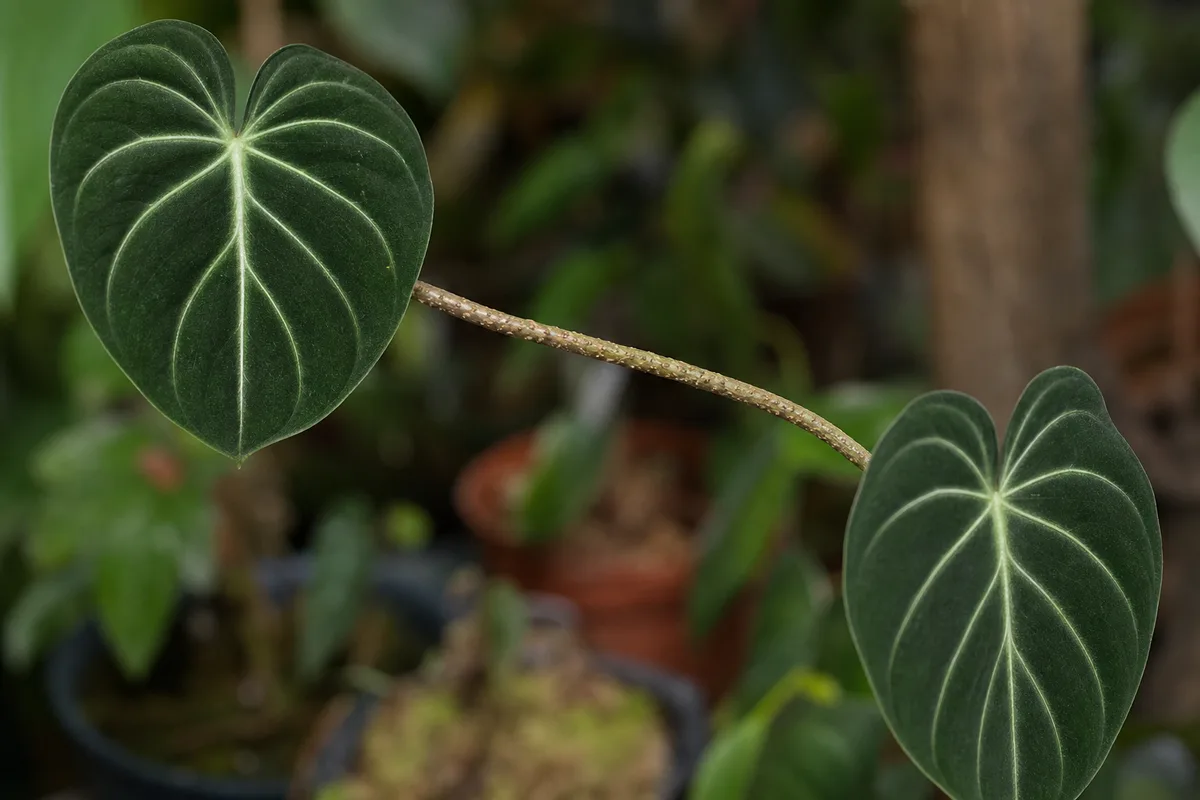
Leggy Growth symptoms on Philodendron Gloriosum - compare with healthy tissue on the same plant.
- Long thin petioles on the newest leaf compared to the leaf before it
- Smaller, paler green blade relative to the prior leaf-not just slow arrival
- Visible lean of the whole plant or newest petiole toward the window
- Wide spacing between rhizome nodes if light was poor for many months
- No bare vines-unlike heartleaf philodendron, you see weak individual leaves on a low crawler
Do not confuse slow natural cadence with legginess. Gloriosum produces leaves infrequently even in good light-see slow growth when the tip is simply unhurried but new foliage stays firm and richly colored. Leggy means disproportionately small/pale new leaves on long petioles, not merely “not growing fast.”
Petiole-length comparison workflow
Etiolation diagnosis on this slow species requires comparing sequential leaves, not calendar speed:
- Identify the two newest fully expanded leaves on the active rhizome tip.
- Measure or estimate each petiole from rhizome to blade base (a ruler or finger spans work).
- Compare blade width at the widest point.
- Leggy pattern confirmed when the newer leaf has a longer petiole and smaller blade than the leaf before it, especially if both lean the same direction.
Example recovery pattern (illustrative): A dim north-facing shelf produced one new leaf with an ~18 cm petiole and a blade roughly 30% smaller than the prior leaf. After moving the pot to ~1 m from an east window and holding humidity near 65%, the next leaf emerged ~10 weeks later with an ~11 cm petiole and a visibly larger blade. Old stretched petioles did not shorten-the improvement showed only on new growth.
Why Philodendron Gloriosum gets leggy
Insufficient light is the primary cause. In dim placement, each new leaf emerges on an elongated petiole with reduced blade size, angling toward the brightest source-a form of etiolation under low light.
Distance from windows matters more than room brightness to human eyes. A plant deep in a living room may etiolate even under LED ceiling lights-most houseplants need brighter exposure at leaf level than ambient room light provides. Gloriosum on a low shelf often sits below window height where intensity drops sharply; the light guide covers crawler geometry and window benchmarks.
Philodendrons tolerate relatively low indoor light-which helps survival-but Gloriosum needs brighter filtered exposure than that minimum to produce large velvet hearts. Survival confusion leads growers to display the crawler across the room for aesthetics while photons never reach the leaf surface.
One-sided light makes the rhizome and leaves lean; the crawler does not self-correct without rotation or relocation.
Low humidity during stretch can worsen thin weak unfurling-address light first, then confirm 60–70% humidity targets so velvet leaves expand cleanly when you increase brightness.
Moss poles and support myths do not fix legginess. Gloriosum is meant to crawl forward with sequential leaves; installing a pole expecting climbing behavior wastes effort. Give forward space in the wide pot for rhizome advance instead.
Leggy etiolation vs. slow growth vs. thin stems
| Pattern | What you see | Petiole trend | Leaf color/size | First check |
|---|---|---|---|---|
| Leggy etiolation (this page) | Stretch toward window; lean | Each new petiole longer than the last | New blades smaller and paler | Light at leaf level; petiole comparison |
| Slow normal growth | One leaf every 1–3 months; firm tissue | Stable petiole length leaf to leaf | New leaves similar size or slightly smaller in winter | Slow-growth guide - humidity, rhizome space |
| Thin stems / wiry rhizome | Pencil-thin runner; long bare gaps between nodes | Rhizome and petioles both wiry | Pale, fragile new tissue | Thin-stems guide - light plus buried wet rhizome |
| Not-enough-light stall | No new leaf 4+ warm-season months | May or may not show stretch yet | Dull, stalled tip | Not-enough-light guide - placement overhaul |
Leggy stretch with wet soil and yellowing is not etiolation alone-inspect for root rot the same day if the rhizome feels soft or mix smells sour.
How to confirm leggy growth vs. other problems
- Light intensity at leaf height - At midday, hold your hand where the velvet leaf sits. A faint or absent shadow usually means below Gloriosum’s growth band. UF/IFAS classifies roughly 100–500 foot-candles as medium indirect and 500–1,000 as high bright indirect at the leaf surface; many dim interior shelves read under 100 fc even when the room feels adequately lit.
- Petiole-length trend - Measure or compare the two newest leaves; lengthening petioles with shrinking blades confirm etiolation.
- Direction of lean - Consistent lean toward one window points to a light deficit on the shaded side.
- Rule out rot - Wet soil + yellowing + stretch suggests dual stress from overwatering in low light; firm rhizome tissue supports light-only correction.
- Season - Winter stretch in an unchanged dim spot is common; reposition closer to glass or add supplemental light November through February per the light guide.
First fix: improve light without scorching velvet leaves
Move to bright indirect light-typically within 1–2 meters (3–6 feet) of an east window or filtered south/west exposure. Acclimate over one week if moving from very dim conditions: shift the pot in small steps so velvet tissue does not jump straight into hot direct sun. Do not add a moss pole; provide forward crawl space in the wide shallow pot instead.
Increase humidity to 60–70% when upgrading light so new leaves unfurl cleanly-dry air during a sudden brightness jump can tear velvet margins on the recovering leaf.
Old elongated petioles will not shorten. Judge success only on the next one or two leaves after correction, not on tissue that already formed under stretch.
Grow lights when windows are not enough
When the pot already sits near glass but shelf height, winter sun angle, or outdoor obstructions block usable light at the rhizome tip, supplement with artificial light rather than accepting stretch.
- Use a full-spectrum LED grow light positioned 10–12 inches (25–30 cm) above the active growth tip, centered over the advancing rhizome-not the back of the pot.
- Run the lamp 12–14 hours daily on a timer, following general indoor plant lighting guidance for foliage houseplants.
- Watch the unfurling leaf for bleach or crisp brown patches-raise the fixture if heat builds at the velvet surface.
- Pair with stable watering dry-down when light increases; brighter leaves transpire faster.
For fixture distance, acclimation steps, and cabinet setups, see the dedicated Gloriosum light guide.
Step-by-step recovery and what old vs. new leaves do
- Relocate to brighter indirect position or install grow light per above; avoid midday direct sun on velvet.
- Rotate the wide pot 90° weekly until growth uprights evenly.
- Maintain stable watering when top 3–5 cm dries per the watering guide.
- Wait for the next one to two leaves-often months on this slow species-to assess shorter petioles and larger blades.
- Optionally remove the oldest weakest leaf only after a healthier new leaf fully expands-never remove the only photosynthesizing leaf.
Pruning the rhizome for bushiness is inappropriate-Gloriosum is meant to crawl forward with sequential leaves. For severe multi-year etiolation with weak tip growth after light correction, salvage firm rhizome sections via the propagation guide.
What not to do
- Do not install a moss pole expecting climbing behavior or compactness.
- Do not jump to full direct sun-velvet scorches.
- Do not fertilize heavily to “bulk up” in dim light-weak etiolated growth attracts pests.
- Do not confuse one slow leaf with legginess; compare petiole length across sequential leaves.
- Do not repot repeatedly instead of fixing light.
- Do not bury the rhizome deeper hoping stems shorten-see thin stems for why buried wet runners worsen weakness.
How to prevent leggy growth long-term
Keep bright indirect placement year-round, rotate the wide pot quarterly, and move slightly closer to the window in winter when sun is weaker. Add a grow-light backup in low-window homes before stretch appears-not after petioles have elongated for multiple leaf cycles.
Accept slow cadence-your goal is to prevent stretch, not demand heartleaf philodendron speed. Monitor new leaf size and petiole length trend, not calendar growth alone.
When to worry - rot, weak rhizome, and propagation
Leggy pale growth with wet yellowing soil suggests rot complicating light stress-inspect rhizome firmness and follow the root-rot guide if tissue is soft or sour-smelling.
Extreme etiolation over years may leave a weak rhizome with poor tip vigor even after light correction. If two leaf cycles in corrected light still produce tiny pale leaves on a mushy or hollow runner, propagate firm sections per the propagation guide rather than waiting indefinitely.
Leggy growth vs. not enough light - which page answers your question
Both problems share low light as the root cause, but the URLs serve different search moments:
| Your situation | Start here |
|---|---|
| New leaves show longer petioles and smaller blades than the leaf before; visible lean | This page - etiolation diagnosis and petiole comparison |
| No new leaf for many months; unsure if placement is too dim; need window and acclimation detail | Not-enough-light guide |
| Need foot-candle bands, grow-light hours, velvet scorch vs. dim warnings | Light guide |
| Growth is slow but leaves stay firm and proportionally sized | Slow-growth guide |
Fixing leggy etiolation almost always requires the same brighter placement described on those sibling pages-the difference is how you confirm stretch before you move the pot.
Conclusion
Leggy Philodendron Gloriosum is a light problem on a crawler, not missing support. Compare sequential petioles and blade size; fix with bright indirect exposure, grow-light backup when needed, and humidity for clean unfurling. Old stretched petioles stay long-judge recovery on the next rhizome-tip leaf, not yesterday’s stretch.
Related Philodendron Gloriosum guides
- Gloriosum overview - crawler biology and full care map
- Light - window placement, foot-candle bands, grow-light setup
- Not enough light - stalled growth and placement overhaul
- Slow growth - normal slow cadence vs. true stall
- Thin stems - wiry rhizome and petiole weakness
- Propagation - salvage firm rhizome after extreme etiolation
- Root rot - wet-soil stretch with yellowing and soft rhizome
Related tool
Use the Plant Problem Diagnosis Tool to narrow causes for leggy growth on this plant before changing multiple variables at once.