Distorted Leaves on Pilea Peperomioides: Causes, Checks &
Quick answer
Distorted new leaves on Pilea peperomioides can follow sap-feeding pests such as aphids or thrips, very small mites, or a recent environmental or physical stress. First isolate the plant and inspect the newest leaves, leaf joints, and undersides before spraying, feeding, or repotting. Damaged leaves usually keep their shape; judge recovery by the next leaves that open.
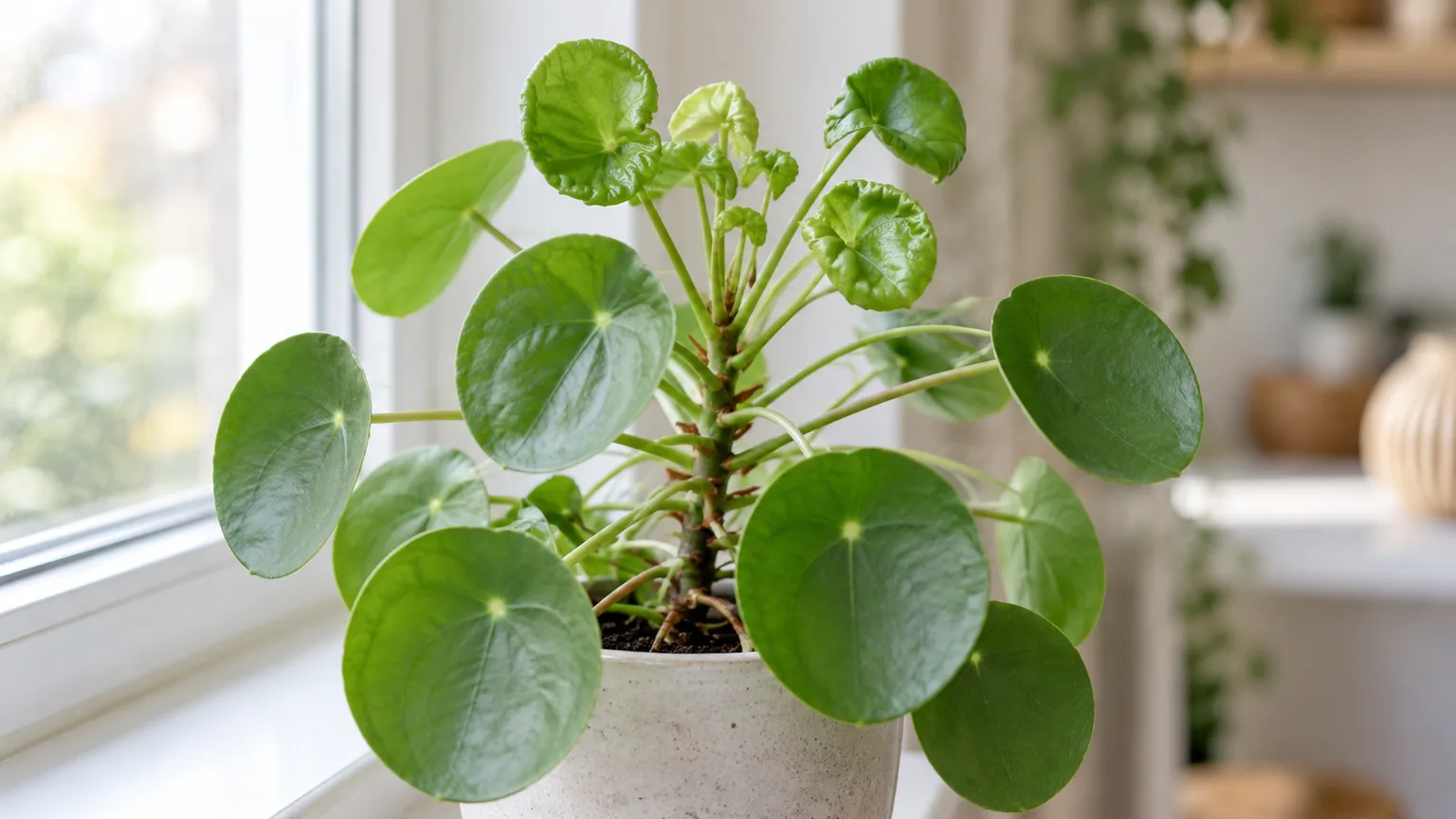
Distorted Leaves on Pilea Peperomioides: Causes, Checks & Fixes
This guide covers distorted leaves on Pilea Peperomioides. See also the general Distorted Leaves guide, watering, and light pages for this plant.
Distorted Leaves on Pilea Peperomioides: Causes, Checks & Fixes
Quick answer
Distorted leaves on a Pilea peperomioides are a symptom, not a diagnosis. When several leaves are deformed as they open, inspect the growing tip for aphids, thrips, mealybugs, or mite injury before assuming the plant needs more water or fertilizer. If the older leaves look normal and the youngest leaves are puckered, thickened, or misshapen, the pattern is more useful than the word “distorted” by itself.
First action: isolate the Pilea and inspect its newest growth closely. Do not spray, fertilize, or unpot it before you have looked for a cause. The plant’s familiar circular, peltate leaves are attached by petioles near the center of the blade, so compare the new leaves around the central stem with older, fully opened leaves rather than comparing their overall size alone.
What distorted leaves look like on Pilea peperomioides
A Pilea may have a leaf that opens unevenly, folds along one side, puckers, cups, or looks crumpled beside otherwise flat coin-shaped foliage. The most useful clue is where the change begins. Damage concentrated at the stem tip or on several leaves that are still expanding raises suspicion of sap-feeding pests; a single leaf bent after it caught on a curtain or was handled may be an isolated injury. Do not call either pattern a disease without checking the plant.
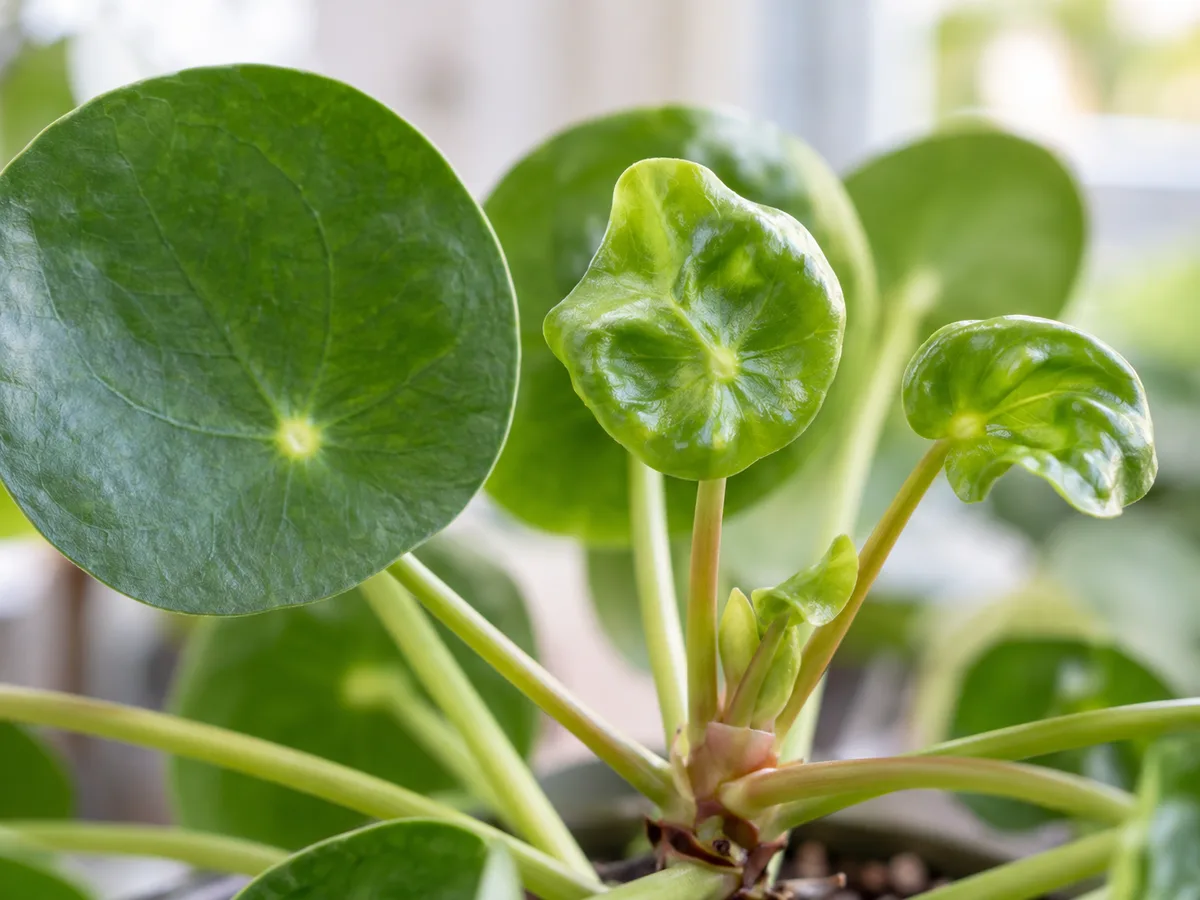
A single misshapen leaf cannot identify its cause. Compare the newest leaves with older growth, then inspect the undersides and the points where the petioles meet the stem.
The page is about the shape of new growth. For a broader comparison of twisted, wrinkled, curled, and misshapen foliage across houseplants, use the distorted-leaves symptom guide; here, the diagnosis depends on how a Pilea’s central growth point and coin leaves are responding.
A few signs point toward a cause more strongly than distortion alone:
- Sticky leaves or a shiny patch under the plant suggest honeydew from sap-feeding insects. Look for small insects near tender leaves and petiole joints.
- Pale scarring with tiny black specks makes thrips more plausible than a simple watering problem.
- Fine webbing and stippling fit spider mites better than a leaf that is merely curled.
- New leaves that feel unusually thick or brittle and cup downward can fit broad- or cyclamen-mite injury, even when the mites themselves are too small to see.
- General drooping, yellowing, or a pot that stays wet shifts attention toward root stress. That can weaken the whole Pilea, but it does not by itself prove why one leaf is puckered; UC IPM notes that root-rot symptoms above ground can vary.
Why Pilea peperomioides develops distorted leaves
Aphids and other sap feeders at the growing tip
Aphids feed on plant fluids and often gather where new growth is soft. On indoor plants, puckered, curled, distorted leaves and stunted or disfigured new growth can accompany aphid activity; look for moving insects, cast skins, or sticky honeydew rather than treating the leaf shape as proof. Mealybugs can also leave stunted or distorted leaves, especially when cottony clusters hide where leaves attach to the stem or in a protected crease; check this pattern against the same houseplant pest signs.
That location makes the Pilea crown worth checking carefully. Its emerging leaves are crowded close together at the top of the central stem, and the joints where petioles meet the stem create small sheltered places that are easy to miss during a quick glance. Use a flashlight and magnifier, gently parting leaves without pulling them apart. A close inspection is more informative than spraying the round leaf faces and hoping the problem stops.
Thrips and mites can damage unfolding leaves
Thrips are slender, fast-moving insects that feed in protected crevices and on growing tips. Feeding can leave pale scars or stunting; tissue damaged before it opens may later appear distorted. Small black specks near the scars can be their droppings, so look at the underside and at the folded edge of a young Pilea leaf, not only the visible upper surface, as described in UC IPM’s houseplant guide.
Mites make a different pattern. Spider mites commonly leave fine stippling and sometimes webbing on leaf undersides. Broad or cyclamen mites are much harder to see; their injury is more likely when the newest growth is thickened, brittle, stunted, or cupped downward. UC IPM notes that these signs can resemble chemical injury, which is why an invisible mite should remain a possibility rather than a confident diagnosis; its houseplant pest guide describes these lookalikes.
Do not assume every curled Pilea leaf is caused by spider mites. If there is no webbing or stippling, and a hand lens does not show mites, continue through the other checks. If the tip keeps producing damaged leaves but pests remain impossible to identify, take clear close-up photographs and seek help from a cooperative extension office or a plant clinic instead of escalating to a broad pesticide treatment.
Environmental stress can curl leaves without a pest
Pilea leaf curl can also follow a care change. Bright indirect light is a safer baseline than strong direct sun, while a sudden change in placement, heat, humidity, or watering can coincide with curled edges. The Spruce’s Pilea guide lists these as possible leaf-curl causes, so use the timing of the change and the rest of the plant’s appearance to weigh them; environmental stress is not confirmed merely because a leaf looks folded.
Compare the last month of care with the plant’s usual position. Did it move from a bright room to a dim corner, sit in a hot afternoon window, stand near a heater, or get moved outdoors and back? A Pilea that is simply leaning toward the window or producing a longer bare stem has a light-orientation problem, not necessarily distorted leaves; Pilea care guidance links light and rotation to balanced growth. Turning the pot can balance the direction of growth, but rotation will not remove a pest or repair a damaged leaf.
Check the soil by feel rather than by a calendar. If the upper inch of mix is still damp and the pot feels heavy, do not water because the leaves look unusual. If the mix is dry well below the surface and the whole plant is limp, water thoroughly and let excess drain. The Royal Horticultural Society’s pilea guidance recommends bright but indirect light, a warm position away from cold drafts, and watering when the upper layer begins to dry; those conditions are a sensible baseline for ruling out a recent Pilea-care mismatch.
One damaged leaf is not the same as a continuing problem
A leaf can be creased while it is unfolding or damaged by rubbing against a nearby object. If only one leaf is affected, the rest of the plant is firm, and the following leaves open normally, monitor rather than remove the growing tip. In contrast, repeated deformity across successive new leaves deserves a closer inspection because the same cause may be affecting the plant’s most active tissue.
Pilea’s growth point matters here. Do not cut off the top of the central stem just to make the plant look even; that removes the place that produces its next leaves and can change the plant’s form. If a leaf is fully torn or mostly dead, trim only that leaf stalk with clean scissors. Leave sound petioles and healthy leaves in place while you correct the cause.
How to confirm the cause at home
Work in this order and keep the plant in quarantine while you inspect it. Write down what you find; it is easy to mistake a care problem for a pest problem if several conditions are changed at the same time.
- Compare leaves by age. Set the newest two or three leaves beside the older, fully expanded leaves. Note whether the distortion repeats at the growing point, appears on just one side, or is limited to an older leaf.
- Inspect the top and the petiole joints. Check both leaf surfaces, the folded margins, the central stem, and the points where leaf stalks join it. Look for live insects, shed skins, cottony material, sticky residue, webbing, pale scarring, and black specks.
- Tap a leaf over white paper. Small moving specks are easier to notice against a plain background. This is a screening check, not a species identification; if you cannot tell what moved, photograph it or ask an extension specialist.
- Check the pot and root-zone clues. Feel the mix below the surface and check that water can leave through the drainage hole. Unpot only if there are additional signs such as a sour smell, softening at the stem base, persistent wetness, or widespread wilting; distorted leaves alone do not justify disturbing Pilea roots.
- Reconstruct recent changes. Note a move, repot, temperature swing, missed watering, prolonged wet soil, direct-sun exposure, or new plant nearby. A change is a lead to test, not proof of cause.
A confirmed diagnosis uses more than leaf shape. Aphids are supported by visible soft-bodied colonies or honeydew with puckering; thrips are supported by pale scarring, tiny dark specks, or insects at the folded growth point; mite injury is more plausible when the newest leaves are thickened or brittle and the pattern continues. If those signs are absent, turn back to the Pilea’s light, water, temperature, and the possibility of one-time mechanical damage.
The first fix: isolate before you treat
Keep the Pilea apart from neighboring plants and inspect it in good light. This is the safest first action because several pests can distort new growth, yet the same appearance can follow a change in light, water, or temperature. Isolation also gives you time to identify a pest without transferring it to another plant. Do not begin with neem oil, fertilizer, pruning, or repotting.
If you find a small aphid colony or visible thrips, a careful rinse with lukewarm water can remove some exposed insects; UAF Extension recommends a water spray to dislodge aphids, and UC IPM recommends washing thrips from houseplants. Shield the potting mix with your hand or a removable cover, support the stem, and rinse both sides of the leaves and the growing point; avoid force that could snap the thin petioles. Inspect again after the leaves dry. A rinse reduces exposed insects but does not confirm that eggs or hidden stages are gone, so continue checking the new growth.
If live pests remain, choose a product labeled for indoor plants and for the pest you identified, and follow its label exactly; UC IPM advises checking the label and testing for plant injury. Test it on one older leaf first and wait to make sure the leaf is not damaged before treating the whole Pilea. Do not mix household detergents or oils into a spray. If you cannot name the pest, pause and get identification help rather than layering different treatments.
If there are no pest signs, do not treat the plant as infested. Correct only the mismatch supported by your inspection: move it out of harsh sun, return it to steady bright indirect light, let an overly wet mix dry appropriately, or water a genuinely dry root ball. Avoid changing the location, soil, pot, watering, and feeding schedule in one weekend; otherwise, the next leaves will not tell you which correction helped.
Lookalike patterns on a Pilea
| What you see | More useful clue | Next check |
|---|---|---|
| Puckered or curled new leaves with sticky residue | Aphids or mealybugs are more likely than dry soil alone | Inspect the crown, petiole joints, and undersides for colonies or cottony clusters |
| Pale scars, black specks, and distorted growth | Thrips may be feeding in folds or at the growing point | Tap the leaves over white paper and check the folded edges |
| Stippled leaves with fine webbing | Spider mites fit this pattern better than isolated deformation | Use a hand lens under leaves and inspect nearby plants |
| Thick, brittle, downward-cupped new leaves without obvious insects | Broad or cyclamen mites are possible but difficult to confirm by eye | Avoid guessing at treatment; get close-up identification help |
| A plant leaning toward a window with smaller or fewer leaves | Light direction or low light may be affecting the whole Pilea | Review the placement and compare the plant’s orientation over time |
| Limp leaves with wet, sour-smelling mix or a soft stem base | Root-zone trouble needs attention alongside the leaf symptom | Check drainage and roots only when these additional signs are present |
| One bent leaf with normal growth around it | Local handling or unfolding damage may be more likely | Leave the crown intact and watch the next leaves |
If the main symptom is smooth edge-curling without puckering or pest evidence, compare it with the Pilea curling-leaves guide. When the leaves are otherwise normal but the stem is long, bare, or leaning, use the Pilea leggy-growth guide. For soft roots, ongoing wetness, and whole-plant decline, the Pilea root-rot guide is the better route.
Recovery: judge the next leaves, not the old ones
A leaf that has already expanded with a crease, curl, or puckered patch usually does not flatten back into a perfect coin. You can remove a badly damaged leaf for appearance, but pruning is optional and does not cure the cause. Keep enough healthy foliage to support the plant, especially if only one or two leaves are affected.
After a confirmed pest treatment or a targeted care correction, check the Pilea weekly for new insects, fresh scarring, and the shape of leaves as they open. A useful sign is that successive new leaves are smoother and the damaged area is no longer expanding. Improvement may take longer in a cool or low-light period because the plant may grow more slowly; do not judge recovery from a single old leaf or expect a precise number of days.
Escalate the inspection if new leaves continue to emerge thick, brittle, or deformed after visible pests are removed and the plant’s conditions are stable. A very small mite or chemical exposure may need expert identification. If the stem base becomes soft, lesions turn dark and water-soaked, or the whole plant collapses despite a corrected root-zone problem, isolate it and ask a local plant clinic whether recovery is realistic; UC IPM describes water-soaked lesions among bacterial problems of indoor plants, including Pilea.
Pilea-specific prevention
Give the coin-leaf crown room to grow. Crowding several Pileas tightly together makes it harder to see pests at the center and can rub the newest leaves before they open. Keep the central stem upright without burying it deeper to correct a lean, and avoid repeatedly turning a plant that is still adjusting to a new window. If the pot needs a different position, make the change once and watch how the next leaves respond.
Keep care steady rather than strict by calendar. Bright indirect light supports balanced growth, but a hot pane of glass or a cold draft can create a sudden contrast the plant did not have in its previous spot. Water when the upper layer of the mix begins to dry, then empty water that collects in an outer pot. If the soil remains wet far longer than usual, assess drainage and light before shortening the interval between waterings. Use the Pilea light guide, watering guide, and soil guide to check those individual parts of the routine.
Inspect the central stem and both sides of the leaves when you rotate the plant or water it. Check any new Pilea you bring home before it sits beside your established plants, and keep it separate while you watch for insects or new damage. If one leaf is misshapen but there is no repeated damage, avoid preventive sprays; they add stress without solving an identified problem. The best prevention is an early look at the newest leaves and one measured response when the pattern changes.
When to use this page vs other Pilea guides
Use this guide when Pilea’s leaves are puckered, twisted, uneven, or misshapen, especially as they emerge. If you already see a definite pest, use the relevant plant problem page; if the main clue is soil or light, follow the matching care issue instead. That keeps the diagnosis focused on what is actually visible.
- Use the Pilea problems hub when you are unsure which symptom best describes the plant.
- Choose the Pilea yellow-leaves guide when older leaves are yellowing more than they are misshapen.
- Choose the thrips guide when you find slender insects or pale scars with dark specks and want the pest’s general identification steps.
- Use the Pilea overview for the species’ care topics and general growing context.
Related tool
If several signs appear together or you are not sure which symptom to investigate first, use the Plant Problem Diagnosis tool. It can help compare visible signs and point you toward a relevant guide; it cannot identify an insect from a photo or replace close inspection of the Pilea’s new growth.