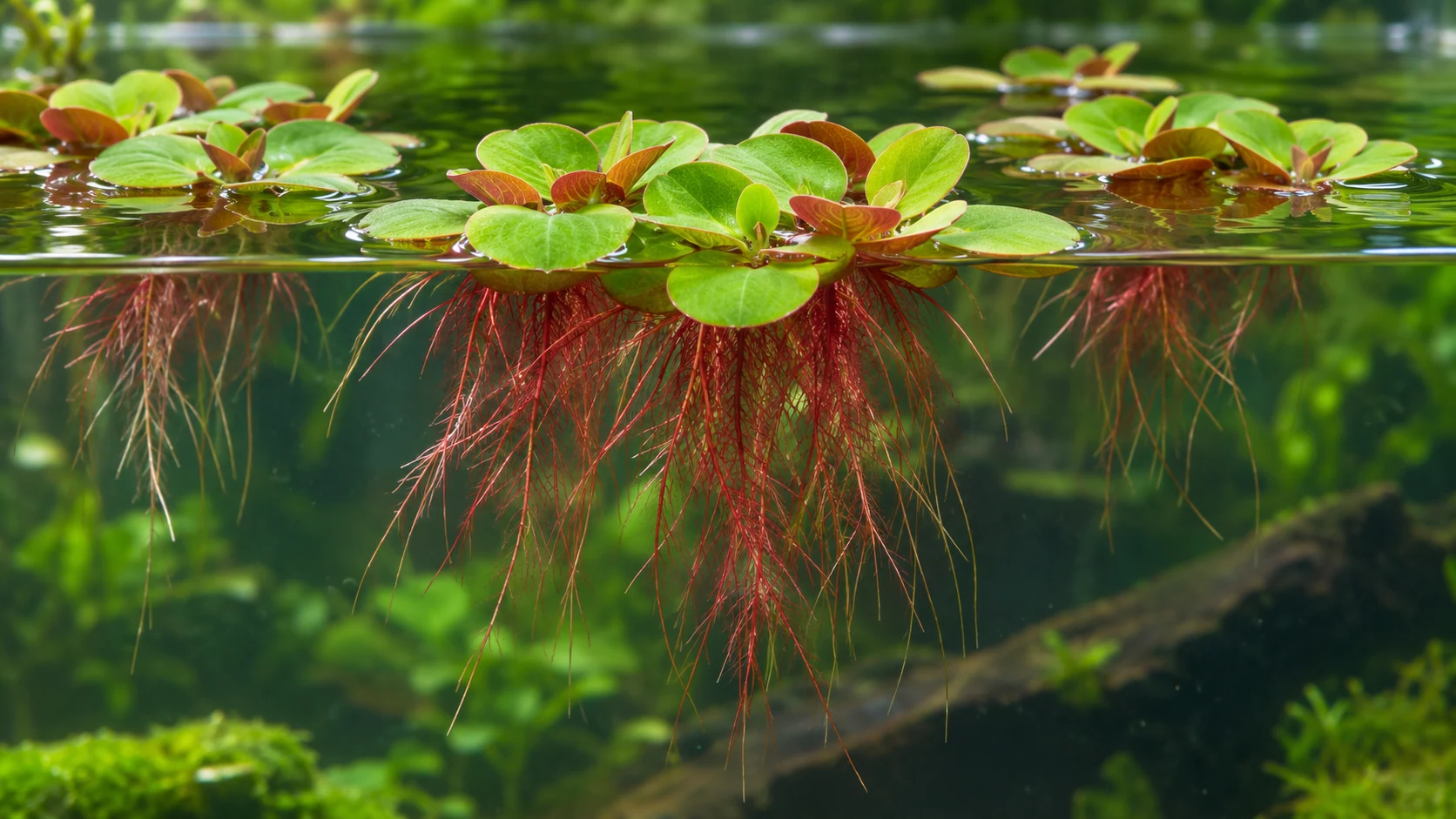
Browse general houseplant problems or use our diagnosis tool for Red Root Floater.
Red Root Floater problems
Use the guides below to diagnose and fix common issues on Red Root Floater. Each problem page explains why it happens on this species and what to do first.
Does Red Root Floater need to be planted in aquarium soil?
No. Phyllanthus fluitans is free-floating. Let its leaves sit at the surface and its roots hang in the water; it does not need potting soil or aquarium substrate.
Why are my Red Root Floater leaves green instead of red?
Leaf color varies with lighting and aquarium water conditions. Tropica associates stronger red coloration with strong light and good nutrient availability, while other aquarium observations report color changes with nitrogen availability. Keep nutrients balanced for the whole tank rather than deliberately depriving plants or livestock of nitrogen.
How much surface movement does Red Root Floater need?
Gentle movement is a good starting point. Keep the mat away from a strong filter outlet or use a floating corral so the leaves and roots are not constantly driven underwater, while retaining open water and normal tank circulation.
How do I stop Red Root Floater from covering the aquarium?
Use a floating ring to confine the area where it grows and scoop out surplus portions regularly. Remove loose pieces before they reach filter intakes or block light from plants below.
Can Red Root Floater be grown in a terrestrial pot?
This guide covers its usual aquarium use as a free-floating aquatic plant, not terrestrial pot culture. Keep the roots in aquarium water and do not treat it like a soil-grown houseplant.
How should I dispose of extra Red Root Floater?
Remove it from the aquarium, contain it with household waste, and do not release it or aquarium water into ponds, canals, or natural waterways. UF/IFAS lists the species as nonnative in Florida and advises preventing aquarium releases.
How often should I water Red Root Floater?
Grow Phyllanthus fluitans floating freely on the surface of a freshwater aquarium. Do not plant it in soil or bury its roots. Keep the leaves at the surface, where they can access light and air, and use a floating ring or corral if you need to keep the plant away from filter outlets or open areas. In practice, water there is no terrestrial watering schedule for a plant grown in an aquarium. Maintain stable aquarium water for the tank’s fish and invertebrates, and check the floater during routine tank care for crowding, trapped clippings, and leaves pushed underwater. Check that leaves remain at the surface and the hanging roots are not constantly swept by a strong outlet. Watch new growth, leaf color, and how much of the surface is covered; color also responds to light and nutrient availability, so it is not a stand-alone water-quality test. Indoor aquarium care is governed by the tank’s temperature, light, and maintenance rather than outdoor seasons. Keep the aquarium stable for its livestock and remove excess growth when it accumulates.
How this Red Root Floater problems guide is reviewed?
Written by Sai AnanthLead content writer at LeafyPixels. B.Pharmacy graduate from Andhra University with a background in pharmacognosy, turned indoor gardening writer after a long-time plant hobby became a research-led resource for home growers.View Sai Ananth's profile · Reviewed by LeafyPixels Review Board
This Red Root Floater problems problem guide was researched and written by Sai AnanthLead content writer at LeafyPixels. B.Pharmacy graduate from Andhra University with a background in pharmacognosy, turned indoor gardening writer after a long-time plant hobby became a research-led resource for home growers.View Sai Ananth's profile. Problems symptoms on Red Root Floater, lookalike causes, and step-by-step fixes are cross-checked against extension pest, disease, and care references before publication.
We prioritize sources that hold up under scrutiny:
University cooperative extension bulletins and fact sheets (Penn State, Clemson, UMD, NC State, and similar programs)
Botanical garden and horticultural society publications
Peer-reviewed plant science and veterinary toxicology references where pet safety matters (including ASPCA Animal Poison Control)
Established reference works on indoor plant culture
The LeafyPixels editorial team then reviews the draft for clarity, step-by-step usefulness, and fit with real apartment and home conditions-not ideal greenhouse setups. When guidance changes materially, we update the page and note the revision date.