Red Root Floater Care: Aquarium Light, Red Roots
Phyllanthus fluitans
Let Phyllanthus fluitans float freely in freshwater, use moderate to bright aquarium light for stronger color, maintain balanced tank nutrients, and remove excess growth before it blocks light or surface area.
Red Root Floater Aquarium Care Guide
Start with wateringThe most common care mistake for Red Root FloaterRed Root Floater watering and water quality →Red Root Floater care essentials
Light
Moderate to bright aquarium lighting; stronger light can support more red coloration
Water
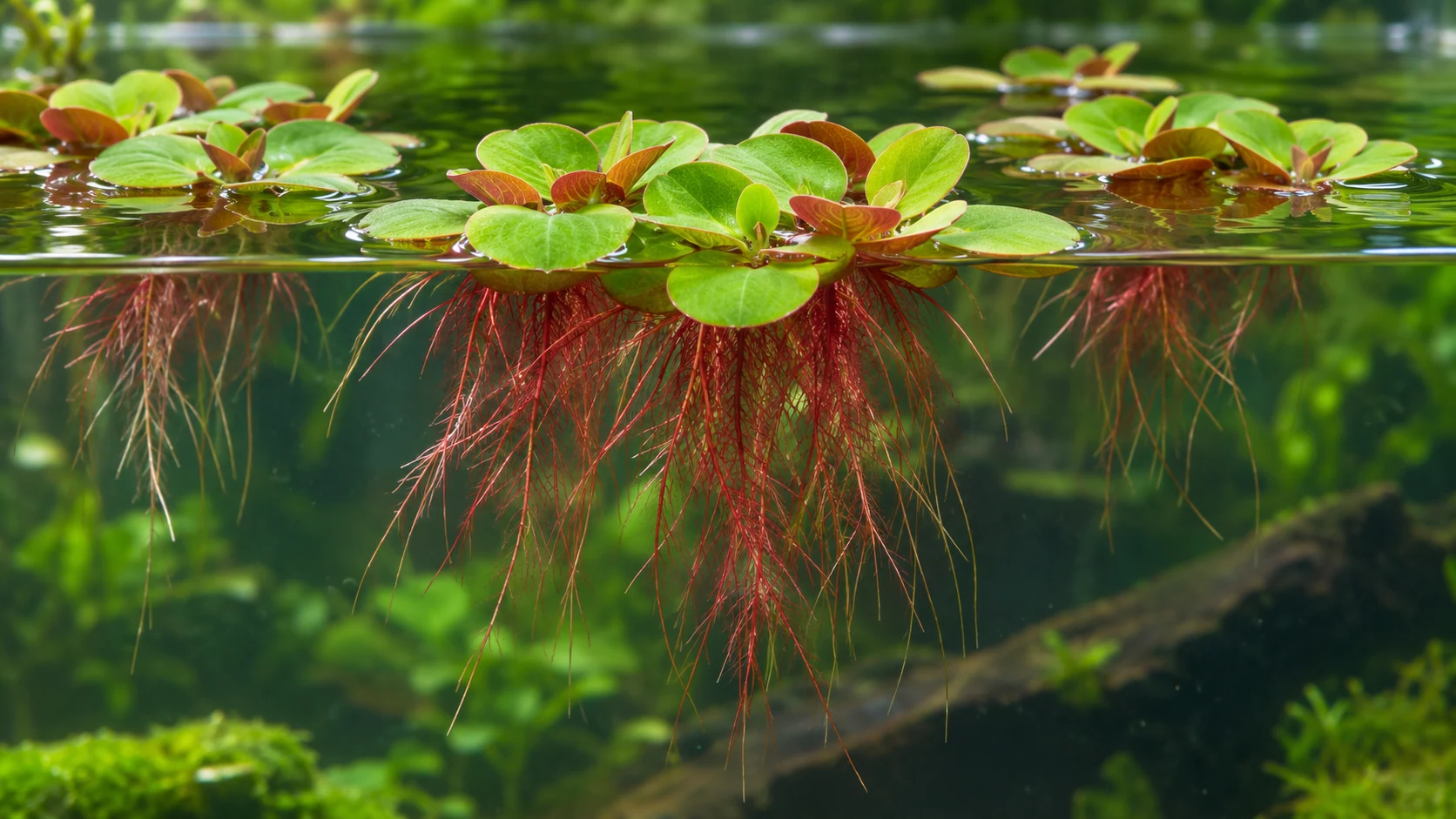
Grow Phyllanthus fluitans floating freely on the surface of a freshwater aquarium. Do not plant it in soil or bury its roots. Keep the leaves at the surface, where they can access light and air, and use a floating ring or corral if you need to keep the plant away from filter outlets or open areas.
Soil
No soil or planted substrate is needed. Red Root Floater is a free-floating aquatic plant; keep its roots hanging in the water and its leaves resting at the surface.
Humidity
Temperature
Fertilizer
Dose only as part of the aquarium's overall nutrient plan. Tropica recommends regular aquarium plant nutrition for growth and color, while established livestock and substrate may already supply nutrients in some tanks.. Aquarium plant fertilizer used according to its label and the needs of the whole tank
About Red Root Floater
Red Root Floater is native to South American freshwater wetlands. The species has also been documented outside its native range, including in Florida, where it is treated as a nonnative aquatic plant., typically reaches A floating mat can spread across the water surface when conditions suit it. UF/IFAS records brittle shoots up to about 13 cm long and individual leaves roughly 9–17 mm long; aquarium spread depends on how much open surface is available. indoors, with fast when light and available nutrients support active growth; growth and surface coverage vary with aquarium conditions. growth. Red Root Floater has a free floating aquatic perennial. its leaves and short brittle stems stay at the water surface while red roots hang below; it is not a rooted substrate plant. growth habit and part of the Phyllanthaceae family. It is also known as Red Root Floater and Floating Phyllanthus.
| Detail | Information |
|---|---|
| Also known as | Red Root Floater, Floating Phyllanthus |
| Native region | South American freshwater wetlands. The species has also been documented outside its native range, including in Florida, where it is treated as a nonnative aquatic plant. |
| Mature size | A floating mat can spread across the water surface when conditions suit it. UF/IFAS records brittle shoots up to about 13 cm long and individual leaves roughly 9–17 mm long; aquarium spread depends on how much open surface is available. |
| Growth rate | Fast when light and available nutrients support active growth; growth and surface coverage vary with aquarium conditions. |
| Growth habit | Free Floating Aquatic Perennial. Its Leaves And Short Brittle Stems Stay At The Water Surface While Red Roots Hang Below; It Is Not A Rooted Substrate Plant. |
| Scientific name | Phyllanthus fluitans |
| Family | Phyllanthaceae |
How to care for Red Root Floater?
How much light does Red Root Floater need?
Moderate to bright aquarium lighting; stronger light can support more red coloration. Lower aquarium light, where leaves may stay greener or brownish. Brighter planted-tank light when heat, algae, and the needs of other livestock are managed. low light
- Moderate to bright aquarium lighting - Moderate to bright aquarium lighting; stronger light can support more red coloration.
- stronger light can support more red coloration - Moderate to bright aquarium lighting; stronger light can support more red coloration.
- Lower aquarium light, where leaves may stay greener or brownish - Lower aquarium light, where leaves may stay greener or brownish.
- Brighter planted-tank light when heat - Brighter planted-tank light when heat, algae, and the needs of other livestock are managed.
- algae - Brighter planted-tank light when heat, algae, and the needs of other livestock are managed.
- and the needs of other livestock are managed - Brighter planted-tank light when heat, algae, and the needs of other livestock are managed.
- low light - Lower aquarium light, where leaves may stay greener or brownish.
When should you water Red Root Floater?
Grow Phyllanthus fluitans floating freely on the surface of a freshwater aquarium. Do not plant it in soil or bury its roots. Keep the leaves at the surface, where they can access light and air, and use a floating ring or corral if you need to keep the plant away from filter outlets or open areas.
- Check that leaves remain at the surface and the hanging roots are not constantly swept by a strong outlet. Watch new growth - Keep the leaves at the surface, where they can access light and air, and use a floating ring or corral if you need to keep the plant away from filter outlets or open areas.
- leaf color
- and how much of the surface is covered - Keep the leaves at the surface, where they can access light and air, and use a floating ring or corral if you need to keep the plant away from filter outlets or open areas.
- color also responds to light and nutrient availability - Keep the leaves at the surface, where they can access light and air, and use a floating ring or corral if you need to keep the plant away from filter outlets or open areas.
- so it is not a stand-alone water-quality test - Grow Phyllanthus fluitans floating freely on the surface of a freshwater aquarium.
- Drain excess water - Grow Phyllanthus fluitans floating freely on the surface of a freshwater aquarium.
What soil works best for Red Root Floater?
No soil or planted substrate is needed. Red Root Floater is a free-floating aquatic plant; keep its roots hanging in the water and its leaves resting at the surface.
- No potting mix or aquarium substrate is required - No soil or planted substrate is needed.
- A floating plant ring can keep the mat contained without pinning roots under hardscape - Red Root Floater is a free-floating aquatic plant; keep its roots hanging in the water and its leaves resting at the surface.
How to propagate Red Root Floater?
Healthy shoots can branch and floating portions may detach readily. Move only as much as you want to keep, and remove surplus growth promptly so it does not shade other plants or cover the whole surface.
- Retain healthy portions that detach from the brittle floating stems - Healthy shoots can branch and floating portions may detach readily.
- Move a small portion to a clear area of the aquarium or a separate tank - Move only as much as you want to keep, and remove surplus growth promptly so it does not shade other plants or cover the whole surface.
- Use a floating ring to keep new growth from spreading over the entire surface - Move only as much as you want to keep, and remove surplus growth promptly so it does not shade other plants or cover the whole surface.
Grower notes for Red Root Floater
Let the plant float; do not bury it
UF/IFAS describes Phyllanthus fluitans as a free-floating perennial aquatic plant. Keep the leaves at the surface and let its red roots hang in the aquarium water. It needs no terrestrial potting mix or planted substrate.
Treat color as a response to conditions
Tropica notes that leaf color can range from green or brownish to deep red depending on lighting and water parameters. It recommends strong light and good nutrients for vivid coloration; low light and nutrient availability can leave the plant greener. Keep tank nutrition balanced for its livestock instead of deliberately starving the aquarium to chase red leaves.
Keep the surface movement gentle
Tropica recommends lower surface movement so the plant can spread, and 2Hr Aquarist warns that turbulent flow can damage it. Place it away from strong filter returns or use a floating ring, while keeping enough open water for normal aquarium circulation and gas exchange.
Thin the mat before it shades the tank
Because the plant can grow quickly at the water surface, a dense patch can shade rooted plants below. Scoop out surplus growth and collect detached fragments before they reach filter intakes. A floating corral helps keep the remaining plants in one area.
Dispose of surplus plants responsibly
UF/IFAS documents this aquarium plant outside its native South American range in Florida and warns that it can form a closed canopy over water. Seal unwanted plants with household waste; never release plant pieces or aquarium water into a pond, canal, or other natural waterway.
Expect floating portions to separate
Tropica reports that its fragile stems branch and floating portions can detach easily. Keep healthy pieces you want to propagate, but remove the rest during maintenance so the mat does not spread across the whole aquarium surface.
Red Root Floater and Pets
No species-specific veterinary toxicity classification for Phyllanthus fluitans was confirmed in the sources checked. The ASPCA plant list reviewed did not provide an exact entry; absence from a list is not proof of safety. Keep aquariums and aquarium-treated water away from pets that may drink or chew them, and ask a veterinarian if ingestion occurs.
Aquarium use does not establish that Red Root Floater is safe to eat. No exact species entry was found in the ASPCA plant list checked; keep pet classifications under review rather than inferring safety from a missing listing.
Watering Red Root Floater
For Red Root Floater, check that leaves remain at the surface and the hanging roots are not constantly swept by a strong outlet. Watch new growth, leaf color, and how much of the surface is covered; color also responds to light and nutrient availability, so it is not a stand-alone water-quality test. and water there is no terrestrial watering schedule for a plant grown in an aquarium. Maintain stable aquarium water for the tank's fish and invertebrates, and check the floater during routine tank care for crowding, trapped clippings, and leaves pushed underwater. Indoor aquarium care is governed by the tank's temperature, light, and maintenance rather than outdoor seasons. Keep the aquarium stable for its livestock and remove excess growth when it accumulates.
| Detail | Information |
|---|---|
| How often | There is no terrestrial watering schedule for a plant grown in an aquarium. Maintain stable aquarium water for the tank's fish and invertebrates, and check the floater during routine tank care for crowding, trapped clippings, and leaves pushed underwater. |
| How to check | Check that leaves remain at the surface and the hanging roots are not constantly swept by a strong outlet. Watch new growth, leaf color, and how much of the surface is covered; color also responds to light and nutrient availability, so it is not a stand-alone water-quality test. |
| Seasonal changes | Indoor aquarium care is governed by the tank's temperature, light, and maintenance rather than outdoor seasons. Keep the aquarium stable for its livestock and remove excess growth when it accumulates. |
Signs of overwatering
- Not applicable while it is kept afloat in a filled aquarium.
- Repeatedly submerged or waterlogged leaves may deteriorate; restore a clear surface position and check the flow.
Signs of underwatering
- Not applicable to established aquarium growth while the plant remains afloat.
- Leaves left dry outside the aquarium can desiccate; keep portions wet during transfer.
Soil & potting for Red Root Floater
Use a mix of No potting mix or aquarium substrate is required, A floating plant ring can keep the mat contained without pinning roots under hardscape for Red Root Floater. Drainage is not relevant to a free-floating aquarium plant. Keep the surface accessible and prevent the plant from being pulled into filter intakes. Repot not applicable; thin or reposition the floating mat instead of repotting, ideally in no seasonal repotting is needed in an indoor aquarium. Thin the plant during routine maintenance whenever it begins covering more surface than the tank can spare.
| Detail | Information |
|---|---|
| Recommended mix | No potting mix or aquarium substrate is required, A floating plant ring can keep the mat contained without pinning roots under hardscape |
| Drainage | Drainage is not relevant to a free-floating aquarium plant. Keep the surface accessible and prevent the plant from being pulled into filter intakes. |
| Repotting frequency | Not applicable; thin or reposition the floating mat instead of repotting |
| Best season to repot | No seasonal repotting is needed in an indoor aquarium. Thin the plant during routine maintenance whenever it begins covering more surface than the tank can spare. |
Signs it needs repotting
- The mat is shading submerged plants that need light.
- Roots or leaves are being drawn into equipment or trapped against the aquarium glass.
- Surface coverage is becoming dense enough to limit open water for gas exchange.
Humidity & temperature for Red Root Floater
Keep the aquarium temperature stable and appropriate for its fish and other inhabitants; sources reviewed for this profile did not establish a single species-specific target range.
| Detail | Information |
|---|---|
| Temperature notes | Keep the aquarium temperature stable and appropriate for its fish and other inhabitants; sources reviewed for this profile did not establish a single species-specific target range. |
Fertilizer & pruning for Red Root Floater
Feed Red Root Floater dose only as part of the aquarium's overall nutrient plan. Tropica recommends regular aquarium plant nutrition for growth and color, while established livestock and substrate may already supply nutrients in some tanks. using aquarium plant fertilizer used according to its label and the needs of the whole tank. Terrestrial fertilizers and attempts to force red color by starving the aquarium of nitrogen.
| Detail | Information |
|---|---|
| Fertilizer schedule | Dose only as part of the aquarium's overall nutrient plan. Tropica recommends regular aquarium plant nutrition for growth and color, while established livestock and substrate may already supply nutrients in some tanks. |
| Fertilizer type | Aquarium plant fertilizer used according to its label and the needs of the whole tank |
| What to avoid | Terrestrial fertilizers and attempts to force red color by starving the aquarium of nitrogen |
Pruning
Scoop or lift out excess plants during routine maintenance and collect loose fragments before they enter a filter. A floating corral can contain the remaining mat. Seal and dispose of unwanted material with household waste; never release this plant or aquarium water outdoors.