Amazon Sword Aquarium Care: A Complete Guide
Echinodorus grisebachii (listed by World Flora Online as Aquarius grisebachii; commonly sold under E. bleheri names)
Grow Amazon Sword in a freshwater aquarium with low-to-medium light, an exposed crown, root-feeding substrate, stable water conditions, and room for its broad leaves to mature.
Amazon Sword Aquarium Care: A Complete Guide
Start with wateringThe most common care mistake for Amazon SwordAquarium watering guide →Amazon Sword care essentials
Light
Low to medium aquarium lighting
Water
Amazon Sword is an aquatic aquarium plant, not a potted houseplant. Keep its roots submerged in freshwater and maintain a stable tank environment suited to the fish and invertebrates sharing the aquarium. It does not need separate top-watering; routine aquarium top-offs and water changes should follow the needs of the whole tank.
Soil
Use aquarium-safe planted substrate or fine-to-medium gravel with aquarium root tabs. Plant the roots into the substrate but leave the central crown at or just above the surface; do not bury the crown or use ordinary potting soil.
Humidity
Temperature
Aquarium care references commonly place Amazon Sword forms around 22–28 °C (72–82 °F); keep temperature stable and compatible with the aquarium's fish and invertebrates.
Fertilizer
Amazon Sword is a strong root feeder. Use aquarium-safe root tabs near the roots in inert or depleted substrate. Supplemental CO₂ is optional for typical low-tech tanks; do not use houseplant fertilizer products in an aquarium.
About Amazon Sword
Amazon Sword is native to Freshwater habitats across tropical Central and South America and the Caribbean; the exact range depends on the species sold under the shared aquarium-trade name Amazon Sword., typically reaches About 20–50 cm tall for the common large sword sold as Echinodorus grisebachii 'Bleherae'; compact cultivars and other species sold as Amazon Swords may be smaller. indoors, with moderate in a stable aquarium with adequate root-zone nutrients growth. Amazon Sword has a rosette forming freshwater aquatic perennial. leaves emerge from a central crown; roots are planted in the substrate, and established plants may produce flower stalks with plantlets. growth habit and part of the Alismataceae family. It is also known as Amazon Sword Plant, Echinodorus grisebachii, Echinodorus grisebachii 'Bleherae', and Echinodorus bleheri.
| Detail | Information |
|---|---|
| Also known as | Amazon Sword Plant, Echinodorus grisebachii, Echinodorus grisebachii 'Bleherae', Echinodorus bleheri |
| Native region | Freshwater habitats across tropical Central and South America and the Caribbean; the exact range depends on the species sold under the shared aquarium-trade name Amazon Sword. |
| Mature size | About 20–50 cm tall for the common large sword sold as Echinodorus grisebachii 'Bleherae'; compact cultivars and other species sold as Amazon Swords may be smaller. |
| Growth rate | Moderate in a stable aquarium with adequate root-zone nutrients |
| Growth habit | Rosette Forming Freshwater Aquatic Perennial. Leaves Emerge From A Central Crown; Roots Are Planted In The Substrate, And Established Plants May Produce Flower Stalks With Plantlets. |
| Scientific name | Echinodorus grisebachii (listed by World Flora Online as Aquarius grisebachii; commonly sold under E. bleheri names) |
| Family | Alismataceae |
Amazon Sword Aquarium Care: A Complete Guide
Amazon Sword is a rooted freshwater aquarium plant, not a terrestrial houseplant that happens to sit in water. The most useful starting points are to give its roots a stable place in aquarium substrate, keep the central crown visible, and leave enough room for a broad, tall rosette. The name on the label matters: plants sold as Amazon Sword are often identified as Echinodorus grisebachii or under the older aquarium-trade names E. bleheri and E. bleherae. The Amazon Sword plant page summarizes the plant details and care data used here.
What Amazon Sword needs in a tank
| Care factor | Practical starting point |
|---|---|
| Water | Stable freshwater conditions suited to the aquarium’s fish and invertebrates |
| Light | Keep the schedule consistent; low to moderate light can work for the common ‘Bleherae’ form |
| Planting | Bury the roots and keep the central crown uncovered |
| Root nutrition | Use a nutrient-bearing aquarium substrate or aquarium-safe root tabs in inert gravel |
| CO₂ | Not essential for basic growth in many low-tech tanks; added CO₂ may support stronger growth |
| Space | Plan for a large rosette that may shade smaller plants |
Treat these as starting points, not a single universal recipe. Supplier profiles describe different plant forms and growing conditions, and aquarium livestock may set tighter limits on temperature and water chemistry than the plant does.
Confirm the plant name before planning
The Royal Horticultural Society lists Echinodorus bleherae and E. bleheri among the synonyms of E. grisebachii in its RHS plant entry. A peer-reviewed Kew Bulletin revision of Echinodorus documents changes in species boundaries across the genus, which helps explain why aquarium labels may preserve older names. Tropical Fish Hobbyist notes that the common name Amazon Sword has historically covered multiple larger Echinodorus species in its species profile. A shop label may therefore describe a trade form rather than identify a precisely documented cultivar. If the seller lists E. grisebachii ‘Bleherae’, that is the large, classic sword most care profiles discuss; for an unlabeled plant, leave room for size variation.
Why size estimates differ
Two professional plant profiles show why it is safer to plan for a range. Tropica describes E. grisebachii ‘Bleherae’ at about 20–50 cm, while Dennerle’s XXL plant profile lists 60–80 cm for its oversized specimen. The measurements refer to different profile contexts, not a guarantee that every aquarium plant will reach either height. A shop label, tank depth, light, and root nutrition all affect what a particular plant becomes, so compare the label with the Amazon Sword plant page profile before choosing a position.
Choose a tank with room for the rosette
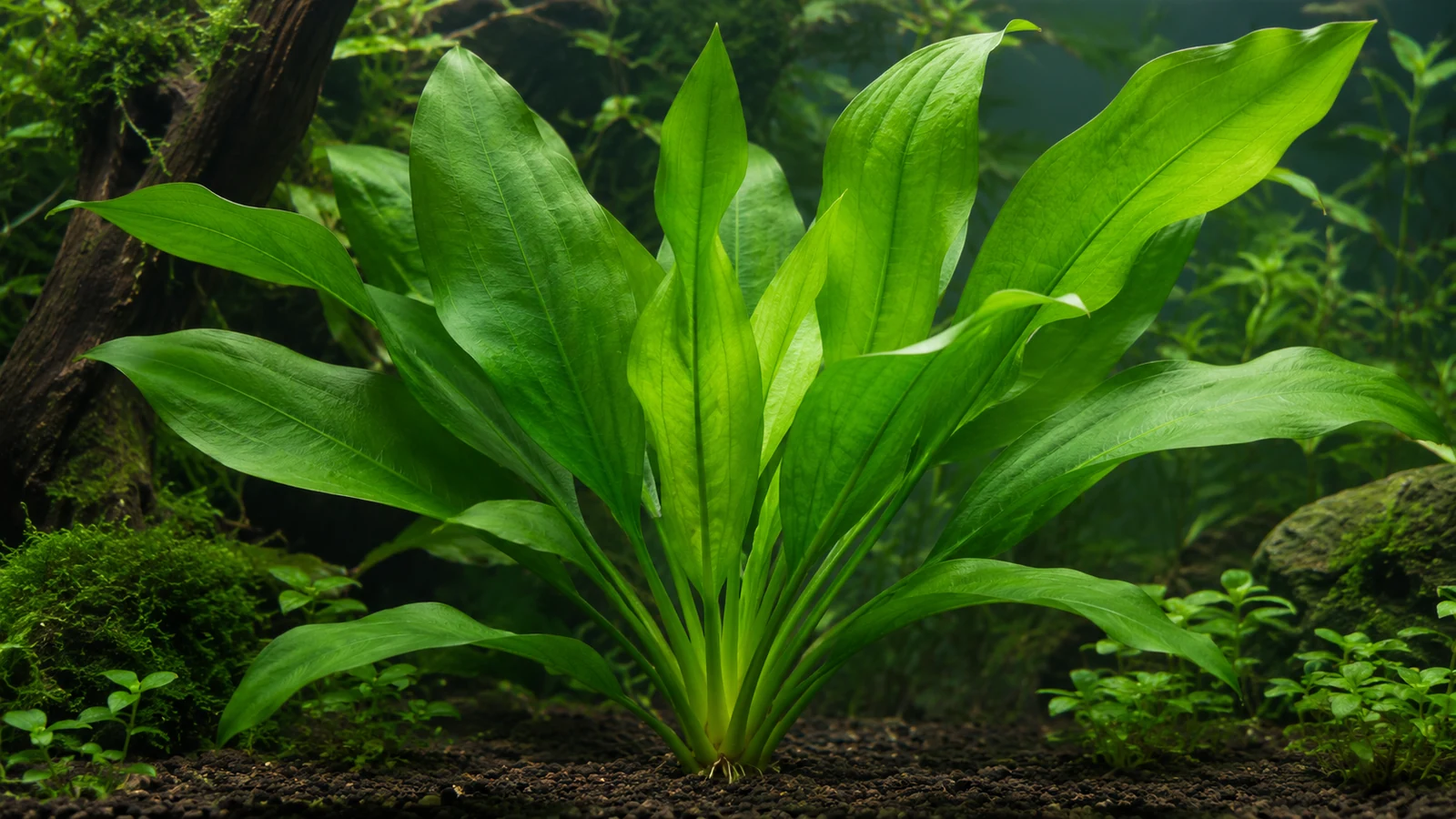
Amazon Sword grows as a rosette, with leaves emerging from a central base. For the common large form, a back or midground position is usually practical; in a shallow tank it can become a focal plant and block sightlines or shade nearby growth.
Before planting, look at the full path each mature leaf can take, not only the size of the nursery plant. Keep the crown accessible for trimming, avoid packing small plants directly beneath the rosette, and don’t choose a location that you will need to disturb repeatedly as it grows. Plan for the expected leaf spread so the plant does not block a sightline or shade nearby growth.
Keep water and tank conditions stable
Use freshwater conditions that fit the other animals in the aquarium, and avoid abrupt swings made only to chase a supposed Amazon Sword optimum. Aquarium Source gives a tropical temperature range of 72–82 °F and describes CO₂ injection as optional with potential growth benefits in its Amazon Sword care overview. Treat its temperature guidance as a reference, not a reason to override the needs of fish or shrimp sharing the tank. Keep a thermometer in the aquarium and use normal tank testing and maintenance to guide changes.
Hot-weather checks for Indian aquariums
During an Indian hot spell, check the aquarium water itself during the hottest part of the day, especially if the tank is near a sunny window or a heat-producing appliance. Don’t rely on the outdoor weather report to judge aquarium temperature, and don’t cool the tank suddenly; any adjustment should preserve stable conditions for the whole community.
Set conservative, steady lighting
For the commonly sold ‘Bleherae’ form, Tropica lists low light demand and pruning needs for preventing the plant from shading growth below. Use the label and the response of the whole aquarium instead of chasing a wattage or PAR number from a generic chart. Begin with a steady, moderate schedule appropriate to the rest of the planted tank. If the sword makes healthy new leaves and algae stays manageable, there is no reason to intensify the light simply because the plant is large. If smaller plants struggle beneath an established sword, assess placement and shade before increasing the whole tank’s light.
Is injected CO₂ necessary?
Many low-tech aquariums can grow Amazon Sword without pressurized CO₂. Treat CO₂ as an optional way to change growth in a deliberately managed planted tank, not a requirement for getting started. Keep light, nutrient supply, and carbon additions balanced; adding CO₂ alone will not correct an exposed crown, depleted root zone, or unstable aquarium.
Plant the roots and leave the crown exposed
Remove the plant from its nursery pot or packing material and gently arrange the roots downward into a hole in the aquarium substrate. Cover the roots and steady the plant, but leave the central crown—the point where the leaves emerge—at or just above the substrate surface. Aquarium Co-Op’s planting instructions for sword plants emphasize keeping the crown uncovered. If the plant repeatedly floats up, anchor the roots more securely instead of piling substrate over the crown.
Choose substrate and root-zone fertilizer
Amazon Sword is a strong root feeder. A nutrient-bearing aquarium substrate can supply the root zone, while inert gravel or sand can be paired with aquarium-safe root tabs placed near the roots. Aquarium Co-Op explains that sword plants draw heavily from the substrate and that root tabs can feed large swords. Press tabs into the substrate according to their label and keep them away from areas where fish may dig them out.
Use only aquarium-labeled fertilizers and follow their directions; do not improvise with garden fertilizer or terrestrial houseplant fertilizer spikes. If you use an aquatic liquid fertilizer, consider the tank’s existing nutrients rather than doubling up by default.
Let a new plant acclimate
Some aquarium plants are raised with leaves above the water and then sold for submerged growth. Aquarium hobbyist Christopher Adams describes older leaves declining as the plant adapts to submerged growth in his Amazon Sword growing notes. A practical way to judge recovery is to keep the crown exposed, remove only leaves that are clearly deteriorating, and watch for fresh growth from the center. Do not uproot the plant every few days to inspect the roots; repeated disturbance sets back establishment.
If all growth is declining, or new leaves also emerge weak or damaged, check root nutrition, light stability, and tank conditions together. A single old leaf changing color does not identify one nutrient deficiency by itself. The planting and root-feeding details above help separate ordinary adjustment from a setup problem.
Maintain older leaves without scalping the plant
As the outer leaves age, remove a fully yellow, damaged, or algae-covered leaf by cutting its stem close to the base with clean scissors. Do not cut through the central crown or shorten every leaf to control height; that removes healthy growth without changing the plant’s basic size pattern. Tropica recommends pruning when this tall plant shades growth below, so remove only enough old foliage to restore space and light.
Use maintenance to preserve the aquarium layout. If the rosette is overtaking neighboring plants, trim the oldest outer leaves and consider moving the plant once, carefully, rather than repeatedly thinning healthy inner leaves. Its roots can be extensive, so work slowly to limit disturbance to the substrate and nearby plants.
Read yellowing and slow growth in context
When an older outer leaf yellows but the center continues to produce healthy leaves, remove that leaf and continue observing. When several leaves decline, or new growth is small, inspect the plant’s root zone and review recent changes in light, fertilizer, temperature, and tank maintenance. A single old leaf changing color does not identify one nutrient deficiency by itself.
Record what changed before adjusting several variables at once. Check that the crown is not buried, confirm root tabs are appropriate for the substrate, and use aquarium tests to assess the tank rather than making a plant-only water adjustment. For a broader visual triage, compare patterns in the plant symptom library and use the plant problem diagnosis tool as a starting point; those general resources cannot identify an aquarium-specific cause from a photo alone. Amazon Sword’s plant problems hub is the plant-specific place to look for issue guides as they become available.
Propagate a mature Amazon Sword
An established plant may send up a stalk that carries plantlets. Let a daughter plant form visible roots and several leaves before separating it, then plant its roots in the substrate while keeping its new crown uncovered. The Tropical Fish Hobbyist species profile describes removing plantlets after roots begin to form; waiting for roots gives the small plant a better chance of anchoring after separation. Some aquarium-trade forms also produce runners, as described in Aquarium Source’s Amazon Sword guide, so check where the daughter plant is attached before cutting. Do not divide a healthy crown simply to make routine maintenance easier.
When to use this page vs other Amazon Sword guides
Use this overview to identify the plant form, set up its aquarium position, and understand the major care choices. A light guide should focus on illumination and shading; a soil or substrate guide should cover root anchoring and nutrient-bearing media; a fertilizer guide should compare root tabs with water-column feeding; a watering guide should explain aquarium stability rather than pot watering; and a propagation guide should focus on separating plantlets. Those topics need their own detail and should not be collapsed into one overview.
Related Amazon Sword guides
Start with the Amazon Sword plant page for the plant’s care data and taxonomy notes. If you are troubleshooting, use the Amazon Sword problems hub to find plant-specific issue coverage. General symptom resources can help you organize observations, but aquatic-plant problems still need to be checked against the aquarium setup.
Conclusion
For Amazon Sword, get the planting depth and root zone right first: bury the roots, leave the crown clear, and use aquarium-safe nutrition where the substrate is inert or depleted. Give the large rosette space, keep lighting and water conditions steady, and judge acclimation by the leaves that emerge after planting. Check the plant’s label when size matters, since aquarium-trade names and grower profiles do not always describe the same form.
How to care for Amazon Sword?
How much light does Amazon Sword need?
Low to medium aquarium lighting. Lower-output planted aquariums. Moderate light when the root zone has adequate nutrients. low light
- Low to medium aquarium lighting - Low to medium aquarium lighting.
- Lower-output planted aquariums - Lower-output planted aquariums.
- Moderate light when the root zone has adequate nutrients - Moderate light when the root zone has adequate nutrients.
- low light - Low to medium aquarium lighting.
When should you water Amazon Sword?
Amazon Sword is an aquatic aquarium plant, not a potted houseplant. Keep its roots submerged in freshwater and maintain a stable tank environment suited to the fish and invertebrates sharing the aquarium. It does not need separate top-watering; routine aquarium top-offs and water changes should follow the needs of the whole tank.
- Check leaf condition
- new growth
- water quality - Keep its roots submerged in freshwater and maintain a stable tank environment suited to the fish and invertebrates sharing the aquarium.
- and the substrate around the crown. Yellowing older leaves or persistently small new leaves can have several causes - Keep its roots submerged in freshwater and maintain a stable tank environment suited to the fish and invertebrates sharing the aquarium.
- including nutrient limitations
- so check root feeding and tank conditions before changing the light or fertilizer - Keep its roots submerged in freshwater and maintain a stable tank environment suited to the fish and invertebrates sharing the aquarium.
- Drain excess water - Keep its roots submerged in freshwater and maintain a stable tank environment suited to the fish and invertebrates sharing the aquarium.
What soil works best for Amazon Sword?
Use aquarium-safe planted substrate or fine-to-medium gravel with aquarium root tabs. Plant the roots into the substrate but leave the central crown at or just above the surface; do not bury the crown or use ordinary potting soil.
- Nutrient-bearing aquarium substrate for rooted aquatic plants - Use aquarium-safe planted substrate or fine-to-medium gravel with aquarium root tabs.
- Inert gravel with aquarium-safe root tabs near the roots - Use aquarium-safe planted substrate or fine-to-medium gravel with aquarium root tabs.
- Keep the crown exposed and never use houseplant fertilizer tabs underwater - Plant the roots into the substrate but leave the central crown at or just above the surface; do not bury the crown or use ordinary potting soil.
How to propagate Amazon Sword?
Established plants can produce flower stalks with plantlets. Let a plantlet develop several leaves and visible roots before separating and planting it; division may also work for a large, healthy crown.
See propagation stepsGrower notes for Amazon Sword
Check the name on the aquarium label
Amazon Sword is a common aquarium-trade name used for more than one Echinodorus species. The large, classic plant is frequently sold as Echinodorus grisebachii 'Bleherae' or E. bleheri. World Flora Online currently treats E. grisebachii as a synonym of Aquarius grisebachii, while aquatic-plant suppliers continue using the Echinodorus name. Check the cultivar or species label when the tank size matters.
Plant the roots and keep the crown clear
Swords grow as a rosette from a central crown. Aquarium Co-Op advises burying the roots while keeping the crown uncovered; a covered crown can decay. Place this large form in the midground or background and give the leaves room to arch outward.
Feed the root zone
A nutrient-bearing aquarium substrate is useful, and Aquarium Co-Op and Aqueon both describe root-zone feeding for rooted aquatic plants. If the tank uses inert gravel, place aquarium-safe root tabs near the roots and follow the product label. Do not put terrestrial fertilizer sticks into the tank.
Expect a nursery-to-aquarium transition
Aquatic nurseries may grow plants with leaves above water before sale. Shrimp and Snail Breeder notes that older leaves can melt after submersion while the plant adjusts. Remove only leaves that are clearly dying, keep the crown exposed, and judge recovery by whether healthy new submerged leaves appear.
Make room for a tall rosette
Tropica lists the large 'Bleherae' form at roughly 20–50 cm tall and recommends pruning that would otherwise shade nearby plants. Smaller Echinodorus cultivars exist, so choose by the exact label rather than assuming every plant sold as an Amazon Sword stays compact.
Keep lighting and water conditions steady
Tropica rates the common 'Bleherae' form as undemanding and able to grow in low light. Aqueon recommends consistent aquarium lighting and stable plant-care routines; extra CO₂ is optional for ordinary low-tech setups. Avoid trying to correct every yellow leaf by increasing light before checking root nutrition and aquarium conditions.
Is Amazon Sword safe around pets?
No species-specific cat, dog, or other household-pet toxicity classification for Amazon Sword / Echinodorus was confirmed in the sources checked. An absent database entry is not proof of safety. Do not use aquarium plants as pet food, and contact a veterinarian or animal poison service if a pet chews the plant or aquarium-treated material.
ASPCA's plant list did not return an exact Amazon Sword or Echinodorus entry in this search. Keep toxicity status under review; do not convert an absent listing into a non-toxic claim.
Watering Amazon Sword
For Amazon Sword, check leaf condition, new growth, water quality, and the substrate around the crown. Yellowing older leaves or persistently small new leaves can have several causes, including nutrient limitations, so check root feeding and tank conditions before changing the light or fertilizer. and water there is no plant-only watering schedule while it is fully submerged. Keep the water level stable, and perform water changes according to aquarium stocking, filtration, and water-test results rather than a fixed plant calendar. Indoor aquariums do not follow outdoor seasons in the same way as garden beds. Growth may slow when tank temperature or lighting changes; keep water conditions steady and adjust care to the aquarium's livestock and equipment.
| Detail | Information |
|---|---|
| How often | There is no plant-only watering schedule while it is fully submerged. Keep the water level stable, and perform water changes according to aquarium stocking, filtration, and water-test results rather than a fixed plant calendar. |
| How to check | Check leaf condition, new growth, water quality, and the substrate around the crown. Yellowing older leaves or persistently small new leaves can have several causes, including nutrient limitations, so check root feeding and tank conditions before changing the light or fertilizer. |
| Seasonal changes | Indoor aquariums do not follow outdoor seasons in the same way as garden beds. Growth may slow when tank temperature or lighting changes; keep water conditions steady and adjust care to the aquarium's livestock and equipment. |
Signs of overwatering
- Fully submerged growth has no terrestrial overwatering threshold.
- A buried or softening crown can indicate planting damage or decay; expose the crown and inspect the plant.
Signs of underwatering
- Not applicable while the plant remains submerged in a filled aquarium.
- Leaves held above the waterline can dry or become damaged if the air is not humid.
Soil & potting for Amazon Sword
Use a mix of Nutrient-bearing aquarium substrate for rooted aquatic plants, Inert gravel with aquarium-safe root tabs near the roots, Keep the crown exposed and never use houseplant fertilizer tabs underwater for Amazon Sword. Drainage holes are not relevant to submerged aquarium culture. Keep the roots anchored in a stable substrate while leaving the crown uncovered; avoid repeatedly uprooting an established plant. Repot amazon Sword is not grown in a terrestrial pot in its usual aquarium setting. Replant only when the aquarium layout or plant size makes relocation useful; mature roots can spread extensively., ideally in replant after the aquarium is stable and the plant has acclimated. Avoid repeated moves, which disturb the root system and substrate.
| Detail | Information |
|---|---|
| Recommended mix | Nutrient-bearing aquarium substrate for rooted aquatic plants, Inert gravel with aquarium-safe root tabs near the roots, Keep the crown exposed and never use houseplant fertilizer tabs underwater |
| Drainage | Drainage holes are not relevant to submerged aquarium culture. Keep the roots anchored in a stable substrate while leaving the crown uncovered; avoid repeatedly uprooting an established plant. |
| Repotting frequency | Amazon Sword is not grown in a terrestrial pot in its usual aquarium setting. Replant only when the aquarium layout or plant size makes relocation useful; mature roots can spread extensively. |
| Best season to repot | Replant after the aquarium is stable and the plant has acclimated. Avoid repeated moves, which disturb the root system and substrate. |
Signs it needs repotting
- The mature rosette is crowding other plants or shading lower growth.
- The plant needs relocation to make room for its full leaf spread.
- A flower stalk has produced rooted plantlets that are ready to be separated.
Humidity & temperature for Amazon Sword
Keep temperatures around aquarium care references commonly place Amazon Sword forms around 22–28 °C (72–82 °F); keep temperature stable and compatible with the aquarium's fish and invertebrates.
| Detail | Information |
|---|---|
| Ideal temperature | Aquarium care references commonly place Amazon Sword forms around 22–28 °C (72–82 °F); keep temperature stable and compatible with the aquarium's fish and invertebrates. |
Fertilizer & pruning for Amazon Sword
Use amazon Sword is a strong root feeder. Use aquarium-safe root tabs near the roots in inert or depleted substrate. Supplemental CO₂ is optional for typical low-tech tanks; do not use houseplant fertilizer products in an aquarium. for Amazon Sword.
| Detail | Information |
|---|---|
| Fertilizer type | Amazon Sword is a strong root feeder. Use aquarium-safe root tabs near the roots in inert or depleted substrate. Supplemental CO₂ is optional for typical low-tech tanks; do not use houseplant fertilizer products in an aquarium. |