Fungus Gnats on Rose: Causes, Checks & Fixes
Quick answer
Fungus gnats on Rose mean the soil surface stays wet too long-usually from overwatering a compost-rich container mix or leaving saucer water standing. First step: let the top 3–4 cm dry between deep base waterings and set yellow sticky traps near the pot rim.
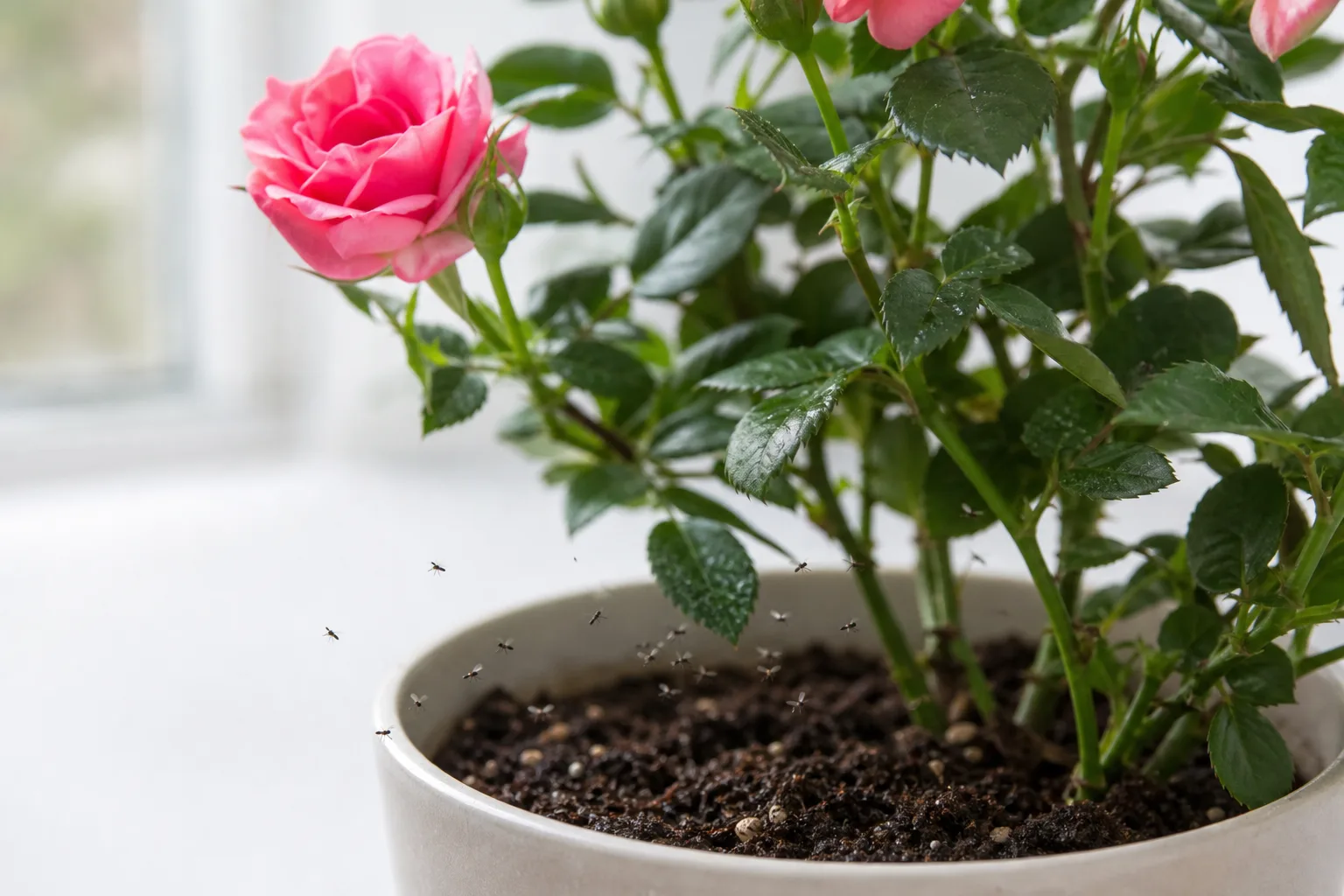
Fungus Gnats on Rose: Causes, Checks & Fixes
This guide covers fungus gnats on Rose. See also the general Fungus Gnats guide, watering, and light pages for this plant.
Fungus Gnats on Rose: Causes, Checks & Fixes
Quick answer
Fungus gnats on a container rose almost always mean the soil surface stays wet too long-not that roses attract a special pest. The small flies breed in damp organic potting mix; their larvae feed on fungi and decaying matter in the top layer and can damage fine feeder roots when numbers build. On a healthy blooming bush, gnats are mainly annoying and diagnostic.
First step: let the top 3–4 cm of soil dry before the next deep base watering, then place a yellow sticky trap at the pot rim to catch adults. Roses need rich, moisture-retentive mix and regular summer water, but the surface should still dry between soaks. If flies persist on soil that never dries, fix drainage and Rose watering guide before reaching for soil drenches.
Why Rose gets fungus gnats
Fungus gnats are not rose-specific. They infest any potted plant whose upper soil stays moist with organic debris. What makes roses prone is how they are usually grown: heavy, compost-rich container mix in pots that growers water generously during bloom season.
Rose soil blends often include potting mix, compost or well-rotted manure, cocopeat, and only a modest amount of perlite. That combination holds moisture well-which roses need for flowering-but a constantly wet surface layer becomes ideal larval habitat. Spring top-dressing with compost or manure adds fresh organic matter right where females lay eggs.
Container roses also create a watering tension. In hot weather they can need frequent deep watering at the base, yet saucers left full or daily light sprinkles keep the surface soggy even when deeper roots would be fine with a drier top. Roses moved indoors for winter, or kept on shaded balconies during dormancy, dry slowly. Many growers keep watering on a summer schedule while the plant is barely growing-exactly when fungus gnat populations surge.
Poor drainage multiplies the problem. Pots without holes, compacted mix, or standing water in saucers keep the upper layer wet for days. Roses dislike waterlogged roots, and fungus gnats thrive in the same conditions. Gnats often hitchhike home on newly purchased container roses or arrive when outdoor pots brought inside for cool weather already harbor larvae in wet media.
What fungus gnats look like on Rose
Adult flies:
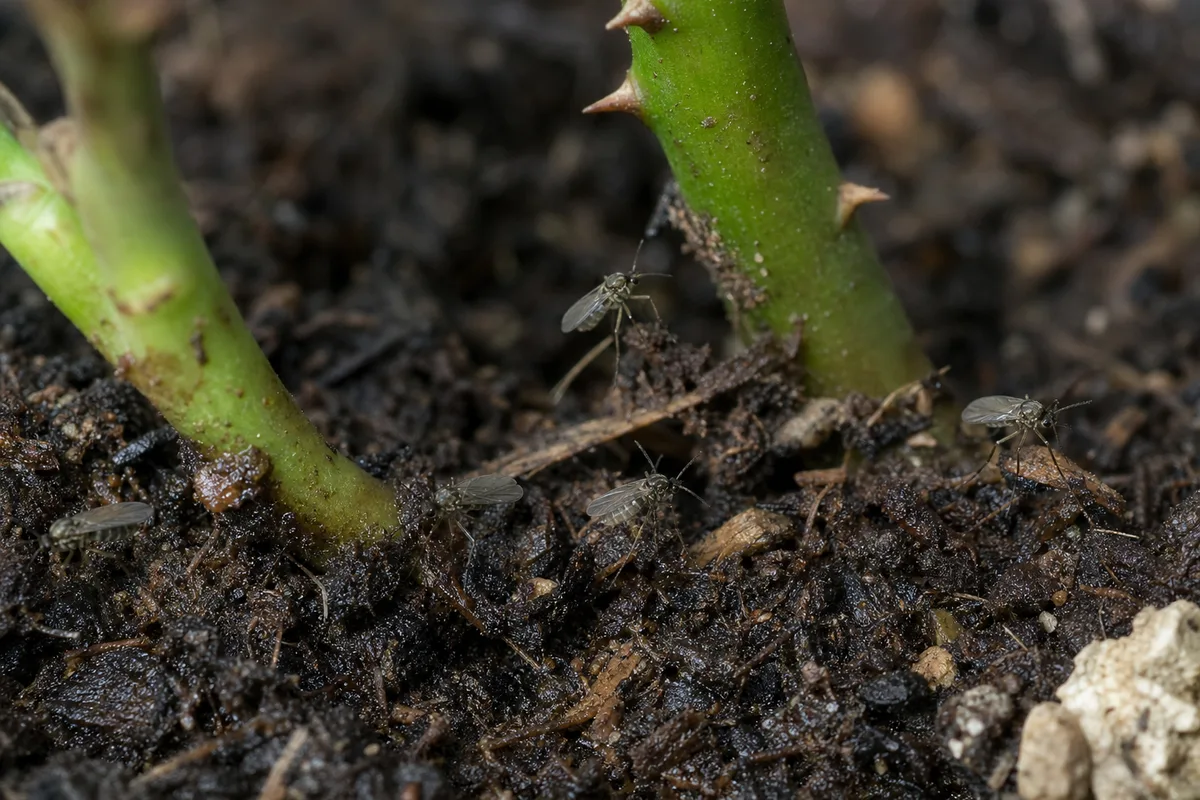
Fungus Gnats symptoms on Rose - compare with healthy tissue on the same plant.
- Tiny dark or grayish mosquito-like insects, roughly 2–4 mm long
- Hover above the pot or rise in a small cloud when you water or brush the soil surface
- Rest on pot rims, saucers, nearby windows, or lower rose foliage-especially in the evening
- Do not chew leaves or petals; they are a nuisance, not a foliage pest
Larval signs in soil:
- Translucent, legless worms with dark heads in the top 2–3 cm of mix when you scrape the surface gently
- Glossy larvae visible near the base of the stem in severely infested pots
- Green algae, mold, or a stale smell on soil that has stayed wet for days
Plant symptoms on Rose (when infestation or wet soil persists):
- Slow new growth or smaller than usual blooms despite otherwise normal care
- Yellowing of lower leaves-not from black spot, but from chronic wet roots and reduced oxygen
- Cuttings or newly planted roses stalling while flies remain heavy
- Otherwise healthy bushes may show no leaf damage at all early on; the flies are the first clue
Fungus gnats do not cause black spot, powdery mildew, or the sticky residue aphids leave on new shoots. If you see circular black leaf spots or clustered soft insects on tender growth, you are dealing with different problems.
How to confirm the cause
Work through these checks in order before treating:
- Fly emergence test - Water the pot or tap the container rim. If small flies rise from the soil surface, fungus gnats are present.
- Surface moisture - Push your finger 3–4 cm deep. If the top layer has felt wet for several days straight, culture-not just the insects-is the core issue.
- Saucer and drainage - Lift the pot. Standing water in the saucer or absence of drainage holes confirms a wet root zone.
- Sticky trap count - Place a yellow sticky trap just above the soil. Catches within 48 hours confirm active adults; declining catches after you dry the surface confirm wet soil as the driver.
- Larva check - Scrape aside the top centimetre of mix. Translucent larvae in moist organic soil confirm breeding in place.
- Rose context - Note season and placement. Cool shaded balconies, indoor winter storage, and fresh compost top-dressing are high-risk moments. Aphids on new red shoots, spider mites on dusty underleaves, and black spot on wet foliage are separate diagnoses.
If traps catch flies but the top 3–4 cm dries within a few days of adjusted watering and fly numbers fall, you have confirmed fungus gnats tied to overwet surface soil.
First fix for Rose
Let the top 3–4 cm of soil dry completely before the next deep base watering.
This single step matches how roses should be watered anyway: deep soaks at the base when the upper mix dries, never keeping the surface constantly damp. Drying the top layer kills larvae in the upper soil and makes the pot less attractive for egg-laying females. Water at the base only-directing flow onto foliage invites black spot and does nothing for gnat control.
After you adjust watering, set one yellow sticky trap per infested pot, positioned just above the soil line, to reduce adult numbers and track progress. Empty the saucer within 30 minutes of each soak so the bottom of the mix does not re-saturate from below.
Do not reach for insecticidal drenches, hydrogen peroxide, or Rose repotting guide on day one. Culture change works for most established container roses once the wet cycle breaks.
Step-by-step recovery
Once the top layer is drying between waterings, follow this sequence:
- Correct the watering rhythm - Check 3–4 cm deep before every soak. In summer, roses may need water every two to three days; in cool dormancy, stretch to four or five days or longer. Let the surface dry even when deeper mix still holds moisture.
- Eliminate standing water - Empty saucers promptly. Elevate pots on feet so drainage holes stay clear.
- Trap adults for two to three weeks - Replace sticky traps when coated. Adult numbers often crash within one to two weeks of drier surface culture, but overlapping life stages mean full suppression can take three to four weeks.
- Remove surface debris - Brush off fallen petals and leaves that decay on wet soil. If you recently top-dressed with fresh compost, scratch the very top layer to let it dry or replace the upper 2 cm with dry mix.
- Improve light and airflow - Move the pot where the rose gets at least six hours of direct sun if possible. Faster drying reduces gnat habitat without starving the plant.
- Add larval control only if needed - If flies remain heavy on soil that is genuinely drying, apply a product containing Bacillus thuringiensis subspecies israelensis (BTI) to the soil surface on the label schedule. This targets larvae without the broad exposure of harsh chemical drenches.
Skip repotting unless the mix is clearly failing-sour smell, perpetual sogginess in the bottom half, or roots turning mushy.
Lookalike symptoms
| What you see | Likely cause | How to tell apart |
|---|---|---|
| Tiny flies from soil when watering | Fungus gnats | Flies rise from pot surface; larvae in top soil |
| Soft green insects on new shoots | Aphids | Clusters on stems and buds; sticky honeydew on leaves |
| Fine webbing on leaf undersides | Spider mites | Hot dry conditions; stippled yellow leaves |
| Circular black spots on leaves | Black spot fungus | Spots on foliage, not flies from soil |
| Small flies near kitchen fruit | Fruit flies | Attractant is food waste, not rose pot soil |
Shore flies look similar to fungus gnats but are more common in greenhouses and on algae-covered surfaces. On home container roses, persistently wet compost-rich mix points to fungus gnats.
Rose care cross-check
Fungus gnats expose a gap between how you think you are watering and how the pot actually dries. Cross-check these rose basics:
- Sun - Roses bloom best with six or more hours of direct sun. Weak light slows evaporation and extends surface wetness.
- Base watering - Soak the soil at the crown, not the leaves. Wet foliage raises disease pressure without helping roots.
- Mix balance - Rich and moisture-retentive is correct for roses, but perlite and drainage holes must prevent the bottom from staying waterlogged. A pot that feels heavy days after watering needs better drainage, not more frequent light watering.
- Seasonal adjustment - Reduce watering in winter dormancy. A dormant rose in a cool room with a wet saucer is a classic gnat setup.
- Top-dressing timing - Annual compost refresh helps roses, but fresh undecomposed material on a wet surface feeds larvae. Top-dress in spring, then let the surface cycle dry normally.
Recovery timeline
| Timeframe | What to expect |
|---|---|
| Days 1–3 | Fewer flies when you disturb soil after the first dry-down cycle |
| Week 1–2 | Sticky traps catch fewer adults; surface mix stays dry between base waterings |
| Weeks 2–4 | Larval generations decline; new rose growth looks steadier if wet roots were the stressor |
| Month 2+ | Infestation effectively gone if watering rhythm and drainage stay corrected |
Damaged lower leaves from chronic wetness do not green up again-judge recovery by firm canes, new clean leaves, and normal bud development. Yellow leaves that appeared during the wet period may drop; that is normal as roots recover.
What not to do
- Do not add more water when you see flies - Gnats mean the surface is already too wet.
- Do not mist leaves to “refresh” the rose - Base watering only; extra surface moisture feeds larvae and invites black spot.
- Do not drench soil with harsh chemicals before fixing watering - Culture change solves most home infestations and is safer for a food-adjacent balcony rose.
- Do not repot on day one - Unnecessary repotting stresses a blooming rose unless roots are clearly rotting.
- Do not ignore saucer water - A dry top can re-wet overnight from a full saucer.
- Do not stop after one dry week - Complete the three-to-four-week monitoring window; overlapping eggs and larvae hatch in stages.
How to prevent fungus gnats on Rose next time
- Check 3–4 cm deep before every deep base watering; skip the soak if that layer is still damp.
- Empty saucers after each watering session.
- Use well-rotted compost for top-dressing, not fresh wet manure sitting on the surface.
- Quarantine new container roses for two to three weeks before placing them beside other pots.
- Set yellow sticky traps in early autumn when outdoor roses move indoors or onto sheltered balconies.
- Keep the rose in enough direct sun that the mix dries predictably between soaks.
- Brush fallen petals and debris off the soil surface weekly during bloom season.
Prevention is moisture management, not a rose-specific pesticide program.
When to worry
Escalate beyond drying and trapping when:
- The top layer never dries within a week of reduced watering-check for blocked drainage holes or a mix that is too water-retentive.
- Canes soften at the base, the pot smells sour, or roots are brown and mushy when you inspect-wet root decline, not gnats alone.
- Buds abort in clusters while soil stays soggy and yellow leaves spread up the bush.
- Fly counts rise weekly despite dry surface culture-consider BTI or repotting into fresh, well-draining rose mix after trimming dead roots.
Fungus gnats rarely kill an established container rose by themselves. They signal conditions that also harm rose roots. Fix the wet culture first; the flies usually follow.
When to use this page vs other Rose guides
- Rose watering guide - Use for routine moisture checks before assuming fungus gnats is the main issue.
- Rose problems hub - Browse all 7 common issues on this species.
- Root Rot on Rose - Different entry point when symptoms overlap with fungus gnats.