Distorted Leaves on Rubber Plant: Causes, Checks & Fixes
Quick answer
Distorted leaves on Rubber Plant—puckered, twisted, or undersized glossy blades—usually trace to pests scarring tissue inside red sheaths at the stem tip or uneven watering while new leaves were forming. First step: inspect the newest red-sheathed leaf at the growing point under bright light and shake it over white paper before changing fertilizer or repotting.
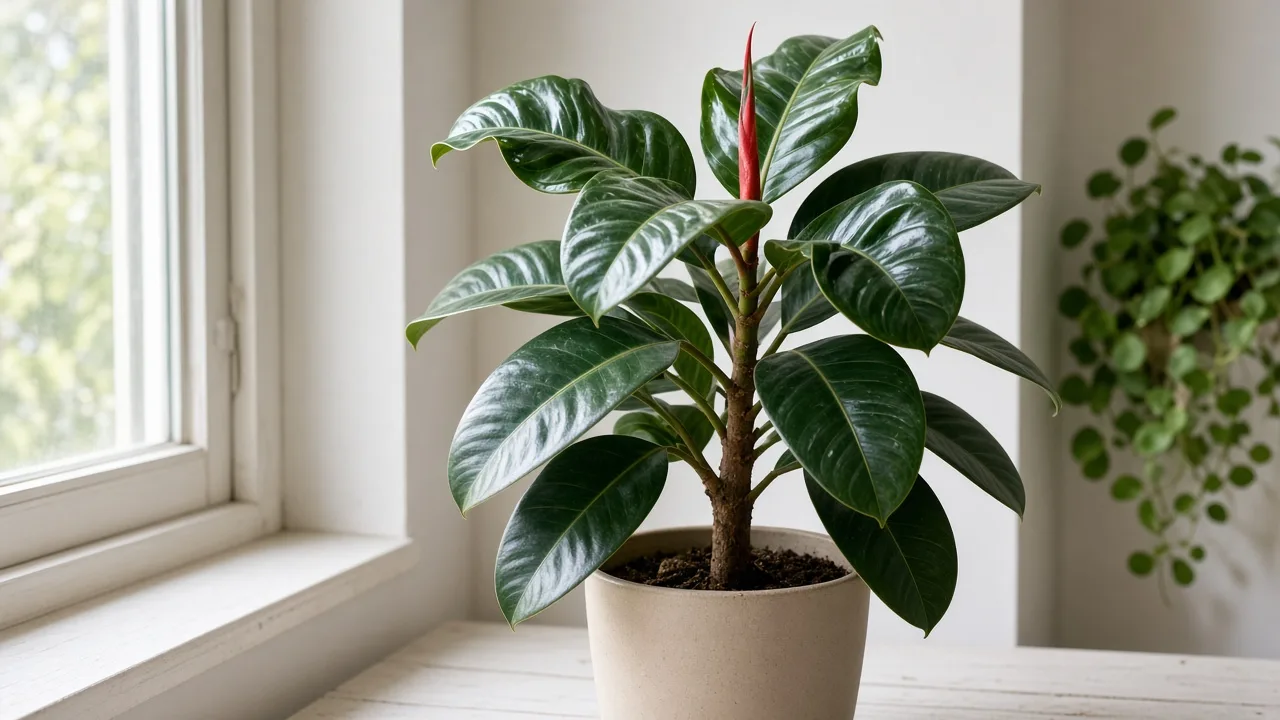
Distorted Leaves on Rubber Plant: Causes, Checks & Fixes
This guide covers distorted leaves on Rubber Plant. See also the general Distorted Leaves guide, watering, and light pages for this plant.
Distorted Leaves on Rubber Plant: Causes, Checks & Fixes
Quick answer
Distorted leaves on Rubber Plant (Ficus elastica) break the plant’s usual look: thick, glossy, oval blades 8–12 inches long on an upright woody stem. When new foliage emerges twisted, puckered, cupped, or smaller than neighbors, something interfered while that leaf was forming—or pests scarred soft tissue at the growing point.
For how crinkled and misshapen leaves develop on houseplants in general, see our distorted leaves hub. On Rubber Plant, the diagnostic clue is almost always at the terminal bud—the rolled glossy leaf still inside its bright red sheath, the woody stem below it, and whether distortion tracks only new growth or older canopy blades too.
First step: inspect the newest red-sheathed leaf at the stem tip under bright light, then shake it over white paper. Silvery scrape marks with black specks need pest treatment; crinkled blades without insects after a dry spell point to watering rhythm—not repotting on day one.
When to use this page vs other Rubber Plant guides
| Pattern | Start here | Or route to… |
|---|---|---|
| Silvery streaks, black frass, scarred new tips | Thrips | This page if shape—not color alone—is the main issue |
| Inward roll on established blades without twist | Curling leaves | — |
| Only the very newest leaf small and odd | This page | Pale leaves if color washed out |
| Yellow lower leaves, wet heavy pot | Overwatering | Root rot if stems soften |
| Sticky clumps along woody stems | Mealybugs | Scale insects if hard bumps |
| Rapid yellow-and-drop after a move | Leaf drop | — |
What distorted leaves look like on Rubber Plant
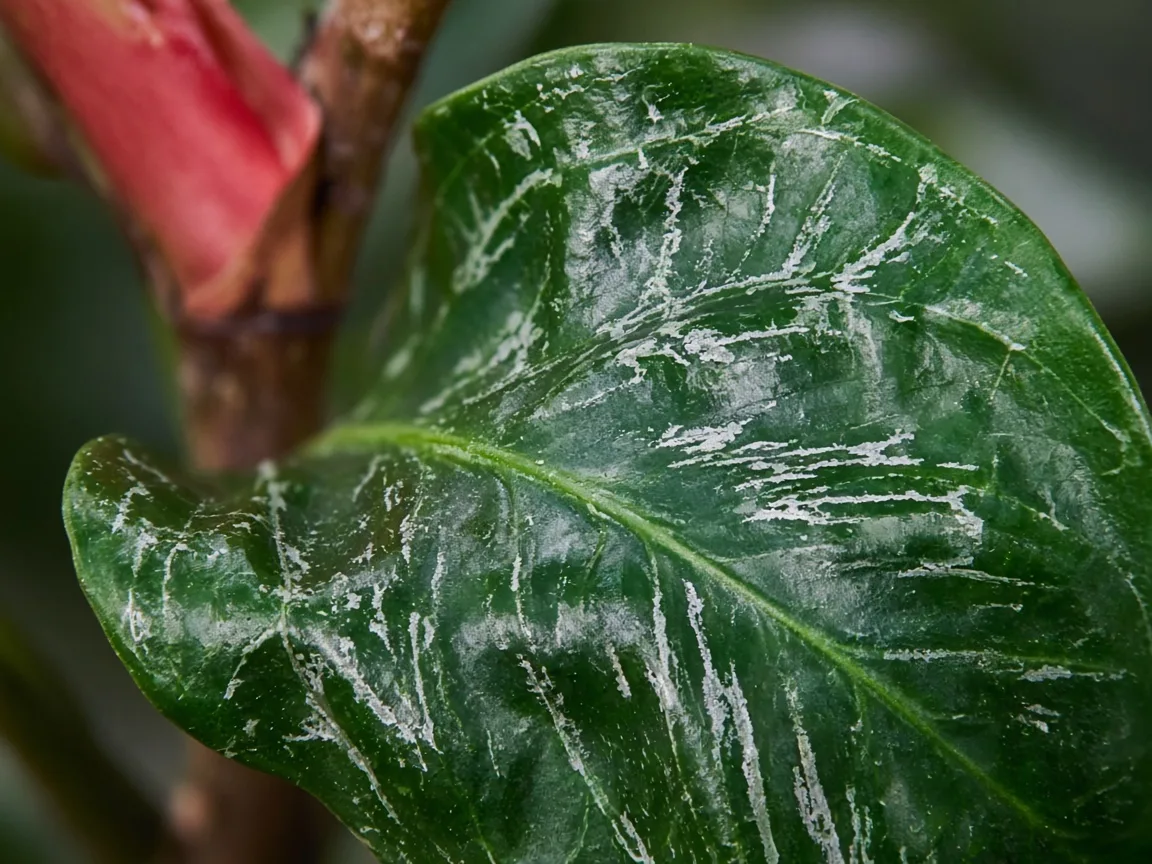
Twisted, undersized glossy leaf at a stem tip with silvery thrips scarring—compare with the flat deep-green blade below it on the same woody stem.
Healthy Rubber Plant carries stiff, glossy, deep green leaves with an acute tip and rotund base on a tree-like upright stem. NC State describes mature indoor blades reaching roughly 17 inches long and 6 inches wide on prized specimens. Distortion means the blade lost that flat symmetry:
Thrips scarring — Silvery or bronze streaks on the glossy upper surface, tiny black varnish-like frass specks, and small twisted or crinkled leaves at stem tips still inside red sheaths. UC IPM notes thrips feeding scars and distorts plant parts; damage often shows before you spot the insects.
Aphid distortion — Clustered soft-bodied insects on new growth, sticky honeydew, and cupped or curled young leaves at the tip. Aphids pierce sap from tender tissue and can stunt blade expansion.
Mealybug or scale stunting — White cottony clumps or hard tan bumps along woody stems and leaf petiole bases, sticky residue, and undersized or twisted new blades while older glossy leaves look normal. See mealybugs on Rubber Plant and scale insects.
Stop-start watering crinkle — Leaves look creased or puckered without silver streaks or insects, often after the pot dried completely and was flooded, or watering paused during an active spring growth flush. RHS guidance on leaf deformation links crinkled leaves to irregular watering while new tissue develops.
Draft or relocation warp — Crispy distorted margins on leaves facing a cold window, air conditioner, or heating vent; soil moisture may be normal. NC State warns that Rubber Plant does not do well with drafts or cold temperatures and prefers to remain in one location.
Nutrient stress on new growth — When lower leaves stay dark green but every new blade is small and twisted, rule out iron deficiency, magnesium deficiency, or chronic overwatering weakening roots before assuming pests alone.
Red-sheath unfurl distortion at the terminal bud (Rubber Plant only)
Rubber Plant pushes each new leaf rolled tight inside a bright red sheath at the end of a thick woody stem. If thrips feed inside that sheath, or the stem tip dries out while the blade is opening, the glossy leaf can emerge twisted, rippled, or permanently undersized even though the petiole and node look fine. Follow the trunk upward: distortion clustered at the last one or two red sheaths on multiple branches points to tip-level stress, not a whole-pot root failure.
Glossy-blade thrips reading on dark foliage (Rubber Plant only)
Unlike matte-leaved houseplants where thrips stippling fades into the background, silver scrape marks read clearly across Rubber Plant’s stiff coriaceous gloss. UC IPM describes stippling and discolored flecking on leaf surfaces with black frass nearby. On dark green Ficus elastica, even mild feeding leaves obvious pale streaks that do not wipe off—do not mistake them for dust or water spots.
Tree-form lower-canopy hiding on woody stems (Rubber Plant only)
Rubber Plant’s upright tree habit means large overlapping leaves shield the woody stem and petiole bases where mealybugs, scale, and thrips shelter. Owners often spot damage only when a new red-sheathed tip opens at the top—but pests may have been feeding on mid-stem joints for weeks. When distortion appears on several tips but insects are not obvious on the newest leaf alone, work downward along each branch, spreading glossy blades apart at every node.
Why Rubber Plant gets distorted leaves
Sap-feeding pests target soft new tissue first. NC State lists mealybugs, scales, and spider mites as problematic on Rubber Plant; thrips and aphids also scar leaves while they are still expanding inside red sheaths, leaving permanent twist or ripple on glossy blades.
Tree-like growth hides infestations. Dense overlapping foliage on a woody trunk creates blind spots. One thrips female on an imported cutting can scar several unfurling leaves before lower canopy blades show symptoms.
Irregular watering during active growth crinkles new leaves. Rubber Plant prefers the top 2 inches of soil to dry between drinks, but letting the whole pot go dust-dry and then soaking—or watering on a rigid calendar while growth speeds up in spring—produces stop-start leaf development that looks like distortion rather than simple curling.
Relocation and draft stress warp developing blades. Clemson HGIC notes that rubber plants are sensitive to environmental changes. A recent move, repot, or cold draft below about 55°F (13°C) can distort leaves still forming at the tip even when watering looks unchanged.
Overfertilization or salt stress stunts tips. Heavy or undiluted feeds when the plant is already stressed push soft, misshapen growth. Hold fertilizer until new blades look normal for two weeks.
Root stress from chronic wet mix — When roots cannot absorb water properly, new growth may emerge small and warped while lower leaves yellow. See overwatering and root rot if stems soften or soil smells sour.
How to confirm the cause
Work through these checks in order:
- New vs old — Distortion only on the last one or two red-sheathed tips per branch → pests, unfurl stress, or recent care change. Warped leaves scattered on mature canopy sections → past event or mechanical damage.
- Shake test — Hold white paper under a suspect leaf and tap the petiole. UC IPM recommends shaking foliage to dislodge thrips before treating.
- Surface scan — Silvery streaks and black frass → thrips. Sticky honeydew and clustered insects → aphids or mealybugs. Hard bumps on stems → scale. No pest signs → watering or environment.
- Pot weight — Very light pot with limp stems and crinkled new blades → drought during growth. Heavy wet pot with yellow lower leaves → wet roots, not primary distortion.
- Fertilizer timeline — Distortion followed a recent full-strength feed or white crust on soil → salt stress; flush once with plain water.
- Placement trace — Warped leaves all face one window or vent → draft or heat. Random tips on a plant in stable bright indirect light → pests or watering.
- Neighbor check — Inspect fiddle-leaf fig, weeping fig, and other Ficus on the same shelf; shared pests move between woody stems.
First fix for Rubber Plant
Photograph the worst distorted glossy leaf, then inspect every red-sheathed tip and leaf axil along woody stems before you fertilize, repot, or spray.
| Confirmed pattern | First fix |
|---|---|
| Thrips signs (silver streaks, frass, shake test positive) | Isolate and rinse every leaf underside with lukewarm water; see thrips |
| Aphids on soft new growth | Isolate and wipe insects off with a damp cloth |
| Mealybugs in axils | Dab visible clusters with 70% alcohol on a swab; see mealybugs |
| Crinkled blades after dry/wet swings, no pests | Water when top 2 inches dry; see watering guide |
| Tips warped after a move or cold draft | Stabilize placement in bright indirect light away from vents; see leaf drop if yellowing follows |
| Warped leaves on vent/window side | Redirect the plant or shield the exposed stem tip from the heat or cold source |
Do not repot a Rubber Plant with distorted tips on day one unless roots are mushy or soil smells sour. Do not stack repotting, pruning, and pesticide the same afternoon—you need to read which fix worked.
Step-by-step recovery
After the first targeted correction:
- Re-inspect red-sheathed tips every three to five days for two weeks—one missed thrips cohort can scar the next unfurling blade.
- Hold isolation until no new distortion appears on emerging leaves.
- Stabilize watering using pot weight and the top 2-inch dry-down check from the watering guide rather than a fixed calendar.
- Wipe dust from large glossy leaves with a damp soft cloth as NC State recommends so early scarring is visible during weekly care.
- Prune only when needed — Remove blades more than half destroyed after pests are gone. Partial ripples on green glossy leaves still photosynthesize.
- Resume diluted fertilizer only after two weeks of flat new growth during spring or summer active flush per the fertilizer guide.
For a small plant with thrips on every tip, air-layering or rooting a clean stem cutting may be faster than fighting a tall tree-form infestation—see propagation once the parent is stable.
Recovery timeline
| Phase | Timing | Good sign | Bad sign |
|---|---|---|---|
| After first fix | Days 1–7 | No new twisted blades at red sheaths | Fresh scarring on unfurling leaves |
| New growth | Weeks 2–4 | Flat glossy leaves at stem tips | Frass returns or crinkle spreads up branches |
| Cosmetic | Ongoing | Old warped leaves stable | Multiple stems declining |
Distorted tissue does not flatten on existing leaves. Judge recovery by clean new glossy foliage, not by old puckered blades. Rubber Plant in bright indirect light with stable soil moisture often outgrows light distortion within one to three weeks once the cause is removed.
Lookalike symptoms to rule out
Inward curl on established leaves without twist points to curling leaves from drought or low humidity—not the same as a misshapen glossy blade.
Yellow lower leaves without shape change suggest overwatering or normal aging—not distortion.
Pale washed-out color without ripple routes to pale leaves or not enough light.
Brown crispy edges after heavy feeding may fit salt burn rather than twist—flush soil and hold feed.
Mistakes to avoid
Do not spray insecticide before confirming live pests—stop-start watering crinkle does not need chemical treatment.
Do not assume one distorted leaf means the problem is solved. Follow each woody branch to its red-sheathed tip.
Do not fertilize a stressed Rubber Plant to “push out” flat leaves—extra nitrogen produces soft growth pests prefer.
Do not move the plant repeatedly while new leaves are forming; NC State notes Rubber Plant prefers to remain in one location.
Wear gloves when handling cut stems; milky latex sap is irritating to skin and toxic to pets if chewed.
How to prevent distorted leaves next time
- Quarantine new Rubber Plants two to three weeks before mixing collections.
- Water when the top 2 inches dry on a steady rhythm through spring growth spurts.
- Keep the tree in bright indirect light away from heating vents and cold window glass—see light guide.
- Feed monthly at half strength during active growth only; skip feed in winter dormancy.
- Scout red-sheathed tips weekly during warm months when thrips enter through open windows.
- Wipe dusty glossy leaves monthly with a damp cloth to expose early scarring.
- Use well-draining mix with perlite so roots stay healthy—see soil guide.
When to worry
Escalate when:
- Fresh distortion appears on multiple stem tips within a week
- New red-sheathed leaves stop opening or tear apart as they unfurl
- Stems soften at the soil line with sour-smelling mix
- Thrips or mealybugs show on several Ficus from one nursery batch
- Every tip is scarred despite repeated treatment
A single slightly crinkled lower leaf that has not changed in a month, with firm woody stems and clean new tips elsewhere, is usually past stress—not an emergency. Discard and restart from a cutting only when every growing point is scarred, roots have failed, and no clean stem section remains to salvage.
Conclusion
Distorted leaves on Rubber Plant mean something interrupted normal glossy blade development—usually sap feeders at red-sheathed stem tips or uneven watering during a fast growth flush. Read the newest unfurling leaf, shake-test for thrips, and trace each woody branch before you repot or feed. Rubber Plant recovers steadily once the cause stops; focus on flat glossy new blades at the growing points.
Related Rubber Plant guides
- Rubber Plant overview — placement, growth habit, and care baseline
- Rubber Plant watering — dry-down checks for tree-form pots
- Rubber Plant light — bright indirect light for steady new growth
- Rubber Plant soil — drainage that keeps roots healthy
- Thrips on Rubber Plant — silvery scarring at stem tips
- Curling leaves — roll without twist
- Leaf drop — sudden loss after moves or drafts
- Rubber Plant problems hub — all common issues on this species
Related tool
Use the Plant Problem Diagnosis Tool to narrow causes for distorted leaves on this plant before changing multiple variables at once.