Pale Leaves on Rubber Plant: Causes, Checks & Fixes
Quick answer
Pale leaves on Rubber Plant usually mean too little light for large glossy foliage, root stress on chronically wet soil, or—on Tineke and Tricolor—variegation fading in a dim room. First step: compare the newest leaf at the stem tip to mature blades below; washed-out color with smaller size and long gaps between leaves means move to bright indirect light before fertilizing.
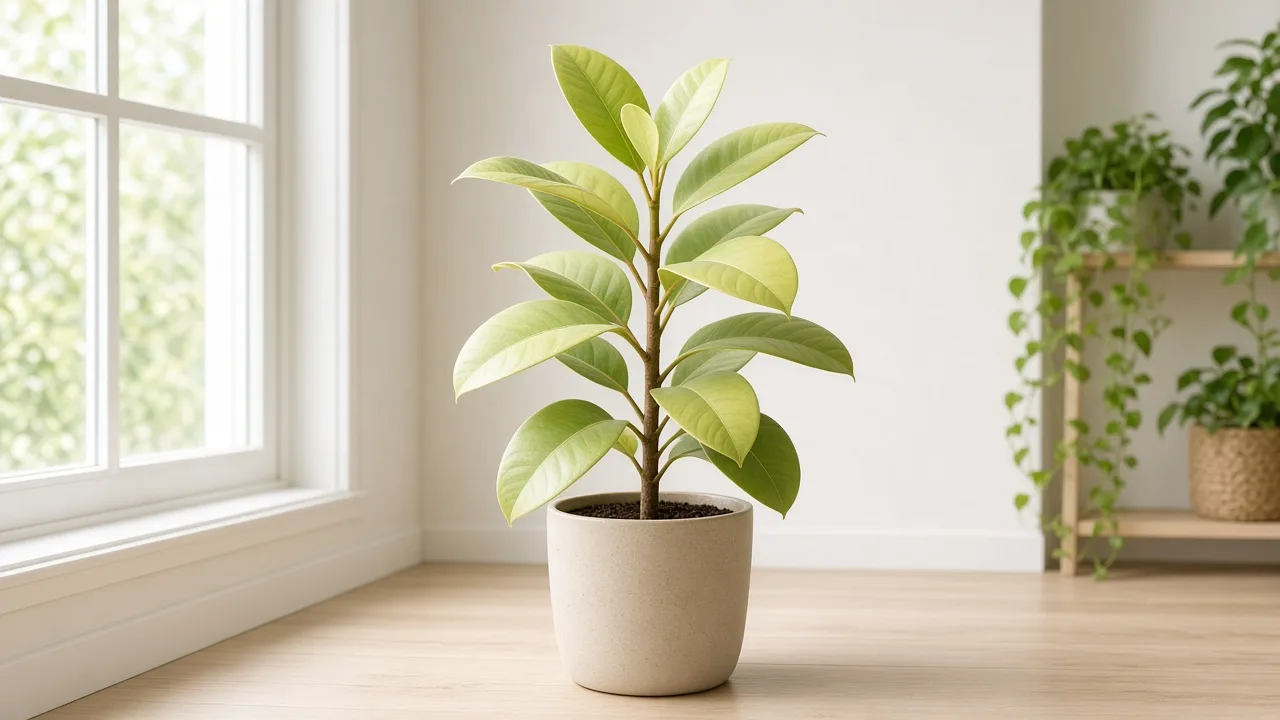
Pale Leaves on Rubber Plant: Causes, Checks & Fixes
This guide covers pale leaves on Rubber Plant. See also the general Pale Leaves guide, watering, and light pages for this plant.
Pale Leaves on Rubber Plant: Causes, Checks & Fixes
Quick answer
Pale leaves on Rubber Plant (Ficus elastica) look washed-out, flat, or light green instead of the deep glossy green—or burgundy-backed color—healthy specimens show in good light. For general chlorosis mechanics, see our pale leaves guide. On rubber plant, the combination of dull new leaves at the upright stem tip, smaller blade size, and long gaps between leaves on a tree-like stem is the signature low-light pattern.
First step: compare the newest unfurling leaf at the stem tip to mature blades two or three nodes below. If color is faded, gloss is gone, and internodes stretch beyond about 2 inches (5 cm), move the pot to bright indirect light before you change watering or feed. If pale lower leaves sit on soil wet 2 inches down for many days, stop watering and check roots instead.
Clemson Extension notes rubber plants prefer bright light but are adaptable to low light—they survive dim rooms, yet they grow best with morning light from an east window and may become tall and lanky without enough intensity. Survival in a corner is not the same as the compact, glossy form most owners want.
When to use this page vs other Rubber Plant guides
- Not enough light — long bare stems, strong lean toward windows, variegation reverting to solid green
- Yellow leaves — soft yellow on wet soil or crisp yellow on dry mix
- Overwatering — heavy pot, sour smell, pale limp lowers on saturated mix
- Leggy growth — stretch-focused entry when pale color is secondary
- Brown leaves — necrotic tissue, not uniform washout
- Spider mites — stippled pale speckling with webbing, not even chlorosis
- Nitrogen deficiency — oldest leaves pale first in bright light with firm roots
What pale leaves look like on Rubber Plant
Healthy rubber plant holds large, stiff, glossy oval leaves—often 8 to 12 inches long on mature indoor specimens—with relatively short spaces between leaves along each upright stem. Pale foliage breaks that pattern in recognizable ways depending on cause.
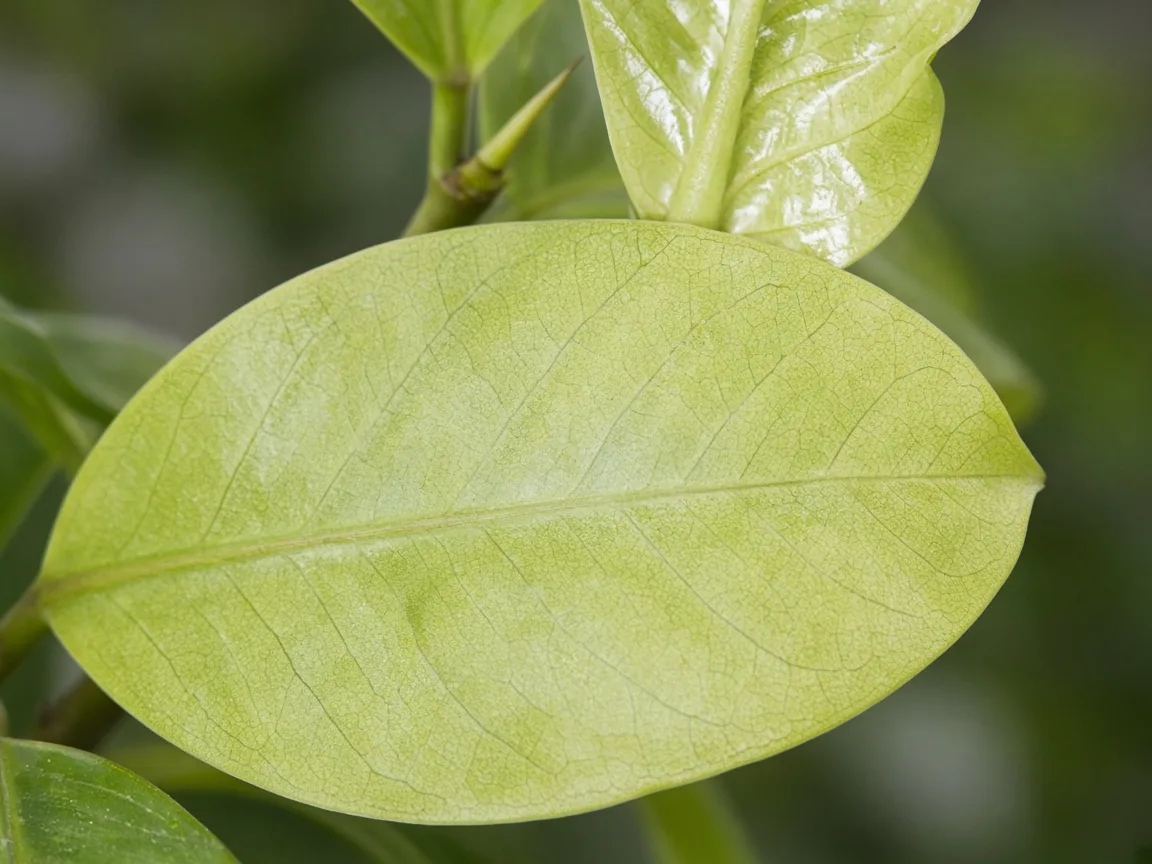
Pale leaf symptoms on Rubber Plant—compare washed-out new growth with deeper green on older stiff blades on the same stem.
Low-light chlorosis (most common indoors)
- Uniform washed-out yellow-green or olive tone across several leaves on the same stem section—not isolated spots
- New leaves open smaller and thinner than mature blades a few nodes back; gloss disappears before size drops noticeably
- Long internodes — bare gaps between stiff leaves as the upright stem reaches toward a window
- Burgundy cultivars lose depth — new leaf backs fade toward plain green; Robusta types look flat olive instead of deep waxy green
- Variegated Tineke and Tricolor lose crisp patterning — cream and pink sectors shrink on new leaves in dim rooms
- Canopy leans toward the brightest direction; one shaded side stays sparse on a tall tree form
Root-stress pale (wet soil)
- Lower leaves fade yellow-green while mix stays damp 2 inches (5 cm) down for 10+ days
- Stems stay firm at first, but growth stalls; sometimes paired with yellowing
- Upper tip leaves may also pale if root uptake is failing—not just natural lower-leaf aging
- Pot feels heavy; fungus gnats may hover when soil never dries in a dim corner
Sun-bleach pale (too much direct sun)
- Pale or whitish patches on leaves facing south or west glass—not uniform canopy washout
- Stiff glossy tissue may turn crisp brown at edges after sudden exposure
- Opposite problem from dim-room chlorosis; see brown leaves on rubber plant for scorch necrosis
Pest stippling (looks pale from a distance)
- Fine yellow speckles across the large leaf surface with possible webbing on undersides
- Pattern is scattered, not evenly washed-out green across the whole blade
- NC State lists spider mites among common pests on Ficus elastica—confirm before treating light
Cultivar baseline (not always a problem)
- Tineke and Tricolor are supposed to carry cream, pink, or pale yellow sectors—that is healthy variegation, not chlorosis
- Yellow Gem opens golden-green by design; worry when new leaves look thin and dull compared to older ones on the same stem
- Worry when new leaves open mostly solid green with no marbling on a variegated type, or when Burgundy backs stop showing red on fresh growth
Reading pale on stiff glossy rubber plant leaves
Rubber plant leaves are very large, glossy, elliptic, stiff and leathery per NC State Extension—often a foot long indoors—with a raised pale to reddish midrib underneath. That anatomy changes how pale reads:
Gloss loss before full yellowing: Because each blade is thick and waxy, depth of color and shine drop first. A leaf that still looks greenish but flat and thin usually means chronic low light—not the soft yellow of wet-root failure.
Tip-first fade on an upright stem: On a tree-like rubber plant, newest leaves at the apical bud show stress before lower canopy leaves. Pale small tips with long internodes below point to light. Pale lowers only on a heavy wet pot point to overwatering on Rubber Plant.
Burgundy back test: On Burgundy and Rubra types, healthy new leaves show red or burgundy on the underside when they unfurl. If backs open plain green while the plant sits far from glass, light is the likely driver—not nitrogen deficiency.
Variegation shrink on Tineke: White and cream sectors contain no chlorophyll. In weak light, new leaves open with smaller pale patches and more solid green as the plant prioritizes photosynthetic tissue—similar to variegation loss described for other houseplants under low light.
Dust dulling: Large rubber leaves collect dust that blocks light to the glossy surface. Clemson recommends washing leaves when dusty to keep them attractive and healthy—a pale canopy in a bright window may need a wipe before you assume the room is too dim.
Why large-leaf Ficus elastica fades before it yellows
Rubber plant’s reputation for tolerating moderate light creates a common trap. Growers see the plant alive in a corner and assume the spot is adequate. In reality, each mature leaf is a large photosynthetic panel. Without enough intensity, the plant cannot maintain deep color on its canopy and responds by opening smaller, paler blades and spacing them farther apart on the upright stem.
That is why pale leaves often appear before widespread yellow leaves on Rubber Plant. Metabolism slows in weak light, so owners who water on a summer calendar keep mix damp while the plant uses little water. The compound trap—pale tips plus wet soil—is a common path to root rot on Rubber Plant even when you are not obviously overwatering.
Winter semi-dormancy and the pale-plus-wet pattern
Rubber plant slows growth from fall to late winter and uses less water. NC State recommends reducing watering when the plant is dormant. Many pale-leaf cases in cold months trace to overwatering on semi-dormant roots in a dim room, not true nutrient deficiency.
When growth is slow and days are short, the top 2 inches of mix may stay wet for weeks if you keep summer watering frequency. Lower leaves turn dull pale green while the pot feels heavy and the stem tip produces weak, washed-out new growth. Fix moisture first; do not fertilize a pale plant on saturated mix.
Move shock and draft sensitivity
Rubber plant prefers to remain in one location and does not do well with drafts or cold temperatures. Clemson warns to avoid temperatures lower than 55°F and cold drafts, which can cause leaf loss.
After a move, repot, or HVAC season change, several leaves may fade and drop within days even when watering has not changed. Do not stack fixes on day one after a move. Stabilize placement in bright indirect light and resume the normal dry-down rhythm from the watering guide. If pale continues on wet soil after two weeks in a stable spot, shift to root inspection—not another relocation. See leaf drop on Rubber Plant when mass failure follows a move.
Nutrient pale (last diagnosis)
RHS notes iron deficiency affects the youngest leaves first, while nitrogen deficiency often starts on older leaves during active growth. On rubber plant in a dim corner, light and moisture cause most pale foliage. Never assume deficiency until placement is bright, soil dries on a normal cycle, and new tip growth still looks stunted and pale after four weeks of corrected light.
How to confirm the cause
Work through these checks in order:
- Stem-tip color, size, and node spacing — Pale small new leaf plus internodes over 2 inches (5 cm) = low light. Rich gloss with tight nodes = light is probably fine.
- Shadow test at the pot — At midday, a soft defined shadow on foliage means moderate light; faint or absent shadow on a solid-green Robusta means too dim for healthy color on large leaves.
- Cultivar check — Is this Tineke (naturally cream-splashed)? Burgundy (red backs on new leaves)? Yellow Gem (golden by design)? Match expectations to type.
- Soil moisture at 2 inches — Wet and heavy with pale limp lowers = root stress. Appropriately dry with pale stretch = light.
- Which leaves pale — Whole stem section uniformly dull = light. Lower leaves only on wet soil = moisture. Speckled pattern = pests.
- Recent moves or cold — Sudden bleach after a window change = sun, not chlorosis. Gradual fade over months in same spot = chronic low light.
- Leaf gloss and dust — Wipe one upper leaf; if color improves within days in an already bright window, maintenance was the issue.
If you move to brighter indirect light for two weeks and the next two leaves open glossier, darker, and closer together, light was the primary issue.
First fix for Rubber Plant
Move the plant to brighter indirect light—not fertilizer, not repotting, not heavy pruning on day one.
Choose a spot within a few feet of an east window or filtered south or west exposure where the canopy receives several hours of usable daylight. If the plant lived in deep shade for months, shift gradually over one to two weeks—first closer to the window, then into the final position—to avoid sun bleach on stiff glossy tissue.
After light improves:
- Resume watering only when the top 2 inches of soil are dry—brighter light dries mix faster, so your old calendar may overwater.
- Rotate the pot weekly so both sides of the upright stem fill evenly.
- Wipe dust from large leaves with a damp soft cloth so gloss and color read accurately.
Do not fertilize until new tip leaves look firm and closer together for two weeks. Do not repot on day one unless roots are mushy or mix smells sour.
Step-by-step recovery
Low-light recovery (most cases)
- Relocate to bright indirect light; avoid hot afternoon sun on glass.
- Wait for the next two new leaves to unfurl—judge color, gloss, and internode length.
- Trim only fully bleached leaves after the plant stabilizes if they bother you cosmetically; partially green stiff blades still photosynthesize.
- Add a grow light in winter if stretch returns despite a good window.
Wet-soil recovery
- Pause watering until the top 2 inches of mix dry completely.
- Confirm drainage holes are open and empty cachepots after every soak.
- If pale spreads after one full dry-down cycle, unpot and inspect roots—firm white roots mean you caught it early; mushy roots need the root rot path.
- Repot into well-draining mix only if roots or mix have failed—not as a first response to pale color alone.
Pest recovery
- Isolate the plant and inspect leaf undersides and stem axils on new growth.
- Rinse undersides thoroughly; confirm active mites or scale before spraying.
- Treat pests per the relevant guide—spider mites, mealybugs, or scale—before assuming a light fix failed.
Recovery timeline
Judge progress by new leaves at the stem tip, not old faded blades.
- Light correction in warm months: Two to four weeks for the next pair of leaves to open glossier, darker, and closer together.
- Winter correction: Slower—allow six to eight weeks; growth is semi-dormant and watering should stay reduced.
- Root-stress recovery: One to two dry-down cycles before new growth firms up; advanced rot may take a full season.
- Existing pale tissue: Rarely re-darkens fully; recovery means the washout stops spreading and new foliage looks healthy.
Signs the problem is getting worse: pale climbing the stem toward the tip, stems softening at the base, several large leaves failing within a week, or soil staying wet and sour-smelling.
Lookalike symptoms
| What you see | Likely cause | Where to go |
|---|---|---|
| Uniform dull washout, small new leaves, long internodes | Low light | Not enough light |
| Soft yellow on heavy wet pot | Overwatering / root stress | Overwatering |
| Crisp yellow with dry edges, light pot | Underwatering | Underwatering |
| Whitish patches on window-facing side only | Sun scorch | Brown leaves |
| Fine speckles, webbing | Spider mites | Spider mites |
| Oldest leaves pale first in bright window | Nitrogen deficiency | Nitrogen deficiency |
| Several leaves fade after a move | Relocation stress | Leaf drop |
Mistakes to avoid
- Fertilizing a pale plant in a dim corner — burns roots when growth is slow; fix light first.
- Sympathy watering on wet soil — keeps roots oxygen-starved and preserves pale limp foliage.
- Repotting, pruning, and relocating the same week — rubber plant reacts to change before slow neglect; stack one correction at a time.
- Assuming Tineke cream sectors are chlorosis — variegation is normal; watch for new leaves losing pattern entirely.
- Ignoring dust on large glossy leaves — blocks light to a plant already in a marginal window.
- Expecting old blades to re-darken — trim cosmetically after new growth looks healthy, not before the cause is fixed.
Wear gloves when handling cut tissue; milky latex sap irritates skin and the plant is toxic to cats and dogs.
How to prevent pale leaves next time
- Place rubber plant where bright indirect light is realistic year-round—not only where the pot looks good in the room layout.
- Water when the top 2 inches of soil are dry; reduce frequency from fall through late winter when growth slows.
- Keep temperatures above about 55°F (13°C) and away from cold drafts near doors and AC vents.
- Give variegated cultivars more light than solid-green Robusta or Burgundy types.
- Wipe leaves when dusty; inspect leaf undersides during weekly care.
- Flush salts annually if you fertilize regularly during active growth—see fertilizer guide and watch for salt-related pale margins before whole blades wash out.
Related Rubber Plant guides
Use this page when color looks washed out but tissue is still mostly green—gloss is flat, variegation is fading, or new leaves are smaller—not when leaves are necrotic brown, soft yellow on wet soil, or dropping in clusters after a move.
- Rubber Plant overview — baseline care and placement
- Problems hub — all symptom guides for this species
- Light guide — ideal exposure for glossy large leaves
- Watering guide — dry-down rhythm that prevents wet-soil pale
- Leggy growth — when stretch is the main complaint alongside pale color
Use the Plant Problem Diagnosis Tool to narrow causes for pale leaves on this plant before changing multiple variables at once.