Black Spots on Rubber Plant: Causes, Checks & Fixes
Quick answer
Black spots on rubber plant are usually sooty mold from scale honeydew, fungal leaf spot on wet glossy leaves, or fixed necrosis from cold drafts and overwatering—not normal aging on upper crown leaves. First step: wipe a spot with a damp cloth; if black smears away, inspect stems for scale before you spray fungicide.
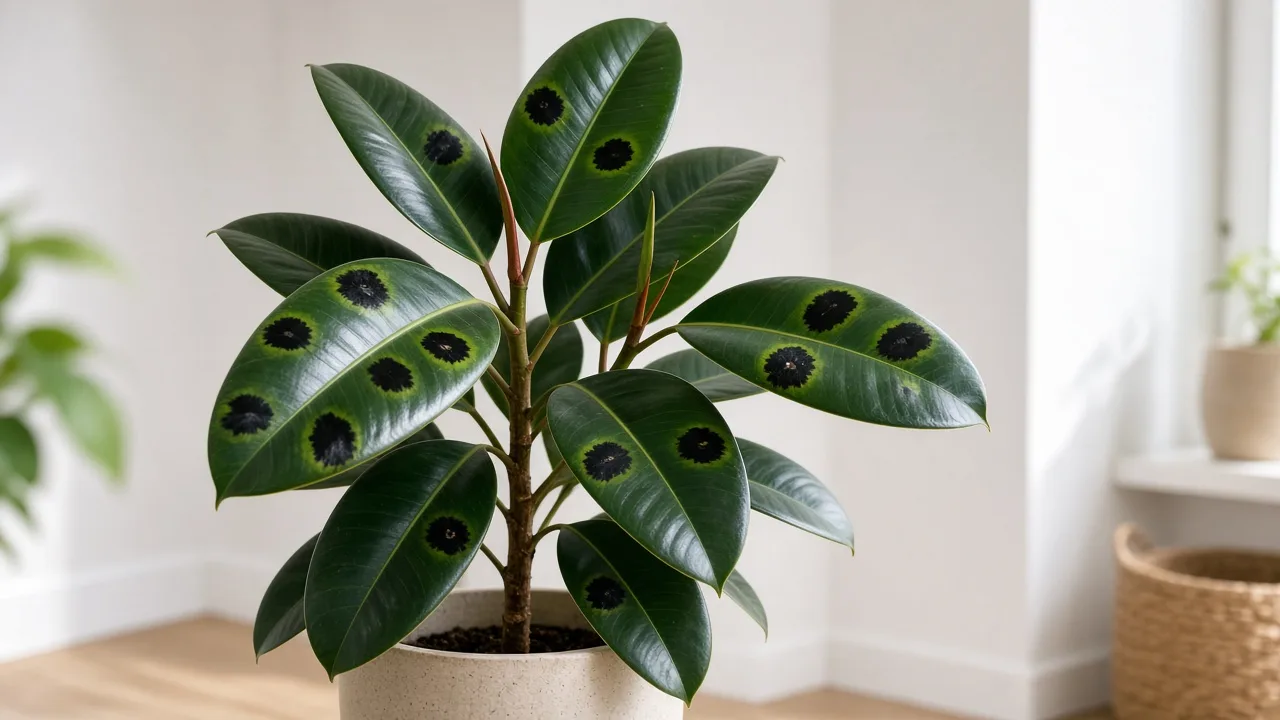
Black Spots on Rubber Plant: Causes, Checks & Fixes
This guide covers black spots on Rubber Plant. See also the general Black Spots guide, watering, and light pages for this plant.
Black Spots on Rubber Plant: Causes, Checks & Fixes
Quick answer
Black spots on rubber plant (Ficus elastica) are localized tissue death or surface mold—dark patches on thick glossy leaves that can mean very different problems. On this upright woody houseplant, the pattern usually splits three ways: black smear that wipes off points to sooty mold from scale honeydew, wet circles with yellow halos on broad blades suggest fungal leaf spot after foliage stays damp, and fixed dry black patches on lower leaves often track overwatering, cold drafts, or normal bottom-leaf senescence. For general spot-disease mechanics, see our black spots guide. On rubber plant, large waxy leaves hold water after shower-rinsing, red sheaths trap moisture at the crown, and Clemson HGIC notes that plant diseases are very rarely a problem indoors—watering mistakes and insects cause most leaf damage.
A few isolated dry black marks on one lower leaf are cosmetic. Spreading wet-looking spots on multiple crown leaves or black smear across glossy blades need action the same week—not extra fertilizer.
First step: wipe one spot with a damp cloth. If black smears away, inspect stems and sheaths for scale insects before fungicide. If the mark stays fixed in the leaf, stop wetting foliage and check the top-2-inch dry-down before treating for disease.
When to use this page vs other Rubber Plant guides
| Your question | Best page |
|---|---|
| Dark spots or smears on leaf blades | This page |
| Tan bumps on stems and sheaths | Scale insects |
| Whole leaves yellowing on wet soil | Overwatering |
| Mushy roots, sour smell, wilt on wet mix | Root rot |
| Uniform brown edges, not round spots | Brown leaves |
| Mass leaf drop after a move or draft | Leaf drop |
| Fine webbing and stippling on glossy leaves | Spider mites |
What black spots look like on Rubber Plant
Healthy rubber plant leaves are thick, stiff, and glossy—often 8 to 12 inches long on a mature floor specimen. Black spotting breaks that pattern in recognizable ways:
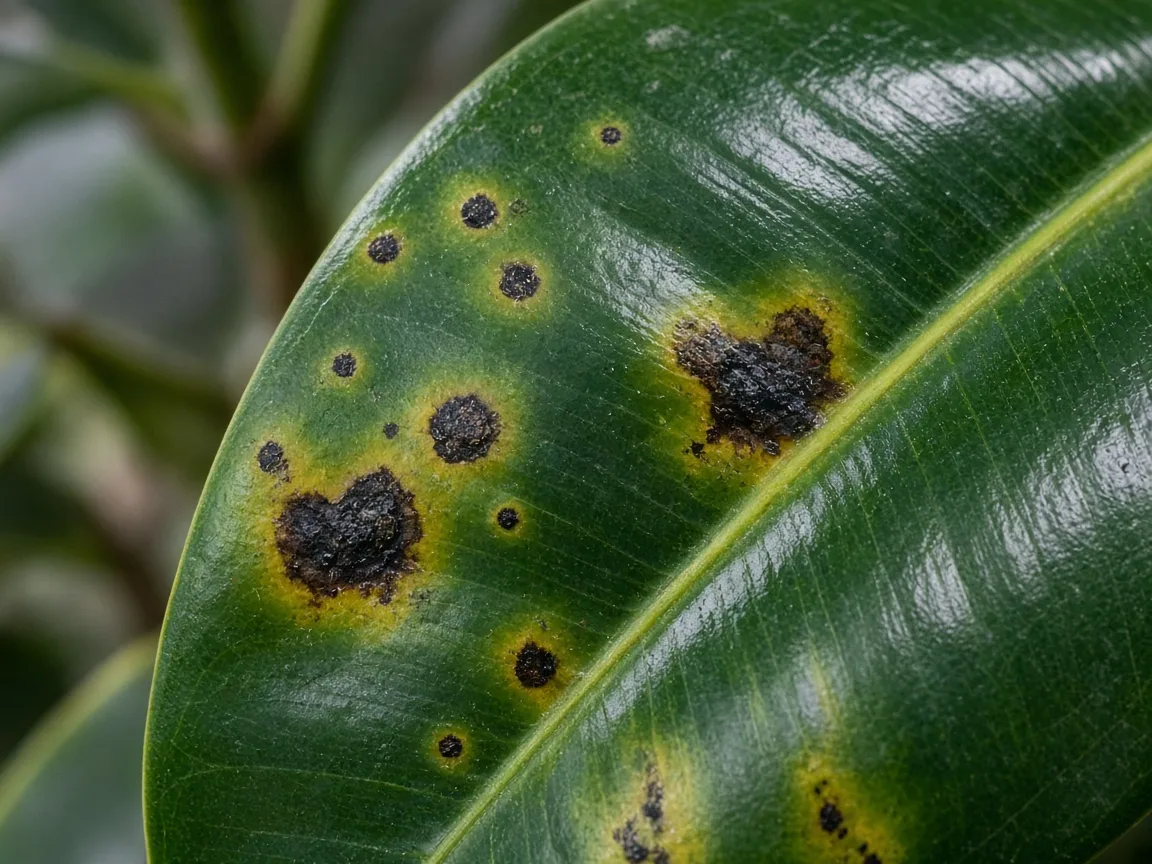
Dark lesions on thick glossy Ficus elastica foliage—compare wipe-off sooty mold with fixed necrotic spots surrounded by yellow halos.
- Black coating that wipes off with a damp cloth — Sooty mold growing on sticky honeydew from scale or other sap feeders. The leaf underneath is often still green.
- Small dark brown to black circles with yellow halos — Often start water-soaked, then crisp at center. RHS notes dark spots with yellow margins may be fungal leaf spot on wet foliage.
- Brown to black patches on leaf undersides — Often on lower crown leaves while mix stays heavy; Clemson HGIC notes leaf yellowing when soil stays too wet on rubber plant, and darkening frequently follows the same wet-mix pattern.
- Dry black patches after a cold night near a window — The Spruce notes brief exposure below 50°F can yellow then brown leaves before they drop—fixed necrosis, not infection.
- Single dry black mark, no halo, no spread — Bumping a stiff leaf, pet damage, or a healed wound on one blade. Stable for months.
- Raised corky tan patches on undersides — Oedema from excess water uptake on thick leaves in stagnant humid air—not classic leaf spot.
- Black soft tissue at the soil line on wet mix — Stem or root failure, not superficial spotting. See root rot.
Spots on new leaves still inside red sheaths are more urgent than one old mark on the lowest senescing leaf.
Why upright rubber plant gets black spots on lower leaves first
Rubber plant grows as a tree-like upright specimen with a single woody trunk and a crown of large leaves—not a trailing vine. That architecture changes where spots start:
Normal bottom-leaf senescence. NC State Extension notes it is normal for some bottom leaves to turn yellow and drop on rubber plant. A few lower leaves develop tan or brown patches before they fall. If upper crown leaves and new red-sheathed growth stay clean, this is aging—not disease.
Crown splash and wet undersides. When you water from above on a tall floor plant, runoff collects on the broad leaf undersides closest to the pot rim. Clemson HGIC advises washing dusty leaves with water for plant health—but leaves that stay wet overnight in a dim corner invite fungal leaf-spot germination.
Red sheath moisture traps. New rubber plant leaves emerge from bright red protective sheaths at the stem tip. Misting or showering the crown keeps sheaths damp for days. Spots that appear on partially unfurled blades often trace to wet-sheath culture, not bad luck.
Winter wet mix on semi-dormant roots. Missouri Botanical Garden recommends reducing watering from fall to late winter when growth slows. Calendar watering through November and December leaves mix saturated while roots idle—UF/IFAS warns rubber tree is easily damaged if over-watered and margin or underside darkening follows before root rot develops.
Why Rubber Plant gets black spots
Sooty mold from scale and honeydew
Scale insects are a common rubber plant pest. Soft scale excretes sticky honeydew that grows black sooty mold on the glossy leaf surface below feeding sites. Owners search for “black spots” when the real problem is scale on stems and sheaths. The wipe test separates this from fixed lesions instantly.
Fungal leaf spot
Fungal spores germinate on persistently wet leaves and create brown to black lesions with yellowish margins. On rubber plant’s thick waxy cuticle, spots often stay small but multiply on several crown leaves after repeated overhead watering or misting in low light.
Overwatering and underside browning
This is the rubber-plant-specific branch many generic spot articles miss. Clemson HGIC notes leaf yellowing when soil stays too wet on rubber plant, and fixed dark patches on lower crown leaves while the pot feels heavy and cool usually track the same wet-mix problem—route to overwatering before fungicide.
Cold drafts and temperature shock
Rubber plant is vulnerable to cold drafts. Leaves near a winter window or HVAC vent develop dry brown-black patches that do not spread like infection. Compare with recent leaf drop after a move.
Sun scorch on thick leaves
Sudden exposure to harsh afternoon sun after a dim corner can scorch patches dry and crisp on stiff glossy blades—see brown leaves if damage followed a relocation, not misting.
Pest stippling and secondary darkening
Spider mites and thrips cause stippled tissue that later browns or blackens on stressed leaves. Check for fine webbing or silver scarring before assuming leaf-spot disease.
How to confirm the cause
Work through these checks before repotting or spraying:
- Wipe test — Damp cloth on the spot. Smears = sooty mold; treat pests first. Fixed in leaf = necrosis or pathogen.
- Spot texture — Wet, greasy, or water-soaked margins suggest active disease. Dry, papery black patches suggest sun, cold, or old mechanical damage.
- Halo presence — Yellow ring around a dark center fits fungal leaf spot per RHS guidance.
- Location on the plant — Spots only on lowest leaves with clean new sheathed growth = senescence or splash. Random spots on mid-crown and new unfurling leaves with misting habit = wet-blade culture.
- Stem and sheath inspection — Tan bumps inside red sheaths or along petiole bases confirm scale before fungicide.
- Soil moisture — Top 2 inches wet for a week with heavy pot weight points to overwatering, not airborne leaf pathogens.
- Spread rate — New spots weekly on multiple leaves = disease or pest. One mark stable for months = mechanical.
The first fix to try
Wipe one representative spot and inspect stems for scale.
If black smears off, isolate the plant and treat scale insects with alcohol swabs on every visible bump before washing leaves or applying horticultural oil. Fungicide on sooty mold alone wastes time while scale keeps feeding.
If the spot stays fixed in the leaf, stop wetting foliage—water at soil level only, improve airflow around the crown, and verify the top 2 inches of mix are dry before the next drink. Hold fertilizer until new growth looks healthy for two weeks.
Step-by-step recovery
For sooty mold and scale
- Isolate from other houseplants.
- Scrape scale bumps with 70% isopropyl alcohol on a cotton swab—wear gloves; Ficus latex irritates skin.
- Wash glossy leaves with lukewarm water and a soft cloth to remove mold residue.
- Re-check sheaths and petiole bases weekly for two weeks.
- If scale persists, follow the full protocol on the scale insects page.
For fungal leaf spot
- Remove the worst spotted leaves with clean shears—sanitize between cuts.
- Stop misting and overhead watering permanently for this specimen.
- Space the plant so leaves do not touch walls or neighboring pots.
- Water only when the top 2 inches of well-draining mix are dry.
- If spots keep appearing on new sheathed leaves after two weeks of dry-foliage culture, a labeled houseplant fungicide applied per label directions is the next step—not before cultural fixes.
For overwatering-related darkening
- Stop watering until the top half of the pot dries noticeably.
- Confirm drainage holes are open and no cachepot traps water.
- Move to brighter indirect light if the plant sits in a dim corner—slow drying worsens wet mix.
- If lower leaves blacken while soil smells sour, unpot and inspect for root rot before resuming any watering schedule.
Recovery timeline
| Severity | What to expect |
|---|---|
| Sooty mold only, scale cleared | Gloss returns within 1–2 weeks after washing; no new smear |
| Mild leaf spot, culture fixed | New spots stop within 2–3 weeks; old lesions stay dark |
| Overwatering underside patches | Stabilizes after 1–2 dry-down cycles; new crown leaves clean |
| Cold-draft necrosis | Damage fixed on affected leaves; no spread once plant is warm |
Judge recovery by firm new leaves emerging from red sheaths without fresh spots—not by old thick blades turning green again.
Lookalike symptoms
| What you see | Likely cause | Check |
|---|---|---|
| Black smear wipes off | Sooty mold / scale | Scale insects |
| Yellow halos around dark circles | Fungal leaf spot | Wet foliage habit, airflow |
| Brown-black lower leaves only | Senescence or splash | Upper crown clean? |
| Underside patches, heavy wet pot | Overwatering | Dry-down test |
| Dry crisp patches after window move | Cold or sun shock | Brown leaves |
| Corky raised underside patches | Oedema | Reduce watering, improve airflow |
| Black at soil line, sour smell | Root/stem rot | Root rot |
Mistakes to avoid
- Spraying fungicide on sooty mold without clearing scale first—the mold returns within days.
- Misting thick glossy leaves in a dim room—water sits on the waxy surface longer than on thin-leaved plants.
- Removing every spotted lower leaf when only normal senescence is happening—compare with NC State’s note on normal bottom-leaf drop.
- Repotting and pruning and spraying on the same day—rubber plant reacts to stacked changes with leaf drop.
- Fertilizing spotted leaves—feed only after new growth is clean for two weeks.
How to prevent black spots next time
- Water at soil level when the top 2 inches of mix are dry per the watering guide.
- Wipe dust from glossy leaves monthly—Clemson HGIC recommends washing dusty leaves so pests and mold are visible early.
- Keep rubber plant away from cold windows and HVAC vents in winter.
- Quarantine new specimens two to three weeks and inspect red sheaths before placing near existing plants.
- Reduce watering frequency in fall and winter when growth slows—Missouri Botanical Garden advises less water from fall through late winter.
Related Rubber Plant guides
- Rubber Plant overview — Species profile and care baseline.
- Problems hub — All rubber plant issue pages in one place.
- Scale insects — When black smears wipe off and bumps hide in sheaths.
- Overwatering — When underside patches track wet mix, not infection.
- Watering — Top-2-inch dry-down and winter reduction.
Use the Plant Problem Diagnosis Tool to narrow causes for black spots on this plant before changing multiple variables at once.