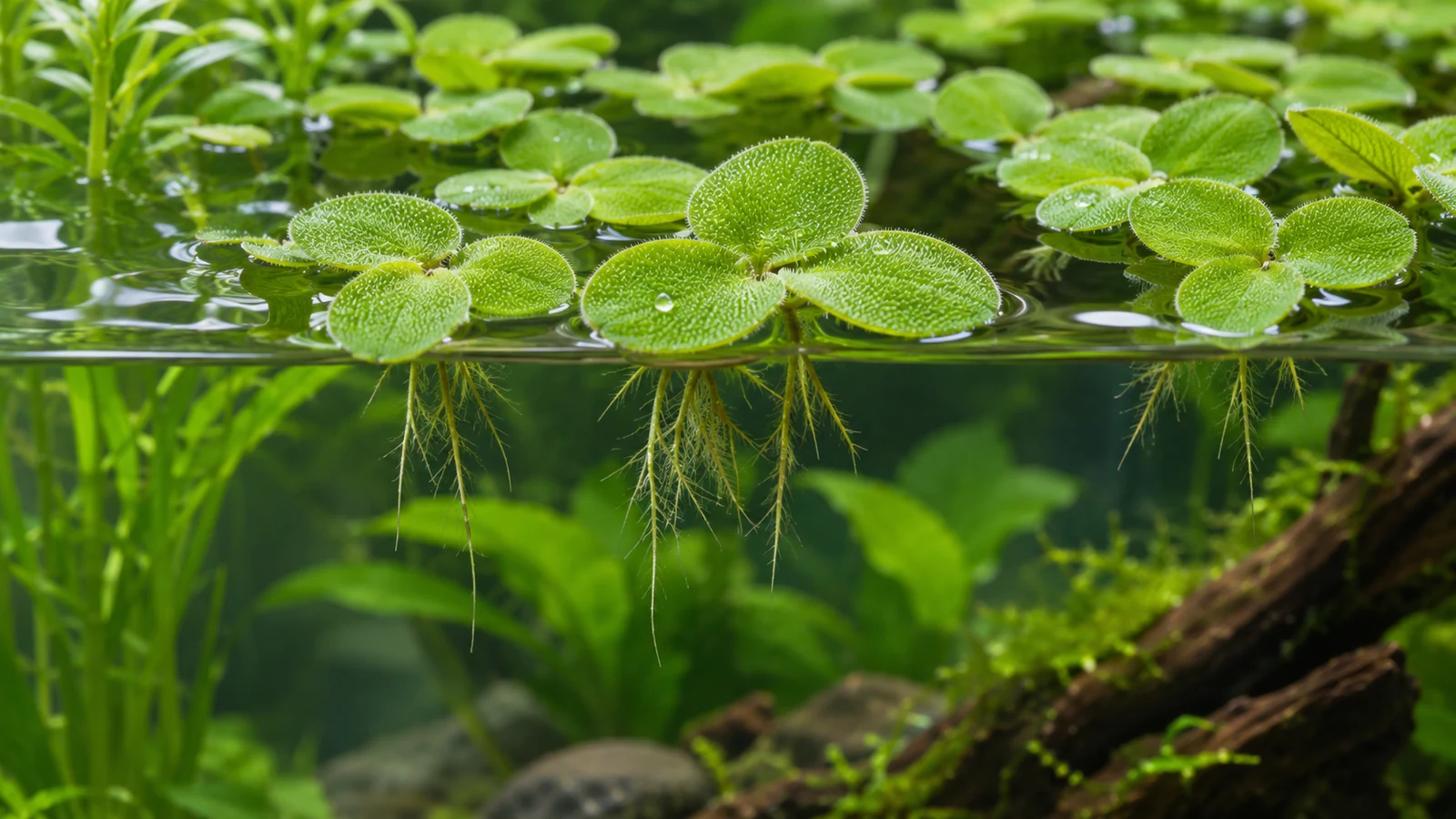
No. Common aquarium species such as S. minima float at the surface and take nutrients from the water column. Do not bury them in aquarium substrate; add a water-column fertilizer only if the aquarium’s overall nutrient needs justify it.
What light does Salvinia need?
Start with low to moderate aquarium lighting. Tropica rates S. minima’s light demand low, and its floating leaves sit close to the light source. Thin the canopy if it blocks light from submerged plants.
Why does my Salvinia keep moving to one side of the tank?
Filter return flow can push surface floaters into a corner or beneath the water. Redirect the outlet or use an aquarium-safe floating boundary so the plants can stay at the surface without obstructing the filter.
How often should I thin Salvinia?
Thin it when the mat begins shading submerged plants, crowding equipment, or covering more surface than your aquarium needs. Growth depends on species, light, and water nutrients, so inspect it during routine tank maintenance instead of relying on a fixed calendar.
Can I release Salvinia or aquarium water into a pond?
No. Do not release live Salvinia, fragments, or aquarium water outdoors. USGS documents S. minima as established outside its native range in parts of the United States, and USDA ARS documents spread of S. molesta. Check local rules for the species you have and dispose of removed growth securely.
Is Salvinia toxic to pets?
Salvinia is toxic to cats and dogs. Keep out of reach of curious pets and choose pet-safe alternatives for accessible spots.
How do I propagate Salvinia?
Salvinia propagates by lift out a small healthy section using clean aquarium tools or hands, keep the new piece floating in a suitable freshwater aquarium, remove surplus growth regularly so the surface does not become a solid mat. The easiest method is allow healthy surface growth to divide and branch, then separate a small section. Salvinia minima spreads through branching rhizomes and vegetative fragments. Separate only the amount wanted for a controlled aquarium and collect every unwanted fragment during maintenance. Do not release live plants, fragments, or aquarium water outdoors or into natural waterways.
Written by Sai AnanthLead content writer at LeafyPixels. B.Pharmacy graduate from Andhra University with a background in pharmacognosy, turned indoor gardening writer after a long-time plant hobby became a research-led resource for home growers.View Sai Ananth's profile · Reviewed by LeafyPixels Review Board
This Salvinia problems problem guide was researched and written by Sai AnanthLead content writer at LeafyPixels. B.Pharmacy graduate from Andhra University with a background in pharmacognosy, turned indoor gardening writer after a long-time plant hobby became a research-led resource for home growers.View Sai Ananth's profile. Problems symptoms on Salvinia, lookalike causes, and step-by-step fixes are cross-checked against extension pest, disease, and care references before publication.
We prioritize sources that hold up under scrutiny:
University cooperative extension bulletins and fact sheets (Penn State, Clemson, UMD, NC State, and similar programs)
Botanical garden and horticultural society publications
Peer-reviewed plant science and veterinary toxicology references where pet safety matters (including ASPCA Animal Poison Control)
Established reference works on indoor plant culture
The LeafyPixels editorial team then reviews the draft for clarity, step-by-step usefulness, and fit with real apartment and home conditions-not ideal greenhouse setups. When guidance changes materially, we update the page and note the revision date.
Sources used
Fin & Stem — Floating Watermoss (Salvinia natans) Care & Tank Mates (n.d.) Species-specific aquarium guidance for S. natans on floating growth, water-column feeding, still-to-low flow, and regular surface thinning; not generalized as an exact species identification or universal legal claim.. [Online]. Available at: https://finandstem.com/plants/salvinia-natans (Accessed: 1 March 2024).
Glassbox Diaries — Salvinia Minima Care Guide (n.d.) Practical aquarium advice for S. minima on low light, no substrate or injected CO2, water-column nutrients, surface coverage and thinning, temperature response, and tolerating some filter disturbance; used as an aquarium grower's guide rather than a taxonomic or legal authority.. [Online]. Available at: https://glassboxdiaries.com/plant/salvinia-minima/ (Accessed: 1 March 2024).
Tropica Aquarium Plants — Salvinia minima (n.d.) Aquarium-specific S. minima profile: floating habit, low light demand, 3–5+ cm listed height, faster growth with light and nutrients, use of water-column nutrients, shading below, and pale leaves as a possible micronutrient-shortage sign.. [Online]. Available at: https://tropica.com/en/plants/plantdetails/4767/4767 (Accessed: 1 March 2024).
USDA Agricultural Research Service — Salvinia molesta (n.d.) Distinguishing the separate S. molesta research and management context from common aquarium S. minima; informs the general containment caution without claiming a universal legal ban.. [Online]. Available at: https://www.ars.usda.gov/southeast-area/fort-lauderdale-fl/iprl/docs/salvinia-salvinia-molesta/ (Accessed: 1 March 2024).
USGS Nonindigenous Aquatic Species — Water Spangles (Salvinia minima) (n.d.) Species-bounded identification, free-floating rootless habit, two surface leaves and a submerged modified frond, Central and South American native range, vegetative spread, dense mats, and documented nonindigenous occurrences of S. minima in the United States.. [Online]. Available at: https://nas.er.usgs.gov/queries/FactSheet.aspx?speciesID=297 (Accessed: 1 March 2024).