Salvinia Aquarium Care: Floating Growth, Light
Salvinia spp. (aquarium-trade plants; often Salvinia minima)
Keep Salvinia floating in freshwater with low to moderate light, nutrients in the water column, and manageable surface flow. Thin it before the mat shades submerged plants, confirm the species where possible, and never release it or aquarium water outdoors.
Salvinia Aquarium Care Guide
Start with wateringThe most common care mistake for SalviniaSalvinia Watering and Water Quality →Salvinia care essentials
Light
Low to moderate aquarium light; surface-floating leaves receive light before plants below them.
Water
Keep Salvinia floating on the surface of a freshwater aquarium. It is not a rooted plant: do not bury it in substrate or potting mix. Aquarium sources describe Salvinia minima as drawing nutrients from the water column. Keep leaves at the surface and out of direct filter discharge; gentle surface movement is easier to manage than a strong current that pushes plants under or collects them at one end of the tank. Aquarium-trade labels can cover different Salvinia species, so use species-specific advice where the Latin name is known.
Soil
No substrate is needed. Salvinia is a surface floater, not a plant to anchor in aquarium soil, gravel, or terrestrial potting mix.
Humidity
Floating at the water surface with its fronds exposed to humid aquarium air
Temperature
Follow the aquarium's livestock requirements. For Salvinia minima, the aquarium sources reviewed give roughly 20–28°C as a comfortable range; other Salvinia species may differ.
Fertilizer
Usually unnecessary in a normally stocked aquarium. Salvinia minima takes up nutrients from the water; consider an aquarium-labeled water-column fertilizer only if growth or leaf color suggests a shortage and the tank's livestock plan permits it.. Aquarium plant fertilizer labeled for freshwater use, dosed for the whole tank
About Salvinia
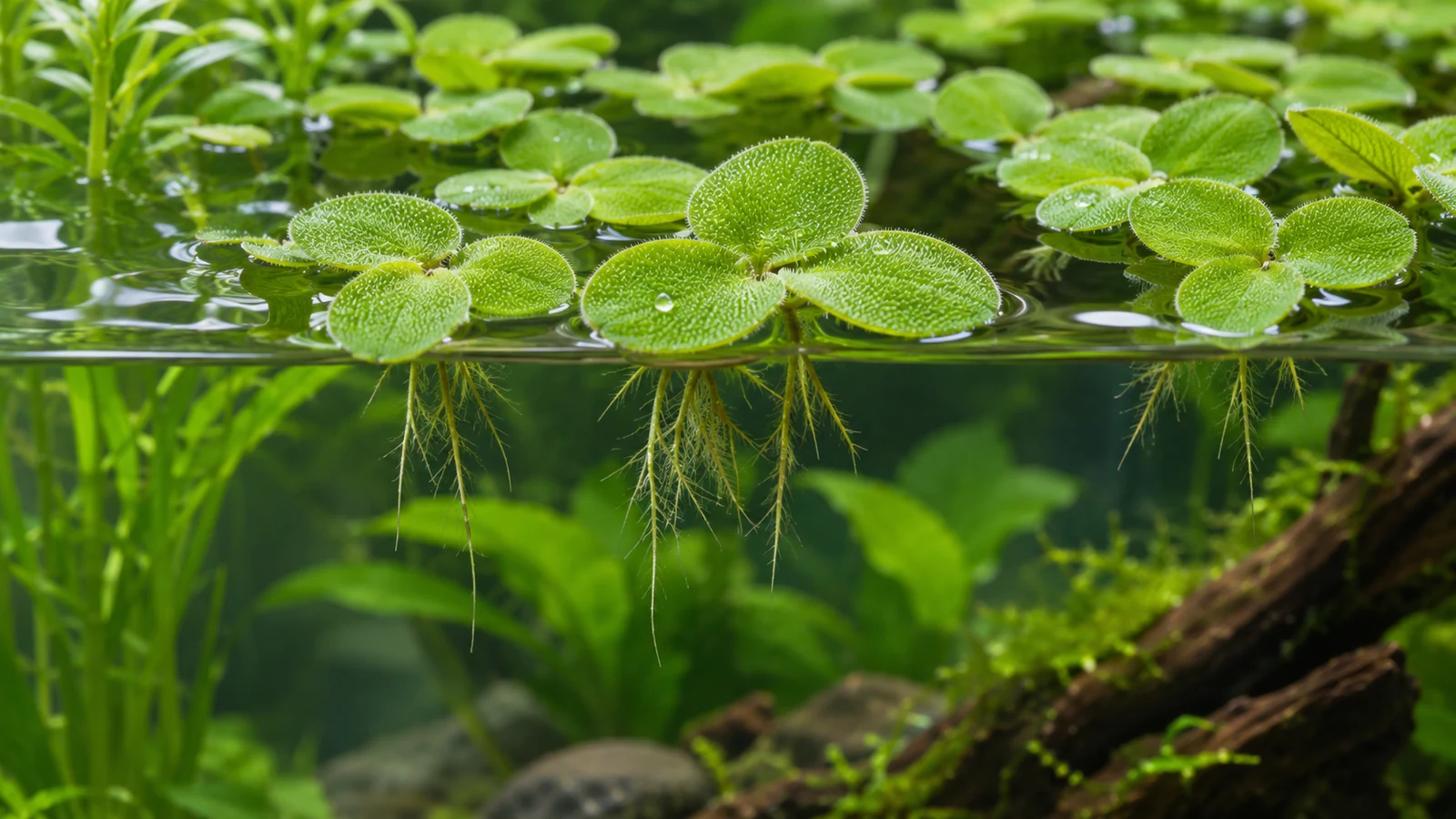
Salvinia is native to Depends on the species. USGS lists Salvinia minima, a common aquarium-trade form, as native to Central and South America; do not apply that range to every species sold as Salvinia., typically reaches Varies with species and conditions. Tropica lists Salvinia minima at 3–5+ cm aquarium height, while USGS reports its floating leaves at about 0.4–2 cm. indoors, with moderate to fast; salvinia minima grows more quickly when light and water-column nutrients are available. growth. Salvinia has a free floating aquatic fern with paired surface fronds and a submerged, root like modified frond; it has no true roots and does not need planting substrate. growth habit and part of the Salviniaceae family. It is also known as Water spangles, Water fern, and Floating watermoss.
| Detail | Information |
|---|---|
| Also known as | Water spangles, Water fern, Floating watermoss |
| Native region | Depends on the species. USGS lists Salvinia minima, a common aquarium-trade form, as native to Central and South America; do not apply that range to every species sold as Salvinia. |
| Mature size | Varies with species and conditions. Tropica lists Salvinia minima at 3–5+ cm aquarium height, while USGS reports its floating leaves at about 0.4–2 cm. |
| Growth rate | Moderate to fast; Salvinia minima grows more quickly when light and water-column nutrients are available. |
| Growth habit | Free Floating Aquatic Fern With Paired Surface Fronds And A Submerged, Root Like Modified Frond; It Has No True Roots And Does Not Need Planting Substrate. |
| Scientific name | Salvinia spp. (aquarium-trade plants; often Salvinia minima) |
| Family | Salviniaceae |
How to care for Salvinia?
How much light does Salvinia need?
Low to moderate aquarium light; surface-floating leaves receive light before plants below them.. Low aquarium lighting. Moderate planted-tank lighting. Brighter lighting when the rest of the aquarium is balanced and the floating cover is thinned as needed. low light
- Low to moderate aquarium light - Low to moderate aquarium light; surface-floating leaves receive light before plants below them..
- surface-floating leaves receive light before plants below them - Low to moderate aquarium light; surface-floating leaves receive light before plants below them..
- Low aquarium lighting - Low aquarium lighting.
- Moderate planted-tank lighting - Moderate planted-tank lighting.
- Brighter lighting when the rest of the aquarium is balanced and the floating cover is thinned as needed - Brighter lighting when the rest of the aquarium is balanced and the floating cover is thinned as needed.
- low light - Low to moderate aquarium light; surface-floating leaves receive light before plants below them..
When should you water Salvinia?
Keep Salvinia floating on the surface of a freshwater aquarium. It is not a rooted plant: do not bury it in substrate or potting mix. Aquarium sources describe Salvinia minima as drawing nutrients from the water column. Keep leaves at the surface and out of direct filter discharge; gentle surface movement is easier to manage than a strong current that pushes plants under or collects them at one end of the tank. Aquarium-trade labels can cover different Salvinia species, so use species-specific advice where the Latin name is known.
- Check that most fronds remain afloat - Keep leaves at the surface and out of direct filter discharge; gentle surface movement is easier to manage than a strong current that pushes plants under or collects them at one end of the tank.
- are not trapped against a filter intake - Keep leaves at the surface and out of direct filter discharge; gentle surface movement is easier to manage than a strong current that pushes plants under or collects them at one end of the tank.
- and are still receiving light. Salvinia minima's pale new or established leaves can indicate limited micronutrients - Keep leaves at the surface and out of direct filter discharge; gentle surface movement is easier to manage than a strong current that pushes plants under or collects them at one end of the tank.
- review the whole aquarium's nutrient balance before adding fertilizer - Aquarium sources describe Salvinia minima as drawing nutrients from the water column.
- Drain excess water - Keep Salvinia floating on the surface of a freshwater aquarium.
What soil works best for Salvinia?
No substrate is needed. Salvinia is a surface floater, not a plant to anchor in aquarium soil, gravel, or terrestrial potting mix.
- Open freshwater surface with room for the fronds to float - Salvinia is a surface floater, not a plant to anchor in aquarium soil, gravel, or terrestrial potting mix.
- A floating ring or other aquarium-safe boundary if you want to reserve an open section of surface - Salvinia is a surface floater, not a plant to anchor in aquarium soil, gravel, or terrestrial potting mix.
How to propagate Salvinia?
Salvinia minima spreads through branching rhizomes and vegetative fragments. Separate only the amount wanted for a controlled aquarium and collect every unwanted fragment during maintenance. Do not release live plants, fragments, or aquarium water outdoors or into natural waterways.
- Lift out a small healthy section using clean aquarium tools or hands - Do not release live plants, fragments, or aquarium water outdoors or into natural waterways.
- Keep the new piece floating in a suitable freshwater aquarium - Separate only the amount wanted for a controlled aquarium and collect every unwanted fragment during maintenance.
- Remove surplus growth regularly so the surface does not become a solid mat - Separate only the amount wanted for a controlled aquarium and collect every unwanted fragment during maintenance.
Grower notes for Salvinia
Check the species name on the label
Salvinia is a genus, and aquarium references cover more than one species. Tropica and Glassbox Diaries have species-specific profiles for S. minima, while Fin & Stem profiles S. natans. USGS treats S. minima and S. molesta as distinct species. Use the Latin name where available rather than assuming one care profile or risk applies to every Salvinia.
Let it float instead of planting it
Salvinia is a surface-growing fern, not a rooted rosette. USGS describes S. minima as free-floating and rootless, with a submerged modified frond that can look root-like. Leave the plant on the water surface; substrate and root tabs are not how it feeds.
Start with modest light
Tropica rates S. minima's light demand low, and the Glassbox Diaries aquarium guide reports that low-intensity light can support it. Because floating leaves sit close to the light, watch the plants below: a thick Salvinia canopy can shade them even when the floater itself is growing well.
Feed through the water, if the tank needs it
Tropica says S. minima grows quickly when light and nutrients are available and that pale leaves can signal limited micronutrients. The Glassbox Diaries guide says regular fertilizer is often unnecessary in a stocked aquarium. Check the wider tank before adding an aquarium-labeled liquid fertilizer; do not add garden products to aquarium water.
Keep the surface flow gentle enough
Floating plants can be pushed together or submerged by a strong outlet. Fin & Stem lists S. natans for still-to-low flow, while Glassbox Diaries reports S. minima tolerates some filter disturbance. If the plants keep collecting in one corner, redirect the outlet or use an aquarium-safe floating boundary, while keeping filtration and livestock needs in mind.
Thin the mat and contain every clipping
Remove surplus growth when it starts shading submerged plants or obstructing access to the surface. USGS documents S. minima spreading by branching rhizomes and notes that it forms dense mats in some US waters; USDA ARS separately documents movement of S. molesta. Do not release aquarium plants, fragments, or tank water into ponds, drains, or natural waterways, and check local rules for the exact species.
Salvinia and household pets
This review did not confirm a species-specific veterinary toxicity classification for aquarium-trade Salvinia. Aquarium use does not establish that it is safe to eat, and tank water may contain treatments or fertilizers. Keep the tank secured from chewing pets and contact a veterinarian if a pet ingests the plant or aquarium water.
Salvinia is used as an aquarium plant, but no species-specific household-pet safety assessment was verified for this genus in this review. Keep all pet entries at caution / needs-review; do not infer safety from aquarium use or from a missing toxic-plant listing.
Watering Salvinia
For Salvinia, check that most fronds remain afloat, are not trapped against a filter intake, and are still receiving light. Salvinia minima's pale new or established leaves can indicate limited micronutrients; review the whole aquarium's nutrient balance before adding fertilizer. and water there is no separate watering schedule for this floating fern. Maintain the aquarium's usual water-change and livestock-care routine, then inspect the floating leaves and thin the mat before it covers the whole surface. Salvinia minima grows more slowly in cooler conditions according to the aquarium-care sources reviewed. Keep temperature stable for the fish and invertebrates; do not alter livestock conditions just to speed up the plant.
| Detail | Information |
|---|---|
| How often | There is no separate watering schedule for this floating fern. Maintain the aquarium's usual water-change and livestock-care routine, then inspect the floating leaves and thin the mat before it covers the whole surface. |
| How to check | Check that most fronds remain afloat, are not trapped against a filter intake, and are still receiving light. Salvinia minima's pale new or established leaves can indicate limited micronutrients; review the whole aquarium's nutrient balance before adding fertilizer. |
| Seasonal changes | Salvinia minima grows more slowly in cooler conditions according to the aquarium-care sources reviewed. Keep temperature stable for the fish and invertebrates; do not alter livestock conditions just to speed up the plant. |
Soil & potting for Salvinia
Use a mix of Open freshwater surface with room for the fronds to float, A floating ring or other aquarium-safe boundary if you want to reserve an open section of surface for Salvinia. Not applicable. Keep the water clean for the aquarium's inhabitants and keep loose plants away from filter intakes and equipment. Repot not applicable; thin or remove floating growth instead of repotting, ideally in any time the aquarium is stable; remove small portions during routine maintenance.
| Detail | Information |
|---|---|
| Recommended mix | Open freshwater surface with room for the fronds to float, A floating ring or other aquarium-safe boundary if you want to reserve an open section of surface |
| Drainage | Not applicable. Keep the water clean for the aquarium's inhabitants and keep loose plants away from filter intakes and equipment. |
| Repotting frequency | Not applicable; thin or remove floating growth instead of repotting |
| Best season to repot | Any time the aquarium is stable; remove small portions during routine maintenance |
Signs it needs repotting
- The mat is blocking light from submerged plants
- Floating plants are crowding filter intakes or the feeding area
- The surface is so covered that normal aquarium maintenance becomes difficult
Humidity & temperature for Salvinia
Salvinia prefers floating at the water surface with its fronds exposed to humid aquarium air. Keep temperatures around follow the aquarium's livestock requirements. For Salvinia minima, the aquarium sources reviewed give roughly 20–28°C as a comfortable range; other Salvinia species may differ. Salvinia is a genus rather than one uniform aquarium species. Do not treat a care range for S. minima or S. natans as a guaranteed range for every plant sold under the trade name.
| Detail | Information |
|---|---|
| Humidity | Floating at the water surface with its fronds exposed to humid aquarium air |
| Ideal temperature | Follow the aquarium's livestock requirements. For Salvinia minima, the aquarium sources reviewed give roughly 20–28°C as a comfortable range; other Salvinia species may differ. |
| Temperature notes | Salvinia is a genus rather than one uniform aquarium species. Do not treat a care range for S. minima or S. natans as a guaranteed range for every plant sold under the trade name. |
Humidity tips
- Keep the floating fronds at the water surface rather than submerged
- If a lid is used, check that condensation does not continually drip onto the leaves; aquarium guides report that wet leaves can deteriorate
Fertilizer & pruning for Salvinia
Feed Salvinia usually unnecessary in a normally stocked aquarium. Salvinia minima takes up nutrients from the water; consider an aquarium-labeled water-column fertilizer only if growth or leaf color suggests a shortage and the tank's livestock plan permits it. using aquarium plant fertilizer labeled for freshwater use, dosed for the whole tank. The best feeding window is during active growth, only if the aquarium's nutrient balance calls for supplementation. Terrestrial garden fertilizer or adding nutrients without considering fish, shrimp, and the other plants in the aquarium.
| Detail | Information |
|---|---|
| Fertilizer schedule | Usually unnecessary in a normally stocked aquarium. Salvinia minima takes up nutrients from the water; consider an aquarium-labeled water-column fertilizer only if growth or leaf color suggests a shortage and the tank's livestock plan permits it. |
| Best season | During active growth, only if the aquarium's nutrient balance calls for supplementation |
| Fertilizer type | Aquarium plant fertilizer labeled for freshwater use, dosed for the whole tank |
| What to avoid | Terrestrial garden fertilizer or adding nutrients without considering fish, shrimp, and the other plants in the aquarium |
Pruning
Lift out surplus plants with a net or aquarium-safe tool before the mat becomes dense. Leave enough open surface for the aquarium's layout and light needs, and inspect the filter intake for small pieces after thinning. Dispose of removed plants securely under local guidance; never empty them into ponds, streams, storm drains, or other outdoor water.