Sansevieria Laurentii Light Needs: Windows & Sun
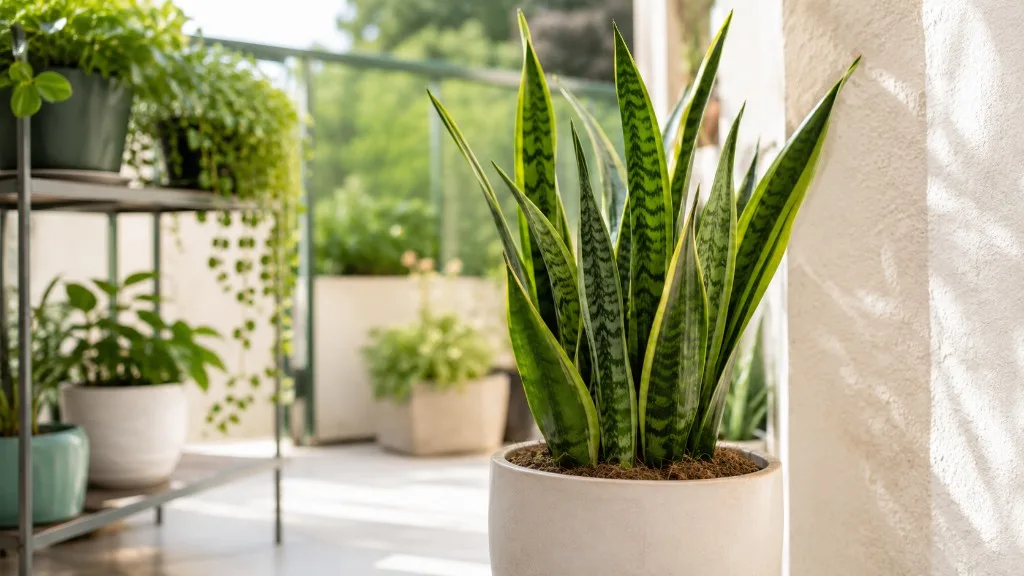
Sansevieria Laurentii Light Needs: Windows & Sun
Sansevieria Laurentii Light Needs: Windows & Sun
You bought Sansevieria Laurentii for the creamy-yellow leaf edges — the RHS Award of Garden Merit variegation that separates this cultivar from plain-green snake plants. Light is the lever that keeps those bands sharp or lets them wash into pale green. Dracaena trifasciata ‘Laurentii’ tolerates dim rooms longer than most houseplants, but dim light is exactly where gold margins disappear first.
The goal is not the darkest corner where the plant refuses to die. The goal is a spot where new leaves emerge with crisp yellow edges, growth stays slow but steady, and you are not fighting soggy soil because the pot never dries. NC State Extension lists snake plant light as partial shade — direct sun only part of the day, two to six hours — while noting the species tolerates very low light. Laurentii sits in the middle of that range: flexible like the species, but less forgiving about variegation than an all-green form.
This guide covers how much light Laurentii needs, which windows work best, direct sun limits, grow-light setups, and the warning signs that tell you to move the pot before margins fade or bleach.
Why Laurentii Margins Need More Light Than Plain Snake Plants
Variegation is not paint on the surface. On Laurentii, the yellow band is leaf tissue with less chlorophyll than the grey-green center. That tissue still costs the plant energy to maintain, but it photosynthesizes less per square inch. In bright, indirect light the whole leaf pulls its weight. In shade, the plant quietly reallocates resources toward greener tissue — and the gold band narrows, dulls, or vanishes on new growth.
The RHS Sansevieria growing guide routes cultivars by light appetite: variegated types belong in brighter placements, while all-green species such as S. zeylanica are the better pick for genuinely low light. Laurentii is explicitly in the bright-light camp even though the genus as a whole is famous for surviving offices.
What Happens When Yellow Edge Tissue Goes Dim
Margin fade usually shows on the newest leaf, not yesterday’s foliage. Old leaves can keep their yellow rim for months while incoming leaves emerge with thin, washed-out edges or no band at all. The center may also look darker green — the plant is packing in chlorophyll to harvest scarce light. That darker look is often misread as health when it signals shade stress.
In very low light, leaves may also elongate and loosen from the rosette as the plant searches for brightness. That stretch is easy to confuse with leggy growth on Sansevieria Laurentii from other causes, but light is the first variable to fix when margins and posture change together.
How Laurentii Compares to Moonshine and Hahnii Types
Moonshine snake plants carry silvery whole-leaf color that also needs stronger light to stay pale — they dull toward green in shade, but the symptom is overall color loss, not edge banding. Hahnii bird’s-nest types stay compact and are often sold for desks; their short leaves hide stretch longer, yet variegated Hahnii still loses contrast in dim shops. Laurentii’s upright swords make both margin fade and lean toward the window obvious once light slips below the growth threshold.
If you want a snake plant for a dark hallway, an all-green cultivar is the better tool. If you want Laurentii’s gold banding, budget one bright window or a grow lamp — not just “any snake plant spot.”
How Much Light Sansevieria Laurentii Actually Needs
Indoors, treat bright indirect light as the default: roughly the brightness two to four feet from an unobstructed east window, or several feet back from a filtered south pane. That is stronger than many “low-light plant” labels imply, but softer than all-day sun on the sill. Clemson Extension describes the ideal for snake plants as bright indirect light, with low light tolerated but slower growth — and cautions against direct hot sunlight that burns leaves.
Laurentii can survive down toward 50 to 100 foot-candles (about 500 to 1,000 lux) for maintenance, but 200 to 400 foot-candles (2,000 to 4,000 lux) at the leaf surface is where gold edges stay crisp and pups still form. You do not need a meter; use the shadow test below.
Bright Indirect Light as the Indoor Default
Bright indirect light means the leaf surface receives strong ambient brightness without leaf-scorching beams for hours. A spot that gets one hour of gentle morning sun plus bright day-long ambient light often outperforms a west sill that blasts hot afternoon rays. Duration matters: Laurentii benefits from roughly eight to ten hours of useful brightness, matching what the RHS calls a bright, lightly shaded position indoors.
Season shifts the target. A placement that works in June may be too dim in December when sun angle and day length drop. Re-check in late winter if new leaves arrive without yellow edges.
Reading Light With a Simple Shadow Test
On a clear day, hold your hand between the plant and the window. A soft, readable shadow with defined edges at the leaf surface suggests bright indirect — the Laurentii sweet spot. A faint or missing shadow means low light: survivable, but expect margin fade. If the leaf feels hot to touch within an hour of sun hitting it, you are in direct exposure that may need curtain diffusion or extra distance.
Place the pot within a few feet of the glass on the chosen exposure. A Laurentii on a bookshelf across the room is décor; one beside the pane is horticulture.
Best Window Placement for Crisp Gold Bands
Window direction is a starting point. Overhangs, trees outside, tinted glass, and indoor walls all change intensity. Still, compass orientation gives a reliable first guess in the northern hemisphere.
Rotate the pot a quarter turn every two to three weeks if growth leans toward the glass. Leaning is normal directional growth; rotation keeps the fan symmetrical so one side does not age faster.
East and South Windows
An east-facing window is the safest default for Laurentii in most homes. Morning sun is bright but relatively cool, followed by strong indirect light the rest of the day. Two to three feet from an unobstructed east pane often holds margins sharp without frequent bleach scares. Clemson Extension specifically notes Dracaena trifasciata ‘Laurentii’ for its bright yellow leaf margins — a cultivar worth placing where it can use that color, not hide it in shade.
A south-facing window delivers the highest total daily light, especially in winter. Use it with four to six feet of setback or a sheer curtain so you get intensity without baking the yellow edge tissue. The RHS advises keeping sansevierias out of midday sun that can scorch leaves — particularly important for variegated margins that bleach before the green center shows stress.
West, North, and Interior Shelves
West windows work in spring and fall but need caution in midsummer when late-afternoon sun carries heat through the pane. Treat west like south with extra distance, not like east with bonus sun.
North windows provide gentle indirect light all day, often landing in low to moderate range — especially in winter. Laurentii survives north light better than most tropical foliage, but gold bands commonly dull within a few new leaves. Pair north placement with a grow light if you care about variegation, and tighten your Sansevieria Laurentii watering rhythm because soil dries slowly.
Deep interior shelves without a window path are short-term holding zones only unless you add a lamp.
Can Laurentii Take Direct Sun?
Yes — in measured doses. Snake plants handle some direct sun, especially gentle morning exposure on an east sill or filtered beams through sheer fabric. UF/IFAS describes cultural needs as part shade with protection from hot afternoon sun, and notes that ‘Laurentii’ leaves have yellow edges — tissue that bleaches faster than the green center when light intensity jumps.
Problems start when a plant moves from a dim shop to harsh south glass in July without acclimation. Photobleaching on yellow margins is permanent; damaged tissue does not re-green.
Morning Sun vs Afternoon Heat Through Glass
Morning direct sun differs from afternoon sun in heat load and UV intensity at the leaf. East exposure gives Laurentii a manageable direct period plus long ambient brightness. Afternoon sun through west or south panes can exceed what yellow edge tissue tolerates, especially when outdoor temperatures are high and the pot sits on a heat-radiating sill.
If you want slightly faster growth and tighter leaf posture, east morning sun is the safest entry. South and west direct sun can work for established, acclimated plants behind diffusion. Never assume toughness equals burn immunity — see sunburn on Sansevieria Laurentii when crisp white-yellow patches appear on sun-facing sides.
Acclimating a Store-Bought Plant to Brighter Light
Retail Laurentii often comes from low-light nursery rows where margins already look pale. Move toward brighter exposure in stages over two to three weeks: week one, same room but several feet back from the target window; week two, halfway to the final spot; week three, settle unless new leaves show bleach.
Watch newest leaves first. Slight temporary curling on the sun-facing side during brightest hours can occur during acclimation; wide bleached bands or softening tissue mean you moved too fast. Do not stack a major light jump with immediate repotting and fertilizer — change light alone and let the next leaf confirm success.
Low-Light Survival Without Losing Variegation
Laurentii can linger in dim hallways and distant-office desks longer than a fern would — that is the species’ reputation, and NC State’s very-low-light tolerance note is real. Survival is not the same as keeping the cultivar you paid for. In shade, the plant often stays plump while gold bands disappear on new growth and pups stop forming.
The RHS is explicit: choose all-green sansevierias for low light, not variegated laurentii displays. If you must use a dark corner temporarily — three to six months during a renovation, for example — accept duller margins or add artificial light. Multi-year dark-corner storage turns Laurentii into a plain-looking green snake plant even if the label still says variegated.
Signs Your Laurentii Is in Survival Mode
Survival mode looks like rigid old leaves with no new pups, new leaves without yellow edges, and soil that stays wet for weeks because transpiration collapsed. Leaves may read as darker green while actually receiving less light. That combination raises overwatering risk — the classic Laurentii failure when light and drainage both slip.
If policy forces a dim office, run an 8 to 12 hour full-spectrum LED on a timer rather than hoping tolerance equals preference. Moderate artificial light often preserves margins better than a mediocre north window alone.
Grow Lights When Natural Windows Fall Short
Windowless rooms, deep interior desks, and winter north exposures are where full-spectrum LED grow lights earn their keep. Laurentii does not need flowering-level PAR, but it does need consistent daily photons to maintain variegation and keep soil on a safe dry-down schedule.
Choose a fixture labeled for houseplants or seedlings, roughly 4000K to 6500K white spectrum. Position 12 to 18 inches (30 to 45 cm) above the tallest leaf as a starting point. Run 8 to 12 hours daily on a timer. If leaves pale or stretch toward the lamp, increase duration slightly or lower the fixture a few inches; if edges crisp only under the bulb, raise it.
Integrate lamps with seasonal window light instead of treating them as winter-only tools. When total daily brightness rises, revisit watering — brighter light dries the pot faster.
Warning Signs of Too Little or Too Much Light
Laurentii whispers before it screams. Use a two-week observation window after any move. Old scars from a previous shop location are history; the next leaf and the next pup are the verdict.
Too little light: no new growth for many months, new leaves lacking yellow margins, darker overall green, elongated loose rosette, soil wet for weeks, and escalation paths to not enough light on Sansevieria Laurentii when adjustments fail.
Too much light or heat: bleached white-yellow patches on margins first, crisp brown on sun-facing edges, sunken papery scorch zones, sudden damage right after an unacclimated move to south glass. Sunburn tissue does not heal — only new leaves recover the look.
Margin Fade vs Margin Bleach
Fade is a slow chlorophyll shift: edges turn creamy, then greenish, often with smaller new leaves — classic insufficient light on a variegated cultivar. Bleach is fast tissue death on the yellow band under intense sun, leaving stark white-yellow zones that feel thin or papery. Fade needs more brightness; bleach needs less direct beam or more acclimation.
When heat and dimness compete — hot glass in a short winter day — remove direct beam and heat first. Scorch can arrive in a week; margin fade takes months.
How Light Changes Watering on Laurentii
Light sets the throttle on metabolism even though watering gets blamed first. Brighter placement increases photosynthesis and transpiration; dim corners slow both. A watering routine that worked on a bright east sill will overwater the same pot in a dim hall because the root zone stays saturated longer — the route into root rot.
After you increase light, check dryness more often for a month, but still wait until the mix is bone dry throughout before soaking. After you decrease light, stretch intervals and skip fertilizer until new growth proves the plant is still active. Do not feed your way out of shade; margins will still fade.
Light also shapes propagation: division pups root more cleanly under moderate to bright indirect light. Remember that leaf cuttings from variegated cultivars revert to green per RHS guidance — division under good light is how you preserve gold bands when multiplying the plant.
Conclusion
Sansevieria Laurentii light needs boil down to one cultivar-specific rule: the yellow margin is the first thing you lose in shade and the first thing that bleaches in harsh sun. The species tolerates low light; this AGM variegated form rewards bright, indirect placement — east windows at moderate distance, filtered south exposures, or a simple grow lamp on a timer.
Place the pot where the next leaf proves the light works, not where the room looks nice in photos. Acclimate retail plants gradually, link watering to dry-down speed, and reach for problem guides when margin fade or scorch persists after you fix placement. Old damaged tissue never re-colors, but the right light today still produces clean gold edges tomorrow.
When to use this page vs other Sansevieria Laurentii guides
- Sansevieria Laurentii overview — Whole-plant context, toxicity, and quick placement summary before you tune light.
- Sansevieria Laurentii watering — Dry-down schedules once light placement is stable; dim light slows drying.
- Not enough light on Sansevieria Laurentii — Step-by-step recovery when margins have already faded.
- Sunburn / scorched leaves on Sansevieria Laurentii — Fix bleach and scorch after too much direct sun.
- Leggy growth on Sansevieria Laurentii — When stretch and loose rosettes persist after brightening.
Related Sansevieria Laurentii guides
- Sansevieria Laurentii overview
- Sansevieria Laurentii watering
- Sansevieria Laurentii soil
- Sansevieria Laurentii propagation
- Sansevieria Laurentii fertilizer
- Sansevieria Laurentii repotting
- Not enough light on Sansevieria Laurentii
- Sunburn / scorched leaves on Sansevieria Laurentii
- Sansevieria Laurentii problems