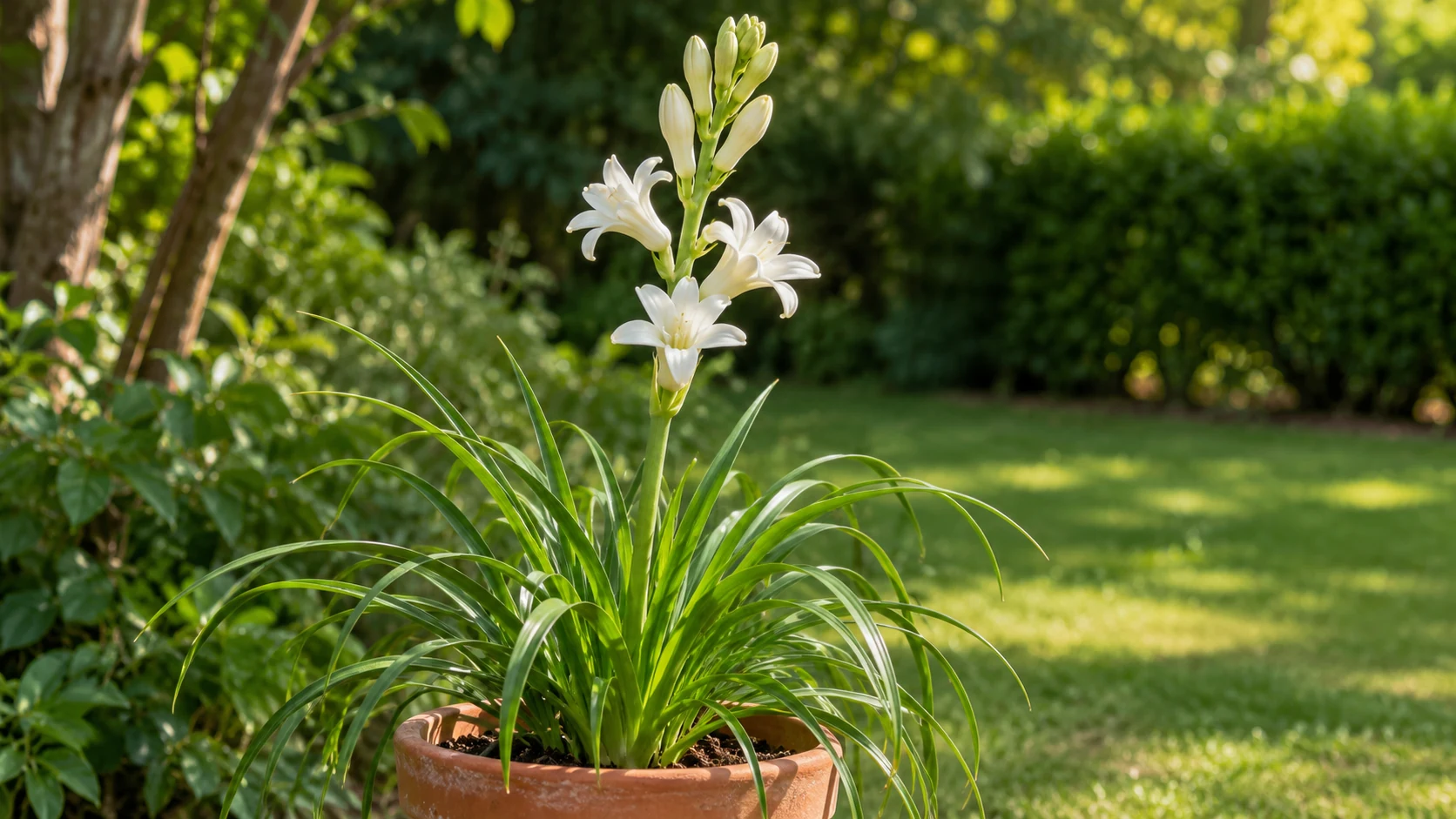
Tuberose is accepted as Agave amica. NC State Extension and the RHS list Polianthes tuberosa as its former name. Rajnigandha is one of its common names.
Is tuberose a true lily?
No. Tuberose is in the Asparagaceae family, not the genus Lilium. Some sources call it Polyanthus lily, but that common name does not make it a true lily.
How much sun does tuberose need?
Full sun is best for flowering. NC State Extension says tuberose can also tolerate partial shade, while the RHS lists it for a full-sun position.
How often should I water tuberose?
Water during active growth when the upper soil has begun to dry, and let excess water drain. Reduce watering as the leaves yellow and stop routine watering while lifted tubers are dormant. Wet soil can cause root rot.
Can tuberose stay outside over winter?
Only in mild conditions. NC State Extension lists zones 8a–10b and recommends lifting and storing tubers in colder regions. The RHS says tuberose needs at least 15°C and should be overwintered indoors, so a movable container is useful where winters are cool.
Is tuberose safe for cats and dogs?
The RHS says Agave amica is harmful to cats and dogs if eaten and notes that it may irritate skin. It does not report symptoms or severity. Keep pets from chewing it and contact a veterinarian if ingestion occurs.
What light does Tuberose need?
Tuberose grows best in full sun for the strongest growth and flowering. It also tolerates Partial shade. Avoid deep shade and cold, unprotected conditions.
Written by Sai AnanthLead content writer at LeafyPixels. B.Pharmacy graduate from Andhra University with a background in pharmacognosy, turned indoor gardening writer after a long-time plant hobby became a research-led resource for home growers.View Sai Ananth's profile · Reviewed by LeafyPixels Review Board
This Tuberose problems problem guide was researched and written by Sai AnanthLead content writer at LeafyPixels. B.Pharmacy graduate from Andhra University with a background in pharmacognosy, turned indoor gardening writer after a long-time plant hobby became a research-led resource for home growers.View Sai Ananth's profile. Problems symptoms on Tuberose, lookalike causes, and step-by-step fixes are cross-checked against extension pest, disease, and care references before publication.
We prioritize sources that hold up under scrutiny:
University cooperative extension bulletins and fact sheets (Penn State, Clemson, UMD, NC State, and similar programs)
Botanical garden and horticultural society publications
Peer-reviewed plant science and veterinary toxicology references where pet safety matters (including ASPCA Animal Poison Control)
Established reference works on indoor plant culture
The LeafyPixels editorial team then reviews the draft for clarity, step-by-step usefulness, and fit with real apartment and home conditions-not ideal greenhouse setups. When guidance changes materially, we update the page and note the revision date.
Sources used
Garden Guides — How to Care for a Tuberose (n.d.) Named-author practical guidance on full-sun siting and moving tuberose containers indoors in colder climates; taxonomy and care details cross-checked against NC State and RHS. [Online]. Available at: https://www.gardenguides.com/109798-care-tuberose.html (Accessed: 1 March 2024).
MyGardenLife — Tuberose (Agave amica) (n.d.) Evening fragrance, cut-flower and patio placement context, cross-checked against RHS, NC State, and NParks. [Online]. Available at: https://mygardenlife.com/plant-library/tuberose-agave-amica (Accessed: 1 March 2024).
National Parks Board Singapore Flora & Fauna Web — Agave amica 'Sensation' (n.d.) Cultivar-specific pink flowers, fragrance that intensifies at night, full sun, moderate water, height, drainage, and container use. [Online]. Available at: https://www.nparks.gov.sg/florafaunaweb/flora/8/5/8552 (Accessed: 1 March 2024).
NC State Extension Plant Toolbox — Agave amica (Tuberose) (n.d.) Accepted name and synonym, family, Mexico origin, size, sun, soil, drainage, watering, root-rot risk, dormancy, hardiness, bulb storage, offsets, and cultivars. [Online]. Available at: https://plants.ces.ncsu.edu/plants/agave-amica/ (Accessed: 1 March 2024).
Royal Horticultural Society — Agave amica (Tuberose) (n.d.) Agave amica name, Polianthes tuberosa synonym, full-sun and well-drained loam conditions, size, winter temperature, offset propagation, and cat/dog/skin warnings. [Online]. Available at: https://www.rhs.org.uk/plants/388095/agave-amica-po/details (Accessed: 1 March 2024).
Springer — Postharvest physiology and technology of tuberose (n.d.) Review-level context on Polianthes tuberosa as a Mexican ornamental grown for its fragrant flowers. [Online]. Available at: https://link.springer.com/article/10.1007/s13580-018-00122-4 (Accessed: 1 March 2024).