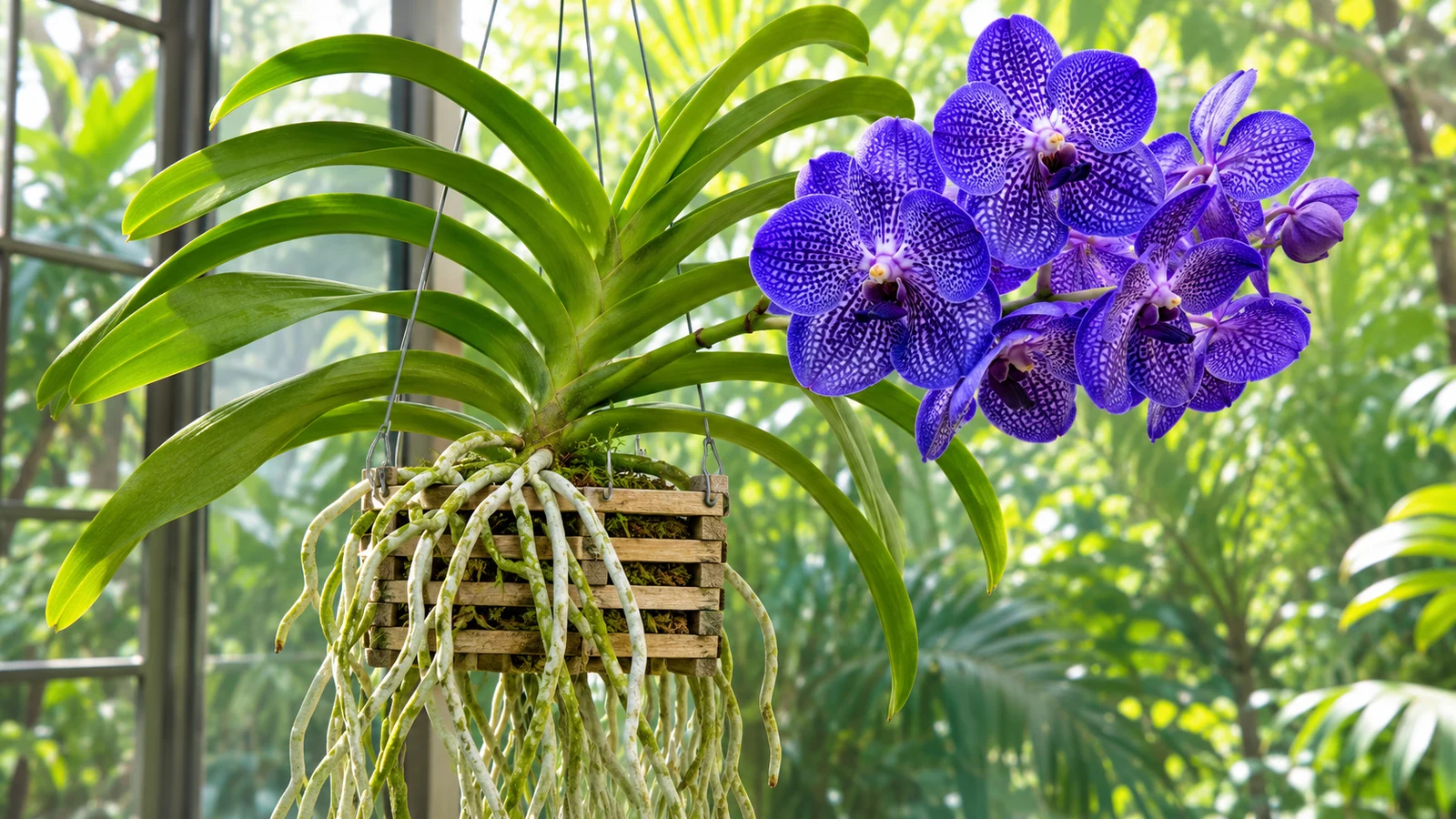
It can, but many Vanda species are difficult to grow in an ordinary room because they need very bright light, warm temperatures, high humidity, and strong airflow. Compact vandaceous hybrids may adapt more easily; a bright greenhouse is often a better fit for large true Vanda species.
How often should I water a Vanda?
Check roots and medium daily in warm, bright conditions. Greenhouse-grown Vandas often need daily watering, but a cooler or less airy home may need less. Water when the exposed roots or coarse medium have dried, then let excess water drain.
Should Vanda roots be covered with potting mix?
No. Do not use ordinary potting soil. Many Vandas grow bare-root in an open basket; others use a small amount of coarse orchid bark or lava rock that drains and dries quickly.
How much light does a Vanda need?
Vandas need very bright light, but leaf type matters. Strap-leaved types are usually grown in bright indirect or dappled light; terete-leaved forms tolerate stronger sun. Acclimate plants gradually and avoid abrupt hot midday exposure.
Why are my Vanda's roots shriveling?
Exposed roots dry quickly, especially in hot, bright, breezy weather. Check whether your watering and humidity match the conditions, but do not keep roots continuously wet to correct shriveling. Also check that the water is not excessively hard or salt-softened, and maintain good airflow.
Is Vanda toxic to pets?
Vanda is toxic to cats and dogs. Keep out of reach of curious pets and choose pet-safe alternatives for accessible spots.
How do I propagate Vanda?
Propagate Vanda from healthy stem or root divisions during active growth.
Written by Sai AnanthLead content writer at LeafyPixels. B.Pharmacy graduate from Andhra University with a background in pharmacognosy, turned indoor gardening writer after a long-time plant hobby became a research-led resource for home growers.View Sai Ananth's profile · Reviewed by LeafyPixels Review Board
This Vanda problems problem guide was researched and written by Sai AnanthLead content writer at LeafyPixels. B.Pharmacy graduate from Andhra University with a background in pharmacognosy, turned indoor gardening writer after a long-time plant hobby became a research-led resource for home growers.View Sai Ananth's profile. Problems symptoms on Vanda, lookalike causes, and step-by-step fixes are cross-checked against extension pest, disease, and care references before publication.
We prioritize sources that hold up under scrutiny:
University cooperative extension bulletins and fact sheets (Penn State, Clemson, UMD, NC State, and similar programs)
Botanical garden and horticultural society publications
Peer-reviewed plant science and veterinary toxicology references where pet safety matters (including ASPCA Animal Poison Control)
Established reference works on indoor plant culture
The LeafyPixels editorial team then reviews the draft for clarity, step-by-step usefulness, and fit with real apartment and home conditions-not ideal greenhouse setups. When guidance changes materially, we update the page and note the revision date.
Sources used
American Orchid Society — Vanda Culture Sheet (n.d.) Vanda light by leaf type, temperature range, quick wet-dry cycles, daily greenhouse watering, humidity, airflow, and potting. [Online]. Available at: https://www.aos.org/orchid-care/care-sheets/vanda-culture-sheet (Accessed: 1 March 2024).
Epic Gardening — How to Plant, Grow and Care for Vanda Orchids (n.d.) Named-author practical growing context for Vanda light, humidity, baskets, roots, and common cultivation problems. [Online]. Available at: https://www.epicgardening.com/vanda-orchids/ (Accessed: 1 March 2024).
NC State Extension Plant Toolbox — Vanda (n.d.) Vanda taxonomy, native range, epiphytic habit, light, humidity, exposed roots, fast-draining culture, and disease risks. [Online]. Available at: https://plants.ces.ncsu.edu/plants/vanda/ (Accessed: 1 March 2024).
Orchid Bliss — 8 Tips for Caring for Vanda Orchids (n.d.) Vanda-specific basket culture, leaf-form differences, and practical watering and humidity guidance. [Online]. Available at: https://orchidbliss.com/8-tips-for-caring-for-vanda-orchids/ (Accessed: 1 March 2024).
RHS — Vanda (n.d.) Monopodial growth, epiphytic habit, aerial roots, leaves, and inflorescence form. [Online]. Available at: https://www.rhs.org.uk/plants/162989/vanda/details (Accessed: 1 March 2024).