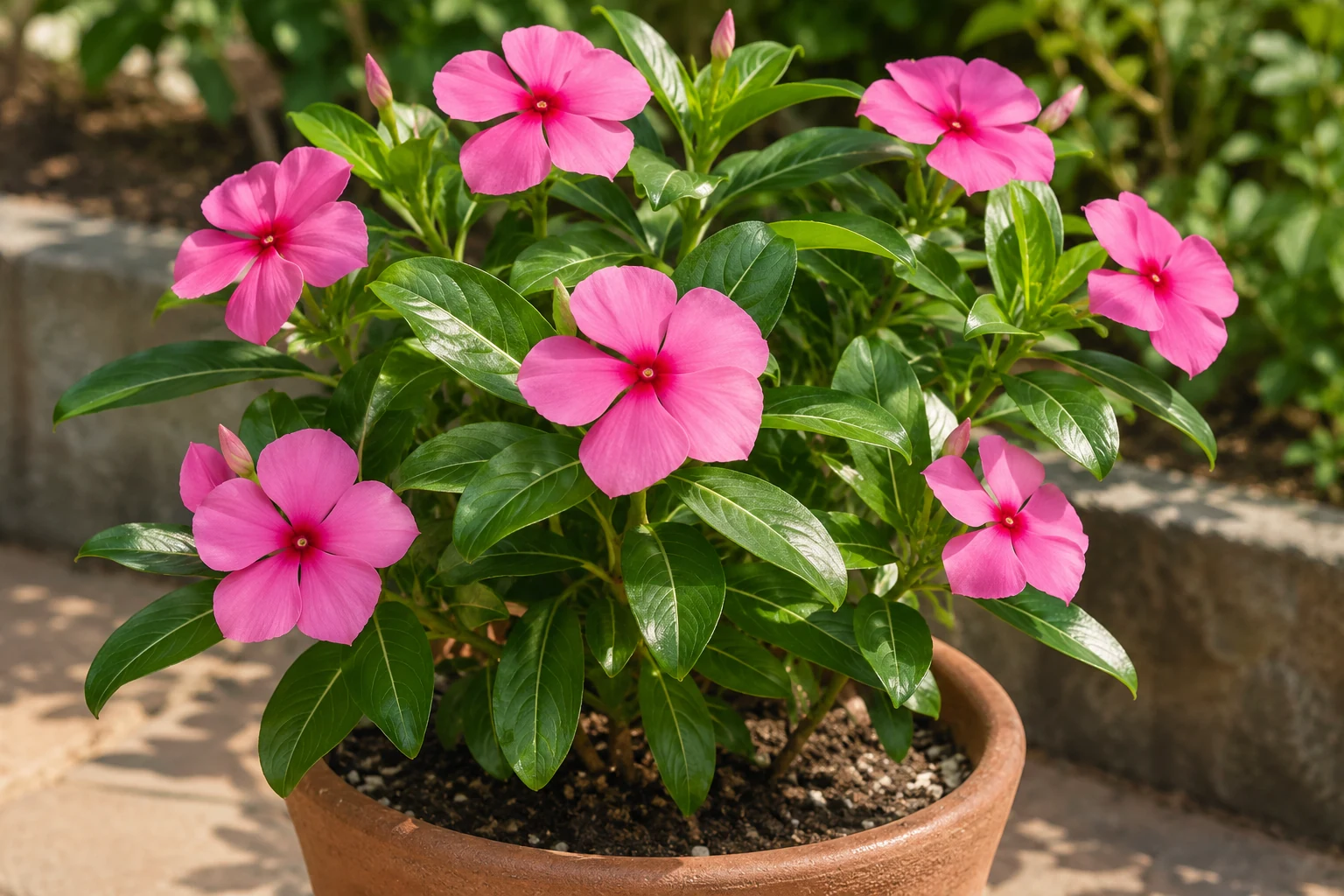
No. This page covers Madagascar periwinkle, Catharanthus roseus, commonly sold as annual vinca. Vinca minor and Vinca major are separate, hardier ground-cover species with different growth habits and shade tolerance.
How much sunlight does Madagascar periwinkle need?
Grow it in full sun for the strongest flowering. It tolerates partial or dappled shade, but deep shade can reduce blooms.
How often should I water annual vinca?
Water new plants while they establish, then check the root zone and water when the upper soil has dried. Established plants tolerate heat and short dry spells, but containers may need water during long hot periods.
Can Madagascar periwinkle survive winter?
It is a tender perennial in frost-free warm climates and is usually grown as a summer annual where winters bring frost. NC State Extension notes it can persist in warm regions, while flowering outdoors continues until frost.
Is Madagascar periwinkle toxic to pets?
NC State Extension identifies vinca alkaloids in all parts of the plant and flags it as a problem for cats, dogs, and horses. Prevent chewing or grazing and contact a veterinarian if an animal eats any part.
How do I propagate Vinca?
Propagate Vinca from healthy stem or root divisions during active growth.
What soil is best for Vinca?
Use use a freely draining garden soil or container mix. Catharanthus roseus grows in several soil textures and prefers acidic conditions, but dependable drainage matters more than amending the soil to a precise pH. A good mix includes For containers, use a quality potting mix amended with perlite or another coarse drainage material if it stays wet., Do not use a pot without drainage holes or leave the container standing in water. Excellent drainage is essential. Avoid low spots that remain saturated and use pots with open drainage holes; prolonged wetness and heavy rain can trigger root problems.
Written by Sai AnanthLead content writer at LeafyPixels. B.Pharmacy graduate from Andhra University with a background in pharmacognosy, turned indoor gardening writer after a long-time plant hobby became a research-led resource for home growers.View Sai Ananth's profile · Reviewed by LeafyPixels Review Board
This Vinca problems problem guide was researched and written by Sai AnanthLead content writer at LeafyPixels. B.Pharmacy graduate from Andhra University with a background in pharmacognosy, turned indoor gardening writer after a long-time plant hobby became a research-led resource for home growers.View Sai Ananth's profile. Problems symptoms on Vinca, lookalike causes, and step-by-step fixes are cross-checked against extension pest, disease, and care references before publication.
We prioritize sources that hold up under scrutiny:
University cooperative extension bulletins and fact sheets (Penn State, Clemson, UMD, NC State, and similar programs)
Botanical garden and horticultural society publications
Peer-reviewed plant science and veterinary toxicology references where pet safety matters (including ASPCA Animal Poison Control)
Established reference works on indoor plant culture
The LeafyPixels editorial team then reviews the draft for clarity, step-by-step usefulness, and fit with real apartment and home conditions-not ideal greenhouse setups. When guidance changes materially, we update the page and note the revision date.
Horticulture — Annual Vinca Valiant Takes Heat and Drought (n.d.) Annual vinca versus true Vinca distinction, full-sun preference, heat and drought tolerance, container growing, flowering, and low-maintenance cultivar notes. [Online]. Available at: https://www.hortmag.com/plants-we-love-2/annual-vinca-valiant-takes-heat-and-drought (Accessed: 1 March 2024).
NC State Extension Gardener Plant Toolbox — Madagascar Periwinkle (n.d.) Scientific identity, family, native range, size, growth habit, flowering, light, soil, drainage, drought tolerance, and plant-specific poison information. [Online]. Available at: https://plants.ces.ncsu.edu/plants/catharanthus-roseus/common-name/running-myrtle/ (Accessed: 1 March 2024).
University of Nebraska–Lincoln Extension — Annuals for Nebraska Landscapes (n.d.) Identifies Catharanthus roseus as Vinca or Madagascar periwinkle and describes its sun exposure, mature height, heat tolerance, poorer-soil tolerance, and container use. [Online]. Available at: https://extensionpubs.unl.edu/publication/g1774/na/html/view (Accessed: 1 March 2024).