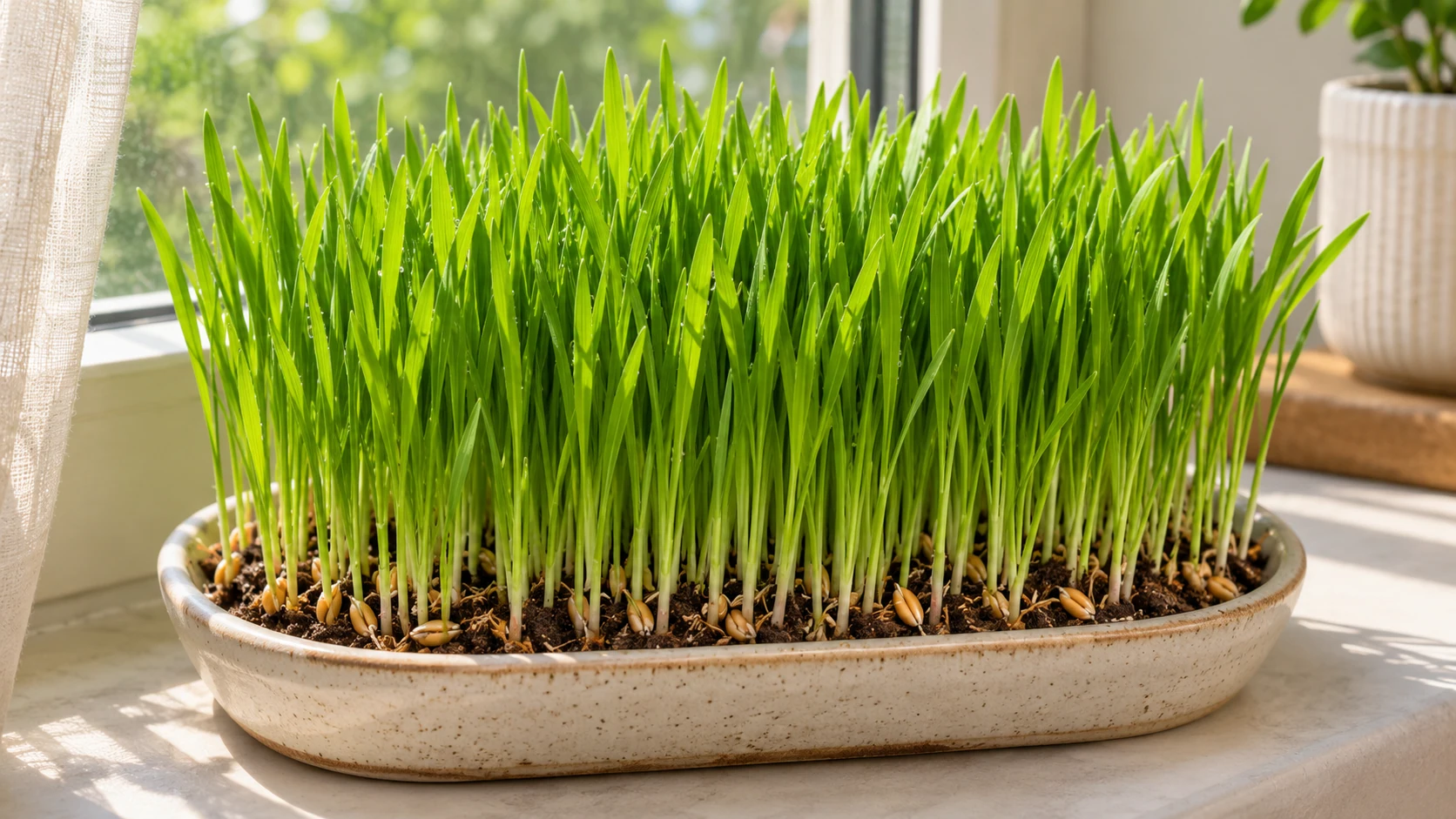
Wheatgrass is the young shoots of common wheat, Triticum aestivum, usually harvested before it reaches grain maturity. Other perennial grasses can also share a wheatgrass common name, so check the scientific name.
Can wheatgrass grow without soil?
Yes. It can grow in a shallow tray with seed-starting mix or on a soilless surface such as coconut coir, vermiculite, or a fiber mat.
How often should I water wheatgrass?
Check the tray daily and keep the surface damp rather than saturated. Light misting or bottom watering once or twice a day is a common starting point; adjust if the medium dries faster or stays wet.
When is wheatgrass ready to harvest?
Young shoots are often harvested about 6–14 days after sowing, around 15–18 cm tall. Temperature, light, seed, and growing method affect timing.
Is wheatgrass safe for cats?
A veterinary hospital lists wheatgrass among cat grasses suitable for cats. Use clean, mold-free growth; this reference does not establish a safety rating for other pets.
What light does Wheatgrass need?
Wheatgrass needs bright, indirect light for steady indoor growth.
How do I propagate Wheatgrass?
Propagate Wheatgrass from healthy stem or root divisions during active growth.
Written by Sai AnanthLead content writer at LeafyPixels. B.Pharmacy graduate from Andhra University with a background in pharmacognosy, turned indoor gardening writer after a long-time plant hobby became a research-led resource for home growers.View Sai Ananth's profile · Reviewed by LeafyPixels Review Board
This Wheatgrass problems problem guide was researched and written by Sai AnanthLead content writer at LeafyPixels. B.Pharmacy graduate from Andhra University with a background in pharmacognosy, turned indoor gardening writer after a long-time plant hobby became a research-led resource for home growers.View Sai Ananth's profile. Problems symptoms on Wheatgrass, lookalike causes, and step-by-step fixes are cross-checked against extension pest, disease, and care references before publication.
We prioritize sources that hold up under scrutiny:
University cooperative extension bulletins and fact sheets (Penn State, Clemson, UMD, NC State, and similar programs)
Botanical garden and horticultural society publications
Peer-reviewed plant science and veterinary toxicology references where pet safety matters (including ASPCA Animal Poison Control)
Established reference works on indoor plant culture
The LeafyPixels editorial team then reviews the draft for clarity, step-by-step usefulness, and fit with real apartment and home conditions-not ideal greenhouse setups. When guidance changes materially, we update the page and note the revision date.
Herbs at Home, How to grow wheatgrass indoors: soil vs soilless (n.d.) Practical indoor growing conditions, soilless media, watering, harvest, and mold prevention. [Online]. Available at: https://herbsathome.co/how-to-grow-wheatgrass-indoors/ (Accessed: 1 March 2024).
PLOS One, Elemental and macromolecular modifications in Triticum aestivum L. plantlets under different cultivation conditions (n.d.) Defines wheatgrass as young common-wheat plantlets, gives the 6–14-day stage, and compares soil and hydroponic growing methods. [Online]. Available at: https://pmc.ncbi.nlm.nih.gov/articles/PMC6112624/ (Accessed: 1 March 2024).