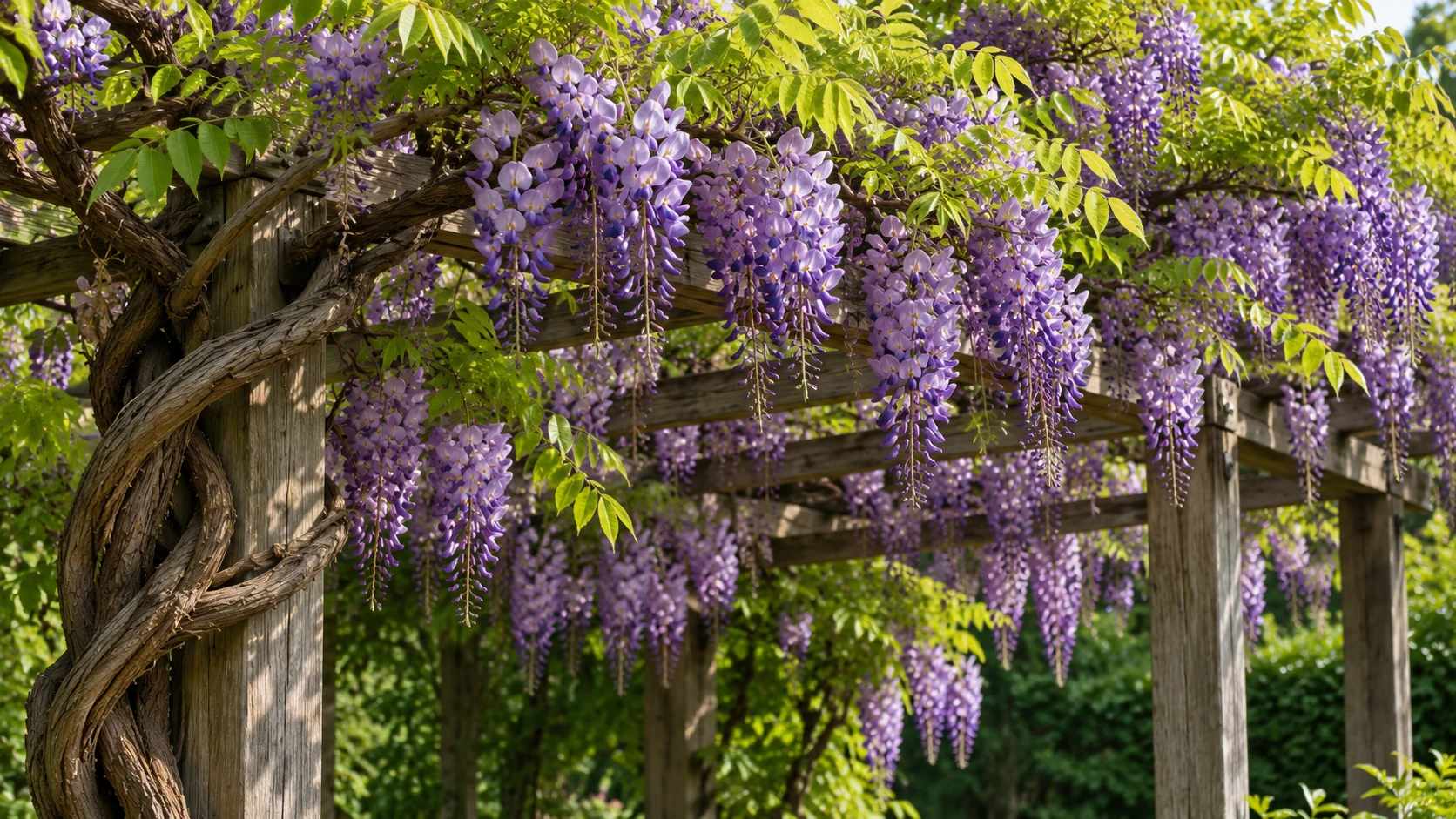
It depends on your climate and local invasive-plant guidance. Chinese and Japanese wisterias can be vigorous and invasive in some regions. American wisteria, Wisteria frutescens, is a less aggressive native choice in parts of the eastern United States. Check the species name and local rules before planting.
Does wisteria need full sun?
Wisteria grows in partial shade, but it flowers best in full sun. In a shaded position the vine may produce leaves and shoots without the same flower display.
How often should I water wisteria?
Water new plants while their roots establish and give established vines a deep drink during flowering or a prolonged dry spell. Let excess water drain, and adjust to rainfall and soil rather than following a fixed schedule.
When should I prune wisteria?
Many cultivated wisterias are pruned after flowering and again while dormant. Exact months depend on the hemisphere and local growing season; shorten long shoots in the first session, then trim the retained shoots during dormancy.
Why is my wisteria not flowering?
Shade, a young seed-grown plant, or an unchecked tangle of shoots can all delay or hide flowering. Give it a sunny position, identify the cultivar, and follow a regular pruning routine. Seed-grown plants may take several years to reach flowering age.
Is wisteria poisonous to pets?
NC State Extension lists Wisteria as poisonous and flags cats, dogs, and horses as animals of concern. Keep pets away from the vine and its fallen pods. Call a veterinarian if an animal chews or swallows any part.
What light does Wisteria need?
Wisteria grows best in full sun for the strongest flowering. It also tolerates Partial shade. Avoid deep shade, which can reduce flowering.
Written by Sai AnanthLead content writer at LeafyPixels. B.Pharmacy graduate from Andhra University with a background in pharmacognosy, turned indoor gardening writer after a long-time plant hobby became a research-led resource for home growers.View Sai Ananth's profile · Reviewed by LeafyPixels Review Board
This Wisteria problems problem guide was researched and written by Sai AnanthLead content writer at LeafyPixels. B.Pharmacy graduate from Andhra University with a background in pharmacognosy, turned indoor gardening writer after a long-time plant hobby became a research-led resource for home growers.View Sai Ananth's profile. Problems symptoms on Wisteria, lookalike causes, and step-by-step fixes are cross-checked against extension pest, disease, and care references before publication.
We prioritize sources that hold up under scrutiny:
University cooperative extension bulletins and fact sheets (Penn State, Clemson, UMD, NC State, and similar programs)
Botanical garden and horticultural society publications
Peer-reviewed plant science and veterinary toxicology references where pet safety matters (including ASPCA Animal Poison Control)
Established reference works on indoor plant culture
The LeafyPixels editorial team then reviews the draft for clarity, step-by-step usefulness, and fit with real apartment and home conditions-not ideal greenhouse setups. When guidance changes materially, we update the page and note the revision date.
Garden Ninja, Lee Burkhill — How to Prune Wisteria: When and Where to Cut in Summer and Winter (n.d.) Practical seasonal pruning sequence and training young vines, attributed to a named professional garden designer and horticulturist. [Online]. Available at: https://www.gardenninja.co.uk/how-to-prune-wisteria-winter-summer-pruning-guide-for-beginners/ (Accessed: 1 March 2024).
NC State Cooperative Extension, Madison County Center — On the Lookout for Non-Native Invasive Plant Species: Chinese Wisteria (n.d.) Chinese wisteria growth, heavy woody stems, spread, regional invasiveness, native American wisteria comparison, and toxicity caveat. [Online]. Available at: https://madison.ces.ncsu.edu/news/on-the-lookout-for-non-native-invasive-plant-species-chinese-wisteria/ (Accessed: 1 March 2024).
NC State Extension Plant Toolbox — Chinese Wisteria (n.d.) Chinese wisteria identification, growth habit, flower clusters, invasive status, and species-specific poison detail. [Online]. Available at: https://plants.ces.ncsu.edu/plants/wisteria-sinensis/ (Accessed: 1 March 2024).
NC State Extension Plant Toolbox — Wisteria (n.d.) Genus identity, growth habit, sunlight, soil/moisture adaptability, pruning, species differences, plant scale, and poison profile. [Online]. Available at: https://plants.ces.ncsu.edu/plants/wisteria/ (Accessed: 1 March 2024).
Royal Horticultural Society — Wisteria Pruning Guide (n.d.) Seasonal pruning approach, summer shoot reduction, winter bud pruning, and growth control. [Online]. Available at: https://www.rhs.org.uk/plants/wisteria/pruning-guide (Accessed: 1 March 2024).