Wisteria Care Guide: Pruning, Support, Sun, and Species
Wisteria spp.
Grow wisteria in full sun with a strong permanent support, water during establishment and prolonged dry spells, and prune long shoots after flowering and again during dormancy. Check whether the chosen species is invasive in your area.
Wisteria Care: Choose a Species, Build Strong Support, and Prune Well
Start with wateringThe most common care mistake for WisteriaWatering guide →Wisteria care essentials
Light
Full sun for the strongest flowering
Water
Keep newly planted wisteria evenly moist while its roots establish, then water deeply during flowering and extended dry spells. Established in-ground vines tolerate some dry weather, but growth and flowering can suffer in prolonged drought. Let excess water drain; do not leave the root zone waterlogged.
Soil
Wisteria adapts to a range of soils and grows best in full sun with deep, moderately fertile soil that holds some moisture but drains freely. Avoid sites that stay waterlogged, and choose the planting position for the eventual woody framework rather than only the size of a young nursery plant.
Humidity
Temperature
Fertilizer
About Wisteria
Wisteria is native to Species-dependent: eastern Asia for Chinese and Japanese wisterias, and eastern North America for American wisteria., typically reaches Varies with species, cultivar, pruning, and support. A managed vine commonly occupies 10–25 ft; Asian wisterias can climb much farther when left unchecked. indoors, with fast, especially in chinese and japanese wisterias growth. Wisteria has a deciduous woody twining vine growth habit and part of the Fabaceae family. It is also known as Wisteria vine, Chinese wisteria, Japanese wisteria, and American wisteria.
| Detail | Information |
|---|---|
| Also known as | Wisteria vine, Chinese wisteria, Japanese wisteria, American wisteria |
| Native region | Species-dependent: eastern Asia for Chinese and Japanese wisterias, and eastern North America for American wisteria. |
| Mature size | Varies with species, cultivar, pruning, and support. A managed vine commonly occupies 10–25 ft; Asian wisterias can climb much farther when left unchecked. |
| Growth rate | Fast, especially in Chinese and Japanese wisterias |
| Growth habit | Deciduous Woody Twining Vine |
| Scientific name | Wisteria spp. |
| Family | Fabaceae |
How to care for Wisteria?
How much light does Wisteria need?
Full sun for the strongest flowering. Partial shade. direct sun
- Full sun for the strongest flowering - Full sun for the strongest flowering.
- Partial shade - Partial shade.
- direct sun - direct sun.
When should you water Wisteria?
Keep newly planted wisteria evenly moist while its roots establish, then water deeply during flowering and extended dry spells. Established in-ground vines tolerate some dry weather, but growth and flowering can suffer in prolonged drought. Let excess water drain; do not leave the root zone waterlogged.
- Check the soil below the mulch near the root zone. If it is drying during active growth or a prolonged dry spell - Keep newly planted wisteria evenly moist while its roots establish, then water deeply during flowering and extended dry spells.
- water slowly and deeply - Keep newly planted wisteria evenly moist while its roots establish, then water deeply during flowering and extended dry spells.
- then let extra water drain away - Let excess water drain; do not leave the root zone waterlogged.
- Drain excess water - Let excess water drain; do not leave the root zone waterlogged.
What soil works best for Wisteria?
Wisteria adapts to a range of soils and grows best in full sun with deep, moderately fertile soil that holds some moisture but drains freely. Avoid sites that stay waterlogged, and choose the planting position for the eventual woody framework rather than only the size of a young nursery plant.
- For a container-grown compact cultivar - Avoid sites that stay waterlogged, and choose the planting position for the eventual woody framework rather than only the size of a young nursery plant.
- use a loam-based potting compost in a large - Wisteria adapts to a range of soils and grows best in full sun with deep, moderately fertile soil that holds some moisture but drains freely.
- stable pot with open drainage - Wisteria adapts to a range of soils and grows best in full sun with deep, moderately fertile soil that holds some moisture but drains freely.
Grower notes for Wisteria
Choose the wisteria species before planting
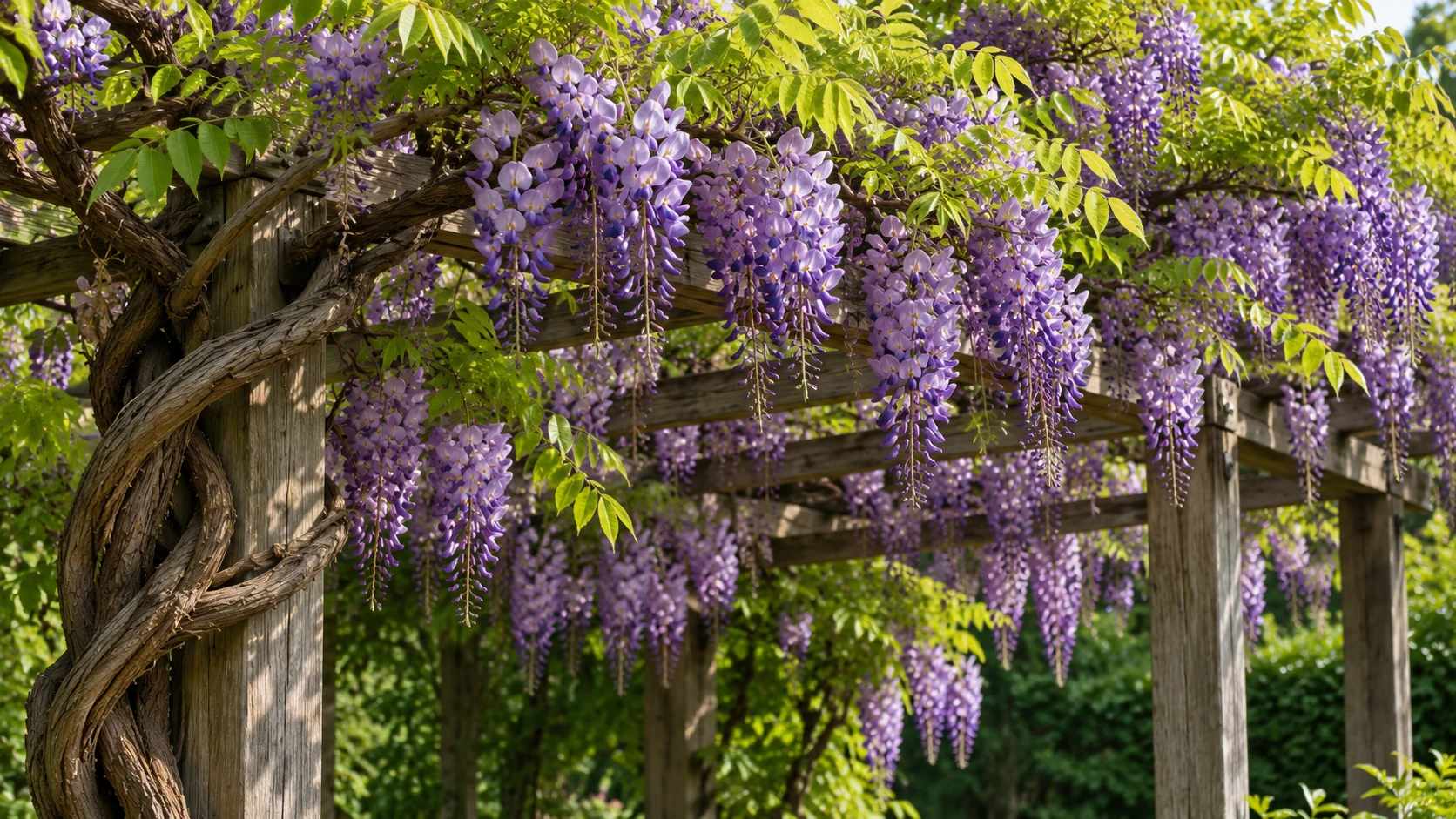
The name Wisteria covers several woody vines. Chinese and Japanese species are prized for their long flower clusters but can become exceptionally vigorous and escape cultivation in some regions. American wisteria, Wisteria frutescens, is a less aggressive native option in the eastern United States. Check local invasive-plant guidance before buying an Asian species, and do not assume all wisterias have the same regional risk.
Build a strong support first
Mature stems become thick and heavy, and the vine can wrap around and overwhelm weaker structures. Set a durable pergola, arbor, or freestanding trellis before planting. Keep it away from gutters, downpipes, shutters, small trees, and structures that cannot carry a permanent woody vine.
Give it sun for the best flowering
Wisteria grows in partial shade, but full sun gives the best chance of a strong flower display. Leave enough room for the canopy and train shoots across the support instead of letting them climb into nearby trees.
Prune by season and growth stage
Many garden wisterias benefit from two pruning sessions: shorten long current-season shoots after flowering, then trim the retained shoots again during dormancy. The exact months shift with hemisphere and climate, so use local flowering and leaf-fall rather than a northern-hemisphere calendar. Regular pruning keeps the framework manageable and can help form flowering spurs.
Seed-grown vines may take years to bloom
A young plant raised from seed can take several years to flower. Most named garden cultivars are grafted, and choosing a plant that is already flowering helps confirm that it has reached flowering age. Ask the nursery which species or cultivar is on the label.
Keep seed pods away from pets and children
NC State Extension lists Wisteria as poisonous and identifies cats, dogs, and horses as animals of concern. Its profile lists seeds along with other plant parts as poisonous; keep the vine and fallen pods out of reach and contact a veterinarian if a pet chews or swallows any part.
Is Wisteria safe for pets?
NC State Extension identifies Wisteria as poisonous and flags cats, dogs, and horses as animals of concern. Keep all plant parts, including fallen pods and seeds, away from pets. The source does not establish a safe amount for pets; contact a veterinarian after a suspected ingestion.
NC State Extension describes poisonous characteristics for Wisteria and lists lectin and wisterin glycoside as toxic principles, with bark, flowers, leaves, roots, sap, seeds, and stems among the listed parts. Its profile gives a low severity rating for human poisoning and separately flags cats, dogs, and horses; do not treat the human rating as a pet dose assessment.
Watering Wisteria
For Wisteria, check the soil below the mulch near the root zone. If it is drying during active growth or a prolonged dry spell, water slowly and deeply, then let extra water drain away. and water check the root zone during active growth and water when the soil begins to dry several centimeters below the surface. Increase checks for new plants and in hot, dry weather; rainfall and soil texture matter more than a fixed calendar. Newly planted vines and plants in flower need more reliable moisture. Reduce supplemental watering in cool, rainy, or dormant periods, especially in heavy soil that stays wet.
| Detail | Information |
|---|---|
| How often | Check the root zone during active growth and water when the soil begins to dry several centimeters below the surface. Increase checks for new plants and in hot, dry weather; rainfall and soil texture matter more than a fixed calendar. |
| How to check | Check the soil below the mulch near the root zone. If it is drying during active growth or a prolonged dry spell, water slowly and deeply, then let extra water drain away. |
| Seasonal changes | Newly planted vines and plants in flower need more reliable moisture. Reduce supplemental watering in cool, rainy, or dormant periods, especially in heavy soil that stays wet. |
Signs of overwatering
- Soil remains saturated or drains very slowly after rain or watering.
- Leaves yellow or growth weakens while the root zone is still wet.
Signs of underwatering
- New growth wilts or dries during a prolonged hot spell.
- The root zone is dry and the vine stops extending or flowering normally.
Soil & potting for Wisteria
Use a mix of For a container-grown compact cultivar, use a loam-based potting compost in a large, stable pot with open drainage. for Wisteria. Use free-draining soil that does not remain saturated. Wisteria can tolerate varied conditions, but a persistently wet root zone is a poor fit for a long-lived woody climber. Repot ground-grown wisteria does not need repotting. Container growing is best kept to compact, manageable cultivars; refresh or move a container plant when its roots fill the pot, often every few years., ideally in repot a container-grown vine during dormancy or just before spring growth begins, avoiding hot weather and active flowering.
| Detail | Information |
|---|---|
| Recommended mix | For a container-grown compact cultivar, use a loam-based potting compost in a large, stable pot with open drainage. |
| Drainage | Use free-draining soil that does not remain saturated. Wisteria can tolerate varied conditions, but a persistently wet root zone is a poor fit for a long-lived woody climber. |
| Repotting frequency | Ground-grown wisteria does not need repotting. Container growing is best kept to compact, manageable cultivars; refresh or move a container plant when its roots fill the pot, often every few years. |
| Best season to repot | Repot a container-grown vine during dormancy or just before spring growth begins, avoiding hot weather and active flowering. |
Signs it needs repotting
- Roots circle the pot or emerge from the drainage holes.
- The container dries unusually fast even after thorough watering.
- The vine is too top-heavy for the pot to remain stable.