Wisteria Not Blooming? Diagnose It Before You Prune
Wisteria not blooming? Check its age, species, sun, pruning, nitrogen, drought, and frost, then follow a practical plan to protect next year's flower buds.
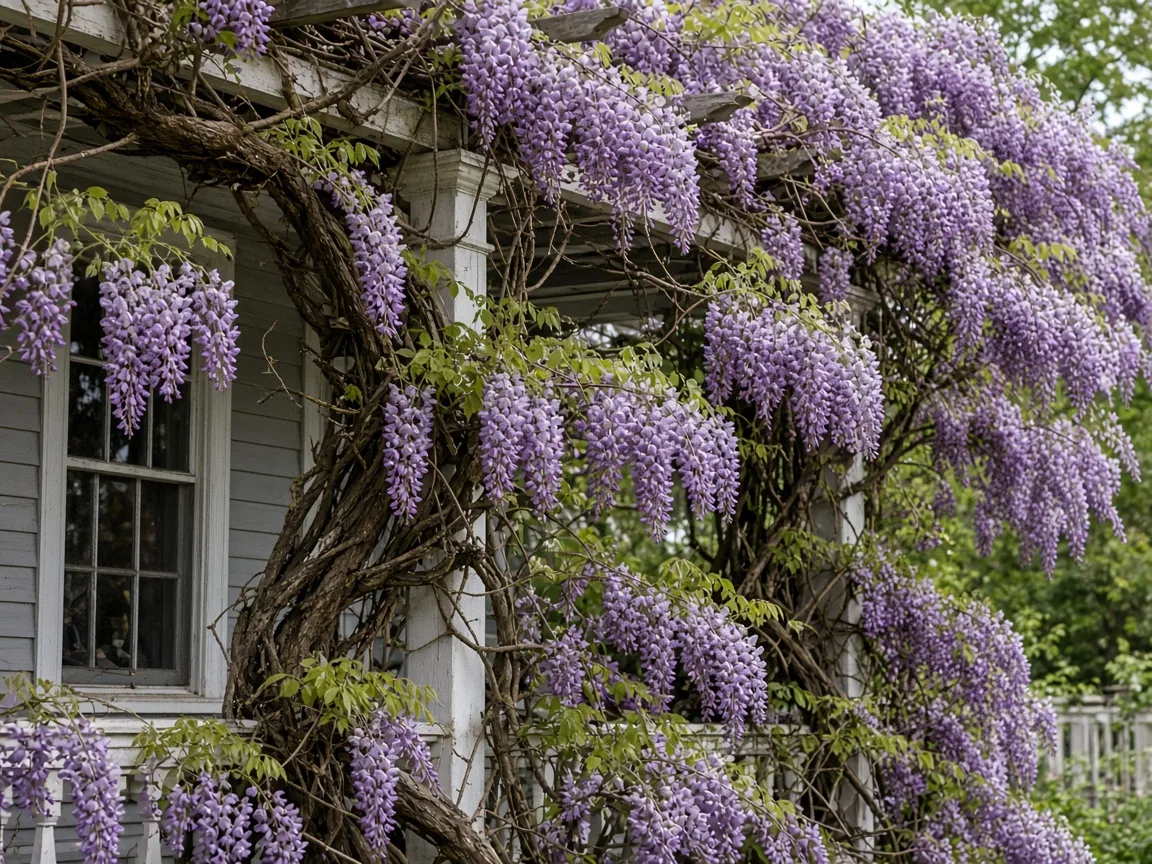
A wisteria covered in leaves but bare of flowers is usually not asking for a special “bloom booster.” The more useful question is whether it has reached flowering age, whether it made flower buds last year, and whether those buds survived pruning, shade, drought, and spring weather. A young seedling and a mature vine with buds that turn brown need different responses, and treating them alike can cost you another season.
Start with low-risk checks: find out how the vine was propagated, watch how much direct sun reaches its woody framework, and inspect the buds before cutting. Then match pruning to the plant’s flowering cycle. Fertilizer changes, root pruning, and transplanting come later—if they are needed at all.
Start with the vine’s age and propagation history
Age is easy to overlook because wisteria can grow vigorously long before it is ready to flower. A young vine may throw long stems and large leaves, climb a fence, and still devote most of its energy to building roots and framework. That does not automatically mean the plant is unhealthy or that a nutrient deficiency needs correcting.
How it was propagated matters. Named nursery cultivars are commonly grafted or propagated from mature plant material and tend to flower sooner than plants raised from seed. Seed-grown wisteria is unpredictable: Kansas State Extension gives a range of roughly seven to 15 years before first flowers, while the Royal Horticultural Society cautions that seed-raised plants can take up to 20 years. Those ranges are not a promise that every seedling will bloom at a particular age; they are a reason to verify a plant’s origin before declaring it a failure. (Kansas State Extension’s wisteria guide; RHS growing guide)
If you inherited the vine or lost its label, look for a graft union near the base: a swollen seam or change in stem texture can be a clue, though it may be hard to see on an old, rough trunk. Ask the previous owner or nursery if possible, and keep a simple record of when the vine first flowered, when it was planted, and whether it came from seed. If it is young and healthy, patience plus correct training is safer than forcing it with pruning shocks.
Identify the species before judging its bloom pattern
“Wisteria” covers species with different flowering habits. Chinese and Japanese wisterias are common in gardens and typically carry spring flowers on established older framework; their racemes may appear before or around leaf-out. American wisteria (Wisteria frutescens) and Kentucky wisteria (W. macrostachya) tend to flower on the current season’s growth, often with the leaves, so their clusters can be shorter and less dramatic. A native vine that flowers later and less extravagantly is not necessarily failing. A recent horticulture Q&A in Birds & Blooms also points gardeners in colder regions toward native Kentucky wisteria as a more reliable option where Asian species lose buds to winter cold. (Birds & Blooms’ wisteria troubleshooting guide)
Species also changes the pruning stakes. If you have an Asian type that blooms on older spurs, a hard cut at the wrong time can remove the next display. A native type may tolerate dormant-season pruning differently, but you still need to identify it before applying a one-size calendar. Check the original plant tag, nursery invoice, leaf and flower photos, or a local extension plant clinic; leaf shape alone may not settle the species.
Before replacing a nonflowering vine with Chinese or Japanese wisteria, check your state’s invasive-plant guidance. These vigorous climbers can overrun nearby trees, so a locally appropriate native cultivar may be a better fit even if its flower display is smaller. (Kansas State Extension’s wisteria guide)
Check sunlight where the flower spurs actually grow
Wisteria can survive and make foliage in partial shade, but flowering is strongest in full sun. Do not judge light from the vine’s base alone: a stem may start beside a sunny wall and then run under a dense tree canopy, roof, or pergola roof where its flowering spurs sit in shade. The Royal Horticultural Society notes that wisteria tolerates light shade but flowers less, and may not flower in deep shade. (RHS wisteria growing guide)
Track direct sun at the height and side of the vine where the buds form, not just at ground level. Check in spring and again after nearby trees leaf out; a site that looks bright in March may be shaded for most of the growing season. A south- or west-facing wall can help in many climates, but a hot, reflected wall in a dry region can also increase water stress. Sun is one factor, not a reason to move a mature wisteria before checking age, pruning, and bud condition.
If the framework is shaded by overgrown branches, selective thinning of the overhead canopy may be less disruptive than moving the vine. Do not cut a neighbor’s tree or a large limb without permission and a safe plan. If the wisteria is firmly established in deep shade and cannot be given more light, accept reduced bloom or consider a more suitable plant for the site.
Prune twice in the right seasonal windows
For established Chinese and Japanese wisteria, routine pruning has two jobs: summer pruning limits long, leafy whips and helps short flowering spurs mature; dormant-season pruning shortens those laterals while leaving their flower buds in place. Pruning is not a way to punish a nonflowering vine into blooming. The goal is a manageable framework with many short laterals, not a tangled canopy of vigorous shoots.
Calendar dates vary with region and species. The RHS describes a summer pass in July or August and a dormant pass in January or February for its climate; Missouri Botanical Garden describes summer and late-winter pruning as well. In North America, follow the plant’s flowering and growth cycle, then adjust around your local frost and bud-swell dates rather than copying a month from another climate. (RHS wisteria pruning guide; Missouri Botanical Garden’s wisteria pruning advice)
Summer pruning controls whips after bloom
After the main flowering period, let the new shoots extend enough to see which ones are needed to lengthen the framework. Tie in a few well-placed shoots as replacement arms; shorten the surplus side shoots rather than shearing the whole vine. The RHS recommends cutting whippy current-year shoots back to about five or six leaves. That keeps them from swallowing a pergola or climbing into gutters while leaving enough leaf area for the plant to keep growing.
Use bypass pruners for small shoots and a clean pruning saw for woody cuts. Cut just above a healthy leaf or bud, and trace any shoot back to its point of attachment before removing it so you do not accidentally sever a structural arm. If the vine is already flowering well and is not overgrown, light selective pruning may be all it needs. Repeated hard shearing can create more vigorous shoots and obscure the older spur system you are trying to maintain.
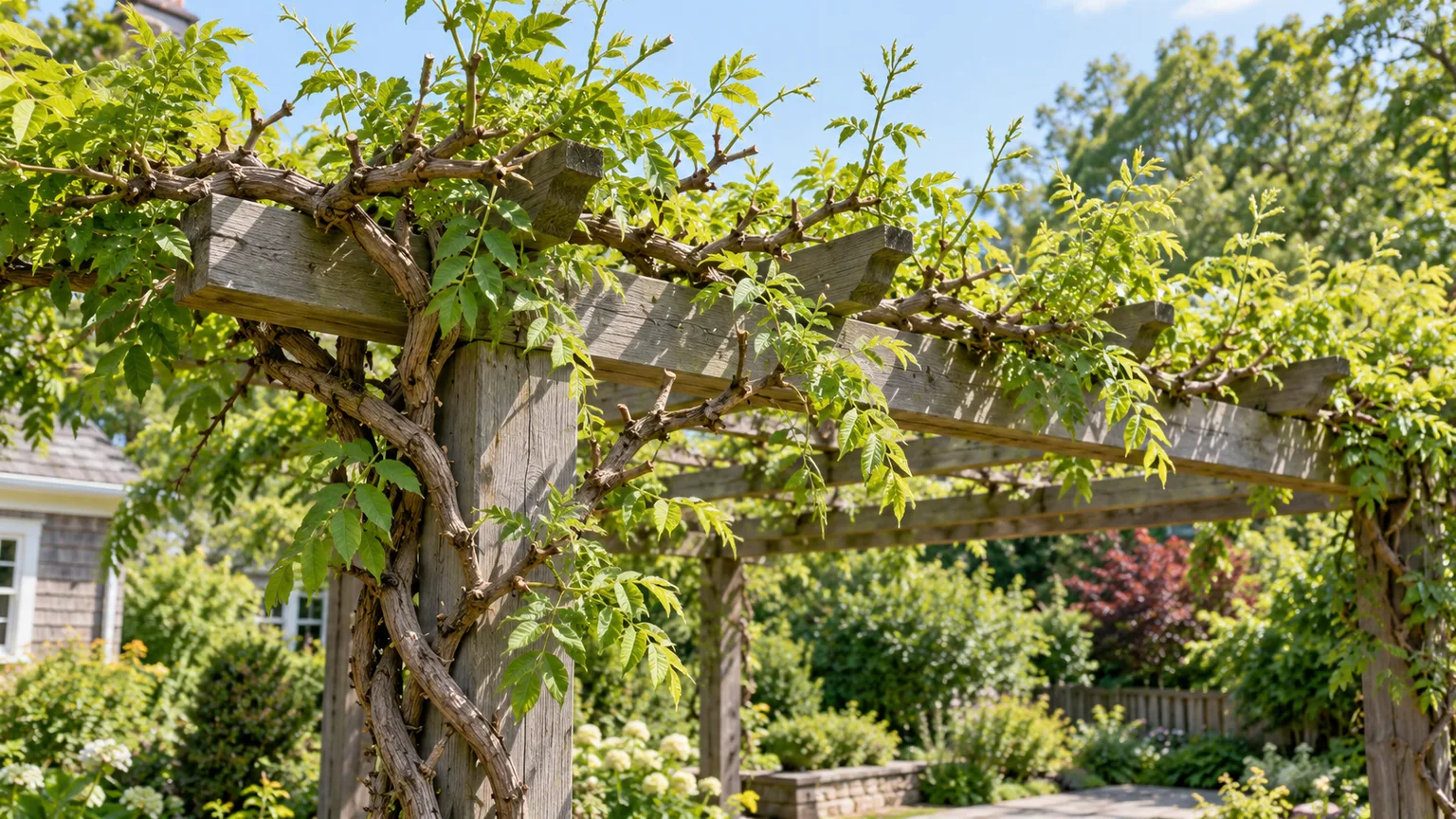
On established Asian wisteria, shorten surplus whippy growth after bloom while preserving the main framework and selected replacement shoots.
Late-winter pruning preserves short flowering spurs
During dormancy, before buds begin to swell, shorten the side shoots that were reduced in summer to a few buds from their base. RHS guidance uses two or three buds; Missouri Botanical Garden describes leaving roughly three or four buds, about four to six inches of last year’s shoot. These are compatible rules of thumb rather than a precision formula: retain short, knobby spurs along the framework and avoid cutting them flush to the main branch.
First remove dead, broken, crossing, or unsafe growth. Then work from the main framework outward, shortening only laterals you can trace confidently. If you are unsure whether a swollen bud is a flower bud, leave an extra inch or two and make a smaller correction next year. If pruning was missed for years, renovate in stages unless a damaged structure or safety issue requires immediate work. A severe cut can trigger a flush of leafy shoots and may postpone the flower display.
Learn to distinguish flower buds from leaf buds
On mature Asian wisteria in winter, flower buds are generally plumper and rounder than the narrow, pointed buds that produce leaves and shoots. They often sit close to the older wood on short spurs. This distinction is easier to see once the vine is leafless and the buds have developed, but cultivar and weather can affect their appearance; do not treat it as a foolproof test on every stem. The University of Washington’s Elisabeth C. Miller Library summarizes this difference from pruning references: flower buds are plump and blunt, while growth buds are narrow and pointed. (University of Washington Miller Library’s wisteria pruning reference)
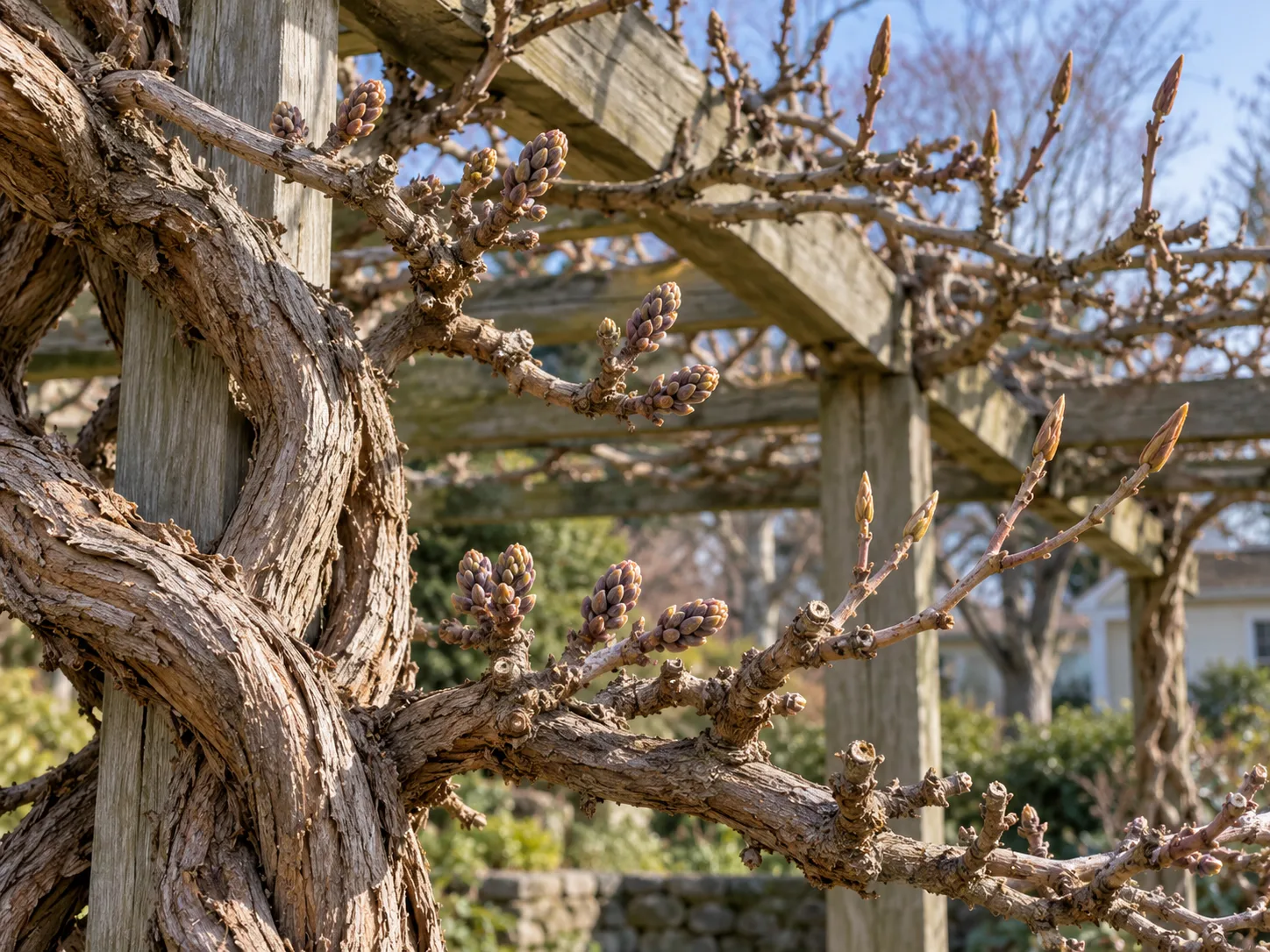
Look along several established laterals before pruning: preserve plump buds close to the framework and avoid removing every short spur.
Photograph a few representative shoots before you prune. Compare buds on different parts of the vine, and mark the structural arms you want to keep with soft ties. If every branch has only small pointed buds, the vine may be young, shaded, pruned at the wrong time, or simply not setting flowers yet. If plump buds were visible but disappear after a cut—or swell and then turn brown—the likely problem is different from a vine that never formed them.
Stop feeding foliage with unnecessary nitrogen
A dense canopy of leaves and long soft shoots with no flowers can point to excess nitrogen, especially if you have been applying lawn fertilizer near the vine or adding a high-nitrogen plant food. Wisteria is vigorous, and extra nitrogen can push vegetative growth at the expense of flowering. Missouri Botanical Garden also cautions that overfertilizing and overwatering can reduce the chance of bloom. (Missouri Botanical Garden’s wisteria pruning advice)
Stop routine high-nitrogen feeding while you diagnose the site. Do not automatically add phosphorus because a fertilizer bag advertises “bloom booster”: first use a soil test to determine whether phosphorus or potassium is actually low. Unneeded phosphorus can accumulate in garden soil and wash into waterways, and it will not make a seedling mature faster or restore buds removed by pruning. If a test identifies a deficiency, follow its rate and timing rather than improvising.
Also check nearby lawn products and compost inputs. A wisteria planted at the edge of a fertilized lawn can receive more nitrogen than you intend. If growth is modest and a soil test shows a need, use a balanced, measured feeding plan; if the vine is already producing excessive shoots, adding food is unlikely to solve the problem.
Check drought, drainage, and root-zone stress
A wisteria can tolerate brief dry spells once established, but drought during the period when next year’s buds are developing can reduce flowering. The RHS specifically warns that dry conditions from midsummer into early autumn can affect flower-bud formation. In your region, think in terms of the weeks after flowering and during active shoot growth, not a fixed date on a British calendar. (RHS wisteria growing guide)
Water deeply when the root zone is dry, especially for newly planted vines, container-grown plants, and wisteria in sandy soil. Then allow excess water to drain; constantly saturated soil deprives roots of oxygen and can weaken the plant. Overwatering does not “make up” for a dry summer, and frequent shallow splashes may wet the surface without reaching established roots.
If the vine has sparse leaves, wilting, or dieback in addition to no flowers, inspect the root zone and drainage before focusing on bloom. Look for downspouts that flood the base, compacted soil, buried root flares, or construction damage. A healthy, vigorous plant is less likely to have a root problem as the sole cause of no flowers, so prioritize age, light, and pruning first unless other symptoms point below ground.
Look for frost damage after buds have formed
A vine may set flower buds successfully and still produce no open flowers after a late frost. This is especially frustrating because the plant can leaf out normally while flower buds are browned, distorted, shriveled, or dropped. A freeze during bud swell is a different problem from a mature vine that never made flower buds. The RHS lists spring frost as a cause of damaged or dropped developing flowers, and Birds & Blooms notes cold winters can kill flower buds even where the vine’s stems survive. (RHS wisteria growing guide; Birds & Blooms)
If buds turned brown after a cold snap, there is no pruning or feeding treatment that can bring those flowers back that year. Wait until the damage is clear, remove only dead or broken material, and maintain steady care so the vine can form buds for the next cycle. Avoid late-season pruning that would remove healthy buds still developing on undamaged wood.
Where late frost is common, a sheltered site can help, but do not wrap a large pergola vine in a way that breaks branches or traps moisture. A more cold-tolerant species suited to your region may be a better long-term answer than repeated attempts to protect an exposed Asian cultivar.
Check for graft failure or a rootstock shoot
A mature grafted wisteria that suddenly stops flowering deserves a different check from a young vine that has never bloomed. Inspect the base for a graft union and see whether the main flowering framework is declining while a new, vigorous shoot rises from below the union. That shoot may be rootstock growth rather than the named cultivar you bought. The RHS identifies graft failure as one cause of a mature wisteria dying back and being replaced by a healthy shoot from ground level. (RHS wisteria growing guide)
Do not train the basal shoot into the framework until you know what it is. If it grows from below the graft, it may not flower like the named cultivar and may crowd out the original plant. Photograph the union and shoot, then ask the nursery or a local extension service to help identify it. If the grafted top has died, replacement may be more practical than waiting for an unknown rootstock to bloom.
Use the symptom pattern to narrow the cause
Use the pattern you see to decide what to investigate next. One symptom rarely proves a single cause, but it can keep you from making an unnecessary high-impact change.
| What you see | More likely explanation | First check |
|---|---|---|
| Long, leafy shoots but no buds on a young vine | Juvenile or seed-grown plant; excess nitrogen is another possibility | Plant age, propagation history, fertilizer nearby |
| Mature vine has few plump buds on shaded wood | Too little sun, drought during bud formation, or pruning at the wrong time | Sun at spur height; last summer’s care and cuts |
| Plump buds formed, then shriveled or dropped | Late frost or dry stress while buds were developing | Weather around bud swell; late-summer watering |
| Flowers disappeared after a recent pruning | Flowering laterals or buds may have been removed | When and how far back the previous cuts went |
| Old top declines while basal shoots grow strongly | Possible graft failure or rootstock takeover | Location of shoot relative to graft union |
A vine with plenty of leafy growth is often not nutrient-starved. A vine that has flowered reliably for years and then loses one season’s buds after a freeze is not necessarily mis-pruned. Compare this year’s evidence with last year’s weather and pruning notes before choosing a corrective action.
Follow a one-year recovery plan
In spring, identify what species or cultivar you have if possible, photograph the vine, and note whether any plump flower buds were present. Check direct sun after nearby trees leaf out. Skip a bloom fertilizer; if nutrient symptoms or poor soil are a concern, test the soil first. If flowers open, record when they finish so you can time the next pruning pass by the plant rather than a generic calendar.
After flowering, retain a few well-placed shoots to extend the framework and shorten surplus whips. During dry periods while new growth is maturing, water deeply when the root zone needs it, then let it drain. In late summer, do not keep shearing new growth every few days: repeated unplanned cuts make it harder to see which laterals and buds are being preserved.
When the vine is dormant, inspect the framework again. Remove dead or hazardous branches and shorten last year’s laterals to a few buds, keeping short flowering spurs. Photograph the pruned plant so you can compare bud formation next year. Give a healthy but young seed-grown vine time; give a mature vine at least one complete bud-forming cycle after a corrected pruning routine before deciding that the change failed. A timeline prevents a common mistake: changing fertilizer, pruning, water, and location all at once, then having no way to tell which factor mattered.
Keep root pruning and transplanting as last resorts
Root pruning is sometimes suggested for a stubborn, nonflowering wisteria, but it is an invasive intervention with uncertain payoff. It cuts the plant’s water- and nutrient-absorbing roots, can stress or destabilize a large vine, and does not fix youth, shade, frost-damaged buds, or flower spurs already removed. Some extension and gardening articles mention it as a possible stimulus; the safer order is to verify maturity, sunlight, species, pruning, and fertilizer before considering it. Gardening Know How includes root pruning among possible interventions, but it does not make it a universal first-line remedy. (Gardening Know How’s wisteria bloom troubleshooting)
Do not plunge a spade around an old vine on a whim, especially near a foundation, irrigation line, or support posts. If the plant is valuable and you are considering root pruning, get advice from a local horticulturist or arborist who can assess its size, soil, and nearby utilities. A soil test and a correct pruning cycle are cheaper and less disruptive checks.
Transplanting is similarly a poor first move for a mature wisteria: the root system can be extensive, the heavy framework is difficult to handle, and establishment can take time. If shade is the only persistent issue and the plant is small enough to move, plan the move for the locally recommended dormant season and expect a recovery period. For a large vine, removing competing shade or accepting fewer flowers is often safer than digging it up.
Renovate or replace only when the plant cannot stay
An old, tangled vine can be renovated if its framework and support are sound, but severe renovation trades immediate flowers for manageability. Large cuts stimulate vigorous replacement shoots; the Royal Horticultural Society notes that flowering may take a few years to resume as a new framework develops. Mark the main arms you want to keep, remove hazardous or unwanted growth in stages, and train replacement shoots deliberately instead of stripping every branch at once. (RHS wisteria pruning guide)
Replacement makes sense when the vine is the wrong species for the region, the support is unsafe, graft failure has killed the intended cultivar, or the site cannot provide adequate light. Before planting another wisteria, choose a named, known-origin plant and check local invasive-species guidance. A smaller, regionally appropriate native can be a better match than a vigorous Asian vine on a structure you cannot maintain.
Avoid fixes that can delay bloom another year
Do not apply high-phosphorus fertilizer without a soil-test result, keep watering saturated soil, prune the whole vine whenever it looks untidy, or root-cut it because one season was disappointing. Each action targets a different possible cause and can add stress when the real issue is simply that a seedling has not matured. A useful diagnostic order is: age and species, bud evidence, light, pruning timing, weather and water, then soil fertility.
Do not cut every long shoot back to the trunk in late winter. Some of those short laterals may carry flower buds, and removing them can erase the display you were trying to encourage. Conversely, do not let the vine grow unchecked around roofs, gutters, or trees while waiting for flowers; guide a few structural leaders and control only the surplus shoots with the correct seasonal pass.
If no flowers appear after a full year of appropriate light, water, and pruning, reassess the evidence instead of escalating automatically. Confirm the species and age, take photos of buds before and after winter, and ask a local extension office to review them. A second season of observation is often more informative—and less risky—than a drastic intervention.
Conclusion
The best fix for wisteria that will not bloom begins with diagnosis, not fertilizer. Confirm whether the vine is old enough and which species you have, check sunlight at the flowering framework, and determine whether buds never formed, were pruned off, or were lost to frost or drought. For established Asian wisteria, use a summer pass after flowering and a careful dormant-season pass that leaves short spurs intact.
Skip nitrogen unless a soil test calls for it, and treat root pruning or transplanting as last resorts. Record what you see through one complete growing cycle. That steady approach protects the next set of flower buds and gives you a clear basis for deciding whether the plant needs a small correction, a staged renovation, or replacement.



