Table of Contents
Can Pebble Trays Prevent Crispy Leaves?
Crispy leaves tempt people into quick fixes. A tray of pebbles and water sounds simple, cheap, and harmless, so it becomes the default move. Sometimes that works. Sometimes it does almost nothing, because the real issue is not humidity at all.
The honest answer is this: pebble trays can help prevent some crispy leaf tips when low humidity is the actual problem, but they are a limited fix. They create a small pocket of moisture around the plant, not a dramatic room-wide change. University of New Hampshire Extension says pebble trays can help “a little,” while a portable humidifier placed nearby provides the most benefit. At the same time, Iowa State Extension and the Royal Horticultural Society both note that brown or crispy tips can also come from inconsistent watering, dry air, excess fertilizer salts, water quality, or other environmental stress. (Extension | University of New Hampshire)
That matters because crispy leaves are a symptom, not a diagnosis. If your plant is getting blasted by a heater vent, drying out between waterings, or reacting to mineral-heavy tap water, a pebble tray will not solve the root problem. If the plant is a humidity-loving tropical species sitting in very dry indoor air, a tray may reduce future damage, especially when used correctly and combined with better placement. The real win comes from knowing which situation you are dealing with before you start adding gadgets.
Why Houseplant Leaves Turn Crispy
Houseplants do not produce crispy edges for one single reason. They do it when water balance breaks down somewhere between the roots, the leaf tissue, and the air around the plant. The plant is losing moisture faster than it can replace it, or the roots are under stress and cannot move water efficiently. In practice, that leads to a handful of usual suspects, and they overlap more than most people think.
Extension and horticulture sources are consistent on this point: low humidity is common, but it is not the only cause. Iowa State lists low humidity, inconsistent watering, excess fertilizer salts, and problematic water quality as common reasons for brown tips. The RHS adds under- or overwatering, dry atmosphere, and poor ventilation to the list. Missouri Botanical Garden also points to salt buildup in the potting mix as a frequent reason leaf edges slowly turn yellow or brown and die back. (Yard and Garden)
Low Humidity
Low humidity is the reason pebble trays exist in the first place. Many common houseplants come from tropical or subtropical environments where the air carries more moisture than a heated living room in winter. University of New Hampshire Extension says most houseplants prefer 40% to 60% relative humidity, while tropical species may prefer 70% to 80%. When the air is too dry, foliage can start looking dry, brown, and brittle at the leaf margins. (Extension | University of New Hampshire)
This is why you often see brown tips, crisp edges, and curling first on plants like calathea, ferns, orchids, prayer plants, and peace lilies. Those plants are less forgiving when indoor air gets dry. Pebble trays can be useful here because they target the same issue causing the damage: lack of ambient moisture. Still, even in this best-case scenario, the tray is usually a modest support tool, not a miracle.
Watering Problems
A plant that dries too much between waterings will often show it at the leaf edges first. Iowa State explicitly notes that inconsistent watering, especially letting the plant dry out for too long, can cause brown tips and edges. The RHS says brown tips or margins may indicate overwatering or, more likely, underwatering, which is why blindly increasing humidity can send you in the wrong direction. (Yard and Garden)
This is where a lot of people misread the symptoms. They see dry-looking leaves and assume dry air, when the real issue is dry soil or damaged roots. If the pot feels extremely light, the mix is shrinking from the sides, or the whole leaf goes papery instead of just the tips, watering is the better place to start. A humidity tray cannot rescue a plant that is repeatedly running short on water at the root level.
Salt Buildup, Hard Water, and Fertilizer Burn
Leaf-tip browning also shows up when salts accumulate in the soil. Missouri Botanical Garden warns that as plants are watered and fertilized, salts and other chemicals can build up in the potting mix; one typical reaction is for the tip or edge of a leaf to turn yellow or brown and slowly die. Iowa State also notes that too much fertilizer and certain chemicals in water, including fluoride and chlorine for sensitive species, can cause brown leaf tips over time. (Missouri Botanical Garden)
This matters a lot for plants like spider plant, dracaena, prayer plant, and calathea, which are known to react badly to water quality and salt stress. If that is the issue, the fix is not more humidity. It is flushing the soil, adjusting fertilizer habits, repotting if buildup is severe, or switching to filtered, distilled, or rainwater where practical. A pebble tray can sit under the pot all month and never touch the reason the tips are browning.
Light, Heat, and Drafts
Dry indoor air often comes bundled with heating vents, sun stress, drafty windows, and poor air placement. The RHS notes that a too-dry atmosphere and poor ventilation can contribute to brown tips or margins. Missouri Botanical Garden adds that indoor heating, lower humidity, and reduced light can all stress plants and trigger leaf drop or decline. (RHS)
That is why placement matters more than many people realize. A plant perched above a radiator or next to a forced-air vent may crisp no matter how pretty the pebble tray looks. The same plant moved a few feet away, kept evenly watered, and grouped with other plants may stabilize fast. Pebble trays work best when they support a good environment, not when they are asked to cancel out a bad one.
What a Pebble Tray Actually Does
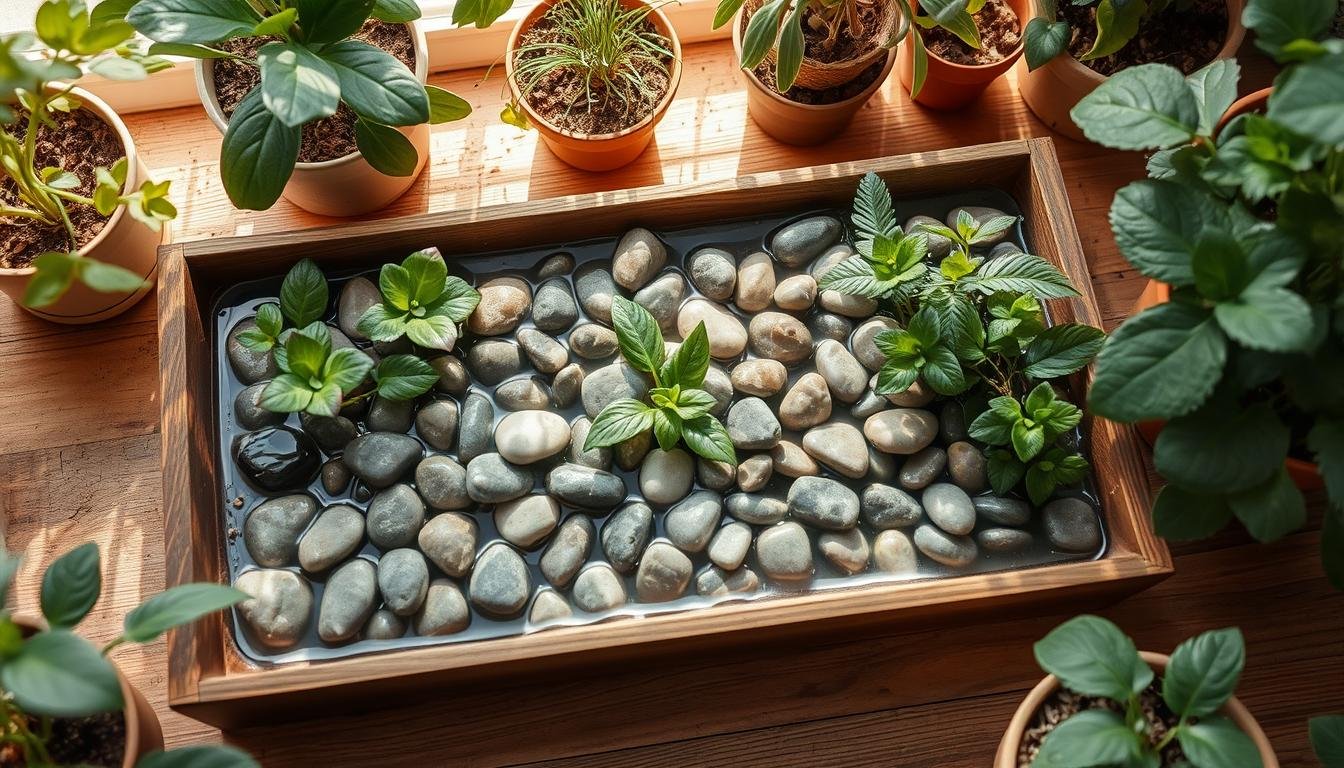
A pebble tray is just a shallow, watertight tray or saucer filled with pebbles and a small amount of water, with the plant pot resting on top of the pebbles rather than in the water. As the water evaporates, it raises humidity in the immediate area around the plant. The Spruce defines it this way and notes that the method relies on natural evaporation to increase local humidity. (The Spruce)
That local effect is the key. A pebble tray does not turn a dry room into a greenhouse. It creates a mild microclimate around the foliage, especially if the tray is broad, kept filled, and used in relatively still air. That is why good sources describe pebble trays as a helpful support, not the strongest humidity tool available. New Hampshire Extension says they help a little; a nearby humidifier provides more benefit. (Extension | University of New Hampshire)
How Evaporation Creates a Local Humidity Boost
The mechanism is simple: water evaporates, and the air right around the tray becomes slightly moister. If the tray sits directly under a plant with a dense canopy, that moisture is more likely to linger around the leaves long enough to matter. A wider tray exposes more water surface area, which can improve the effect, and some houseplant guides point out that broader saucers work better than tiny ones for that reason. (The Spruce)
There is also a practical limit built into the method. Evaporation slows in moving air, and the boosted humidity disperses quickly into the room. So if your home sits at very low humidity during winter, a pebble tray may reduce stress on one small plant or cluster, but it is unlikely to raise the entire growing area into the range that tropical species really prefer. That is why using a hygrometer is smart. The EPA recommends using a moisture or humidity gauge to see if indoor humidity is in a good range, and the same logic applies to plant care. (US EPA)
When a Pebble Tray Helps
A pebble tray is most helpful when all of these are true: the plant is humidity-sensitive, the room is a bit too dry rather than extremely dry, the potting and watering are otherwise under control, and the tray is placed correctly. Under those conditions, the tray can help prevent further tip damage, especially on plants that show early edge crisping when the air dries out. The Spruce specifically notes that while a tray will not repair already browned tissue, it can help stop more leaves from browning. (The Spruce)
This is why calathea, prayer plant, peace lily, ferns, philodendron, monstera, orchids, and parlor palms are the usual candidates. These plants often tolerate ordinary home conditions for a while, then start showing stress at the edges when humidity drops. If the symptoms are mild and clearly tied to dry air, a pebble tray is a sensible first step because it is cheap, low-risk, and easy to maintain. It is also useful when you want a gentle bump in humidity without committing to a machine.
When a Pebble Tray Will Not Solve the Problem
A pebble tray will not fix underwatering, root damage, salt buildup, tap-water sensitivity, sun scorch, or a plant sitting next to a heater. It also will not satisfy extremely humidity-demanding plants if your room is far below what they need. That is the central limitation people miss when they hear that pebble trays “work.” They work for one kind of stress, not for every plant problem that happens to look dry. (Yard and Garden)
There is another hard truth here: already crispy tissue does not turn green again. You are managing future growth, not reversing dead leaf margins. If you set up a tray and expect existing brown edges to disappear, you will think it failed even if new leaves come in better. Judge the method by what the next few leaves do, not by whether the old damage magically heals.
How to Set Up a Pebble Tray the Right Way
A proper pebble tray is simple, but the details matter. Use a watertight tray or saucer, fill it with clean pebbles, then add water only up to just below the top of the pebbles. The pot should sit on the stones, with the drainage hole above the waterline, not submerged in it. The Spruce emphasizes this because direct contact between the pot base and standing water can keep the mix too wet and lead to root rot. (The Spruce)
Size matters more than people think. A tiny saucer under a large plant has limited evaporative surface area, which means limited effect. Broader trays do better because they expose more water to the air and create a more useful humid zone around the foliage. If you want the tray to do real work, choose one noticeably wider than the pot and keep water topped up consistently so the evaporation cycle does not stop every couple of days. (The Spruce)
Placement matters just as much. Put the plant away from heating vents, strong fans, and harsh direct sun that accelerates moisture loss. If possible, combine the tray with plant grouping, because clustered foliage helps hold humidity around the leaves. New Hampshire Extension specifically notes that grouping plants creates a microclimate that boosts humidity, and that pairs well with a tray. (Extension | University of New Hampshire)
The most common mistakes are predictable. People let the pot sit directly in water. They use too little surface area. They forget to refill the tray. Or they use the tray while ignoring the real cause, such as bone-dry soil or fertilizer buildup. The tray is a support system. It is not a substitute for basic plant care.
Which Plants Benefit Most
Pebble trays make the most sense for humidity-loving tropical houseplants that show leaf-edge stress when indoor air dries out. The recurring examples across houseplant guides are ferns, peace lilies, parlor palms, monstera, philodendron, calathea, prayer plants, and orchids. These are the plants most likely to respond because their natural environments are not dry, heated living rooms. (The Spruce)
You will usually notice the benefit most on plants that give early warnings. Calathea is the classic one: the leaves stay attractive until the air gets too dry, then the margins start crisping and the plant looks rough fast. Prayer plants and some ferns behave similarly. For these species, a pebble tray can be worth using even if you later upgrade to a humidifier, because it adds another small layer of protection.
Pebble trays make less sense for succulents, cacti, and plants that prefer drier air. Those plants are not asking for a humidity bump, and excess moisture around them can create more trouble than benefit. The same goes for plants whose leaf damage is clearly tied to mineral-sensitive watering or poor root health. Match the method to the plant and the problem, not to the symptom alone.
What Works Better When the Air Is Very Dry
If your indoor air is consistently dry, a humidifier is usually the stronger tool. New Hampshire Extension says using a portable humidifier near plants and monitoring humidity with a sensor provides the most benefit. Pebble trays and grouping help, but they are not on the same level when the room itself needs a meaningful humidity increase. (Extension | University of New Hampshire)
That does not mean pebble trays are pointless. It means you should rank your fixes. Start by measuring humidity and checking whether your plant’s issue is really humidity-related. The EPA advises keeping indoor humidity between 30% and 50% for the home environment, while many houseplants do best at 40% to 60%, and some tropicals prefer higher than that. If your room is already sitting near the upper end of normal home humidity, the crispy edges are probably coming from something else. If your room is much drier and the plant is humidity-sensitive, a tray may help, but a humidifier is the more decisive move. (US EPA)
Other fixes can be just as important. Flushing the soil helps reduce salt buildup. Switching water sources can help fluoride- or chlorine-sensitive plants. Moving the plant away from vents and cold drafts can stop repeated stress. Fixing watering consistency often does more than any humidity hack. The best result usually comes from stacking small correct moves rather than betting everything on one tray of rocks.
Conclusion
Yes, pebble trays can help prevent crispy leaves, but only when low humidity is the real problem and only to a limited degree. They create a small humidity boost around the plant, which can reduce future browning on humidity-sensitive species like calathea, ferns, orchids, and peace lilies. They do not heal damaged tissue, and they do not solve underwatering, salt buildup, bad water quality, root stress, or poor placement. (Extension | University of New Hampshire)
The practical way to think about pebble trays is this: they are a useful minor tool, not a universal cure. If your plant lives in mildly dry air and otherwise has good care, a tray may be enough to take the edge off. If the room is very dry or the cause is something else, you need a better diagnosis and probably a stronger fix. The fastest way to get this right is to check humidity with a hygrometer, inspect your watering routine, look at water and fertilizer habits, and then decide whether the tray is support or just decoration. (US EPA)
FAQs
Do Pebble Trays Actually Increase Humidity?
Yes, but locally and modestly. The water in the tray evaporates and raises humidity in the immediate air around the plant, which is why extension and houseplant sources still recommend the method as one option. The University of New Hampshire’s guidance is especially useful here because it avoids hype: pebble trays can help a little, while a nearby portable humidifier gives more benefit. That is the right mental model. Think small boost, not room transformation. (Extension | University of New Hampshire)
Can a Pebble Tray Fix Brown Tips on Calathea?
It can help if the brown tips are being caused by low humidity, and calathea is exactly the kind of plant that often reacts to dry air with crispy margins. But calathea can also respond badly to hard water, fluoride, salt buildup, or watering inconsistency, so a tray is not always the answer. Iowa State lists low humidity, water-quality issues, and fertilizer salts among common causes of leaf-tip browning. So for calathea, the smart move is to pair a tray with softer water, careful watering, and a check on indoor humidity. (Yard and Garden)
Should the Pot Sit in the Water?
No. The pot should sit on the pebbles above the waterline, not directly in standing water. If the drainage hole stays in contact with water, the potting mix can remain too wet and increase the risk of root rot. That is one of the easiest ways to turn a helpful humidity setup into a root problem. A proper tray lets water evaporate under the plant without soaking the root zone from below all the time. (The Spruce)
Is Misting Better Than a Pebble Tray?
Usually not. Misting is short-lived, uneven, and easy to overestimate. A pebble tray at least provides a steady evaporative source beneath the plant, while a humidifier is better than both when the room is seriously dry. Good guidance on indoor humidity increasingly favors measuring humidity and using more reliable methods rather than assuming a quick spritz changed anything meaningful. If you want a low-effort humidity method, a pebble tray beats occasional random misting, but a humidifier still beats the tray for real control. (US EPA)
How Long Does It Take to See Results?
You usually judge success over new growth, not over damaged leaves that already turned brown. Existing crispy tissue does not recover, so the signal you are looking for is whether fresh leaves emerge cleaner and whether the browning stops spreading as fast. If low humidity was the real cause, you may notice stabilization over the next few weeks as the plant grows and conditions stay more consistent. If damage keeps advancing despite the tray, that is your cue to reassess watering, salts, water quality, or placement rather than doubling down on humidity alone. (The Spruce)