How to Attract Nesting Hummingbirds to Your Yard
Learn how to attract nesting hummingbirds with native plants, sheltered branches, insects, water, and safe feeder care—without disturbing an active nest.
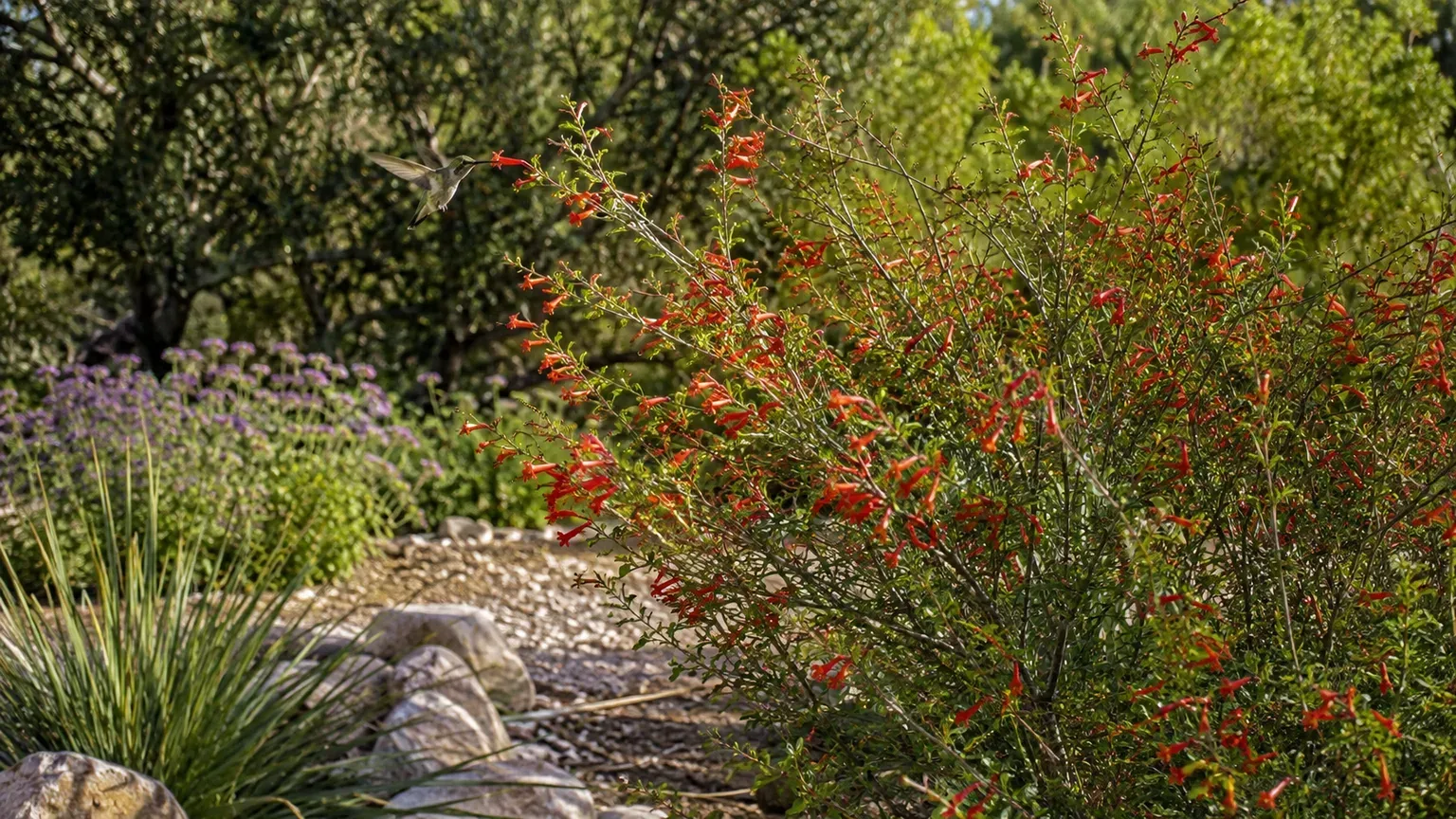
You can make a yard more attractive to nesting hummingbirds, but you cannot order a nest the way you choose a feeder. A female hummingbird selects a site that fits her species, food supply, shelter, weather, and sense of safety. Your job is to improve the habitat and give her choices—not to lure her to a particular branch or handle nesting material for her.
That distinction changes the whole plan. A nectar feeder may bring a bird through the yard, but a nesting female needs protected branches, a steady supply of flowers and small invertebrates, and a place where she can raise young with minimal disturbance. The most effective yard combines those elements across the property, then gives the birds room to decide whether to use it.
Understand what attracting a nest can and cannot mean
Hummingbirds do not nest in cavities or conventional birdhouses. They build small, expandable cup nests on branches, often where foliage screens the nest and a fork or downward-curving twig gives it support. A National Wildlife Federation guide describes females choosing sheltered branches in trees or shrubs, while Audubon’s account of a Rufous Hummingbird nest illustrates the scale: the finished cup can be smaller than half a walnut and camouflaged with moss and lichen.
A yard can offer suitable sites without guaranteeing that a bird will choose one. The female may prefer a particular tree, branch angle, exposure, or distance from competing birds that you cannot reliably predict. Seeing hummingbirds at a feeder is encouraging evidence that food is available, not proof that they will breed there; some birds are passing through on migration, and even a breeding pair may select a neighboring property.
Measure success by the habitat you build and the safe visits it supports, not by whether you can spot a nest. A garden with native flowers, mature shrubs, clean water, and healthy insect life remains useful to birds even in a season when no hummingbird nests in view. That patient approach also protects the birds from the common impulse to hang a house, move a branch, or inspect a nest to make the project feel successful.
Check your local species and breeding window
Before choosing plants or changing your pruning calendar, find out which hummingbird species occur in your region and whether they breed there. The Ruby-throated Hummingbird is the familiar eastern species, while the West and Southwest support several other species; some hummingbirds migrate through an area without nesting in it. The National Wildlife Federation notes that even a garden with visiting hummingbirds may not be within those birds’ breeding range. Compare its hummingbird habitat guidance with Audubon’s hummingbird-friendly-yard recommendations and local sightings to distinguish a regular breeder from a seasonal visitor.
Use a current range map from a bird organization such as Audubon or Cornell Lab of Ornithology, then check your local Audubon chapter or cooperative extension for seasonal observations and regional planting guidance. A migration map tells you where a species is generally expected, but neighborhood elevation, coastlines, weather, and urban microclimates can shift arrival and departure. Do not treat a calendar date from another state as the exact date to start pruning or put out a feeder in your own yard.
If hummingbirds visit but do not nest, the right response is not to increase the sugar concentration or add more red objects. First ask whether the birds are in your area during the local breeding period. If they are, look next at the condition and continuity of cover, the availability of insects and blooms, and the amount of activity around likely nesting zones. This sequence avoids spending money on a feature that does not solve the real habitat gap.
Design for a female’s nesting choices
Think in terms of a small habitat patch rather than a single “hummingbird plant.” The best site gives a female several branches to choose from, some protection from wind and harsh afternoon sun, and nearby routes to nectar and insect food. Existing trees and shrubs do more for this purpose than a collection of isolated flower pots because they create structure, shade, perches, and a buffer from routine foot traffic.
A Cornell Lab and National Wildlife Federation description of hummingbird nesting emphasizes branches in trees and shrubs, not boxes. Keep dense cover in more than one spot so a bird can choose a site according to its own behavior. A sheltered corner near a quiet bed can be a better offer than a prominent shrub beside a door, path, play area, or frequently used patio—even if the latter is closer to the feeder and easier for people to watch.
Provide sheltered branches and layered cover
Preserve established woody plants where they are healthy and safe, and add regionally appropriate shrubs or small trees where the yard has no protected structure. A dense outer edge with more open space nearby gives wildlife cover while allowing you to garden without brushing against every branch. Leave some small horizontal and forked branches intact; avoid shaping every shrub into a tight ball or cutting all interior growth away when it provides useful shelter.
A mixed planting is more resilient than relying on one evergreen screen or one flowering shrub. Combine a small tree, a mid-height shrub, and flowering plants where your site allows, with the most undisturbed portion set back from routine activity. If you are starting from bare ground, remember that newly planted shrubs take time to develop branches and foliage; keep a mature safe shrub if you have one rather than removing it to install a fashionable but immature planting.
The National Wildlife Federation’s hummingbird gardening guidance explains that trees and shrubs supply cover, nesting sites, and insect food, especially when they are native to the region. That is why nesting habitat cannot be reduced to “plant a red flower”: the branch architecture and shelter may be the part that makes a female consider the yard at all.
Plant for a continuous food web, not just red blooms
Flowers provide high-energy nectar, but hummingbirds also eat small insects and spiders. The National Wildlife Federation notes that insects are especially important for young birds, and Audubon’s habitat guide describes hummingbirds gleaning insects from leaves and spider webs as well as capturing them in the air. A yard that offers nectar but is kept sterile with broad insecticides removes part of the food supply a nesting female needs for her chicks.
Create overlapping bloom periods rather than planting a single wave of red annuals that disappears after a few weeks. A mix of trees, shrubs, vines, and herbaceous flowers can provide early, middle, and late-season forage, and it supports different insects as the season changes. Horticulture Magazine’s hummingbird garden guide and Savvy Gardening’s practical habitat advice both emphasize that shelter and food work together; the former also offers useful ideas for arranging blooms across a garden. In practice, draw a simple three-column bloom calendar—spring, summer, fall—and identify at least one locally suitable plant that flowers in each period before you buy more of the same midseason bloomer.
Color and flower shape can help hummingbirds find nectar, but they are filters, not guarantees. Red and orange tubular blooms are often useful cues, yet birds will also use flowers in other colors, and the value of any species depends on whether it grows well in your climate and actually offers nectar. Choose plants for your local hummingbird species and site conditions rather than assuming that a red cultivar from a distant climate will provide the same food or shelter.
Choose regionally native nectar plants
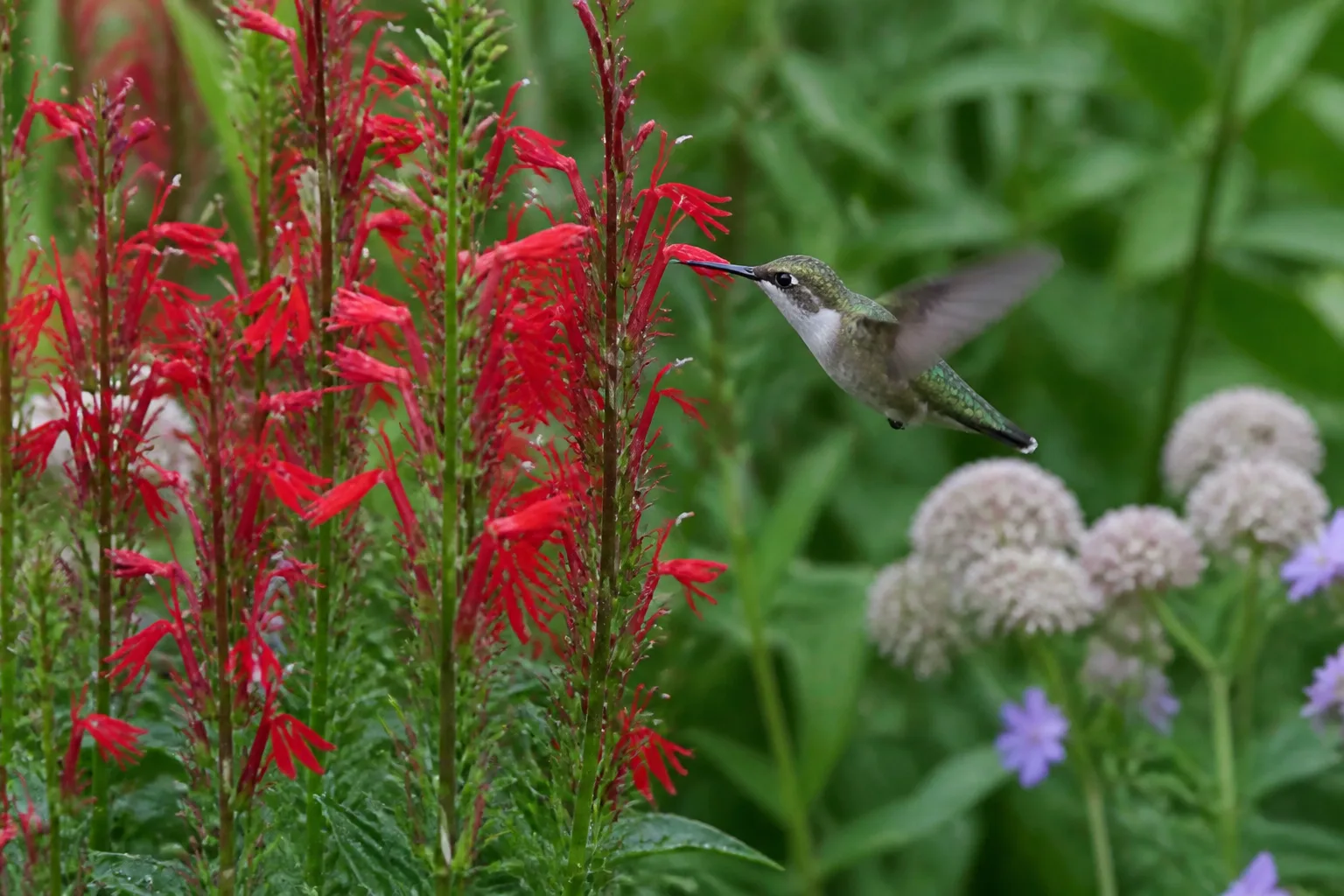
Start with a local native-plant list from a state extension, Audubon’s yard guidance, or a regional native-plant society. Examples include cardinal flower and bee balm in parts of the East, coral honeysuckle in much of the eastern United States, and red-flowering currant in parts of the Pacific Northwest. Those examples are not a universal shopping list: verify the species’ range, water needs, and growth habit where you live before planting. A native plant in one region can be unsuitable or even invasive in another.
Use Horticulture Magazine’s plant guidance as a practical starting point for choosing bloom succession and garden layers, then check every candidate against a regional source. For a humid eastern garden, a moisture-loving cardinal flower may fit a rain-garden edge; a dry western site calls for different regional species. In Florida, UF/IFAS Extension Duval County discusses locally appropriate options such as firebush, scarlet sage, and coral honeysuckle, but those recommendations should not be copied into a colder or ecologically different region without checking hardiness and native status.
You do not need dozens of species. A small group of suitable plants in a sunny or partly shaded bed, backed by shrubs or a small tree, can offer more continuity than a long list of plants that are poorly matched to soil and exposure. Grouping a few of the same species also makes bloom patches easier for birds to locate and makes irrigation and maintenance simpler for you. For balconies, use locally suitable flowering containers, but understand that pots alone cannot replace a nearby tree or shrub as a nesting site.
Keep insects and spiders in the garden
Do not treat a hummingbird-friendly yard as a place where every caterpillar, aphid, or spider must be removed. Hummingbirds are not sustained by sugar water alone, and the insects that seem like garden “extras” can become prey for adults and nestlings. Native plants often support a broader set of local insects than a simplified ornamental bed, so leaving a small patch of natural vegetation can serve more than one purpose.
Avoid preventive, broad-spectrum insecticide applications in beds used by birds, and do not spray flowering plants while pollinators are active. If a plant has a serious pest problem, identify the pest first and use the least disruptive method that fits the plant and local label directions; a hummingbird garden is not improved by eliminating the insects that its visitors eat. Keep some spider webs in low-traffic parts of the garden rather than sweeping every web from shrubs and eaves.
A web is a building resource, but that does not mean you should deliberately encourage dangerous spiders or leave webs where people can be injured. The practical goal is modest: stop treating every spider as a pest, avoid spraying indiscriminately, and let the birds forage through healthy vegetation. Audubon’s nesting-material guidance describes spider silk as a flexible binding material in a Rufous Hummingbird’s nest and also explains that the female gathers insects for her young.
Add water and perches without creating hazards
Hummingbirds may use water to bathe and clean their feathers, and a fine mist or gentle dripper can be easier for them to use than a deep, still basin. Place a mister so droplets collect on foliage or produce a light spray, with a perch close enough for a bird to rest afterward. Keep the equipment and basin clean, and make sure the water feature does not leave a slippery path or standing water where mosquitoes can breed.
Perches matter because hummingbirds need places to pause between flights and watch the area. Keep some branches and small twigs available rather than pruning every limb smooth. A feeder pole or open wire can provide a perch, but natural cover near the feeding area offers a more complete environment than a bare pole standing alone in a lawn.
Place water and feeding stations where you can maintain them, but do not cluster every feature beside a likely nesting shrub. A human walkway, a dog’s favorite route, or a bright patio is a poor center for a quiet nesting zone. Spread useful resources through the yard so birds can feed, bathe, and perch without repeatedly crossing the busiest part of the property. Audubon and Horticulture Magazine both describe water and resting sites as useful parts of a hummingbird garden; treat them as supporting features, not as a way to force nest-site choice.
Use feeders as support, not as nesting bait
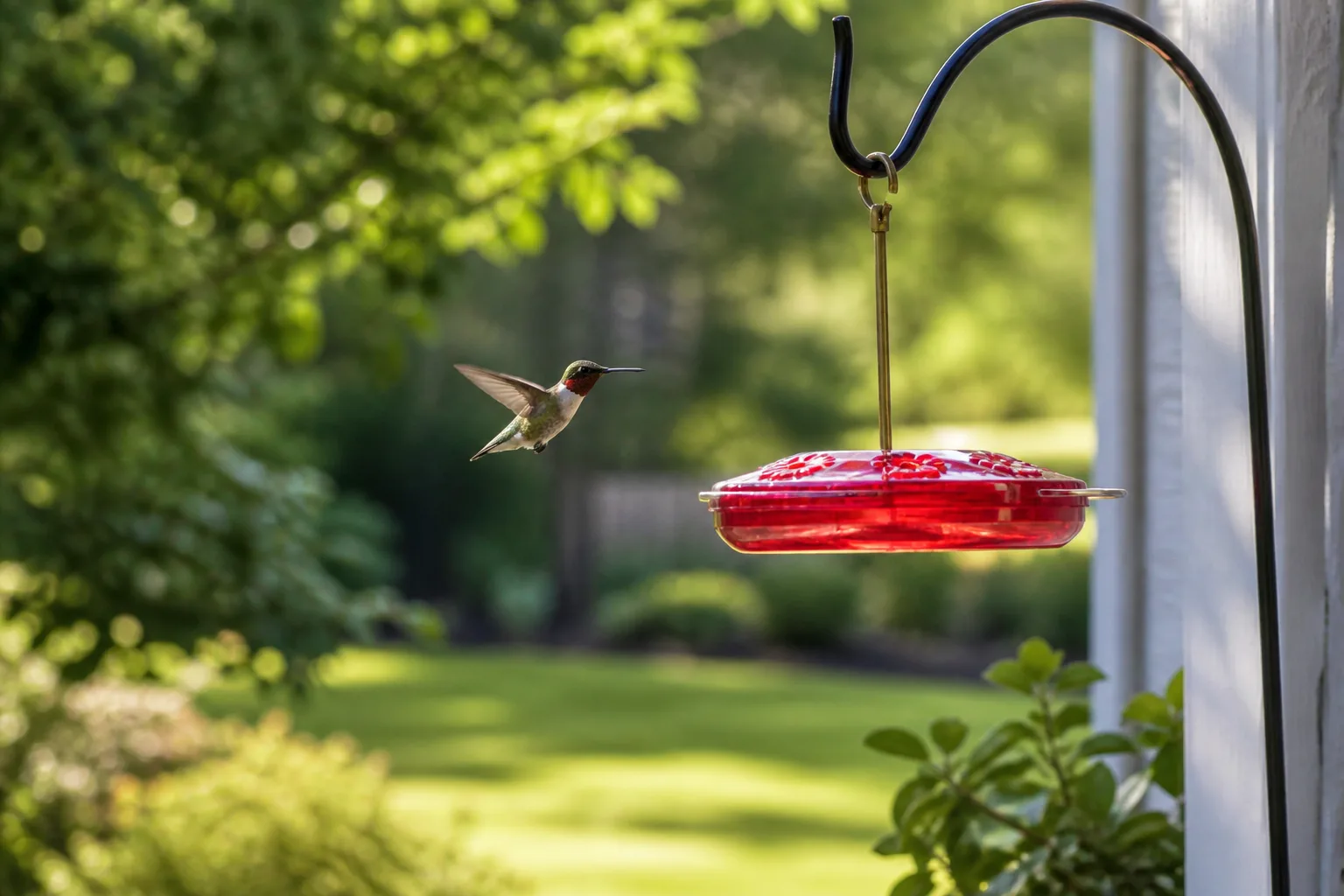
A clean nectar feeder can support visiting hummingbirds when flowers are scarce, especially during migration, but it does not substitute for nesting cover or insect food. If a feeder brings birds to your yard, use their presence as a reason to improve the surrounding habitat rather than as a sign that the feeder is causing them to nest. Place the feeder in shade when practical and where you can inspect and clean it easily, without putting it right beside a window, a cat’s launch point, or the shrub you want to keep quiet.
Several closely visible feeders can create competition because hummingbirds may defend feeding territories. If one bird monopolizes a feeder, spacing separate stations so they are not all visible from one perch can reduce the chance that a single bird controls the whole supply. There is no need to remove every feeder to make nesting more likely; focus on cleanliness, thoughtful placement, and a garden that offers natural forage.
Make nectar and feeder care safe
Use a simple solution of one part plain white granulated sugar to four parts water by volume. Allow it to cool before filling the feeder, and do not add red dye, honey, raw sugar, or artificial sweeteners. Audubon’s feeder guidance recommends the 1:4 recipe and warns against those additives. Red feeder parts are enough to make the station visible; colored nectar adds risk and no necessary benefit.
Clean and refill the feeder on a schedule that responds to heat and use. Audubon advises cleaning every two to three days, and daily during especially hot weather; cloudy nectar or a dirty feeder should be cleaned immediately. Rinse thoroughly after cleaning, and make only as much nectar as you can keep fresh. This is a real maintenance commitment, not an occasional decoration: if you cannot reliably clean a feeder, focus on flowers and remove the feeder until you can.
Reduce pesticide and predator risks
A nesting-friendly yard should be safe during both the quiet nest-building stage and the busy period when adults are carrying food. Keep cats indoors or within a secure enclosure; roaming cats can reach low shrubs and can wait beneath a nest tree. Also avoid placing a feeder, birdbath, or favorite viewing spot where a cat can hide close to the birds. The National Wildlife Federation recommends keeping cats indoors and reducing pesticides as part of sustainable hummingbird gardening.
Do not use netting, sticky substances, or chemical repellents around a nest. Avoid broad-spectrum pesticides and herbicides in the habitat, and follow label directions whenever a legally labeled product is needed for another garden problem. A product’s garden use does not make it harmless to every bird, insect, or spider that enters the treated area. If you cannot identify a pest or determine whether an application is compatible with wildlife, pause and ask your local extension service before treating.
Look at the surrounding landscape too. A safe yard is more useful when nearby gardens also offer habitat and pesticide-free forage, since birds do not recognize property boundaries. You can invite a neighbor to add a native flowering shrub or leave a small section of natural vegetation; a connected patchwork of resources is more practical than expecting one tiny yard to supply every need. Keep exterior lights modest during migration periods where possible, and avoid shining spotlights directly into dense cover after dark.
Make pruning and yard work nest-aware
Hummingbird nests can be so small and well camouflaged that a gardener may not notice one until a female makes repeated trips to the same area. Before pruning a tree or shrub during the local breeding window, pause to look for regular bird traffic and scan branches from a respectful distance. Repeated visits to one small area, a female carrying fibers, or a bird that repeatedly returns to a concealed branch can be a reason to stop and observe; it is not an invitation to part the foliage or inspect the nest by hand.
If a nest is present, postpone routine pruning nearby until the young have left and the site is no longer active. Do not cut or move the branch, shake the shrub, water-blast it, or place a camera or ladder close to the nest. Hummingbirds are small, and an apparently minor disturbance can expose the nest, cause a parent to abandon a feeding route, or put the nestlings at risk from weather and predators. If a branch presents an immediate hazard to people or property, keep people away and contact a licensed wildlife rehabilitator or local wildlife agency before taking action.
BBC Gardeners’ World gives general garden-bird advice to avoid disturbing nesting cover during the breeding season and to preserve useful shrubs and hedges. For hummingbirds, the safer rule is to combine local timing with a direct check before you cut: a broad seasonal calendar cannot tell you whether a particular branch currently holds a nest. If you have hired a tree-care professional, tell them that active nest checks are part of the job and ask them to stop if they find one.
Offer natural nesting resources carefully
Hummingbird nests use natural fibers, plant down, moss, lichen, and spider silk, but there is little reason to build a special nest-material station. The strongest long-term approach is to grow suitable native plants, preserve small twigs and undisturbed vegetation, and avoid clearing every spider web and seedhead. This lets a female choose only the materials and site she wants, instead of making her dependent on a product or a material you selected for her.
Do not offer yarn, string, fishing line, human hair, dryer lint, or synthetic fluff. Long strands can entangle legs or wings, and dryer lint can collapse when wet. Cornell Lab of Ornithology and Audubon’s safe-material guide both warn that apparently soft nesting materials can harm birds; Cornell also cautions against pet hair from animals treated with flea or tick products. BBC Gardeners’ World’s plant guide offers a useful gardening perspective on leaving natural seedheads and woody cover, but it discusses garden birds generally, not a guaranteed hummingbird nest recipe.
If you decide to make natural materials available for birds, keep them short, clean, untreated, dry, and loosely accessible. But a station is optional, and it is easy to get wrong: the materials that look softest to people may not be durable or safe in weather. For hummingbirds specifically, supporting their supply of spider silk and plant material through a healthy garden is more reliable than hanging a bundle of fibers and hoping it becomes a nest.
Adapt the plan to a small yard, patio, or balcony
A small space can support visiting hummingbirds with a flowering container, a clean feeder, a small mister, and a perch. Choose a container plant that is locally suitable and flowers over a useful part of the season; pair it with other pots that take turns blooming rather than buying one pot that flowers for a week. A compact balcony garden can be an important stop for nectar even if it does not contain the woody cover or protected branches a nesting female prefers.
If you have no shrub or tree, consider whether a suitable native shrub can grow in a large container or in a shared courtyard nearby. Ask a landlord or neighborhood association before planting permanent woody plants, and choose a species whose mature size and roots fit the site. Where a container tree is not practical, keep the patio contribution honest: provide food and water for visitors and encourage a nearby property manager or neighbor to retain mature cover rather than claiming a row of pots is complete nesting habitat.
On a larger lot, prioritize one quiet edge instead of spreading every plant evenly across lawn. A layered border can combine shelter, nectar, insect food, and a view from a window at a distance. Do not place seating or a feeder directly under the branch you hope birds will use; watching from farther away with binoculars is less disruptive and can make the garden more enjoyable for everyone.
Watch activity without disturbing birds
Observation can help you improve the habitat, but use the birds’ behavior as a signal to back away rather than as a reason to get closer. Watch from a window or a fixed position at a distance. If an adult repeatedly flies to the same concealed point, avoid pruning or entering that section and keep children and pets from investigating. Do not stand beneath the branch, point a phone flash at it, or repeatedly approach to confirm whether eggs are present.
Record what you can see without exposing the nest: date, species if known, which flowers are in bloom, whether a feeder is used, and which part of the yard receives the most visits. These notes help you make practical improvements next season. If you do not see nesting behavior, compare your plant bloom calendar with local hummingbird observations, add habitat in the weakest season, and keep the yard pesticide-light; do not assume that more feeder sugar or a nest box is the missing solution.
If you find a fallen nestling, an injured bird, or a nest that has been damaged, do not attempt to raise or relocate the bird yourself. Keep pets and people away and contact a permitted wildlife rehabilitator or the appropriate local wildlife agency for instructions. Laws and handling rules vary by location, and a licensed rehabilitator can advise you on the safest response.
Conclusion
To encourage hummingbirds to nest in your yard, start with the resource that feeders cannot provide: sheltered, undisturbed branches in trees or shrubs. Add regionally native flowers that bloom across the local breeding season, keep insects and spiders in the habitat, provide clean water and safe perches, and use feeders only if you can maintain them properly.
Then give the birds time and privacy. Confirm which species breed in your region, keep cats and pesticides away, avoid unsafe nesting materials, and check before pruning. A good habitat improves the chances that a female will consider your yard, but the choice remains hers—and a yard that supports safe visits is worthwhile even when no nest appears.



