17 Best Heat-Tolerant Trees for Your Landscape
Compare 17 heat-tolerant trees by climate, shade, water needs, and mature size, with picks for humid summers, dry deserts, and heat-reflecting urban yards.
A tree can handle blazing afternoons and still struggle in a dry root zone, salty coastal wind, or the coldest night of winter. The most useful way to shop for heat-tolerant trees is to match the tree’s strengths to the heat your yard actually gets, then leave enough room for its mature canopy and roots.
The picks below cover humid southern summers, hot inland cities, and arid landscapes. They are not interchangeable: some make broad shade if you can irrigate during establishment, while desert species stay healthier in lean, sharply drained soil.
How to choose a tree for the kind of heat your yard gets
Start by separating four stresses that often get lumped together: high air temperature, lack of water, reflected heat from pavement or walls, and warm humid nights. A tree adapted to one may not tolerate the others. A wet-site tree can take high summer temperatures when its roots have moisture; a desert tree may decline in heavy, poorly drained clay. Extension guidance likewise treats species choice, microclimate, soil, mature size, and purpose as linked decisions, rather than reducing the choice to a hardiness zone. Alabama Cooperative Extension’s tree-selection guide notes that the USDA Plant Hardiness Zone Map reflects average extreme winter lows; it is useful for cold survival, but does not rate summer heat tolerance.
| Yard condition | Start with | Important trade-off |
|---|---|---|
| Hot, humid summers with ordinary garden soil | Crape myrtle, southern live oak, cedar elm, or southern magnolia | Large evergreen trees need room; young trees need water through dry spells |
| Hot summers and seasonally wet or clay soil | Bald cypress or catalpa | These are poor choices for an arid site without irrigation |
| Dry heat and fast-draining soil | Desert willow, palo verde, mesquite, Arizona cypress, or olive | Most give open or filtered shade; some are frost-sensitive or thorny |
| Pavement, parking strips, or urban heat | Ginkgo, hackberry, honeylocust, or Chinese pistache | Check available root volume and local invasive-species lists before buying |
| Hot summers plus cold winter nights | Bur oak, hackberry, honeylocust, or ginkgo | Match the cultivar to local winter lows, not a neighboring state’s climate |
Before choosing, watch the planting spot during the hottest part of the day. South- and west-facing walls, stone beds, and broad paving can push heat back toward a tree and dry its root zone faster. Penn State Extension describes reflected heat and lack of water as a combination that can kill trees even when the species seems broadly adaptable; its advice is to assess the actual location before selecting a replacement. Penn State Extension’s climate-ready tree discussion is a useful reminder that a sheltered garden and a paved street edge are different planting sites.
Then check the tree’s eventual height and spread, not just the nursery pot. A small sapling may be easy to fit under wires or beside a driveway, but a mature oak can shade a house and push branches over a roof. Ask a local cooperative extension office or municipal tree list for cultivars suited to your county, especially where a nonnative tree might spread. The Penn State Extension list for long, hot summers includes a range of trees, but it is regional guidance for Pennsylvania—not a universal shopping list.
Finally, don’t expect a newly planted drought-tolerant tree to fend for itself. Until new roots grow beyond the nursery root ball, it needs consistent moisture during hot, rainless weather. Water slowly over the root zone, check below the mulch before repeating, and adjust for sandy versus clay soil; calendar watering can leave one site dry and another waterlogged. Practical tree-growing guidance from Epic Gardening also emphasizes that many dry-climate species need regular attention while they establish before they become more independent.
Crape Myrtle
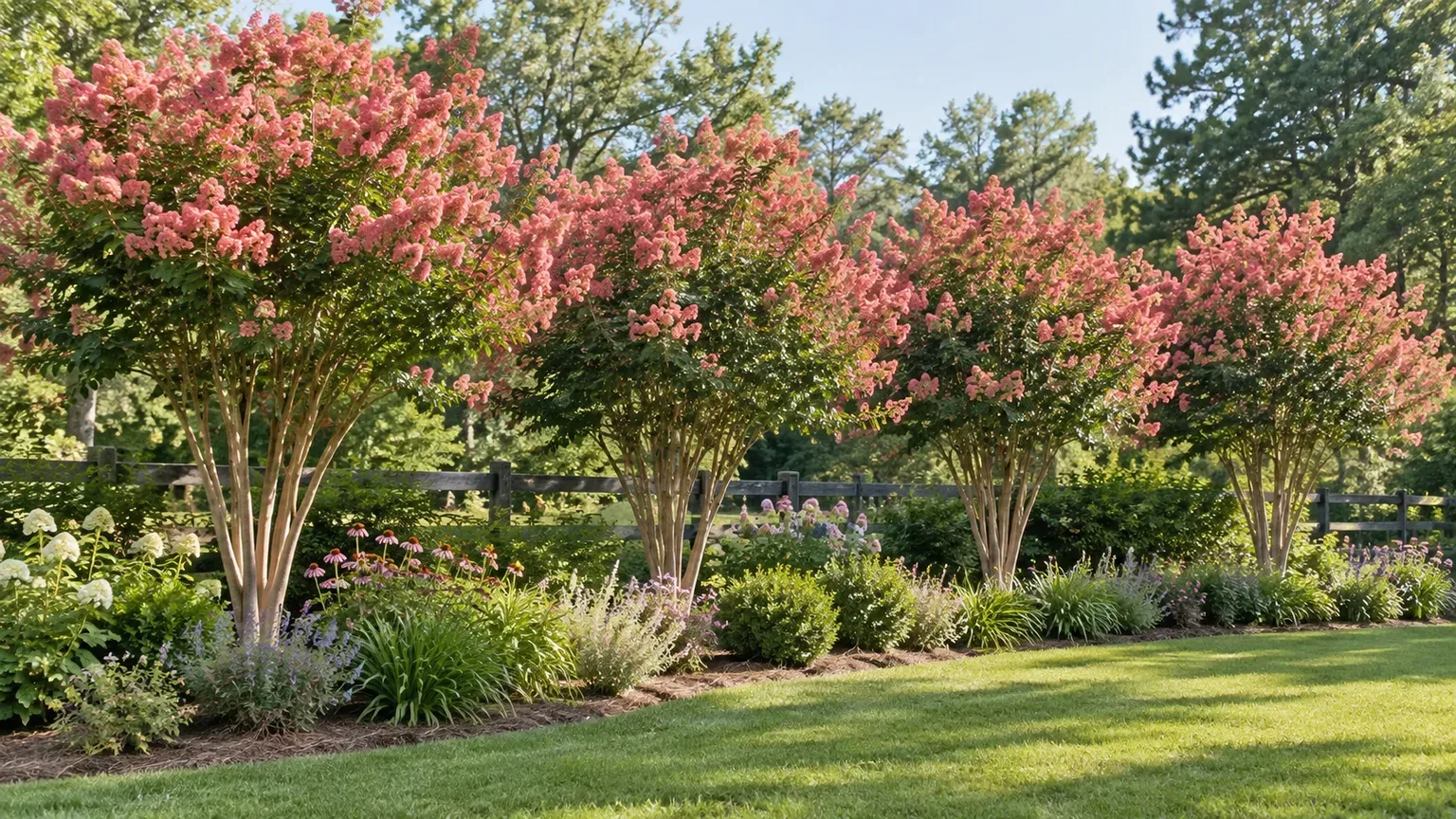
Crape myrtle (Lagerstroemia indica and hybrids) is one of the most dependable flowering choices for a hot, sunny yard. It blooms on new growth, comes in shrub-sized and small-tree cultivars, and gives a longer summer flower display than many deciduous shade trees. Give it full sun and well-drained soil; a shaded tree may leaf out well but flower sparsely. In warm climates, it can handle dry periods after establishment, but a young crape myrtle still needs water while its roots spread.
Choose a cultivar by mature size instead of pruning a too-large tree into a smaller shape. Some selections stay low enough for a patio, while full-size types become broad small trees. Resist the common practice of cutting every trunk back to thick stubs each year: hard topping disfigures the branching and is not needed for bloom. Gardening Know How’s Zone 9 tree list includes crape myrtle among hot-weather options, and Epic Gardening’s growing notes stress sun, drainage, and establishment watering.
Southern Catalpa
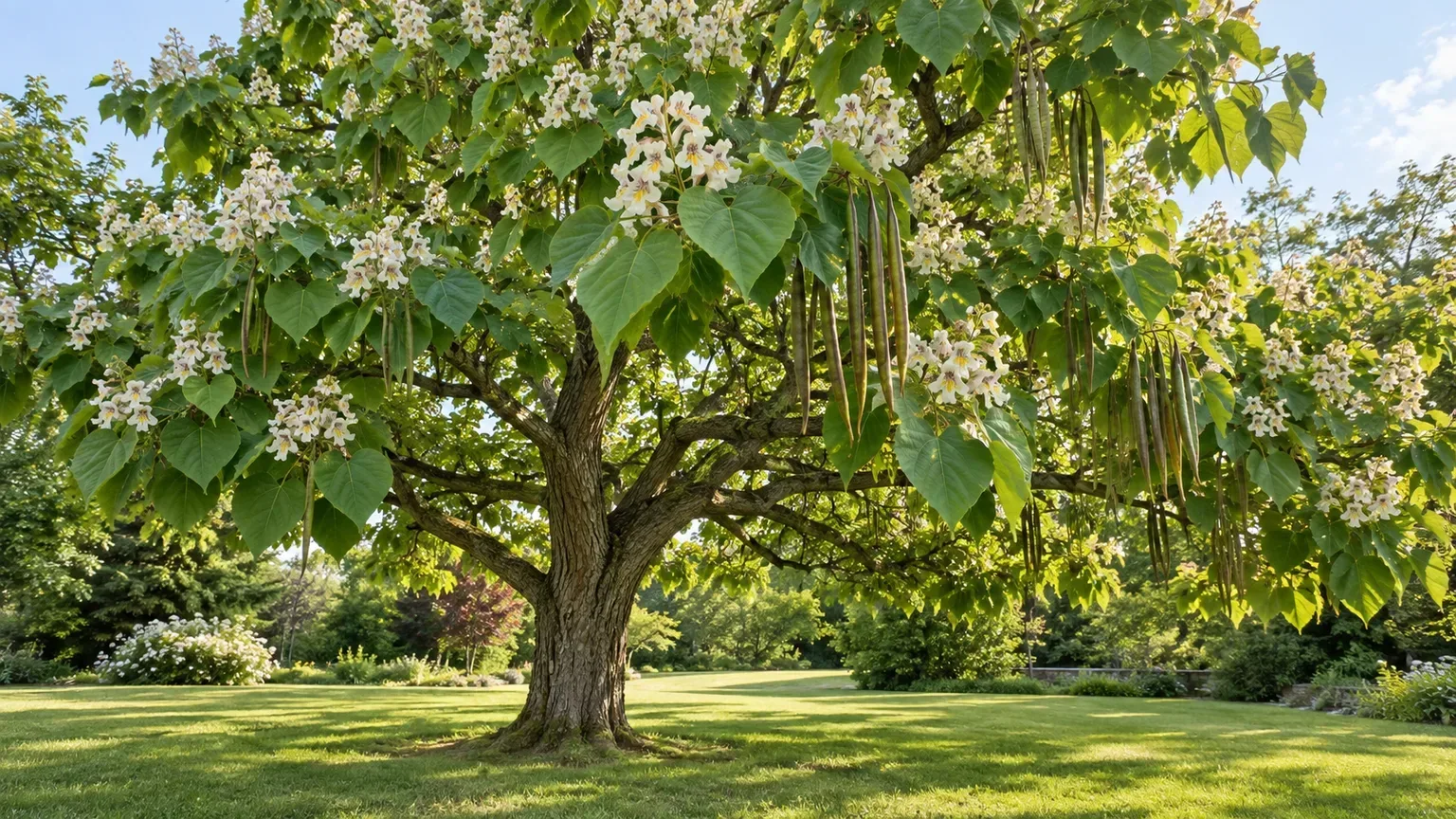
Southern catalpa (Catalpa bignonioides) suits a spacious yard in a hot, humid region where the tree can receive rain or occasional deep watering. Its very large leaves create a dense summer canopy, and white flower clusters add a showy spring display. Compared with a desert willow or olive, catalpa is the better fit for a landscape with regular soil moisture; don’t plant it in gravelly desert soil and expect drought performance from the heat tolerance alone.
Plan for a broad mature crown and seasonal cleanup. Catalpa drops leaves, flowers, and long narrow seed pods, so it works better over lawn or an open bed than beside a pool, patio, or frequently swept walkway. Allow roots and branches enough space away from utilities and structures. A young nursery specimen will take time to provide the cooling shade of a mature tree.
Southern Live Oak
Southern live oak (Quercus virginiana) is a long-lived, broad-canopied evergreen for warm regions with mild winters. It tolerates high temperatures and, once established, can manage dry spells; it also gives heavier shade than many flowering trees. Alabama Cooperative Extension specifically lists live oak as tolerant of heat and drought, while noting that selection still depends on site conditions. Its tree-selection guidance also describes live oak as a strong-wooded choice for storm-prone landscapes.
This is not a small-yard tree. The canopy can spread far beyond the trunk, and a large root zone needs open soil rather than a tiny planting cutout surrounded by concrete. Give it room from buildings, walks, and overhead wires, and keep irrigation steady while the young tree establishes. Choose a locally adapted live oak where it is native or commonly recommended; the species’ success in the coastal South does not mean it will thrive in every hot inland or cold-winter climate.
Bur Oak
Bur oak (Quercus macrocarpa) is a strong candidate for places with hot summers and genuinely cold winters, especially across the central and upper portions of the United States. Its large lobed leaves and rugged habit suit a park-like lawn or broad front yard, and established trees tolerate dry periods better than moisture-loving trees. It is a long-term shade investment, not a quick screen: the tree takes time to develop a broad canopy and needs substantial space as it matures.
Do not confuse drought tolerance with the ability to survive without water after planting. Water a new bur oak during extended dry weather, then taper supplemental irrigation as roots expand and the tree grows steadily. Select a source-grown tree suited to your local soils and winter range. If your site is a small paved courtyard or permanently wet low spot, choose a smaller or moisture-adapted tree instead.
Cedar Elm
Cedar elm (Ulmus crassifolia) is a useful native shade tree for hot, humid parts of the south-central United States, including places where summer heat lasts well into fall. It is more appropriate for a large lawn or street-side planting than a narrow planting strip, and it can cope with a range of urban conditions once established. In a region where local extension services recommend it, it offers a practical native alternative to choosing an unfamiliar ornamental tree from a national list.
Its scale is the main limitation: cedar elm matures into a real canopy tree, so look up for wires and measure from the trunk to the house, driveway, and neighboring trees before planting. A young specimen should not be left to dry out simply because a mature tree tolerates heat. Ask a local nursery or county extension office which elm species and cultivars perform well in your area; regional disease pressure and winter lows can change the recommendation.
Common Hackberry
Common hackberry (Celtis occidentalis) earns a place on a heat-ready list because it tolerates a wider range of ordinary landscape conditions than a tree that needs pampering. It is a deciduous shade tree for much of the central and eastern United States, and it can handle wind and dry spells after establishment. Penn State Extension includes hackberry in its list of trees for long, hot summers, and Alabama Extension identifies it as a wildlife-supporting landscape tree. The Penn State list is regional, so pair that recommendation with your local hardiness and soil conditions.
Its small fruits feed birds, but they can make a mess on paving, decks, and parked cars. Hackberry also gets leaf galls from insects in some regions; these are often cosmetic rather than a reason to spray. Use the species or cultivar native to your area, give its eventual canopy room, and choose a different tree if you need a spotless surface under every branch.
Thornless Honeylocust
A thornless honeylocust (Gleditsia triacanthos var. inermis) is a good fit when you want a large deciduous tree that casts filtered shade rather than deep darkness. That lighter canopy lets lawn or lower plantings receive more sun, and the tree is used in warm, dry, and urban sites. Alabama Extension lists thornless honeylocust among trees that tolerate heat and drought; Penn State includes it among options for long, hot summers. Epic Gardening’s profile also notes the value of choosing thornless forms for easier maintenance.
Buy a named thornless cultivar from a reputable nursery and ask whether it produces seed pods. Podless selections avoid the cleanup associated with fertile female trees, while a seed-bearing tree can leave long pods beneath the canopy. Honeylocust still grows large, so it is not a shortcut for a tight sidewalk space. Water during establishment, then use the tree’s growth and local rainfall—not a fixed calendar—to decide whether mature specimens need supplemental irrigation.
Ginkgo
Ginkgo (Ginkgo biloba) is a slow-to-moderate-growing choice for urban heat, summer sun, and cold-winter regions that need a tough deciduous tree. Its fan-shaped foliage turns yellow in fall, and its upright form can work where a spreading oak would be too wide. The species is adaptable, but it is not instant shade: young trees need time to create a useful canopy, and established trees still benefit from deep watering through severe dry spells.
Buy a male cultivar. Female ginkgo trees produce fleshy seeds with an unpleasant smell when they fall, which makes them a poor fit beside sidewalks, entries, or patios. Check mature height and spread before choosing a narrow cultivar for a street planting, and do not mistake winter hardiness for a guarantee against summer drought. Gardening Know How includes ginkgo among trees for warm Zone 9 conditions, while its zone guide also distinguishes it from region-specific desert trees.
Chinese Pistache
Chinese pistache (Pistacia chinensis) is a deciduous, medium-to-large tree that handles hot sun and urban conditions, with useful red-orange fall color in climates that produce it. It is often considered for parking areas and open lawns where a sturdy shade tree is needed. Give it well-drained soil and water while it establishes; drought resistance in a mature tree is not a reason to keep a new transplant dry. Its eventual spread makes it a better choice for an open site than a narrow planting strip.
This species is not appropriate everywhere. It is nonnative and can become invasive in some regions; Epic Gardening specifically cautions Texas gardeners to consider native alternatives. Check your state invasive-plant list and local extension recommendations before purchasing. Where it is acceptable, select a named cultivar with known sex and fruiting behavior if fruit cleanup or seedlings would be a problem. The Epic Gardening species discussion provides a useful example of why a general heat recommendation still needs a local invasive-species check.
Southern Magnolia
Southern magnolia (Magnolia grandiflora) is a handsome evergreen shade and screening tree for hot, humid regions. It tolerates summer heat and has large glossy leaves and fragrant flowers, but it looks best with a reasonably moist, well-drained root zone. It is therefore a better match for humid climates or irrigated gardens than for a no-water desert landscape. A newly planted magnolia can be stressed by dry wind and hot pavement even if the species is common across the South.
Allow room for the mature canopy and root zone, and consider leaf and seed-cone litter before putting it beside a pool or paved seating area. Many cultivars reach substantial size, while compact selections may suit smaller yards; verify the mature dimensions of the actual variety. Avoid planting under power lines or squeezing it into a bed that will be repeatedly cut back. Shade, evergreen screening, and flowers are the payoff when the location matches the tree’s moisture needs.
Bald Cypress
Bald cypress (Taxodium distichum) is a deciduous conifer for hot, humid places where the soil stays moist or periodically wet. It is especially useful for poorly drained ground that would challenge many drought-adapted trees. Alabama Extension contrasts its wet-soil fit with live oak and honeylocust’s heat-and-drought tolerance, a practical example of why “heat tolerant” alone does not describe a tree’s water needs. The extension guide explains those species differences.
This large tree needs room, and it is a poor match for a dry, compact yard where frequent irrigation is unavailable. It can also grow in better-drained landscapes, but do not choose it as a low-water desert tree. Bald cypress sheds its needle-like leaves in fall, bringing warm color before winter; its “knees” are associated with wet conditions and are not guaranteed in every garden. Give the tree space and a soil moisture regime that makes sense for its regional form.
Arizona Cypress
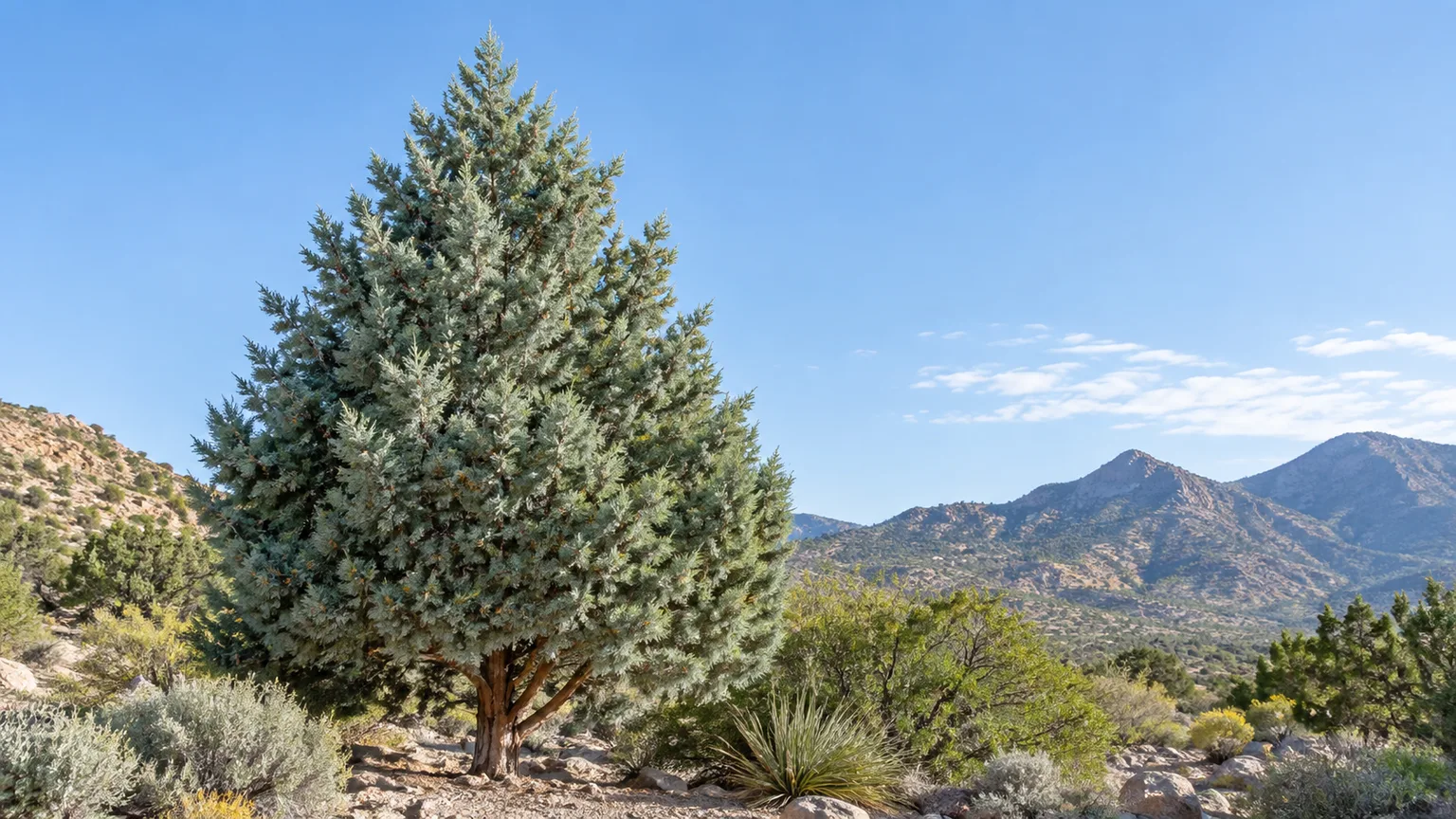
Arizona cypress (Hesperocyparis arizonica) fills a different role from the deciduous shade trees above: it is an evergreen screen for hot, dry, sunny sites with well-drained soil. The silvery blue-green foliage can break wind and offer year-round privacy, and the tree is better suited to inland arid climates than to a soggy or heavily shaded bed. Gardening Know How’s warm-zone tree overview includes cypress for Zone 9 landscapes, though the correct cypress species still depends on local climate and mature shape.
Use it where an upright evergreen form fits, and leave enough space for branches to fill out without pressing against buildings or paths. Water slowly during establishment, especially in a hot, windy location, then reduce routine irrigation as roots spread. Avoid planting a row on soil that stays saturated; poor drainage can undo the advantage of selecting a tree for heat. As an upright evergreen, it screens views year-round but casts less broad cooling shade than a large deciduous canopy tree.
Desert Willow
Desert willow (Chilopsis linearis) is a small, airy tree for the hot, dry Southwest, especially where a flowering accent is more valuable than dense shade. Its narrow leaves and trumpet-shaped flowers suit a sunny landscape with fast-draining soil. It is not a true willow, and it does not share a weeping willow’s demand for wet ground. The open canopy provides moving, filtered shade rather than the deep cover of a live oak.
A young desert willow needs a good start with water, but once rooted it is adapted to dry summers. Avoid heavy, frequent irrigation in a soil that already drains slowly. The tree may be leafless in winter in cooler parts of its range, and a severe freeze can limit where it performs reliably. Check native-plant guidance for your county; local desert willow selections are usually a safer bet than a generic nursery label.
Palo Verde
Blue palo verde (Parkinsonia florida) is a signature desert tree for hot, dry gardens where a light canopy and spring flowers are welcome. Its green bark carries on photosynthesis when small leaves drop during drought, so the tree can retain color when nearby plants look dormant. Its canopy is naturally open, which means it will not cool a patio like a dense broadleaf shade tree; think of it as filtered shade, visual structure, and a strong fit for a desert planting.
Choose the palo verde species native or proven in your region, and avoid treating it like a lawn tree with frequent shallow sprinkling. Water a new tree deeply enough to wet the root zone, let the soil drain, and extend the interval between watering as the tree establishes. Keep thorny branches away from paths if your chosen species has them. In the hottest neighborhoods, a locally adapted palo verde can handle sun and reflected heat better than trees that expect cool, moist soil.
Mesquite
Honey mesquite (Prosopis glandulosa) is a high-heat, low-water choice for the Southwest, where it can provide a broad but filtered canopy and habitat for wildlife. Native mesquites are adapted to long dry spells once their roots are established. Their small leaflets also create less dense shade than a live oak, which can be useful when you want to cool a seating area without turning the entire yard dark. Select a locally native species rather than treating every mesquite sold across the country as interchangeable.
The drawbacks are real: many types have thorns, seed pods, and branches that need training when young. Keep thorny forms back from play areas and narrow walkways, and inspect the nursery plant for a clear trunk and well-spaced scaffold branches. Water a new mesquite during its first dry seasons, then cut back as the tree settles in; overwatering a desert-adapted mature tree works against the low-water goal. Epic Gardening’s mesquite notes describe its heat and drought adaptation alongside the thorn and establishment trade-offs.
Jacaranda
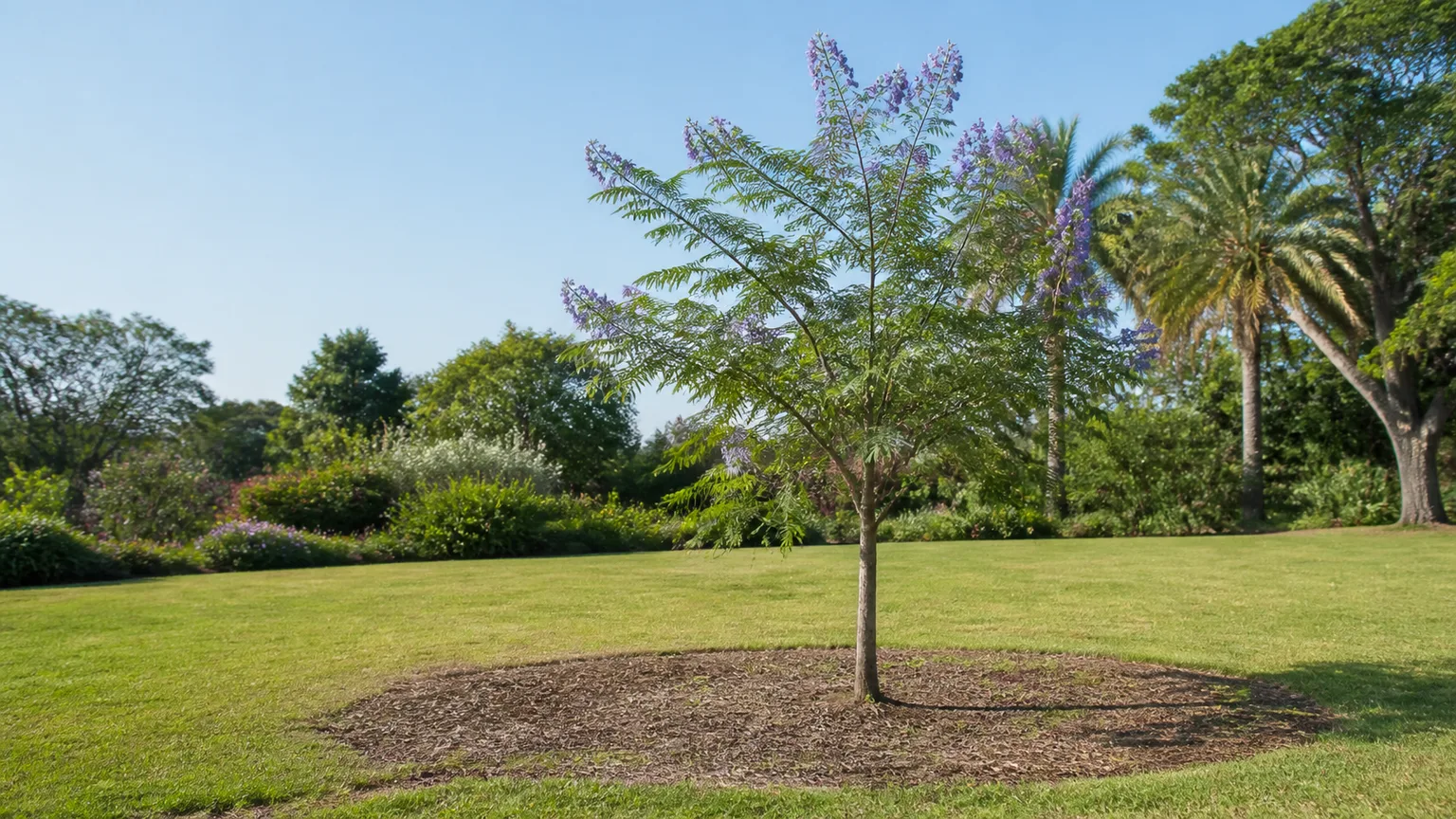
Jacaranda (Jacaranda mimosifolia) gives frost-free and mild-winter landscapes an exceptional purple-blue flower show in late spring or early summer. It tolerates hot sun and dry conditions after establishment, and its fine, fernlike leaves create a wide, light canopy. The tree is most reliable in warm coastal or subtropical areas; cold snaps can damage it, so check the local winter range before planting. A hot inland site with dry, fast-draining soil suits it better than a persistently wet corner.
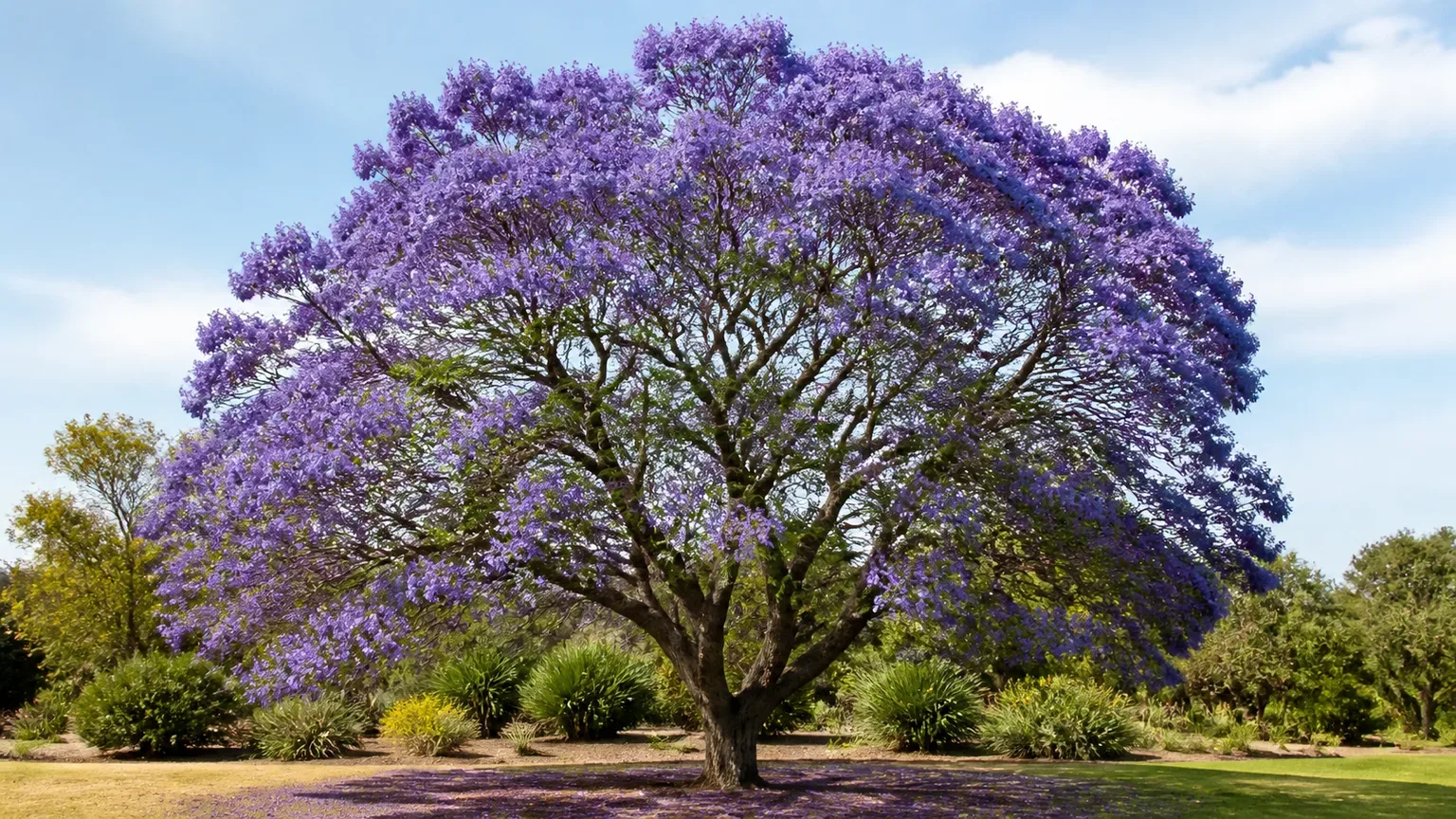
Petals and woody seed capsules drop, so avoid placing a jacaranda above a pool or a spotless paved entry. It needs room to spread and can take time to reach a useful shade size. Water the root ball while the tree establishes even if the mature landscape receives little irrigation. An open planting site keeps the spreading canopy away from paving and gives roots more soil to explore.
Olive
Olive (Olea europaea) is an evergreen option for hot, dry regions with long sunny seasons and mild winters. Its gray-green leaves and sculptural trunk suit Mediterranean-style gardens, while established trees handle drought better than many leafy shade trees. It is not a fast way to cool a large lawn: most olives create moderate, dappled shade, and fruiting forms drop olives that can stain paving. Avoid wet, poorly drained soil and protect a young tree from cold beyond its cultivar’s tolerance.
For a cleaner ornamental, ask for a fruitless cultivar, but verify that the selection is legal and recommended locally. Some olives can naturalize or become invasive in warm-winter regions, so a nursery’s “low maintenance” label is not enough. Epic Gardening’s olive guidance discusses both the tree’s drought tolerance and invasive potential in warm regions. Give it water while roots establish, then reduce irrigation according to rainfall and soil drying.
Conclusion
Heat tolerance is a starting point, not a complete planting plan. For a hot, humid yard, compare live oak, cedar elm, magnolia, and catalpa by space and moisture; for an arid yard, look first at desert willow, palo verde, mesquite, Arizona cypress, or olive. For a cold-winter city with hot pavement, consider locally recommended hackberry, honeylocust, ginkgo, or bur oak and make sure roots have enough open soil.
Before you buy, confirm winter hardiness, mature size, drainage, and regional invasive status with a county extension service or municipal tree list. Plant during a locally suitable mild season, mulch broadly without piling it against the trunk, and keep the root ball from drying through establishment. A correctly matched young tree needs years to make useful shade; a poorly matched mature tree can never be fixed by more pruning.