How to Grow and Care for White Spruce Trees in a Yard
Compare full-size white spruce with dwarf Alberta spruce, then learn when to plant, how to water new roots, and what to do about winter burn and mites.
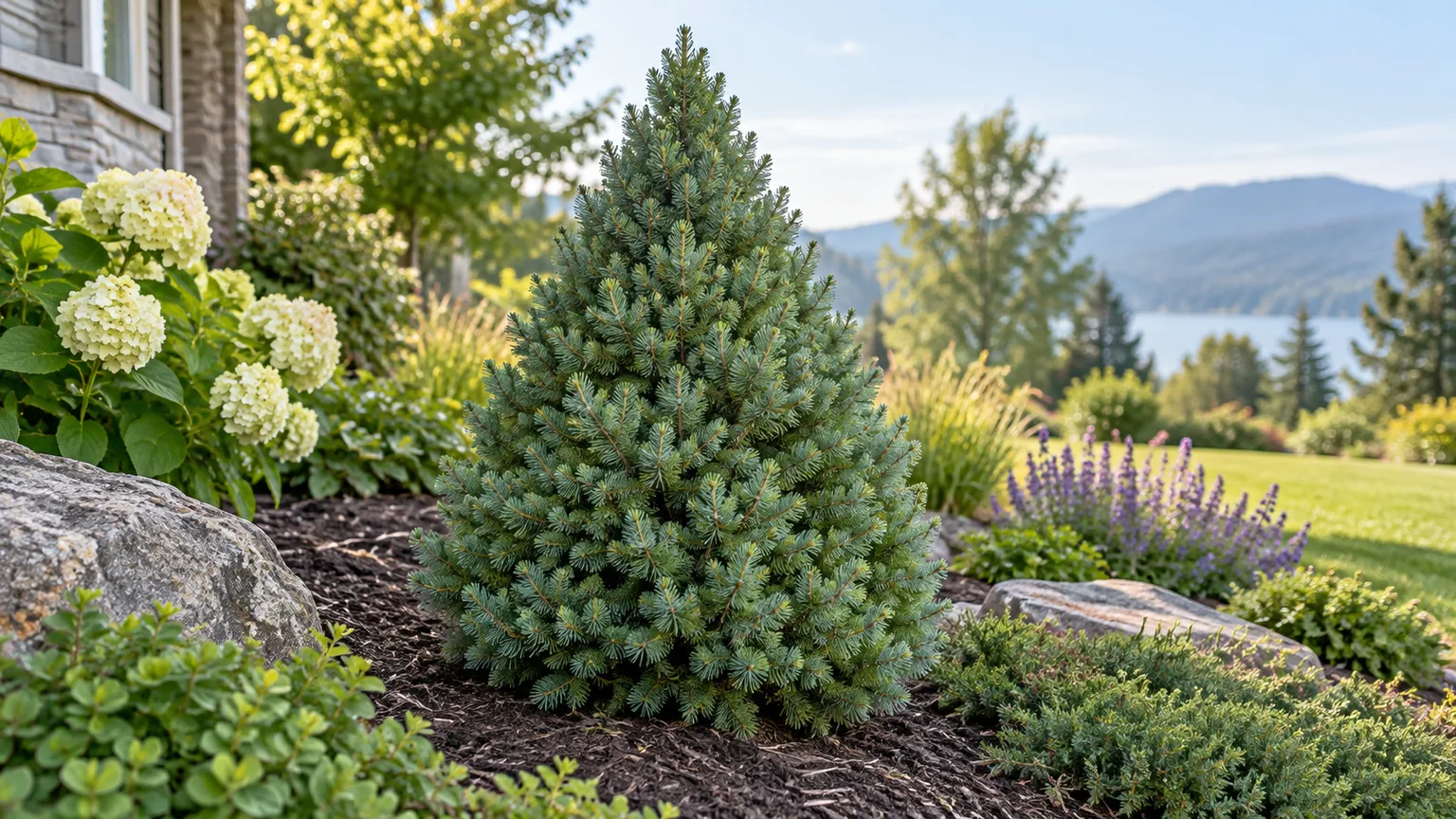
White spruce (Picea glauca) is a long-lived evergreen for places with cold winters and summers that stay relatively cool. The full-size species becomes a substantial landscape tree; the familiar dwarf Alberta spruce is a compact cultivar of the same species, not a miniature that can tolerate every climate. Choosing the right form and planting site matters more than adding fertilizer or pruning for shape.
| White spruce at a glance | Typical guidance |
|---|---|
| Mature size of the species | About 40–60 feet tall and 10–20 feet wide; cultivars differ |
| Climate | Commonly listed for USDA Zones 2–6; summer heat and humidity still matter |
| Light | Full sun for dense growth; light partial shade is tolerated |
| Soil | Moist but well drained; avoid standing water |
| Water | Consistent moisture while establishing, then deep irrigation during prolonged dry weather |
| Maintenance | Usually low; prune only for dead, damaged, or hazardous branches |
The numbers describe the species in a landscape, not every cultivar or every site. North Carolina State Extension lists the white spruce under the synonym Picea laxa and gives a mature range of 40–60 feet by 10–20 feet, while the University of Minnesota UFOR tree profile notes that trees can grow taller in suitable conditions. Treat nursery labels as a starting point, then plan for the cultivar’s eventual dimensions.
Is white spruce a good fit for your climate and yard?
White spruce is native to northern North America and is adapted to cold winters. Its hardiness range is often given as Zones 2 through 6, but a zone number mainly describes average annual extreme winter lows. It does not tell you whether summers are cool enough, whether humid nights keep dense foliage wet, or whether reflected heat from pavement will stress a young tree. North Carolina State Extension’s profile describes the species as suited to cool climates and cautions against hot, humid summers.
If your region has hot summers, long stretches of humidity, or a sunny planting strip beside pavement, do not assume a cold-hardy label solves the problem. A sheltered spot with afternoon shade may help a small cultivar through heat, but it cannot turn a persistently hot site into a good match for a full-size boreal tree. Where summers are regularly hot, choose a locally recommended evergreen better adapted to your climate rather than hoping frequent watering will compensate.
White spruce is a strong fit where the tree has room to become large, winters are cold, and the soil drains after rain. It can work as a specimen, screen, or windbreak, but its eventual canopy and branch spread must fit the property. Avoid planting where road salt, de-icing spray, or strong reflected heat repeatedly reaches the foliage; white spruce can struggle in polluted or salty sites.
White spruce, Alberta spruce, and popular cultivars
“Alberta spruce” usually refers to dwarf Alberta spruce, Picea glauca ‘Conica.’ It is a naturally occurring, slow-growing form of white spruce discovered in Alberta, and its compact conical habit makes it useful in a smaller bed or large container. It does not stay tiny forever: North Carolina State Extension estimates that a 10-year-old plant may be around 3 to 4 feet tall, with mature specimens reaching roughly 10 to 13 feet tall and 7 to 10 feet wide over several decades. Epic Gardening’s cultivar guide also emphasizes that this dwarf form still prefers cool outdoor conditions.
Other selections may have a weeping, bun-shaped, narrow, blue-toned, or variegated habit. Names such as ‘Pendula,’ ‘Echiniformis,’ ‘Jean’s Dilly,’ and ‘Rainbow’s End’ describe different forms; they do not share one mature size or growth rate. The plant tag should include the cultivar name in single quotation marks. If it lists only “spruce” or “Alberta,” ask the nursery for the botanical name and expected dimensions before buying.
Choose a form by its mature footprint
Choose the full-size species when you have room for a tall tree and want year-round screening or wind protection. Choose a dwarf or prostrate cultivar for a focal point, rock garden, or smaller bed, but check how wide it becomes as well as how tall. A small plant in a nursery pot is not evidence that the mature plant will stay within a narrow foundation bed.
Pick a site with room, sun, and airflow
Give the full-size species a sunny site with enough open ground for its mature spread and nearby access for maintenance. Measure from the trunk position, not the edge of the nursery pot. Keep branches clear of buildings, walks, and overhead wires as the tree grows; where utilities or a tight property line limit the canopy, select a smaller tree instead. White spruce can tolerate some partial shade, but a shaded or crowded site usually produces less dense growth and dries slowly after rain.
Air movement is especially valuable around dense cultivars. A tight, evergreen canopy that stays damp in a crowded corner can be more susceptible to mites and fungal problems. Leave enough space between trees for mature branches, not just enough room to fit the root balls on planting day. The white spruce’s native range stretches across northern parts of the United States and Canada, where it occupies varied forest settings; the U.S. Forest Service’s species review offers useful background on that ecological range.
Plant white spruce without burying its roots
Plant in spring or early fall when the ground is workable and temperatures are moderate. Avoid planting a stressed root ball immediately before hot, dry weather or a hard freeze. If a tree arrives container-grown, keep the root ball evenly moist until planting and do not let it sit in standing water. For a balled-and-burlapped tree, follow the nursery’s handling instructions and avoid lifting it by the trunk.
A short planting sequence
- Find the root flare—the point where the trunk widens into the first structural roots. Remove excess soil from the top of the root ball if the flare is buried in the pot.
- Dig a hole two to three times as wide as the root ball but no deeper than its measured depth. A wide hole gives new roots loose soil to enter without settling the trunk too low.
- Set the tree upright with the root flare at or slightly above finished grade. If roots circle tightly around the ball, loosen them or make a few shallow vertical cuts through the outer mat; do not leave a girdling loop against the trunk.
- Backfill with the excavated soil. Do not create a rich compost pocket that the roots may avoid crossing, and do not add fertilizer to the planting hole.
- Water slowly to settle soil around the roots. Apply a 2- to 3-inch layer of organic mulch over the root zone, keeping it several inches away from the trunk.
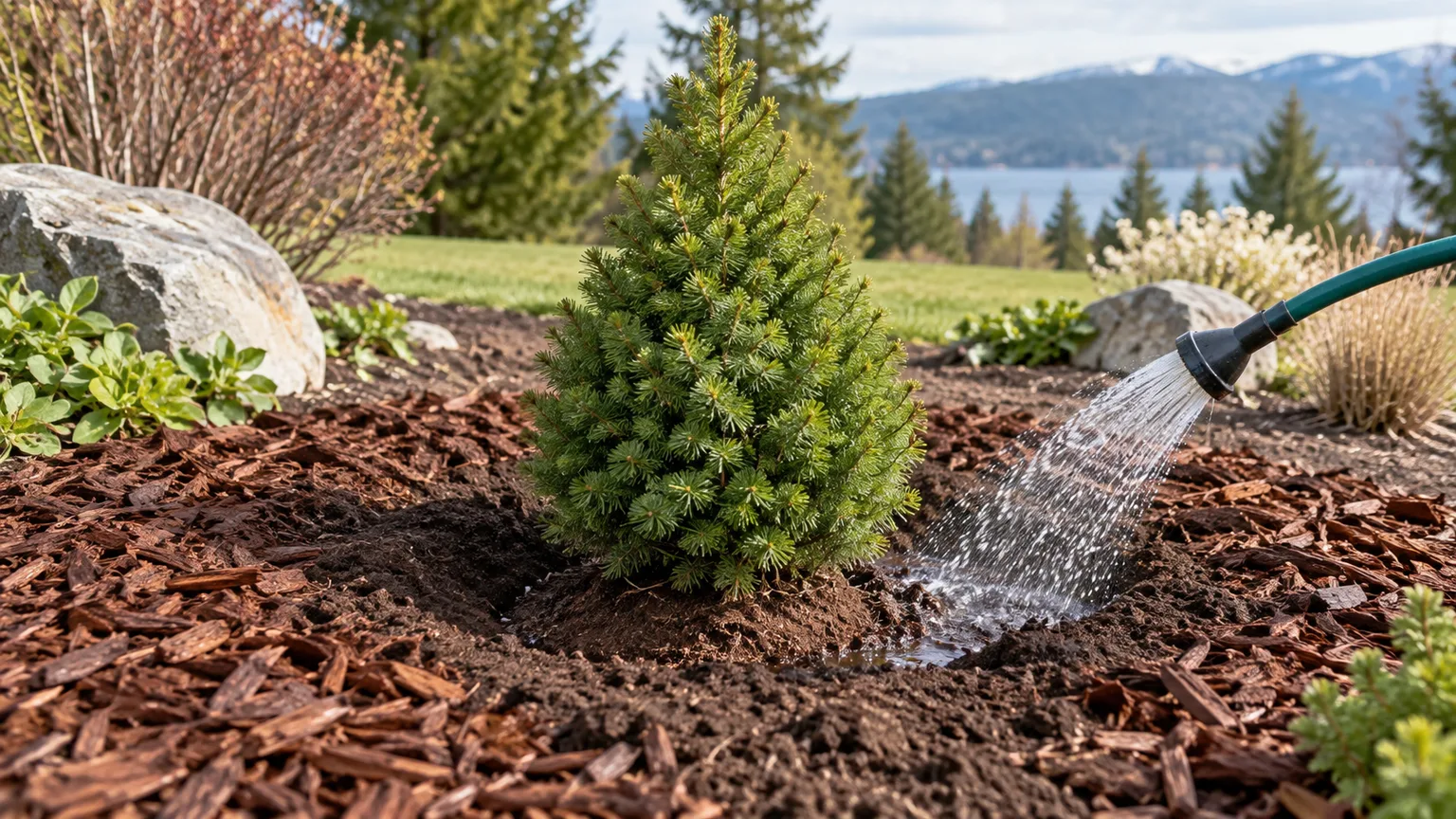
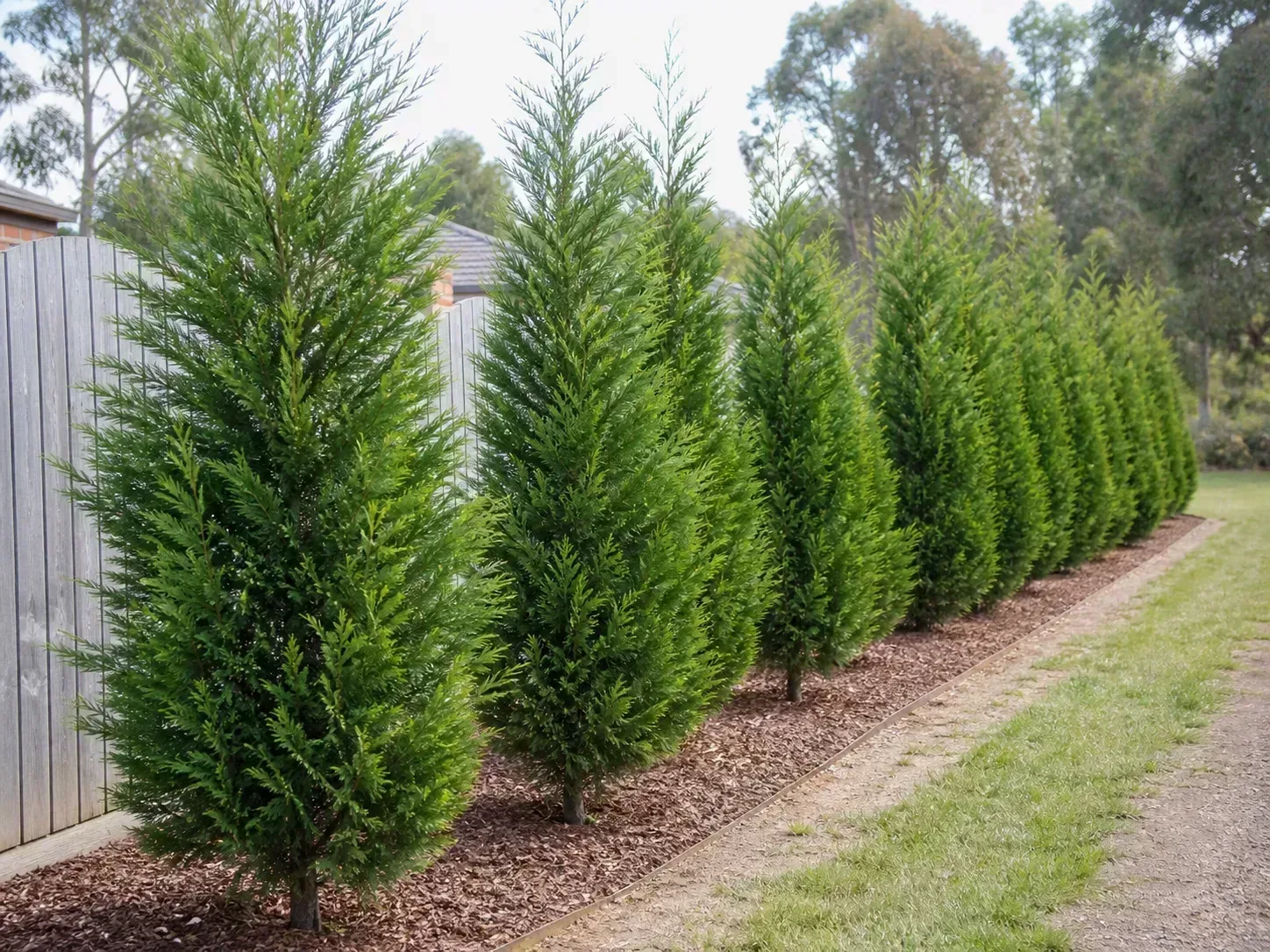
This compact cultivar illustrates planting depth and watering at the root zone; a full-size white spruce needs far more room as it matures.
The root flare is a better depth reference than the potting mix line, which may be several inches too high. If you discover after planting that the flare is buried, correct the grade while the tree is young rather than piling more soil or mulch around the trunk. Epic Gardening’s planting directions for dwarf Alberta spruce likewise emphasize the root flare and a hole wider than the root ball.
Light and soil that keep growth healthy
Full sun encourages dense, even branching. White spruce tolerates partial shade, particularly in cooler regions, but a tree that receives only a few hours of direct light may grow more loosely. For dwarf forms, shade can soften some afternoon stress in a warm location, but low light does not remove the need for cool summers or good air circulation.
The soil should hold enough moisture to support roots yet drain rather than remain saturated. White spruce can grow in different soil textures, including loam and some clay, if water does not stand around the root zone. In compacted ground, raised planting or a different species may be a better fix than repeatedly amending the hole. Do not add lime or sulfur by habit; test the soil first if pH is a concern.
Water deeply while roots establish
For the first growing season or two, check soil moisture around the root ball regularly, especially during dry or windy weather. Newly planted trees can dry out even when nearby lawn looks green because much of the root system is still confined to the original ball. Push a finger or narrow trowel a few inches into the soil near the ball: if it is dry at root depth and rain has not soaked the area, water slowly until the root zone is moist. If soil is still wet or sticky, wait and check drainage before watering again.
Once established, white spruce usually needs supplemental water only during a prolonged dry spell. Apply water slowly to the soil beneath the canopy rather than spraying the needles, and avoid frequent shallow sprinkling that wets the surface but misses deeper roots. A soaker hose or a slowly flowing hose placed around the root zone can help a new tree receive a thorough drink without runoff.
In hot weather, check the soil before increasing the watering schedule. Browning in a hot site can reflect heat stress, root restriction, salt exposure, or disease—not just thirst. Saturating poorly drained soil can make decline worse by depriving roots of oxygen. Before the ground freezes, water deeply if autumn has been unusually dry; do not keep watering frozen soil.
Mulch and fertilizer: what helps and what does not
Mulch moderates soil temperature, slows moisture loss, and reduces competition from turf. Spread a shallow, even layer over as much of the root zone as practical, then keep it away from the trunk so bark stays dry. Avoid a tall mulch “volcano”: it hides the root flare and holds moisture against the trunk, which can invite decay.
Do not automatically feed white spruce every spring. If the tree is growing normally and the surrounding soil supports healthy plants, fertilizer is usually unnecessary. Yellowing or slow growth alone does not prove a nutrient shortage; poor drainage, buried roots, heat, drought, and pests can look similar. Use a soil test or local extension diagnosis before adding nutrients, and avoid late-season high-nitrogen feeding that may push tender growth before winter.
Prune lightly, and never top the tree
White spruce generally needs little pruning. Remove dead, broken, rubbing, or clearly hazardous branches, and make cuts just outside the branch collar rather than flush with the trunk. For a live branch, cut back to a healthy lateral that can take over as the growing tip. If a limb is large, overhead, or close to a structure or utility, hire a qualified arborist instead of working from a ladder or cutting into a heavy branch yourself.
Do not top the tree or shear the outer surface into a shape. Topping removes the main leader, leaves large wounds, and can create weak replacement shoots. Spruce branches also may not refill a section cut back into bare, old wood. If a dwarf cultivar has an unusually vigorous shoot that clearly reverts to larger species-like growth, remove that shoot back to its origin while it is small; this is different from routinely reshaping the entire plant.
Protect container plants and winter foliage
A full-size white spruce is not a practical permanent container tree: its root system and eventual crown need more room than a pot can provide. Compact cultivars such as ‘Conica’ can grow in a large container for a time, but the pot must drain freely and the root ball needs closer summer monitoring because containers dry faster than garden soil. Nature Hills’ dwarf Alberta spruce guide likewise treats the cultivar as a small-space and container option, while its size still increases over time.
Container roots are more exposed to temperature swings than roots in the ground. In cold climates, move a potted spruce to a sheltered outdoor location or protect the pot itself before severe freezes; do not keep it in a heated living room all winter. A dwarf spruce can decorate indoors briefly during the holidays, but it is an outdoor tree that needs a seasonal temperature cycle. Return it outside as soon as practical and avoid repeated warm-cold moves.
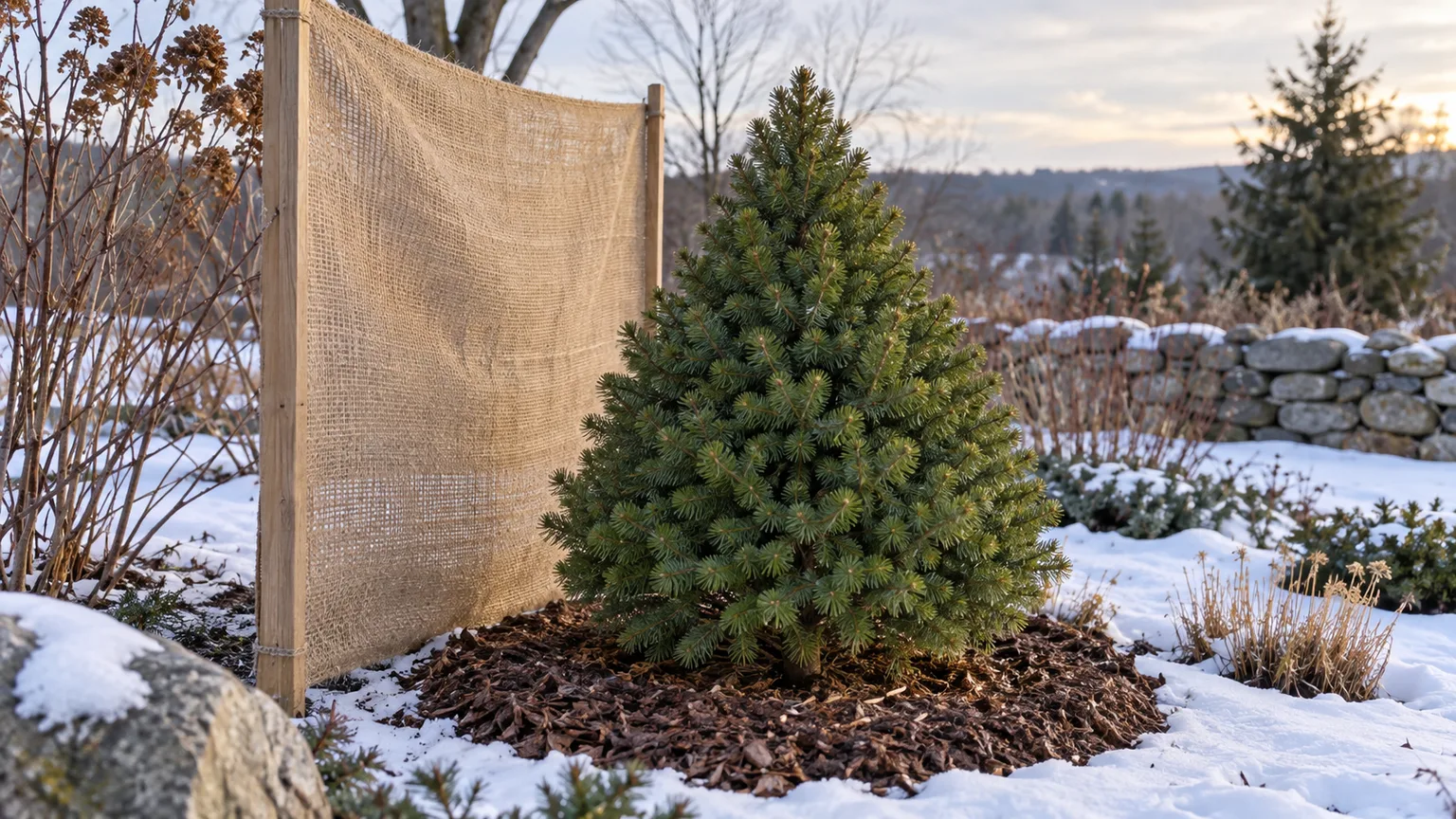
In-ground trees usually need no special winter covering. Newly planted trees may benefit from mulch over the root zone, and a burlap screen can reduce desiccating wind where exposure is severe. Keep the screen from pressing tightly against foliage. During winter, brown needles concentrated on the windward or road-facing side may signal drying wind or salt rather than a watering problem in the current season.
Propagate the species, not a named cultivar
White spruce can be grown from seed, but seedlings vary genetically and take time to become landscape trees. Collecting or sowing seed is useful when you want the species and are willing to wait; it will not reliably reproduce a named dwarf, blue, or weeping selection. Cultivars are generally maintained by vegetative propagation, such as cuttings or grafting, so their distinctive growth habit is preserved. North Carolina State Extension lists seed, cuttings, and grafting among propagation methods for white spruce, while its ‘Conica’ profile identifies that form as a cultivar.
For a home gardener, buying a correctly labeled cultivar from a reputable nursery is usually more dependable than attempting to root spruce cuttings. Rooting can be slow and inconsistent, and a cutting that survives may still need years of care before it becomes a substantial plant. If you want to experiment, start with healthy current-season material, clean tools, a sterile, free-draining medium, and several cuttings rather than relying on a single one. Keep the medium lightly moist, not waterlogged, and protect young rooted plants from both drying wind and hard freezes.
Diagnose browning before treating
Browning is a symptom, not a diagnosis. Before watering, spraying, or pruning, note where the color change starts, whether it affects old or new needles, whether one side of the tree is worse, and whether the soil is wet or dry. Take a photo from the same angle every week or two; a pattern that is spreading along branches tells you more than a single close-up.
Read the pattern across old needles and new growth
A modest loss of older needles inside the canopy can be normal. Evergreen trees retain foliage for several seasons, not forever, and the oldest shaded needles are usually the first to yellow and drop. If branch tips and the newest flush remain green and vigorous, avoid treating normal inner shedding as disease.
If the root ball is dry, the whole tree or exposed tips may fade after a dry spell. If the soil remains saturated, roots can be injured and the tree may look wilted despite wet ground. Browning mostly on the windward or road-facing side points toward winter drying or salt injury; a pattern that begins on lower branches and gradually advances upward deserves closer inspection for needle disease or canker. Heat stress can make any of these problems harder to recover from.
Pests and diseases that can weaken spruce
Check the inner and lower branches for fine webbing, stippled or bronzed needles, and tiny moving dots. Spider mites are easier to confirm by tapping a branch over white paper and looking for specks that move. They often become more troublesome in hot, dry conditions and on dense cultivars with poor airflow. The North Carolina State Extension profile notes that repeated mite infestations can seriously damage dwarf Alberta spruce. A close look is more useful than treating every brown needle as mites.
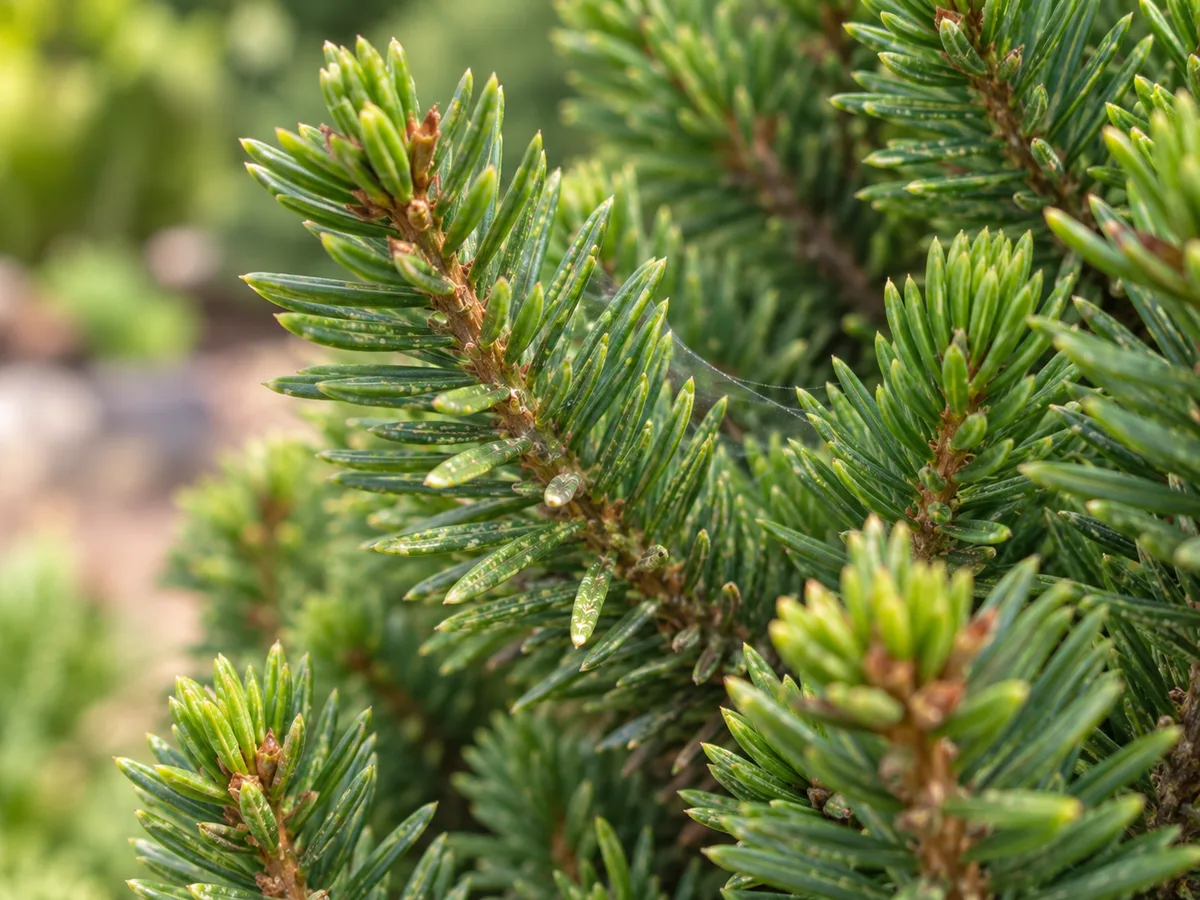
Needle cast and other fungal problems can cause older needles to discolor and drop, often in a pattern that advances along branches. Cytospora canker may kill individual lower branches; resin on the branch or trunk can be a clue, but resin alone does not establish the diagnosis. Root rot is more likely where soil stays saturated and the tree shows broad decline. Remove dead wood only after checking whether damage is confined to one branch or progressing through the crown.
The response depends on the cause. Restore even soil moisture and drainage where roots are stressed, clear fallen diseased needles when practical, and improve spacing if a dense planting stays wet. Do not spray a fungicide or insecticide just because the tree is brown; products differ by pest, timing, and site, and some symptoms need confirmation from an arborist or local extension service. For large trees, recurring dieback, or damage near buildings, get an on-site diagnosis before cutting or treating.
Conclusion
White spruce is easiest to grow when its climate and mature scale match the site. Start by deciding whether you have room and cool enough summers for the full-size species, or whether a named dwarf cultivar is a better fit. Then plant at the root flare, keep the root zone moist but not waterlogged while it establishes, mulch without touching the trunk, and let the natural shape develop.
When needles brown, look for a pattern before changing the care routine. Dry soil, winter wind, salt, spider mites, fungal disease, and normal inner-needle shedding require different responses. A few careful checks—and the willingness to choose another tree when the site is too hot, crowded, or wet—will do more for a healthy white spruce than routine fertilizer or aggressive pruning.