Weeds With White Flowers: 10 Types to Identify and Treat
White flowers do not always mean a harmless weed. Identify 10 types, spot toxic lookalikes and choose removal that will not spread roots or seed.
A white bloom can belong to a welcome wildflower, a lawn volunteer, or a persistent invasive plant. Flower color alone does not tell you which one you have—or whether it should be removed. Look at the whole plant: leaves, stem, growth pattern, and, when safe and practical, the roots or seed heads. This guide compares ten common plants with white flowers and explains a first response for each.
If a plant is unfamiliar, do not touch or pull it until you have checked its identity. Pokeweed and jimsonweed are poisonous, and poison hemlock can be confused with wild carrot. Use a regional field guide, county extension service, or other qualified local source if identification is uncertain. The safest removal plan starts with knowing what is growing and whether it is actually a problem in that spot.
Decide whether the plant is a weed before you pull it
A weed is simply a plant growing where it is unwanted. A white clover patch may be acceptable in a low-input lawn, and a native violet can be valuable habitat; the same plants may be unwelcome in a formal bed. Consider the plant’s location, spread, effect on nearby plants, and local conservation guidance before removing it. If an invasive plant is present, check regional rules: some jurisdictions restrict its sale, transport, or disposal.
Timing matters. For annual weeds, pulling or hoeing before seed matures can prevent a new crop. For a perennial that stores energy in deep roots or creeping stems, cutting off flowers may reduce seed but will not remove the underground plant. Knotweed, goutweed, and bindweed need a longer plan, and careless digging can leave pieces that regrow. Choose the smallest effective intervention and revisit the site rather than expecting one pass to solve every problem.
Quick ID: use more than the flower
Start with the flower’s shape, then compare the leaves and growth habit. A flat cluster of many tiny flowers, a round clover head, and five-petaled violet blooms all look white at a distance but belong to very different plants. Note whether stems creep, climb, or stand upright, and whether leaves grow opposite, alternate, in a basal rosette, or in threes. RHS identification guidance likewise recommends combining flower, leaf, and growth-form clues when identifying common weeds.
| Plant | Flower and leaf clue | Growth or root clue | Useful first response |
|---|---|---|---|
| Japanese knotweed | Small cream-white flowers in sprays; broad leaves with a flat base | Tall cane-like stems; spreading rhizomes | Avoid fragmenting it; get local invasive-plant guidance |
| Narrowleaf plantain | Short spikes of tiny pale flowers; long ribbed leaves | Low basal rosette; fibrous roots | Remove young plants with the crown before seed forms |
| Common pokeweed | Drooping white-green flower racemes; large leaves | Thick reddish stems and deep perennial root | Keep children and pets away; use gloves and local advice |
| Queen Anne’s lace | Flat, lacy white umbels; finely divided leaves | Upright carrot-family plant; often a taproot | Confirm carefully against poison hemlock before handling |
| White wild violet | Five-petaled flowers; heart-shaped leaves | Low clumps, often spreading by rhizomes or seed | Keep if wanted; remove clumps with roots if contained |
| White clover | Rounded heads of small flowers; three leaflets, often marked | Creeping runners root at nodes | Hand-pull small patches or mow before seed |
| Common chickweed | Tiny star-like flowers with five deeply divided petals | Low mat; shallow roots, sprawling stems | Pull or hoe before it sets seed |
| Field bindweed | Small funnel-shaped white or pinkish flowers; arrowhead leaves | Twining stems and persistent creeping roots | Repeatedly cut or remove shoots; avoid fragmenting roots |
| Goutweed | Flat clusters of small white flowers; divided leaves | Dense spreading underground rhizomes | Contain the patch and remove shoots repeatedly |
| Jimsonweed | Trumpet-shaped white flowers; irregularly toothed leaves | Upright annual with spiny seed capsules | Avoid contact; bag seed capsules and follow local disposal guidance |
This table is a screening aid, not a definitive botanical key. Plant size and bloom time vary with region and conditions, and similar species occur in many places. If the plant could be poisonous or regulated, confirm it with a local expert before you intervene.
Ten weeds with white flowers, identified and managed
Use the descriptions below to narrow down an identification and select a response. Several of these plants are perennial and difficult to eliminate; removal guidance here is a starting point, not a promise of eradication. A photograph of leaves, stems, flowers, and the whole growth habit can help an extension specialist make a safer identification.
Japanese knotweed
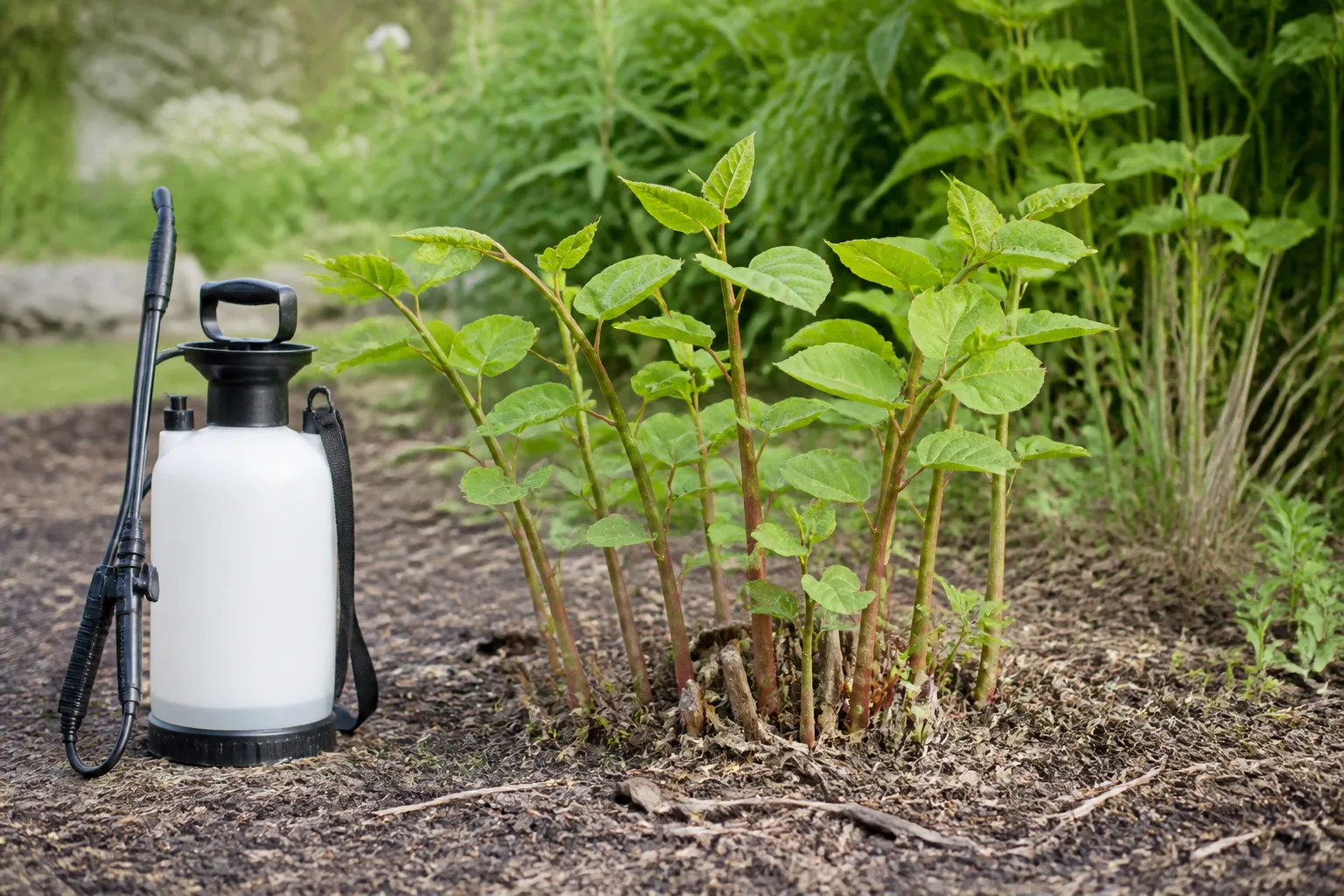
Japanese knotweed (Reynoutria japonica, also called Fallopia japonica) is a tall, vigorous perennial with jointed, hollow-looking canes, broad leaves with a flattened base, and clusters of small creamy flowers that usually appear in late summer. The leaves alternate along the stem. Young shoots can be reddish, while mature stands form dense thickets that shade other vegetation. The RHS notes the plant’s bamboo-like canes and heart-shaped leaves as helpful recognition features.
The main challenge is underground: knotweed spreads through extensive rhizomes, and small fragments can regenerate. Do not rototill, chip, or casually move soil from an infested patch; those actions can distribute viable pieces. Penn State Extension explains why cutting alone is not a reliable eradication method. If the stand is established, contact your county extension or local invasive-species program for an approach suited to your area. Any herbicide use must follow the product label and local rules; treatment timing and follow-up matter, and a single application should not be assumed to finish the job.
Narrowleaf plantain
Narrowleaf plantain (Plantago lanceolata) grows as a ground-hugging rosette of narrow, lance-shaped leaves. Several strong ribs run lengthwise through each leaf. From the center rise leafless stalks topped by short, dense spikes of tiny flowers; pale stamens may make the spike look whitish from close up. Its low rosette and narrow leaves distinguish it from broadleaf plantain, which has wider, oval leaves.
This perennial often appears in lawns, paths, and compacted soil. A small plant can usually be lifted with a narrow weeding tool, but remove the crown as well as the leaves so it does not resprout. Work when the soil is damp enough for the root to release, and check for regrowth. In turf, maintaining a dense lawn and relieving compaction where appropriate can make bare spots less available to new seedlings. Avoid scalping the lawn in an attempt to eliminate it; that can thin desirable grass and open space for more weeds.
Common pokeweed
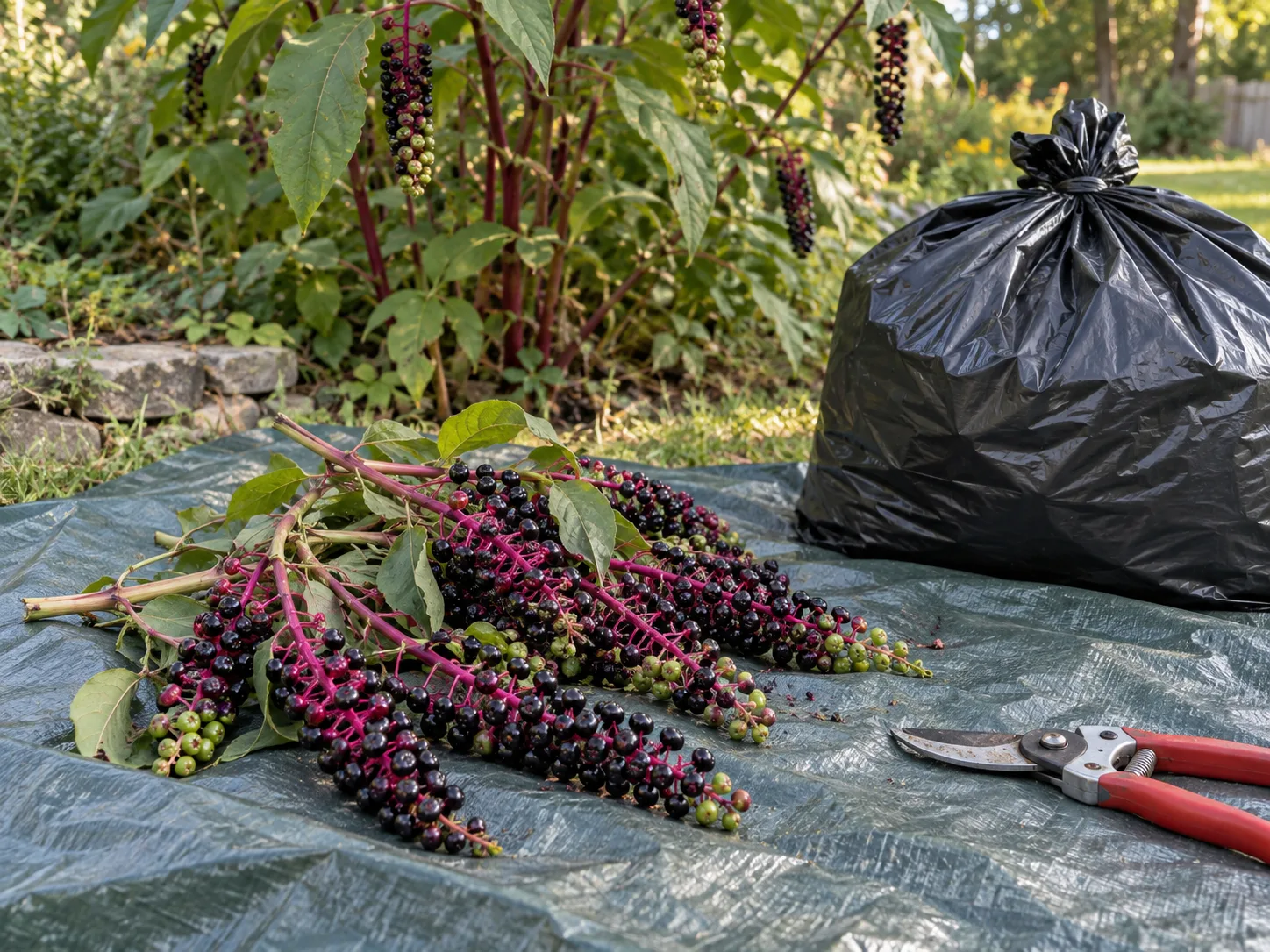
Common pokeweed (Phytolacca americana) is a large perennial that may reach several feet tall. It has broad, smooth-edged leaves, conspicuous reddish or purplish stems, and drooping clusters of small white to greenish flowers. Those flowers are followed by glossy dark-purple berries on hanging stalks. The red stems and berry clusters are especially useful clues, but do not use them as a reason to handle the plant.
Pokeweed is toxic if eaten, and extension sources caution that all parts can be poisonous. Keep children and pets away, wear gloves, and do not compost berries or roots where animals might reach them. Penn State Extension’s pokeweed guide recommends preventing fruit from spreading and notes the substantial root system; mature plants can regrow if only the top is cut. Purdue’s toxic-plant reference also identifies pokeweed as poisonous. If removal is appropriate, work carefully before berries ripen, contain all plant material, and seek local extension guidance for a large plant. Do not burn it, and follow local waste instructions.
Queen Anne’s lace or wild carrot
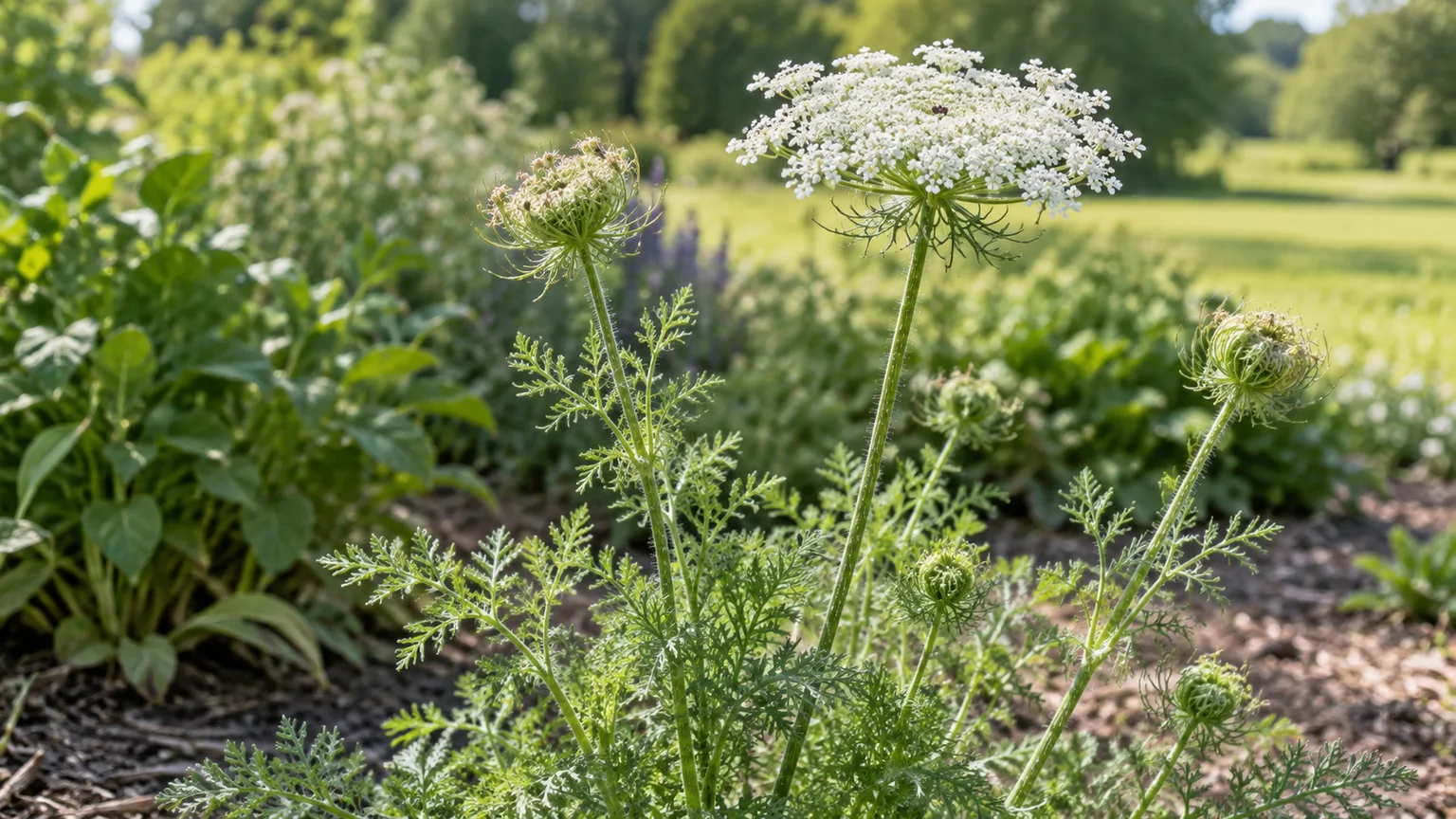
Queen Anne’s lace (Daucus carota) is a biennial in the carrot family. In its first year it forms a low rosette of finely divided, fernlike leaves. In the second year, a tall flowering stem bears a flat-topped umbel made of many small white flowers. The umbel often curls inward as seeds develop; a single dark-purple flower may occur near the center, but it is not always present. The plant commonly grows along roadsides and in sunny disturbed ground.
The crucial caution is its resemblance to poisonous relatives. Poison hemlock also has white umbrella-shaped flower clusters, but may have smooth, purple-blotched stems and finely divided leaves; features can vary, and field identification is not foolproof. Montana State Extension stresses the danger of poison hemlock and its lookalikes. Do not handle a carrot-family plant based on flower color alone. If removal is necessary, first get a confident local identification and wear protective gloves and clothing. Avoid touching sap to skin, and wash tools afterward. If unsure, photograph the plant and ask an extension service or invasive-plant coordinator rather than pulling it.
White wild violet
White wild violets (Viola species) are low-growing perennials with five-petaled flowers and rounded, heart-shaped leaves on long stalks. The flowers may have purple veins or markings, and the plant often forms small clumps in lawns, woodland edges, or moist garden beds. Species vary by region; some spread through seed, while others also form underground rhizomes or short runners.
Violets are not automatically harmful. They can provide early nectar and pollen and may be an attractive lawn alternative, so decide whether the patch is unwanted before controlling it. Where a clump is crowding a small ornamental, loosen the soil and lift the crown and rhizomes as completely as practical. In a lawn, repeated digging can leave bare soil and create new sites for seedlings; adjusting mowing height and maintaining healthy turf may be more appropriate. Check the area in following weeks for small shoots and remove them while young.
White clover
White clover (Trifolium repens) forms a low mat of creeping stems, each with three rounded leaflets. Many leaves have a pale crescent, though the marking is not always obvious. Rounded flower heads are made of many small florets that start white and can turn pinkish as they age. The stems root where they touch soil, which lets a patch spread sideways through a lawn or bed.
Some gardeners leave clover because it flowers for pollinators and tolerates close mowing; others remove it from a uniform lawn or planting bed. For a small patch, loosen the soil and pull or dig out the rooted runners. In turf, improve density with suitable mowing and care rather than relying on a single spray. Mowing before flowers mature can reduce seed, but it will not stop rooted runners. BHG’s weed guide notes clover’s three-part leaves and creeping habit, useful clues when distinguishing it from other low lawn plants.
Common chickweed
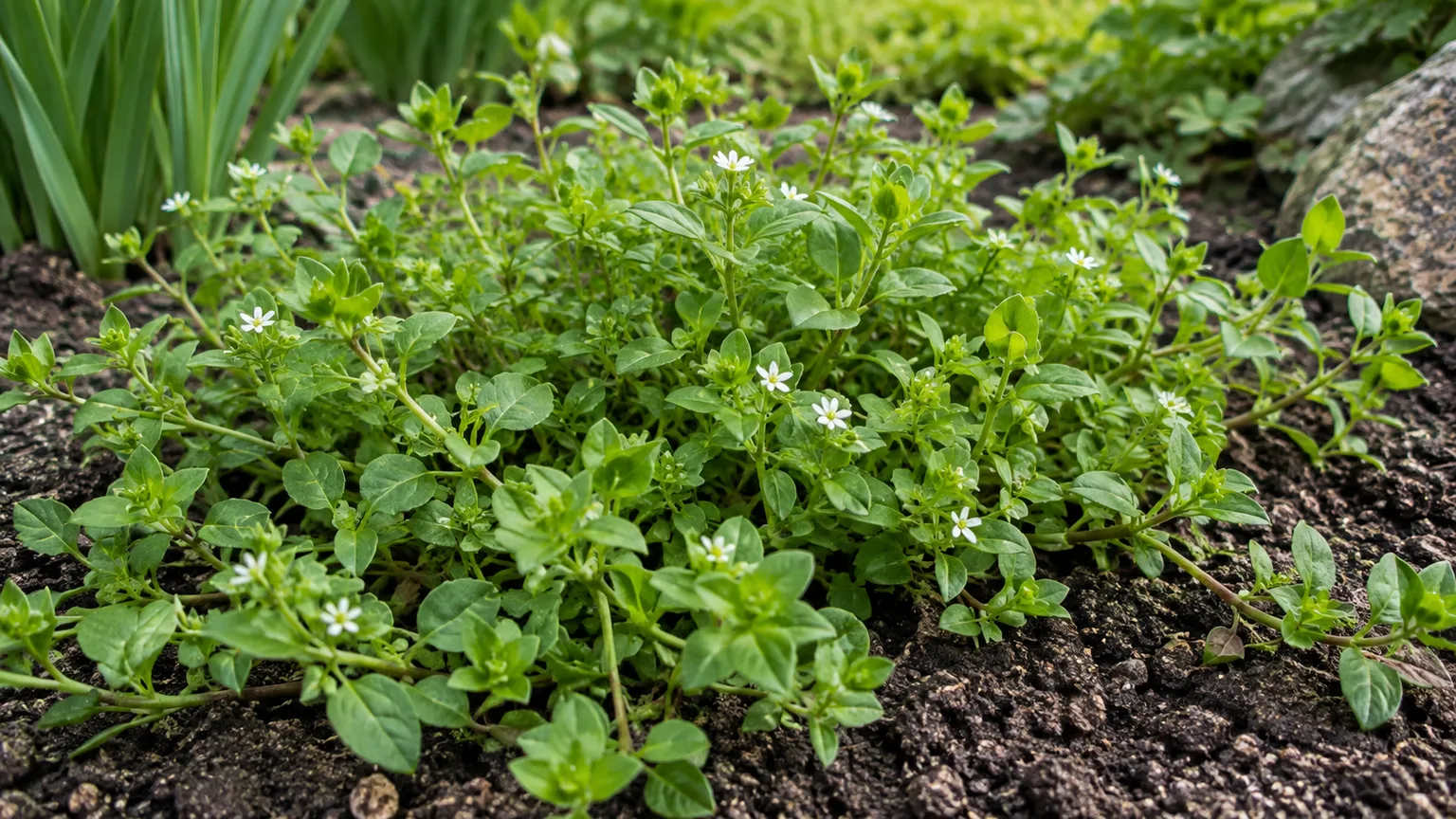
Common chickweed (Stellaria media) is a cool-season annual that often forms a soft, sprawling mat in damp, fertile soil. Its leaves are small and opposite, and its slender stems may have a line of fine hairs along one side. Each tiny white flower looks like it has ten petals, but it is actually five petals deeply divided into pairs. This close-up detail separates chickweed from several other small white-flowered weeds.
Pull young plants before they flower and set seed; shallow roots make them relatively easy to remove when soil is moist. A dense mat can root at stem nodes, so lift the plant rather than simply snapping off the visible top. Bag seed-bearing material if seeds are mature, and avoid leaving pulled plants on damp soil where they may continue growing. In garden beds, mulch and prompt removal of seedlings reduce open ground. In a lawn, avoid overwatering and improve drainage if the site stays persistently wet.
Field bindweed
Field bindweed (Convolvulus arvensis) is a persistent perennial vine with slender stems that twine around other plants or spread along the ground. Its leaves are alternate and arrowhead-shaped, and its funnel-shaped flowers are usually white, pink, or striped. The flowers are smaller than those of many ornamental morning glories. The scrape calls this plant “hedge bindweed,” but that name is more often used for a different, larger-flowered bindweed; C. arvensis is correctly called field bindweed.
The plant’s deep, spreading roots store energy and can resprout after the top is removed. Pull seedlings early, before the roots extend, and repeatedly cut established shoots to weaken the plant over time. Do not till an infested patch: cutting roots into pieces can spread it. Keep vines from wrapping through shrubs or perennials, where complete removal is harder. RHS describes bindweed as a twining weed with funnel-shaped flowers and advises persistent control; expect repeated visits rather than a one-time fix.
Goutweed or bishop’s weed
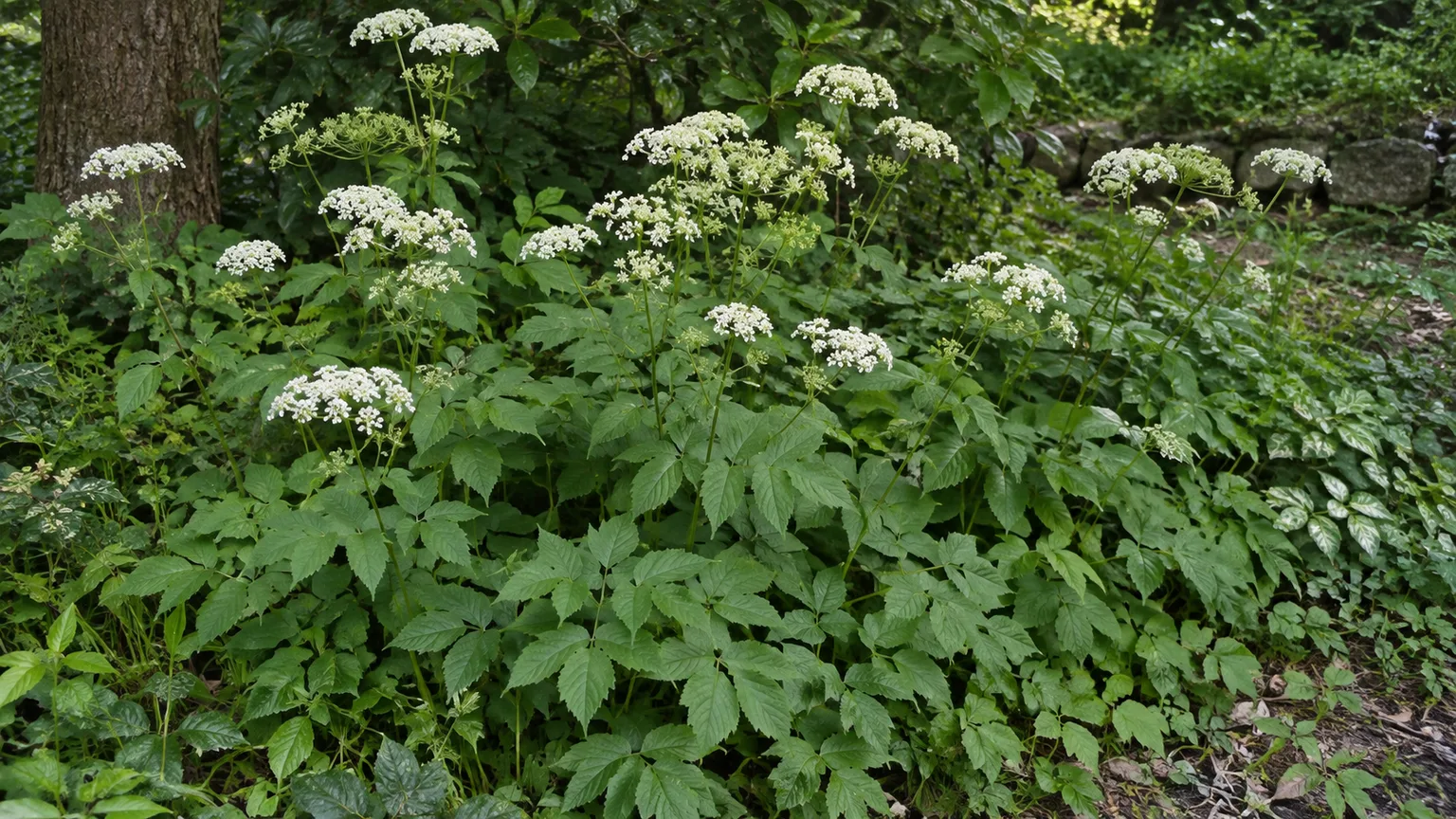
Goutweed (Aegopodium podagraria), also called bishop’s weed or ground elder, grows in dense colonies from creeping rhizomes. It has compound leaves divided into three groups of toothed leaflets and flat clusters of small white flowers. Variegated cultivars are sold as ornamentals, but green seedlings or reverted stems can spread beyond a border. Its vigorous underground growth is the main identification and management clue.
A small, isolated patch can be dug out if you remove the entire rhizome network, but even short fragments may regrow. Screen or carefully inspect excavated soil; do not move contaminated soil or put viable pieces in home compost. In a larger bed, repeatedly cut or smother the patch while protecting desirable plants, and check the edges for escape shoots. The RHS notes that ground elder spreads through underground stems and is difficult to eradicate. Plan for a sustained campaign and use local invasive-plant guidance where it is established.
Jimsonweed
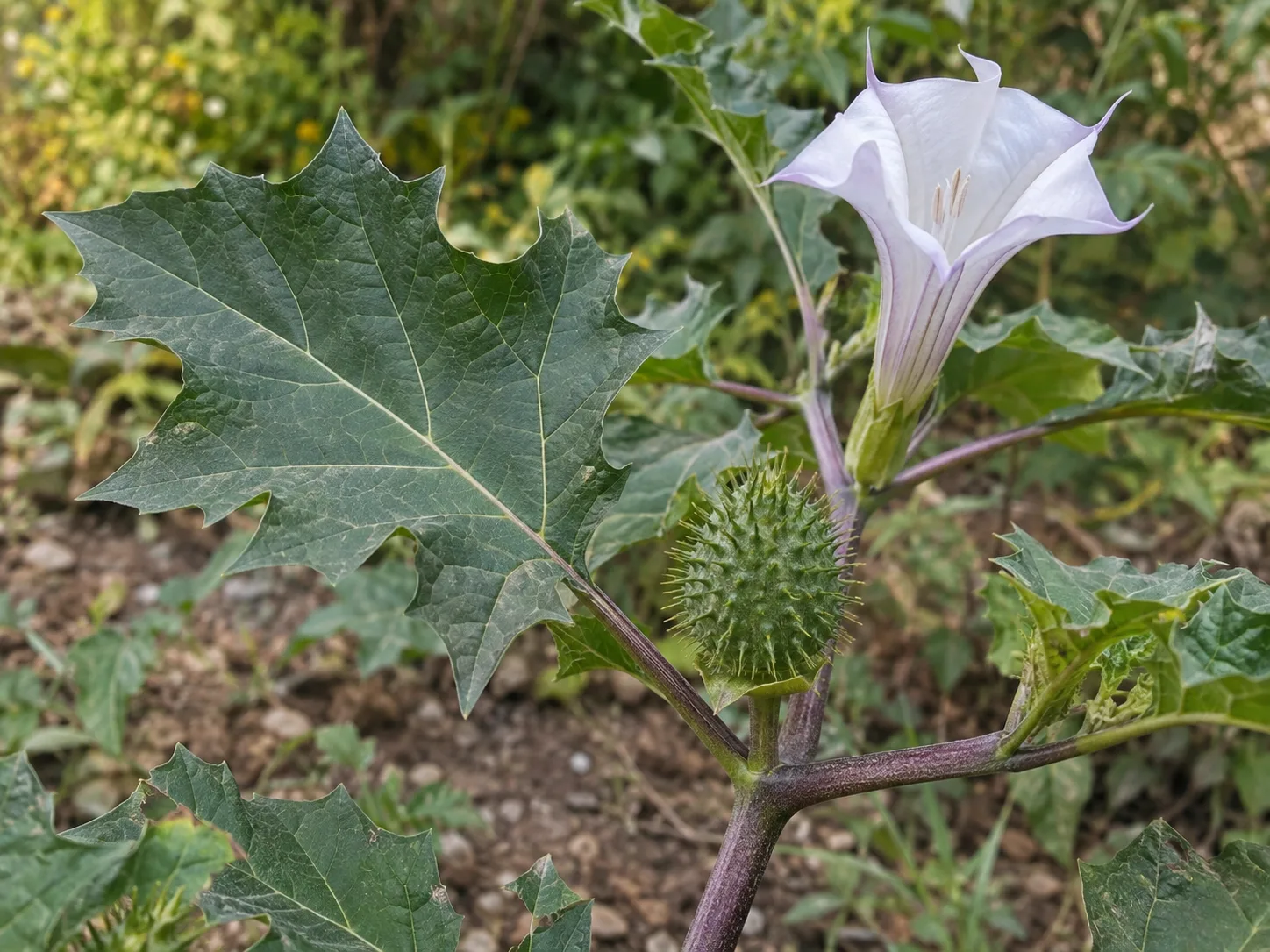
Jimsonweed (Datura stramonium), also called thorn apple, is an upright annual with large, irregularly toothed leaves and trumpet-shaped white or pale-purple flowers. The flowers open at night or in low light and may have a long, flared tube. Its round seed capsules are covered in spines and split open when mature. The combination of a large trumpet bloom and spiny fruit is more useful than leaf shape alone, which can be mistaken for other nightshade-family plants.
Jimsonweed is poisonous. Penn State Extension warns that all parts of the plant contain toxic compounds, so do not handle it casually, burn it, or allow children or animals to chew the leaves or pods. If it is growing where removal is needed, wear gloves and protective clothing, avoid shaking mature capsules, and bag the plant and pods securely. Follow municipal or extension advice for disposal. Pulling an annual before pods mature can prevent seeds, but a mature seed bank may produce seedlings for years, so monitor the site and remove new plants early.
Match removal to the root system
Once you have a likely identification, look at how the plant persists. Annuals live one growing season and reproduce mainly by seed. A taprooted biennial or perennial stores energy belowground. Creeping perennials send rhizomes or runners outward and can regenerate from pieces. This distinction explains why yanking the visible stem works for some seedlings but barely slows an established patch of bindweed or knotweed.
Annuals and taproots
For a young annual, pull or hoe before flowers set viable seed. Work when the soil is moist, grasp low on the stem, and remove the crown rather than just pinching off leaves. Chickweed and jimsonweed are examples where seed prevention is valuable; mature jimsonweed pods require extra care because they are toxic and can spill seeds. Bag or otherwise contain mature seed heads according to local waste guidance.
For a taproot, such as a mature wild carrot, loosening soil around the root can help lift it intact. But do not attempt this until the plant is positively identified and safe handling guidance is clear. Poison hemlock and other hazardous lookalikes make blind pulling an unnecessary risk. A rosette with a deep root may also break if yanked from dry soil, so use a suitable tool after identifying it. Recheck disturbed ground for seedlings and avoid leaving bare soil exposed.
Creeping roots and rhizomes
Bindweed, goutweed, and knotweed need persistence because underground roots or rhizomes can hold enough reserves to send up new shoots. Avoid rototilling or chopping them into fragments. For a small patch, careful excavation may work if every root segment can be collected; for a large patch or regulated invasive plant, ask a local extension or invasive-species program about containment and control. Repeatedly cutting shoots before they replenish their roots can weaken plants, but it generally takes multiple seasons and consistent follow-up.
White clover spreads by aboveground runners that root at nodes, while violets may spread in clumps, by rhizomes, and by seed. Lift the rooted sections where possible and check the margins for new growth. A hoe or mower can suppress shoots in turf, but frequent cutting alone may not eliminate established perennial weeds. Match the effort to the value of the area and decide whether suppression, containment, or complete removal is the realistic goal.
Remove plants safely and dispose of debris
Use gloves and a hand tool for ordinary weeds, and wash hands and tools afterward. For a plant that might be poisonous, invasive, or hard to identify, pause before handling. Do not taste plants to identify them. Keep children and pets away from pokeweed, jimsonweed, and suspected poison hemlock. Wear long sleeves and eye protection when work could flick sap or debris; bag hazardous or seed-bearing material instead of tossing it into a compost pile.
For knotweed and other regulated invasive plants, local disposal rules may prohibit placing stems or soil in ordinary green waste. Never transport soil or plant fragments from a suspected infestation until you know the local requirements. Do not burn unknown weeds; smoke and plant compounds may be harmful, and burning can violate local rules. If a pesticide is appropriate for a specific invasive perennial, select a product labeled for that site and plant, follow every label precaution, and consult local extension guidance. Avoid spraying near desirable plants, water, or pollinators unless the label explicitly permits that use.
Prevent another flush of seedlings
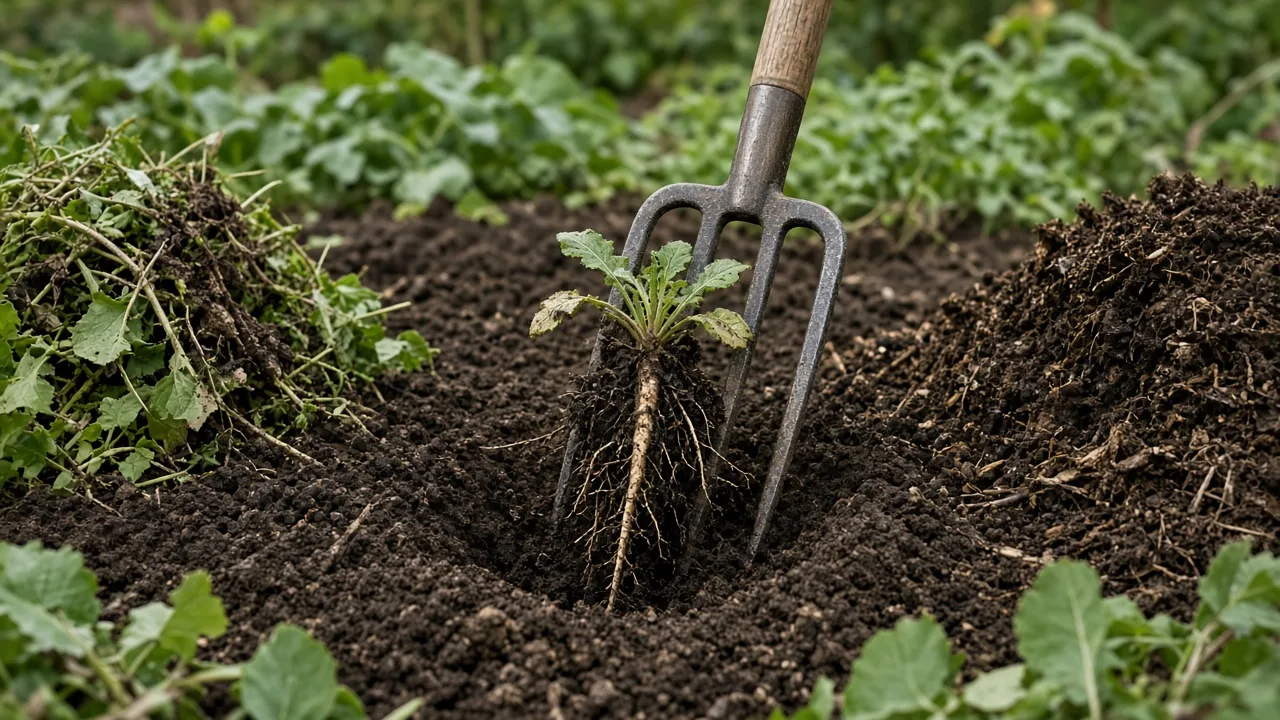
After removal, reduce the opportunities for weeds to return. Cover bare soil with an appropriate layer of mulch, plant beds densely enough to shade open ground, and repair thin lawn areas with grass suited to the site. Remove annual weeds before their seed heads mature, clean soil from tools and footwear after working in infested areas, and avoid moving contaminated soil or compost. These steps reduce new seedlings but do not erase a long-lived seed bank or underground perennial roots.
Water and fertilize desirable plants according to their needs rather than feeding weeds in open ground. A healthy, established planting competes better for light and space, but it will not outcompete knotweed or eliminate deep bindweed roots on its own. Inspect the patch every week or two during the growing season at first. Pull seedlings while they are small, clip perennial regrowth before it builds reserves, and note where shoots emerge so you can catch the edges. If a plant is subject to local invasive-plant rules, use the area’s recommended containment and disposal process.
Conclusion
The safest way to identify a weed with white flowers is to compare more than the bloom: check the leaf shape, stem, growth habit, and fruit or root clues. Then decide whether removal is needed and choose a method that fits its life cycle. Pull small annuals before they seed, contain creeping perennials without spreading fragments, and avoid handling poisonous or uncertain plants until they are identified. Follow up after the first removal; repeated checks are often what prevent a small patch from becoming a larger one.