Best Office Plants for Low Light and Busy Schedules
Compare 15 office plants by light, mature size, pot size, watering, growth habit, and pet safety before you buy one for your desk or cubicle.
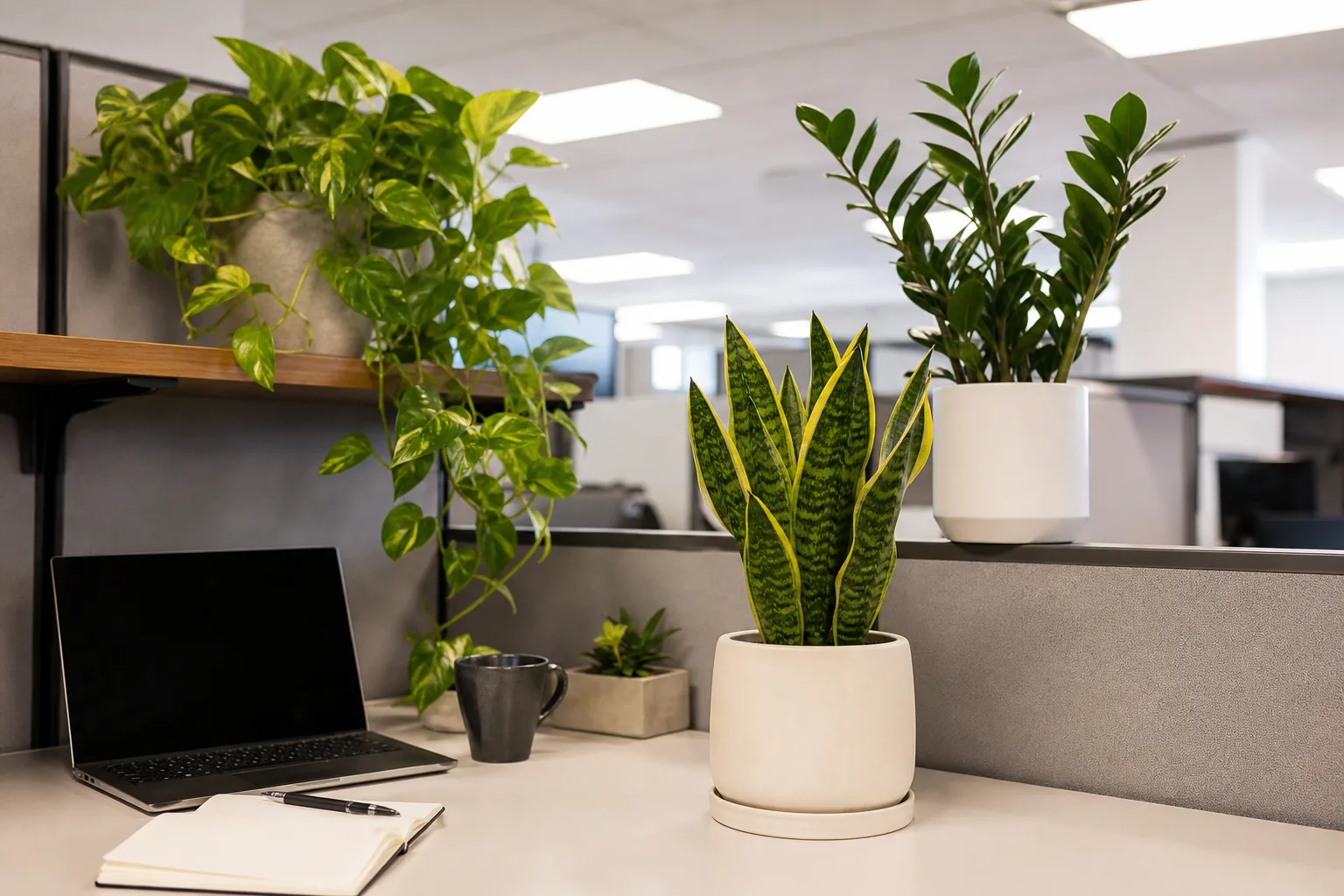
The best office plant is not the most exotic one or the plant with the boldest air-purifying claim. It is the plant that matches the light at your desk, the size of your workspace, and the number of times you will realistically remember to check the soil.
Most offices are dimmer than a bright home window, drier than a tropical greenhouse, and empty for two days every weekend. That combination favors tough foliage plants with forgiving roots. It also makes a fixed weekly watering schedule dangerous: a plant using water slowly can sit in wet soil for days.
Choose for the office you actually have
Start by looking at the plant’s final location, not the window in the building. A desk beside an east-facing window may support a compact aloe or jade plant. An interior cubicle may offer only ceiling LEDs. Low-light tolerance means a plant can survive with less light; it does not mean the plant will grow quickly, flower, or keep strong variegation there.
The University of Minnesota Extension indoor-light guidance treats light as a range rather than a label. If your plant casts a soft shadow for part of the day, you have more options than if it casts no shadow at all. In a genuinely windowless office, a suitable LED grow bulb on a timer is more reliable than ceiling lights alone; ceiling lights may keep a tolerant plant alive but may not provide enough usable light for steady new growth.
Low light changes watering more than most people expect
Light drives photosynthesis and water use. When light is low, the plant usually dries more slowly, so a plant that needs weekly watering in a sunny kitchen may need water every two to four weeks at an office desk. Feel the mix before watering and make sure the pot has a drainage hole.
How these 15 plants were selected
I selected these 15 plants for tolerance of low-to-moderate office light, slow water use, compact mature size, simple watering cues, and verified pet-safety status. Plants are ordered from most forgiving to most demanding of light and attention. Pet status is cited from the ASPCA toxic and non-toxic plant list; “non-toxic” does not mean a plant is food, and pets can still vomit or choke on plant material.
Quick comparison of all 15 office plants
| Plant | Best use | Mature size | Pot size | Light band | Water cue | Habit | Pet status |
|---|---|---|---|---|---|---|---|
| Snake plant | Forgetful owner | 12-36 in | 6-10 in | Low to bright indirect (50-500 fc) | Soil fully dry | Upright rosette | Toxic if chewed |
| ZZ plant | Very dim desk | 18-30 in | 6-8 in | Low to bright indirect (50-500 fc) | Nearly fully dry | Upright canes | Toxic if chewed |
| Pothos | Shelf or cabinet | Vines to 6-10 ft | 6-8 in | Low to bright indirect (50-500 fc) | Top half dries | Trailing vine | Toxic if chewed |
| Heartleaf philodendron | Soft trailing | Vines to 4-6 ft | 6-8 in | Low to medium indirect (75-300 fc) | Top inch dries | Trailing vine | Toxic if chewed |
| Chinese evergreen | Patterned foliage | 12-36 in | 8-10 in | Low to medium indirect (75-300 fc) | Top inch dries | Upright bush | Toxic if chewed |
| Peace lily | Visible wilt cue | 12-24 in | 8-10 in | Medium indirect (150-400 fc) | Top inch begins to dry | Upright clump | Toxic if chewed |
| Spider plant | Pet-conscious shelf | 12-18 in | 6-8 in | Medium indirect (150-400 fc) | Top inch dries | Arching rosette | Non-toxic |
| Parlor palm | Soft texture | 24-48 in | 8-10 in | Medium indirect (150-400 fc) | Evenly lightly moist | Upright palm | Non-toxic |
| Lucky bamboo | Small water vessel | 12-36 in | 3-6 in | Low to medium indirect (75-300 fc) | Roots submerged, water changed | Upright canes | Toxic if chewed |
| Dracaena | Floor corner | 24-72 in | 10-14 in | Medium indirect (150-400 fc) | Top 1-2 in dry | Upright cane | Toxic if chewed |
| Rubber plant | Bright private office | 36-96 in | 10-14 in | Medium to bright indirect (200-800 fc) | Top 1-2 in dry | Upright tree | Toxic if chewed |
| Money tree | Medium-bright office | 24-60 in | 8-12 in | Medium to bright indirect (200-600 fc) | Top inch dries | Upright trunk | Toxic if chewed |
| Peperomia | Crowded desk | 6-12 in | 4-6 in | Low to medium indirect (75-300 fc) | Top half dries | Compact mound | Non-toxic |
| African violet | Color under light | 6-8 in | 4-6 in | Medium indirect (200-500 fc) | Evenly lightly moist | Compact rosette | Non-toxic |
| Aloe vera | Sunny window | 12-24 in | 6-8 in | Bright indirect to direct (400-1000 fc) | Mix dries fully | Rosette succulent | Toxic if chewed |
15 office plants worth considering
1. Snake plant
Best for: Forgetful owners and dim cubicles Difficulty: Easy Light: Low to bright indirect (50-500 fc) Water: Soil fully dry Best placement: Floor corner or wide desk edge Pet safety: Toxic if chewed (ASPCA)
Snake plant (Dracaena trifasciata) is the strongest choice for low attention. Its upright leaves take little desk area and its thick tissues tolerate a long dry interval. Use a smaller bird’s-nest or dwarf form if the office floor plan cannot accommodate tall leaves.
Why it works: It tolerates dry air, irregular watering, and low light better than almost any foliage plant on this list.
Care tip: Water only when the pot is light and the mix is dry several inches down; a thorough soak followed by a long wait beats frequent sips.
Common mistake: Watering on a fixed weekly schedule in a dim office, which keeps the roots wet for days.
Avoid this plant if: You need a plant that grows quickly or you have pets that chew foliage.
Useful care guides:
- Snake Plant care guide
- Snake Plant watering guide
- Snake Plant light guide
- Snake Plant soil guide
- Snake Plant propagation guide
- Snake Plant problems guide
2. ZZ plant
Best for: Very dim desks Difficulty: Easy Light: Low to bright indirect (50-500 fc) Water: Nearly fully dry Best placement: Interior cubicle or shelf Pet safety: Toxic if chewed (ASPCA)
ZZ plant (Zamioculcas zamiifolia) handles dim light and dry air because its underground rhizomes store water. It is slow in a cubicle, which is often an advantage. Water only after the mix is dry several inches down.
Why it works: The rhizomes buffer missed waterings, and the plant stays presentable in low light.
Care tip: Use a pot with a drainage hole; the rhizomes rot if the mix stays saturated.
Common mistake: Leaving a decorative cachepot full of runoff after watering.
Avoid this plant if: You want fast growth or a plant that tolerates cold drafts.
Useful care guides:
- ZZ Plant care guide
- ZZ Plant watering guide
- ZZ Plant light guide
- ZZ Plant soil guide
- ZZ Plant propagation guide
- ZZ Plant problems guide
3. Pothos
Best for: Shelves and cabinets Difficulty: Easy Light: Low to bright indirect (50-500 fc) Water: Top half dries Best placement: High shelf or cabinet top Pet safety: Toxic if chewed (ASPCA)
Pothos (Epipremnum aureum) is the easy trailing choice. Solid green forms generally hold their color better in dim light than heavily variegated forms. Put it on a shelf rather than across a keyboard, and trim vines before they become a trip or snag hazard.
Why it works: It trails attractively, tolerates low light, and recovers well from a missed watering.
Care tip: Let the top half of the mix dry before watering; yellowing lower leaves often mean overwatering.
Common mistake: Buying a heavily variegated form for a dim cubicle, then watching the color fade.
Avoid this plant if: Pets or children can reach the vines.
Useful care guides:
- Pothos care guide
- Pothos watering guide
- Pothos light guide
- Pothos soil guide
- Pothos propagation guide
- Pothos problems guide
4. Heartleaf philodendron
Best for: Soft trailing effect Difficulty: Easy Light: Low to medium indirect (75-300 fc) Water: Top inch dries Best placement: Shelf or hanging basket Pet safety: Toxic if chewed (ASPCA)
Heartleaf philodendron (Philodendron hederaceum) gives a similar trailing effect with softer, heart-shaped leaves. It appreciates brighter indirect light for dense growth, but it can remain presentable in a cubicle. Both pothos and philodendron contain irritating calcium oxalate crystals, so they are poor choices where pets or children can chew them.
Why it works: It offers a softer look than pothos while staying forgiving of missed waterings.
Care tip: Pinch back long vines to keep the plant bushy rather than leggy.
Common mistake: Letting vines trail across a desk where they get snagged or chewed.
Avoid this plant if: You need a compact plant that stays small without pruning.
Useful care guides:
- Heartleaf Philodendron care guide
- Heartleaf Philodendron watering guide
- Heartleaf Philodendron light guide
- Heartleaf Philodendron soil guide
- Heartleaf Philodendron propagation guide
- Heartleaf Philodendron problems guide
5. Chinese evergreen (aglaonema)
Best for: Patterned foliage in low light Difficulty: Easy to medium Light: Low to medium indirect (75-300 fc) Water: Top inch dries Best placement: Desk or credenza Pet safety: Toxic if chewed (ASPCA)
Chinese evergreen (Aglaonema spp.) is one of the better choices for low light with visual interest. Silver and pink cultivars need more light to hold strong color, while green cultivars are more forgiving. Let the surface dry before watering and rotate the pot every few weeks for even growth.
Why it works: It brings color and pattern to spaces too dim for most flowering plants.
Care tip: Choose a green cultivar for the dimmest spot; save pink and red cultivars for brighter desks.
Common mistake: Buying a colorful cultivar for a dark cubicle, then losing the variegation.
Avoid this plant if: You cannot keep the mix from staying wet in low light.
Useful care guides:
- Chinese Evergreen care guide
- Chinese Evergreen watering guide
- Chinese Evergreen light guide
- Chinese Evergreen soil guide
- Chinese Evergreen propagation guide
- Chinese Evergreen problems guide
6. Peace lily
Best for: A visible wilt cue Difficulty: Medium Light: Medium indirect (150-400 fc) Water: Top inch begins to dry Best placement: Desk away from HVAC vents Pet safety: Toxic if chewed (ASPCA)
Peace lily (Spathiphyllum spp.) communicates thirst by drooping, then often recovers after a thorough watering. That signal is useful, but repeated severe wilting can still stress roots and leaves. Give it indirect light, drainage, and a place away from cold HVAC blasts.
Why it works: The dramatic droop makes watering timing obvious for people who prefer a signal.
Care tip: Water when the leaves just start to relax, not after a full collapse.
Common mistake: Using the droop as an excuse to keep the plant permanently dry.
Avoid this plant if: Your office has strong drafts or very dry supply air.
Useful care guides:
- Peace Lily care guide
- Peace Lily watering guide
- Peace Lily light guide
- Peace Lily soil guide
- Peace Lily propagation guide
- Peace Lily problems guide
7. Spider plant
Best for: Pet-conscious shelves Difficulty: Easy Light: Medium indirect (150-400 fc) Water: Top inch dries Best placement: Hanging basket or high shelf Pet safety: Non-toxic (ASPCA)
Spider plant (Chlorophytum comosum) suits a shelf or hanging basket and can produce plantlets when it is growing strongly. Brown tips are common in dry rooms or after inconsistent watering; cut only the dead portion and correct the conditions rather than stripping healthy leaves.
Why it works: It is one of the few plants on this list that is commonly listed as non-toxic to cats and dogs, and it handles average office light well.
Care tip: Flush salts with a thorough watering if tips brown; check water quality if the problem repeats.
Common mistake: Treating brown tips as a watering cue and overwatering to fix them.
Avoid this plant if: You cannot provide medium indirect light; it stretches and weakens in deep shade.
Useful care guides:
- Spider Plant care guide
- Spider Plant watering guide
- Spider Plant light guide
- Spider Plant soil guide
- Spider Plant propagation guide
- Spider Plant problems guide
8. Parlor palm
Best for: Soft, upright texture Difficulty: Medium Light: Medium indirect (150-400 fc) Water: Evenly lightly moist Best placement: Floor stand or wide desk Pet safety: Non-toxic (ASPCA)
Parlor palm (Chamaedorea elegans) brings a softer, feathery look but needs more consistent moisture than a snake plant. It is a better choice for someone who checks plants weekly. Keep it away from a vent and do not let a decorative cachepot hold runoff.
Why it works: It adds a softer silhouette while remaining on the non-toxic list.
Care tip: Check weekly and water before the mix dries completely; it does not recover well from severe drying.
Common mistake: Letting it sit in a hot, dry supply-air stream, which browns the fronds.
Avoid this plant if: You travel often or forget to check soil for weeks.
Useful care guides:
- Parlor Palm care guide
- Parlor Palm watering guide
- Parlor Palm light guide
- Parlor Palm soil guide
- Parlor Palm propagation guide
- Parlor Palm problems guide
9. Lucky bamboo
Best for: Small water-filled vessels Difficulty: Medium Light: Low to medium indirect (75-300 fc) Water: Roots submerged, water changed Best placement: Small desk or reception area Pet safety: Toxic if chewed (ASPCA)
Lucky bamboo (Dracaena sanderiana) works in a small water-filled vessel, but the setup still needs maintenance. Change the water when it becomes cloudy, keep roots submerged rather than the entire stem, and use filtered water if the local supply leaves heavy mineral deposits.
Why it works: It fits tiny spaces and needs no potting mix, which appeals to desks with no room for soil.
Care tip: Keep only the roots underwater and refresh the water before it turns cloudy.
Common mistake: Treating it as maintenance-free because it grows in water.
Avoid this plant if: You cannot change the water or you have pets that chew stems.
Useful care guides:
- Lucky Bamboo care guide
- Lucky Bamboo watering guide
- Lucky Bamboo light guide
- Lucky Bamboo soil guide
- Lucky Bamboo propagation guide
- Lucky Bamboo problems guide
10. Dracaena
Best for: Private offices and floor corners Difficulty: Medium Light: Medium indirect (150-400 fc) Water: Top 1-2 in dry Best placement: Floor corner or tall stand Pet safety: Toxic if chewed (ASPCA)
Dracaena offers upright form for a private office or floor corner. It tolerates moderate light but can develop brown tips in dry air or mineral-rich water. Keep the pot stable and away from a door that opens onto cold drafts.
Why it works: It gives height and structure without the size demands of a rubber plant.
Care tip: Use filtered water if tips brown repeatedly; dracaenas are sensitive to fluoride and salts.
Common mistake: Placing it in a dark corner and then increasing water to compensate.
Avoid this plant if: Your office has very dry air and you cannot use filtered water.
Useful care guides:
- Dracaena care guide
- Dracaena watering guide
- Dracaena light guide
- Dracaena soil guide
- Dracaena propagation guide
- Dracaena problems guide
11. Rubber plant
Best for: Bright private offices Difficulty: Medium Light: Medium to bright indirect (200-800 fc) Water: Top 1-2 in dry Best placement: Floor stand near a window Pet safety: Toxic if chewed (ASPCA)
Rubber plant (Ficus elastica) is a statement plant for a brighter private office, not a back-of-cubicle pick. It needs more light than a ZZ plant and becomes difficult to move as it grows. Wipe its broad leaves occasionally so dust does not block the light.
Why it works: It delivers bold foliage and height where light is adequate.
Care tip: Wipe leaves monthly; dust reduces the light the plant can use.
Common mistake: Buying it for a dim cubicle because it looks tough, then watching it drop leaves.
Avoid this plant if: Your desk is far from any window.
Useful care guides:
- Rubber Plant care guide
- Rubber Plant watering guide
- Rubber Plant light guide
- Rubber Plant soil guide
- Rubber Plant propagation guide
- Rubber Plant problems guide
12. Money tree
Best for: Medium-bright offices with floor space Difficulty: Medium Light: Medium to bright indirect (200-600 fc) Water: Top inch dries Best placement: Floor or wide desk near a window Pet safety: Toxic if chewed (ASPCA)
Money tree (Pachira aquatica) is attractive in a medium-to-bright office with room for a small floor or tabletop plant. Braided trunks do not change its basic needs: use a draining mix, water when the upper mix dries, and never leave the root ball in standing water.
Why it works: It offers a distinctive trunk and canopy where light is adequate.
Care tip: Water when the upper mix dries and empty the saucer promptly.
Common mistake: Assuming the braided trunk makes it drought-tolerant; it is not a succulent.
Avoid this plant if: You cannot provide medium to bright indirect light.
Useful care guides:
- Money Tree care guide
- Money Tree watering guide
- Money Tree light guide
- Money Tree soil guide
- Money Tree propagation guide
- Money Tree problems guide
13. Peperomia
Best for: Crowded desks Difficulty: Easy to medium Light: Low to medium indirect (75-300 fc) Water: Top half dries Best placement: Small desk or windowsill Pet safety: Non-toxic (ASPCA)
Peperomia is compact and useful when the desk is crowded. Its thick leaves store some water, but its small root system can still rot in a large, wet pot. Choose a container only slightly larger than the root ball.
Why it works: It stays small and is commonly listed as non-toxic, which suits a desk with little clearance.
Care tip: Use a small pot; excess soil stays wet and invites rot.
Common mistake: Potting a small peperomia in an oversized decorative container.
Avoid this plant if: You tend to water on a schedule rather than by feel.
Useful care guides:
- Peperomia care guide
- Peperomia watering guide
- Peperomia light guide
- Peperomia soil guide
- Peperomia propagation guide
- Peperomia problems guide
14. African violet
Best for: Color under a grow light or bright window Difficulty: Medium Light: Medium indirect (200-500 fc) Water: Evenly lightly moist Best placement: Desk near a bright window or grow light Pet safety: Non-toxic (ASPCA)
African violet (Streptocarpus ionanthus, formerly Saintpaulia ionantha) can flower under a bright window or a properly positioned grow light. Keep water off fuzzy leaves, give it an airy mix, and rotate it so one side does not stretch toward the light.
Why it works: It is one of the few plants on this list that can flower indoors under adequate light.
Care tip: Water from below or carefully at the soil line to keep leaves dry.
Common mistake: Splashing water on the fuzzy leaves, which can spot and rot them.
Avoid this plant if: Your desk is far from any window or grow light.
Useful care guides:
- African Violet care guide
- African Violet watering guide
- African Violet light guide
- African Violet soil guide
- African Violet propagation guide
- African Violet problems guide
15. Aloe vera
Best for: Sunny windowsills Difficulty: Easy Light: Bright indirect to direct (400-1000 fc) Water: Mix dries fully Best placement: Sunny windowsill Pet safety: Toxic if chewed (ASPCA)
Aloe vera belongs in the bright-window group, not the dark-cubicle group. Use a cactus or succulent mix, a pot with a drainage hole, and a full dry-down between waterings. In weak office light, wet soil can remain damp long enough to cause root problems.
Why it works: It thrives on neglect and bright light, which suits a sunny desk.
Care tip: Use a gritty mix and let it dry fully; overwatering is the usual killer indoors.
Common mistake: Placing it in a dim cubicle because it is “easy,” then watching it rot.
Avoid this plant if: Your desk has no bright window.
Useful care guides:
- Aloe Vera care guide
- Aloe Vera watering guide
- Aloe Vera light guide
- Aloe Vera soil guide
- Aloe Vera propagation guide
- Aloe Vera problems guide
How to choose by desk, window, and work habit
Choose a snake plant or ZZ plant if you regularly travel, forget watering, or have a dim cubicle. Choose pothos or heartleaf philodendron for a shelf where vines can trail. Choose spider plant, parlor palm, or peperomia if pet safety is a priority, but still check the exact cultivar and keep any plant from being chewed.
For a desk with a bright window, aloe vera or a compact jade plant can work if you provide gritty mix and let the soil dry. Jade plant is also listed as toxic to pets by the ASPCA. For color under moderate fluorescent or LED light, try Chinese evergreen or African violet. A peace lily is useful for a person who wants a visible wilt signal, but its dramatic droop is not a reason to keep it permanently dry.
Office light, watering, and HVAC: what actually matters
Test light at the plant, not at the window
Move a hand or sheet of paper beside the leaves at midday. A sharp shadow indicates much more light than a faint shadow. If the plant is several feet from a window, observe at that distance; the light drop is substantial. Turn the pot a quarter turn every week or two unless the plant is deliberately growing toward a single source. For a measurement, a phone light-meter app or an inexpensive lux meter is enough to confirm whether you are in the 50-200 fc low-light band or the 200-500 fc medium band.
Water by soil condition and pot weight
Push a finger into the mix or lift the pot before watering. If the upper mix is damp and the pot still feels heavy, wait. When the plant’s moisture range is reached, water slowly until a little drains out, then empty the saucer or cachepot. Do not use a calendar as a substitute for checking.
Handle HVAC air, holidays, and pests
Keep foliage out of direct supply-air streams. A humidifier can help a room, but misting leaves is short-lived and can keep foliage wet without meaningfully raising room humidity. Before a holiday, water according to soil condition; do not “pre-water” a dry-tolerant plant into saturation. For a plant that will be unattended for a week, move it out of direct sun and ask someone to check high-water-use plants rather than leaving roots in a bucket.
Inspect new plants before placing them beside established plants. Look under leaves and around leaf joints for scale, mealybugs, or webbing. Remove an infested plant from the group, wipe accessible pests away, and follow a labeled treatment appropriate for indoor use; do not spray a pesticide in a shared office without permission and ventilation. The houseplant pests guide covers identification in more detail.
Do office plants clean the air?
The famous NASA indoor plants and air pollutants study showed that plants could remove certain volatile compounds under sealed laboratory conditions. That finding does not mean one plant on a desk replaces ventilation or filtration in a real office. A later review by Cummings and Waring (2019) found that the plant density needed to reproduce those effects in occupied buildings would be impractical.
Plants can still make a workspace feel more pleasant and connected to nature. Treat that as the honest benefit. If you have an air-quality concern, address the source, ventilation, and filtration first. If you want a desk plant for a dim room, the best low-light indoor plants guide is a useful companion.
Common office-plant mistakes
The most common mistake is pairing low light with weekly watering. The second is buying a fast-growing plant for a space that cannot support its mature size. A third is treating a decorative pot without a drainage hole as if it were a nursery pot; water has nowhere to go, so the roots stay wet.
Do not judge a plant only by its first month in the office. A plant can look fine while slowly losing root health. Watch for persistent yellowing, soft stems, sour-smelling mix, fungus gnats, or a pot that never becomes lighter. Those signs call for a root and drainage check, not more fertilizer. For watering fundamentals, see how to water indoor plants the right way.
Conclusion: buy for the constraint, not the label
For most low-light workspaces, a snake plant, ZZ plant, pothos, or Chinese evergreen is the practical starting point. For pet-conscious desks, a spider plant or parlor palm is a better direction, with peperomia for small spaces. For a bright window, aloe, jade, African violet, or rubber plant expands the choices.
The winning routine is simple: place the plant where its light fits, use a pot that drains, check the soil before watering, and accept that low light means slow growth. That approach keeps an office plant healthy long after the novelty of bringing it to work has worn off. If your desk is very dark, a small grow light on a timer is a better investment than a more “tolerant” plant; the grow lights complete guide explains how to choose one.



