How to Grow and Care for Bigleaf Periwinkle
Bigleaf periwinkle is a fast-spreading ground cover. Get practical advice on light, soil, planting, pruning, containers, and checking local invasive-plant rules.
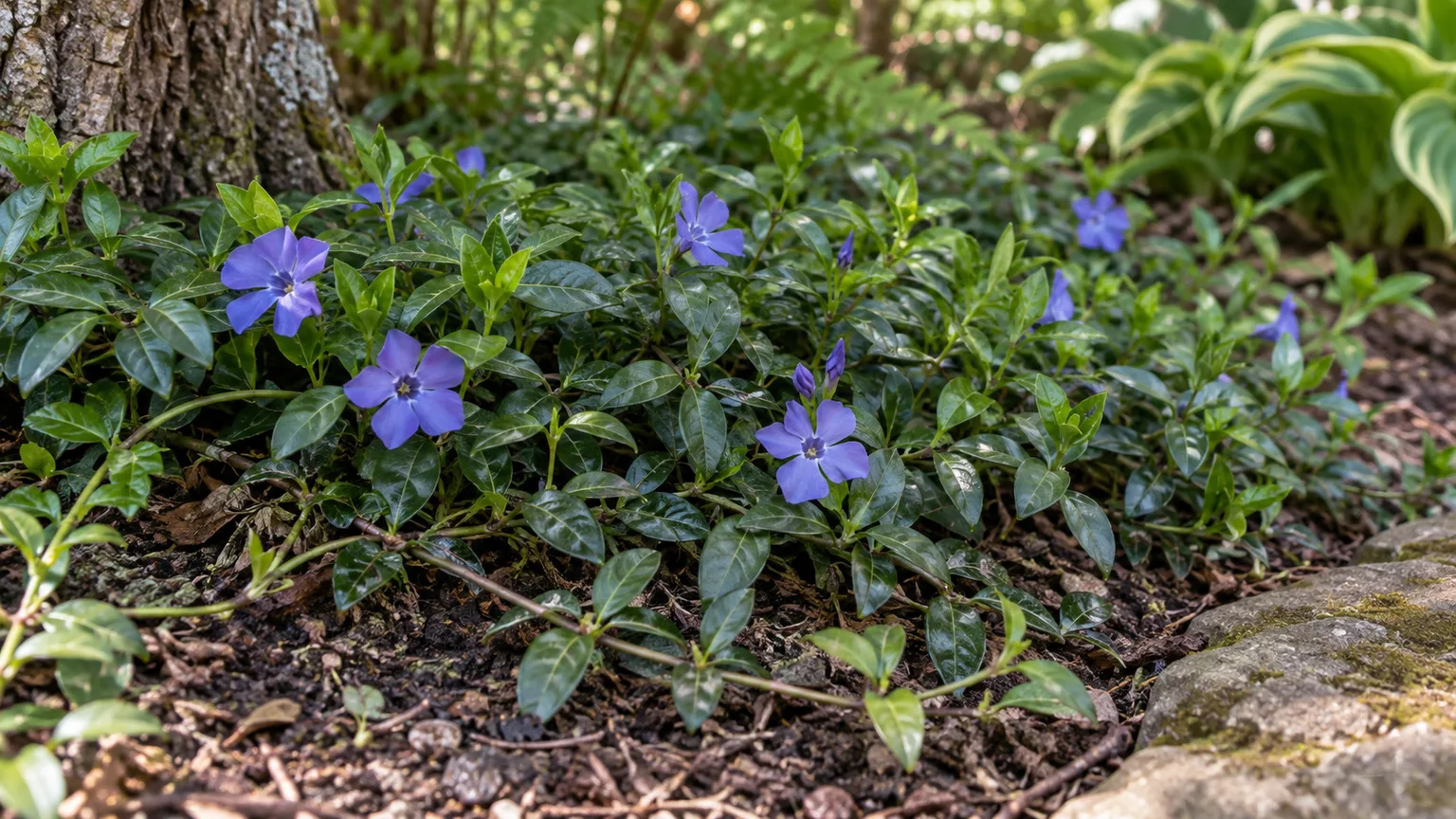
Bigleaf periwinkle (Vinca major) is an evergreen, trailing perennial with glossy leaves and violet-blue flowers. It can cover difficult ground in part shade, but its stems root where they touch soil, so a small planting can turn into a persistent mat. Before you buy it, check whether it is permitted and considered invasive where you live; in many gardens, the best care decision is not to plant it at all.
Where it is allowed and a contained planting makes sense, the basic routine is straightforward: give it part shade and well-drained soil, water while new roots establish, then irrigate during extended dry spells. The more important routine is monitoring the edges, lifting stems before they root beyond the intended patch, and keeping every clipping out of soil, compost, and waterways.
Decide Whether Bigleaf Periwinkle Belongs in Your Garden
Treat bigleaf periwinkle as a vigorous groundcover, not a tidy edging plant. Its low stems spread horizontally, and each node that contacts soil can form roots. That is why it fills banks and shaded areas efficiently—and why it can move beneath a fence, into lawn, or toward a woodland edge if the site gives it a path.
Its invasive status is regional, not universal. NC State Extension’s bigleaf periwinkle profile flags the species as invasive in several southeastern states and California and notes its invasive classification in North Carolina; the Invasive Plant Atlas of the United States documents mats in forests and other natural areas. Those sources describe ecological risk, but they do not replace current state or county rules. Before purchase, check your state department of agriculture, invasive-species council, and county extension office for the exact botanical name Vinca major.
Avoid planting it beside woods, wetlands, streams, drainage ditches, conservation land, or a neighbor’s unmanaged lot. Runoff and moving water can carry detached stems, and a bed near an open natural area gives rooted runners a short escape route. If your site has no reliable boundary or you cannot inspect it several times during the growing season, choose a locally appropriate alternative groundcover instead.
Some gardeners use it in a pot or hanging basket because a container keeps the roots above the ground. That reduces risk only if stems stay off soil and the pot is not emptied into a garden or compost pile. A container is not a workaround where local rules prohibit growing or moving the plant.
Identify Bigleaf Periwinkle Before You Buy
The botanical label matters because “periwinkle” is used for unrelated plants as well as two species of Vinca. Bigleaf periwinkle has opposite, glossy, somewhat heart-shaped leaves and larger violet-blue flowers; its trailing nonflowering stems run along the ground while flowering stems rise above the mat. The Invasive Plant Atlas describes leaves roughly 1.5–2.5 inches long and flowers about 1.5–2 inches across. NC State Extension also notes that bigleaf periwinkle has a heart-shaped leaf base and fine hairs along the leaf edge. A nursery plant with slender runners, broad glossy leaves, and those larger flowers is more likely to be V. major than the compact, smaller-flowered common periwinkle.
Common names can also create a safety mismatch. The ASPCA plant page titled “Periwinkle” identifies its subject as Vinca rosea, not V. major, so that page does not establish the ingestion risk for bigleaf periwinkle. If pets or children may chew the plant, keep it out of reach while you confirm species-specific guidance; give a veterinarian or poison-control service the botanical name and a clear photo rather than relying on the tag’s common name alone.
Bigleaf, common, and annual vinca are different plants
Vinca major is greater or bigleaf periwinkle. Vinca minor, common periwinkle, has smaller leaves and flowers and is generally more cold-hardy. Both can spread by stems rooting at nodes, so do not assume the smaller species is safe in a sensitive site simply because it is less vigorous. Ask a local extension office about the species and cultivars suitable for your region.
Annual vinca or Madagascar periwinkle is Catharanthus roseus, a different genus often sold in summer bedding packs. It grows upright rather than as a mat of long, soil-rooting runners. Check the botanical name on the nursery tag instead of relying on “vinca” alone.
Bigleaf periwinkle cultivars may have white-edged or otherwise variegated leaves, including ‘Variegata’. Variegation changes the foliage pattern, not the plant’s basic rooting habit. Do not treat a decorative cultivar as noninvasive unless a regional authority specifically says it behaves differently in your area. Southern Living’s variegated-vinca profile likewise describes the ornamental form as an aggressive outdoor grower, so a leaf pattern is not a containment trait.
Choose a Site That Matches Its Needs and Growth
The plant tolerates a wide range of light, but tolerance does not mean every position produces equally good growth. Missouri Botanical Garden lists full sun to part shade, while NC State Extension describes a preference for partial shade or dappled light. In a hot climate, part shade usually protects foliage from drying while still giving enough light for spring flowers.
Light, heat, and flowering
A site with morning sun and afternoon shade is a useful starting point. Heavy shade can keep the mat green but reduce flowering; several hours of direct sun can improve bloom, provided the soil does not dry severely. In exposed, hot locations, look for leaf scorch or crisp margins and water at the soil line during drought rather than automatically moving the plant into deeper shade.
Soil, drainage, and moisture
Bigleaf periwinkle grows in average, well-drained soil and can tolerate dry-to-medium conditions once established. It does not need a peat amendment or a narrowly adjusted pH to survive. If the soil stays soggy after rain, improve the site or plant somewhere else; enriching a poorly drained hole does not correct a high water table or compacted subsoil.
A layer of compost can improve very poor soil, but avoid burying the crown in a deep pocket of rich, wet mix. The important balance is enough moisture during establishment with oxygen around the roots. After a heavy rain, note whether water is still sitting around the crown the next morning; repeated saturation is a better reason to relocate the plant than a minor difference in soil pH. In heavy clay, choose a raised or naturally sloping site only if runoff will not carry plant material into a ditch or natural area.
Set Boundaries Before Planting
Plan the mature footprint first. Bigleaf periwinkle can spread indefinitely when nodes keep finding soil, so a narrow border against mulch is not a dependable stop. A sidewalk, paved strip, retaining edge, or another surface with no soil contact can make inspection easier, but runners can cross over it; the edge still needs regular checks.
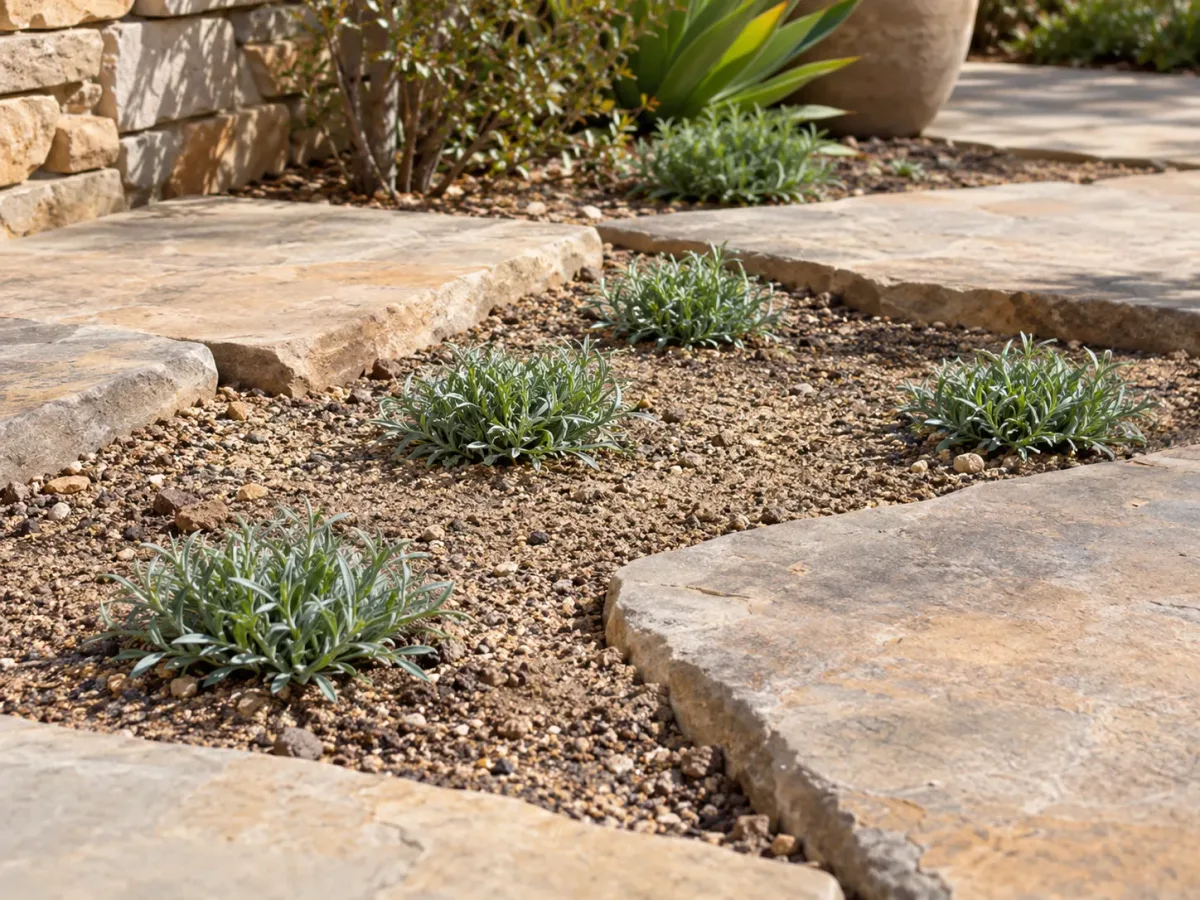
Draw a simple map of the bed and mark where you will cut or lift the outer stems. Keep the planting away from drainage routes and any place where yard waste could wash downhill. If you want evergreen coverage under shrubs but cannot accept frequent boundary work, choose a slower-growing, locally recommended plant that fits the site instead.
Plant and Space Periwinkle Carefully
Plant nursery starts in spring after the soil is workable, or in early fall where roots have time to establish before cold weather. Water the pot before planting, loosen tightly circling roots, and set the crown at the same depth it grew in the container. Backfill with the original soil, firm gently, and water to settle it; do not plant deeper to “anchor” the runners.
Spacing depends on the job, but larger gaps do not change the plant’s eventual ability to spread. Missouri Botanical Garden suggests about 8 inches between starters for quick cover in small areas and 12–18 inches for larger areas. Those figures are horticultural spacing advice, not a recommendation to install a carpet wherever it is sold. Use the wider spacing only where planting is legal, the site is appropriate, and the full patch can be monitored.
For a first month or two, check the soil every few days and water when the root ball and surrounding soil begin to dry. The plant should not sit in a daily puddle, and a new planting should not be left to wilt repeatedly while roots are still shallow. Add a thin mulch layer if needed to retain moisture, but leave the crown uncovered and do not mulch runners into places where you do not want them to root.
Water and Feed for Steady, Healthy Growth
After establishment, rainfall may supply enough water in a shaded bed. During a long dry spell, water deeply at the soil line when the upper soil is dry rather than giving frequent light sprinkles. A plant in full sun, a sandy slope, or a container will dry faster than the same plant in part shade and loam, so judge moisture where the roots are rather than following a fixed weekly schedule.
Containers need more frequent checks because potting mix dries faster than garden soil. Insert a finger an inch or two into the mix; water thoroughly when it feels dry, then let excess drain away. Empty saucers after watering, and do not keep the pot standing in water. A hanging basket avoids soil contact below, but trailing stems can still touch a neighboring pot or a bed when the basket hangs low. Give the plant enough clearance that runners cannot bridge from one growing surface to another.
Fertilizer is usually unnecessary in reasonably fertile soil. Extra nitrogen can encourage leafy growth without solving shade, drainage, or establishment problems—and vigorous growth is already the plant’s strong suit. If growth is weak, first check the light, root moisture, and drainage; use a soil test before adding nutrients to a garden bed.
Prune the Mat Without Spreading Stem Pieces
Prune for a clear reason: remove stems outside the planned boundary, open an overgrown mat, or remove dead and damaged foliage. For a general shape reset, shear after the main spring bloom so the plant has time to make new growth before cold weather. Hunker’s practical guidance also places a periodic shear after flowering; that broad timing is more useful than clipping on a fixed calendar regardless of climate.
For boundary work, hand-pruners are more precise than mowing. Follow each runner to the last node you want to keep, then cut it before the node touches bare soil. Where it has already rooted, loosen and lift that node with a hand fork or trowel; simply shearing the leaves leaves the rooted section behind to regrow.
Collect all stems as you go. A freshly cut stem can still root if it lands on moist soil, so do not blow clippings into a bed, leave them under shrubs, or scatter them along a slope. Bag or otherwise dispose of plant material according to local green-waste rules; do not dump it in woods, roadside vegetation, or a stream.
Propagate Only Where It Is Responsible
Periwinkle propagates easily because its nodes root when they meet soil. In a region where growing and sharing the species is permitted, a rooted section can be separated from the parent plant and potted or replanted. Take a small division with roots and several healthy leaves, settle it at the same depth, and keep it lightly moist while it establishes.
Stem cuttings can also root in a moist, free-draining propagation mix. Use a short healthy piece with at least one node, remove leaves that would sit below the mix, and keep the pot in bright indirect light while roots develop. This method is simple, but ease of propagation is exactly why cuttings should not be offered or transported into places where the plant is restricted or ecologically unsuitable.
Do not collect or share seed pods as a way to expand a garden patch. Seed production is not necessary for the plant’s spread in a home bed; vegetative stems do the work efficiently. If you discover a patch in a natural area, avoid moving any live pieces and report it to a local invasive-plant program if that is the local practice.
Grow Bigleaf Periwinkle in a Container
A container can be a practical choice where the species is legal and the gardener wants a trailing evergreen plant for a patio. Use a sturdy pot with open drainage holes and a standard potting mix, then place it on paving or a stand that keeps stems from contacting soil. A pot left on bare ground can root through drainage holes or send runners over the rim.
Inspect the pot edges and the ground below it whenever you water or prune. Pinch or cut off stems before they touch adjacent pots, mulch, lawn, or a garden bed, and collect every clipping. If you cannot keep the runners contained—or local guidance discourages the plant—replace it with a noninvasive trailing plant suited to your climate.
In climates colder than its reliable outdoor range, Vinca major may suffer winter injury or fail to return. Missouri Botanical Garden lists reliable hardiness in Zones 7–9 and notes that gardeners farther north often treat it as a container annual. A protected container may extend its life, but do not assume that overwintering indoors will eliminate the risk of escape once it goes back outside.
Encourage Flowers Without Forcing Growth
Violet-blue, five-petaled flowers usually appear in spring, with intermittent blooms sometimes continuing into warmer months. Bloom timing shifts with climate and exposure. More sun can support more flowers, but only choose a sunnier position if you can maintain moisture and avoid heat stress; the trade-off is not worth sacrificing healthy foliage for a brief bloom flush.
Variegated forms are chosen mainly for their foliage contrast, while the species is grown for its evergreen mat and spring flowers. Skip routine heavy fertilizer and frequent deadheading. If flowering declines, check whether the site has become too shaded, whether competing shrubs have grown over it, or whether roots are staying wet. Correct the cause before feeding.
Diagnose Yellow Leaves, Wilt, and Leaf Spots
A tough groundcover can still struggle when roots remain saturated or the planting is too crowded. NC State Extension lists aphids and diseases including leaf spot and blight among possible problems; Missouri Botanical Garden also notes root rot and nematodes. Identify the pattern before treating: yellow leaves in a wet patch call for a different response than wilt in dry soil.
Separate drought stress from waterlogged roots
Check moisture several inches below the surface and look at more than one plant. If the soil is dry and leaves feel limp, water slowly at the base and reassess the following day. If the soil is wet, yellowing and wilt can indicate oxygen-starved roots; stop adding water, improve drainage if feasible, and remove badly rotted sections rather than applying fertilizer.
Leaf spots often become more noticeable in crowded, persistently damp growth. Avoid overhead watering late in the day, remove badly affected leaves, and thin the mat enough to improve airflow. Bag diseased debris instead of leaving it in the bed. If spots continue to spread after conditions improve, consult your county extension office for local diagnosis before applying a pesticide.
Aphids may cluster on tender tips and flower stems. A small population rarely justifies a broad insecticide on a flowering groundcover; first dislodge them with a firm water spray and monitor new growth. Avoid treating beneficial insects along with the aphids, especially when flowers are open. Nematode problems are harder to diagnose from leaf symptoms alone; if decline repeats in the same bed, ask an extension office whether a soil or root assessment is appropriate before replanting. For any pesticide, identify the pest, check whether the product is labeled for the site and plant, and follow its label exactly.
Control or Remove an Escaping Patch
For a few runners, act while roots are limited to individual nodes. Cut the connecting stem, then lift each rooted node and its roots; trace the runner before you pull so you do not break it into pieces. Recheck the edge every week or two during active growth, because one pass is unlikely to remove every hidden node.
For a large mat, work in manageable sections rather than tearing at the entire planting at once. Loosen the surface with a fork, remove rooted stems and crowns, and inspect the soil again after several weeks for regrowth. Where the patch is isolated and local conditions suit it, a light-blocking cover may suppress regrowth, but it can also affect desirable plants beneath or around the treatment area. In shaded sites or near sensitive vegetation, ask a local extension or invasive-plant program about the least disruptive method.
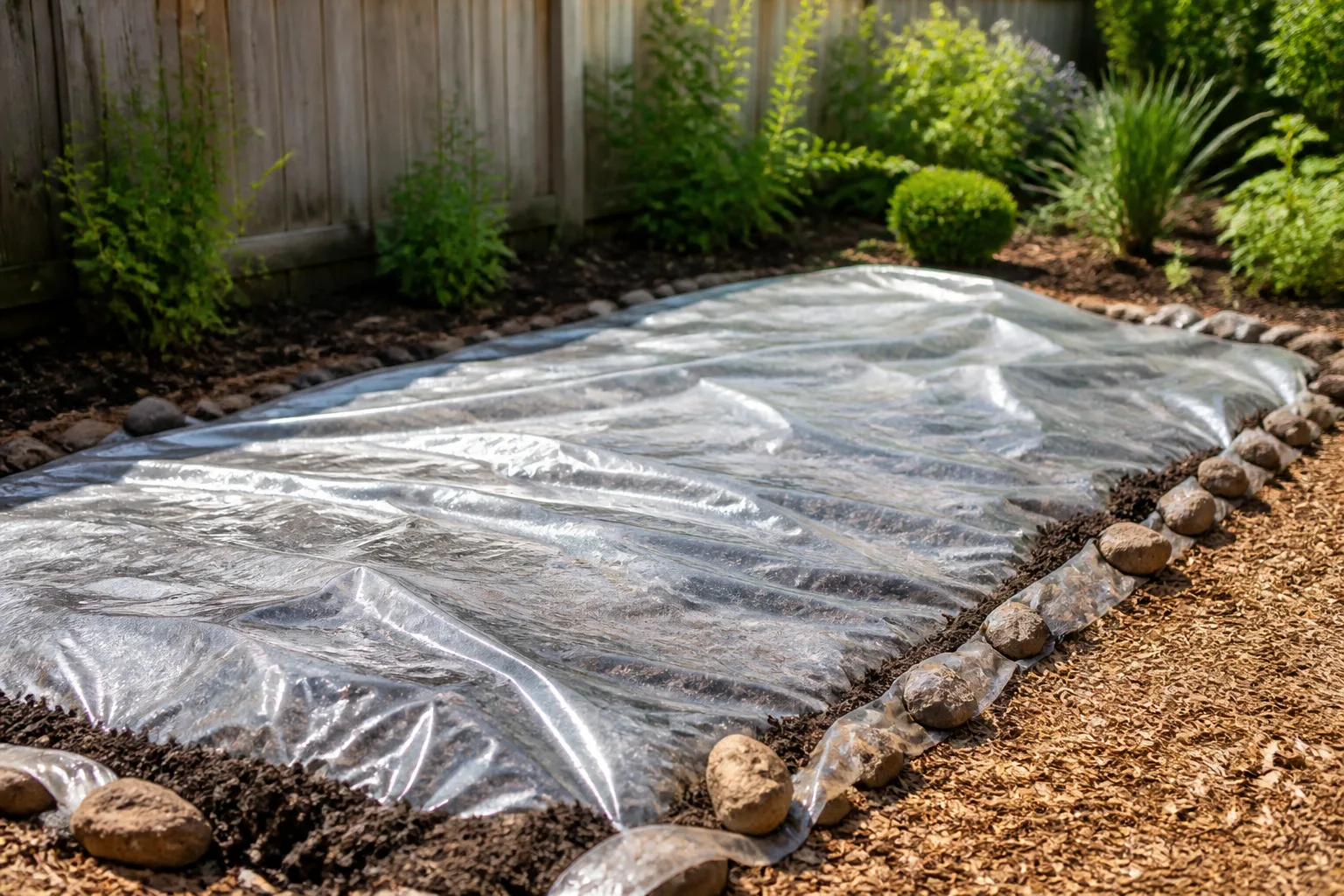
Do not till a patch and assume the job is finished. Fragmenting runners can leave rooted pieces behind, and loose stems can be carried by water. Keep removed material contained, follow municipal green-waste instructions, and never dispose of live periwinkle in a natural area or drainage channel.
If the plant is widespread, entangled with valuable roots, or growing near water, get local advice before using a herbicide or removing large amounts of vegetation. Product labels and local restrictions control what may be used, where, and how. A county extension office or invasive-species coordinator can help distinguish a manageable garden patch from a site that needs a restoration plan.
If a pet or child chews an unknown garden plant, do not wait for symptoms before asking a professional what to do. Provide the botanical name, the part eaten, and an estimate of when it happened; the species listed under a familiar common name may not be the plant in your garden. Do not induce vomiting or use a home remedy unless a veterinary professional or poison-control service directs you.
Conclusion
Bigleaf periwinkle is easiest to care for when the decision happens before planting. Confirm the species and local status, choose a site with part shade and good drainage, and decide exactly how you will keep its rooting stems out of surrounding soil. In a permitted, bounded spot, water through establishment, avoid excess fertilizer, and prune after flowering or as soon as runners approach the edge.
If the site borders natural land, a waterway, or a neighbor’s property—or you want a groundcover that stays put with little checking—choose something else. When periwinkle is already escaping, lift rooted nodes, contain the debris, and return to the patch until new growth stops.



