Black Walnut Tree Identification, Benefits & Risks
Learn the field marks for black walnut, what juglone may mean for nearby plants, how to garden around the tree, and when removal is worth considering.
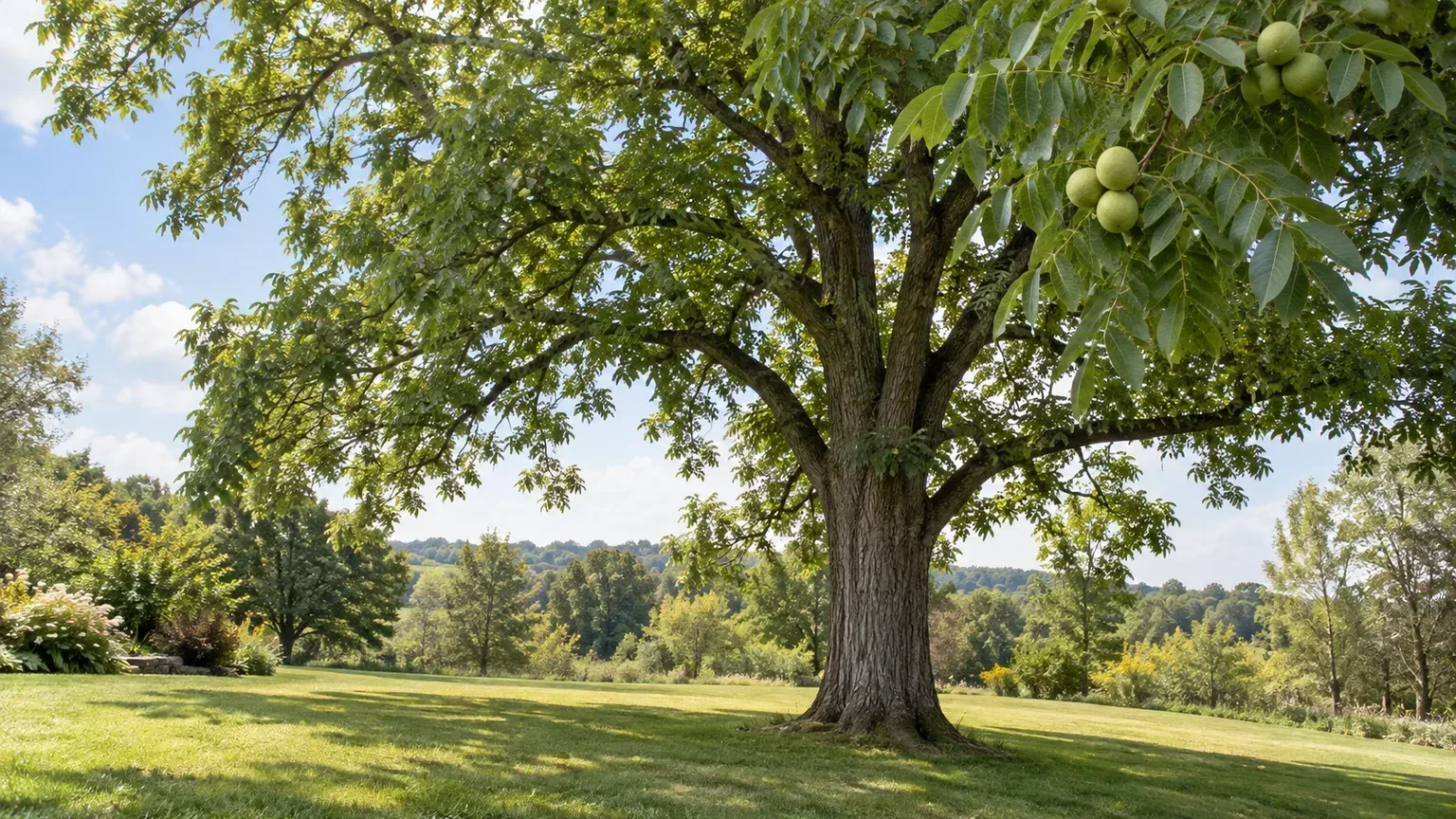
Black walnut (Juglans nigra) is easy to admire from a distance: it is a substantial native shade tree with edible nuts, valuable dark wood, and wildlife value. Living with one is more complicated. The crown can shade a large patch of lawn, fallen husks stain hard surfaces, and nearby plants may struggle for reasons that include both juglone and ordinary competition for water, light, and root space.
Before deciding to keep or remove a tree, confirm its identity and assess the whole site. A black walnut is not automatically a garden-killer, and cutting it down does not instantly erase every belowground effect. The practical answer depends on whether the tree is healthy, where its roots and canopy reach, and what you want to grow around it.
Identify a black walnut tree with four clues
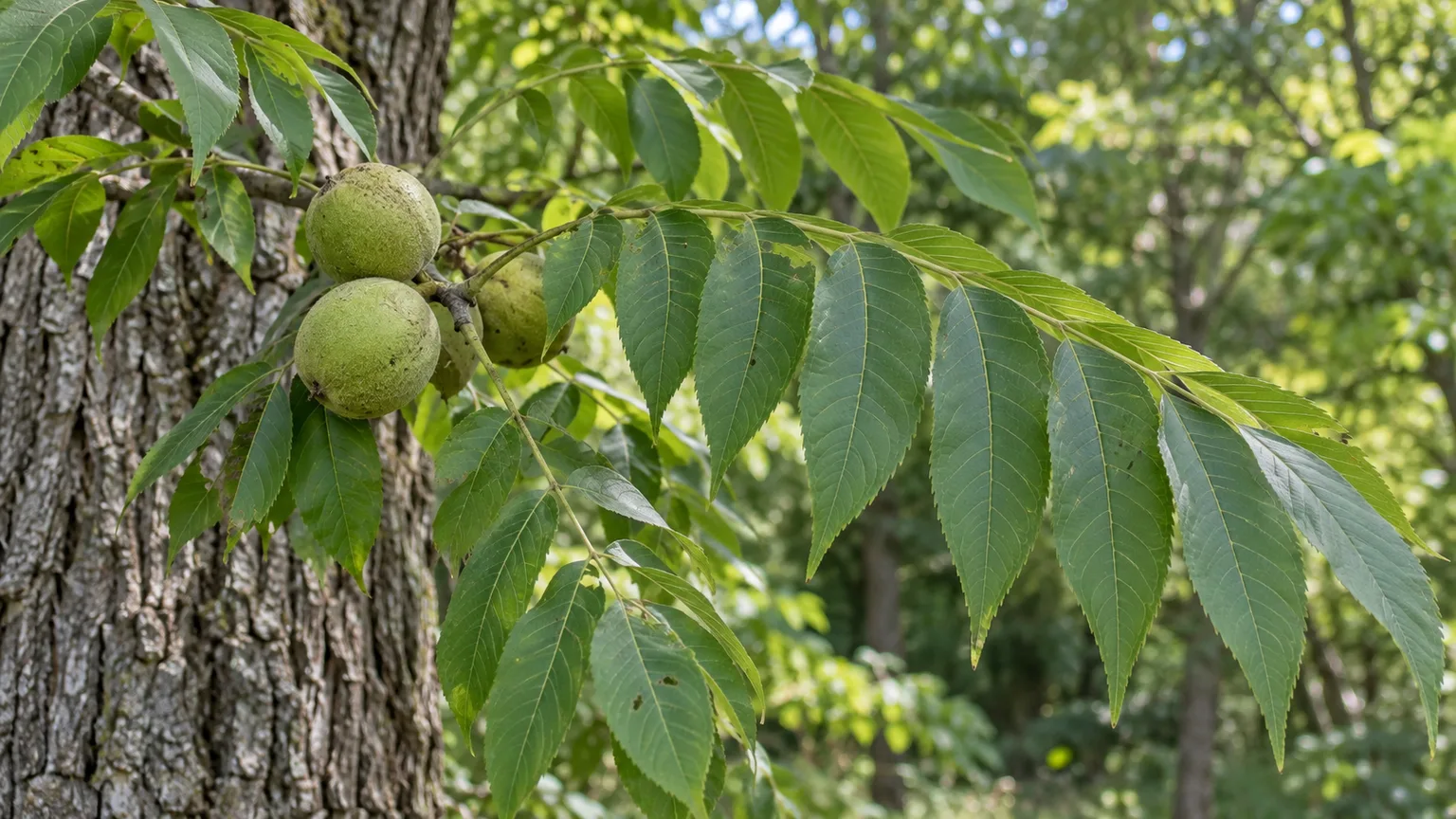
The most reliable field identification combines several parts of the tree. In summer, begin with a full leaf: black walnut carries many leaflets along a central stalk, usually about 12 to 24 inches long with 15 to 23 finely toothed leaflets, according to NC State Extension. The leaf is alternate on the twig, not arranged opposite another leaf at the same point. A single leaflet is not a whole leaf, a common source of confusion when identifying compound-leaved trees.
Look for fruit from late summer into fall. Black walnuts are round nuts enclosed in a thick, fleshy green to yellow-green husk that darkens as it ages and can stain skin, fabric, and concrete. The nuts often occur singly or in pairs. A fallen green husk is useful evidence, but it is not unique to black walnut: confirm the leaf or bark too, particularly if the tree is near a road, park, or mixed woodland.
Mature bark is another strong clue. It becomes dark gray-brown with deep intersecting furrows that form a rough diamond pattern. Young trunks may look much smoother, so bark alone is less decisive on saplings. If you can safely examine a fallen twig, a pungent citrus-like or spicy scent when the leaf or twig is crushed can support the identification; odor varies and should not replace visible traits.
For a quick field check, ask whether the tree has at least two of these four features: a long pinnate leaf with many toothed leaflets, round green husked fruit, dark diamond-furrowed mature bark, and aromatic crushed foliage. If the evidence is mixed, photograph a full leaf, twig, bark, and any fruit, then compare them with a regional tree key or ask a local extension office. Do not rely on a phone app or a single fallen nut when the decision could affect tree removal.
Black walnut look-alikes: what separates them
Several common eastern North American trees also have compound leaves, and a small seedling can lack the bark or fruit that make identification easier. Compare the leaflet margins, smell, fruit clusters, and overall growth form before you decide. When the tree has no leaves or fruit, confidence may be limited; wait for a better season or consult a local naturalist or arborist rather than cutting it down based on a guess.
Tree of heaven, sumac, butternut, and hickory
Tree of heaven (Ailanthus altissima) has pinnate leaves too, but its leaflets are usually smooth-edged and have small glandular notches near the base. Crushed foliage has a strong unpleasant odor rather than the more citrus-like scent associated with walnut. Tree of heaven often produces vigorous root suckers and clusters of winged seeds; black walnut has fleshy round husks around hard nuts. These clues matter because tree of heaven can spread aggressively, while black walnut is a native hardwood across much of central and eastern North America.
Staghorn sumac (Rhus typhina) also has a long compound leaf, but its stems are fuzzy and its upright fruit clusters are red and velvety. It usually grows as a large shrub or small, spreading tree rather than developing a single massive trunk with dark diamond-patterned bark. Butternut (Juglans cinerea) is a closer relative: its fruit is typically more elongated with ridged husks, and its bark is paler. Hickories have compound leaves as well, but their fruit husks and nuts differ; regional tree guides help separate the species.
No one clue is foolproof. A young black walnut may not yet show its adult bark, tree of heaven and sumac can be pruned into tree-like shapes, and fruit may be absent for part of the year. Use multiple characteristics before treating a tree as either beneficial or invasive.
How the tree changes through the year
Black walnut often leafs out relatively late in spring and drops foliage in fall, when the leaves turn yellow. That timing can make a healthy tree look dormant or thin beside earlier-leafing species. The leaves are long and conspicuous once they emerge, and the tree can eventually build a broad crown with its lower branches high above the ground.
Male flowers appear in hanging catkins, while small female flowers occur near the ends of new shoots. Pollination is by wind. The fruit develops through summer and ripens in fall, although the timing shifts with climate and local weather. A tree may produce a light crop one year and a heavier one another year; a lack of nuts in a particular season does not by itself mean the tree is unhealthy.
As it matures, the trunk darkens and its furrows deepen. NC State Extension gives a typical mature height of roughly 50 to 90 feet, but actual size depends on site and growing conditions. This is a long-term canopy tree, not a compact ornamental, and its roots can occupy ground beyond the visible branch tips. Think in terms of decades of shade, leaf litter, and fruit rather than the small sapling you see at planting time.
Why keep a black walnut tree?
A healthy black walnut offers more than shade. Its nuts feed squirrels and other wildlife, and the tree serves as a host plant for native moths and butterflies, including the luna moth and hickory horndevil. NC State Extension describes its edible nuts, wildlife value, and hardwood uses. Its dense crown can make a useful cool retreat on a spacious property, while its durable, dark hardwood is prized for furniture and veneer.
The nutmeat is edible, though black walnuts have a firmer shell and stronger flavor than familiar English walnuts. Gathering a crop can be rewarding if you enjoy the work and have somewhere to process and store it. But the same thick husks that protect the nut are messy: they can stain concrete, clothing, and hands, and nuts can sprout in lawns or garden beds where squirrels bury them.
The best reason to keep the tree is that the benefits matter to you and the location can accommodate its mature crown and fruit drop. The weakest reason is an assumption that a large yard tree will automatically pay for itself through timber. Value depends on trunk quality, access, the buyer, and removal costs; an arborist or local forester can assess the tree rather than promising a lumber price from species alone.
Juglone and nearby plants: what is known and uncertain
Black walnut is associated with juglone, a plant compound that can inhibit growth in susceptible species. It occurs in several parts of the tree, including roots and nut hulls. Extension guidance describes injury as most likely where sensitive roots contact walnut roots or where leaves and hulls accumulate in poorly drained soil. Symptoms can include stunting, yellow or brown leaves, and wilting.
The evidence deserves nuance. Penn State Extension and Wisconsin Extension both provide practical plant-tolerance guidance, while warning that their lists are incomplete and largely based on observation rather than controlled testing. The Morton Arboretum also notes limits in the research. Horticultural writer Robert Pavlis, in Garden Myths, argues that the field mechanism is less certain than many gardening summaries suggest and that several environmental effects can be mistaken for juglone.
For a gardener, the useful conclusion is neither “juglone explains everything” nor “ignore it.” Treat a mature walnut as a real risk factor for sensitive plants, especially under the canopy and in wet, poorly drained beds, but do not diagnose a plant from proximity alone. A toxin can be part of the explanation while shade, root competition, and soil moisture determine whether a plant actually thrives.
Avoid using the canopy edge as a precise safe radius. Roots can extend beyond the crown, but their spread depends on soil and the tree’s age. A Wisconsin Extension factsheet notes that the affected area may extend dozens of feet from a mature trunk, with the greatest concern near the dripline; use that as a caution, not as a hard boundary for every yard.
Diagnose a struggling garden before blaming the tree
Start with the plant’s pattern and the site. If several known-sensitive plants decline in the same walnut root zone while nearby plants stay healthy, juglone becomes more plausible. If only one plant is affected, check watering, planting depth, root disturbance, pests, disease, herbicide drift, and whether the species is simply poorly suited to shade before removing the tree.
Water-stress wilting often improves after watering and tends to develop as soil dries. Extension descriptions of juglone injury note that symptoms can persist despite adequate moisture, but this is not a dependable home test: compacted soil, root damage, and vascular diseases can also cause persistent wilt. Check soil moisture several inches down, look for discolored vascular tissue only if you know how to interpret it, and compare the same plant in a different bed. If a valuable tree or large planting is declining, a county extension diagnostic service can help rule out disease.
The site itself is often the stronger clue. A mature tree intercepts rainfall, casts shade, and fills the soil with competitive roots. A drought-loving plant that needs sun may fail under a walnut even if it tolerates juglone; a shade plant may still need supplemental water while it establishes. Solve these basic growing conditions first, because removing the tree will not turn a deeply shaded, root-filled patch into a sunny vegetable garden overnight.
Choose plants and beds that fit the site
Select for both reported juglone tolerance and the actual light, soil, and water conditions. Penn State Extension lists beans, beets, carrots, corn, melons, squash, and onions among vegetable candidates reported as tolerant. Wisconsin Extension also includes several flowers, grasses, and woody plants, but both universities caution that sensitivity lists vary and do not cover every cultivar or site. Treat a list as a shortlist to test, not a guarantee.
Sensitive crops and better candidates
Tomatoes, peppers, potatoes, eggplant, and some other crops are commonly listed as sensitive; for a kitchen garden, give them a bed outside the walnut’s main root area if you can. If space is limited, trial a small number of tolerant-listed vegetables first rather than filling a raised bed with an entire season’s crop. Keep walnut hulls and leaves out of beds, use clean mulch, and water consistently through hot spells.
For shade beds, look for tolerant-listed choices such as hosta, ferns, astilbe, daylily, or sweet woodruff, then confirm that the specific cultivar suits your light and climate. For shrubs, serviceberry, forsythia, some viburnums, and certain dogwoods appear in extension or horticultural guidance. Northern Gardener writer Susan Barbieri describes success with lilac, arborvitae, dogwood, and weigela near her own Minnesota black walnut, but also recommends checking several extension references when lists conflict. Her experience is a helpful real-yard example, not a universal planting guarantee.
Raised beds can make the root environment easier to manage if they physically limit walnut-root intrusion and have adequate drainage. A tall frame alone is not a permanent barrier: roots can enter from below or around it. Avoid trenching through major structural roots to install a barrier, since that can injure the tree and create a hazard; use a qualified arborist if a large root must be assessed. Where a sensitive crop matters, the simplest reliable solution is often to place it beyond the dense root zone or grow it in a container with clean soil.
Harvest and cleanup trade-offs
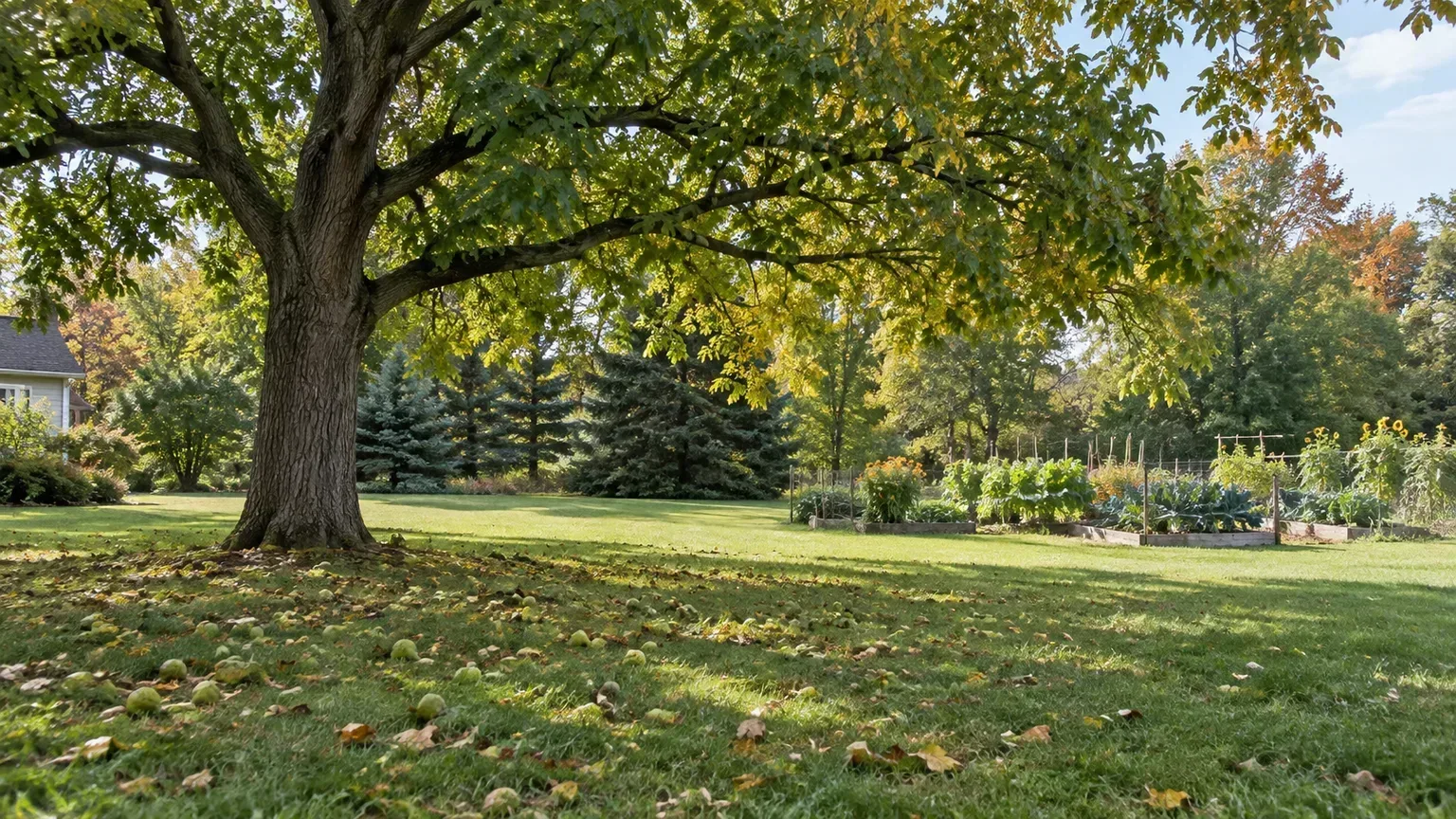
Black walnuts ripen in fall and normally drop when ready. In much of the eastern United States the season runs from late summer into autumn, but local weather shifts the calendar. If you plan to eat the nuts, collect sound fruit promptly, wear gloves while handling the staining husks, and separate damaged or moldy nuts. The fleshy outer hull needs to be removed before the hard shell can be cracked; the nut’s strong flavor is distinctive, so it may not suit everyone.
If you are not harvesting, the maintenance job is mostly seasonal cleanup. Rake or collect fallen nuts and hulls from lawns, paths, and beds where they create slip, stain, or seedling problems. Do not use walnut leaves, hulls, bark, or wood as garden mulch around sensitive plants; Penn State Extension advises keeping walnut material out of landscape beds. A large tree above a play area, sidewalk, or parked car also deserves consideration because falling nuts can hit people or vehicles.
This is a trade-off rather than a defect in the tree. A homeowner who values wildlife, shade, and a nut crop may accept fall cleanup; someone who needs a low-maintenance patio or uninterrupted vegetable beds may reasonably prefer a different tree in that location. Consider the yearly work and the tree’s health together, not the mess from one unusually heavy crop alone.
When should you remove a black walnut?
Juglone concerns by themselves are not a strong reason to remove a healthy, well-sited tree. A tree can have substantial ecological and shade value, tolerant plants may grow nearby, and its roots do not disappear when the trunk is cut. Removal becomes more reasonable when the tree is dead or declining, presents an unacceptable risk, conflicts with construction or essential access, or creates a site problem that cannot be solved by moving the garden or changing the planting plan.
Assess the tree and the property before deciding. Look for major dead limbs, large cracks, significant trunk decay, root-plate movement, or a sudden lean; these observations call for professional assessment rather than a homeowner diagnosis. The International Society of Arboriculture explains that an ISA Certified Arborist has documented knowledge of tree biology, diagnosis, maintenance, and safety, and recommends qualified help for hazardous removal work. Use the TreesAreGood arborist guidance to find a credentialed professional and request a written scope of work.
Before any work, check whether a local tree-protection rule, homeowner association requirement, or utility clearance applies. If branches approach power lines, contact the utility rather than attempting to prune them. A large tree can fail unpredictably during felling, even when the trunk looks sound; removing it is skilled work involving fall direction, rigging, nearby structures, and overhead hazards.
Removal options from seedling to mature tree
For a small seedling, removal is easiest after rain or irrigation, when soil is moist. Grip low on the stem, loosen the surrounding soil with a hand tool, and pull slowly so the taproot comes out rather than snapping at the surface; black walnut develops a deep taproot as it grows, as NC State Extension notes. Repeat checks through the growing season: squirrels bury nuts in lawns and beds, and a new seedling is easier to remove before it develops a thick root.
For a sapling that resists pulling, expose and sever the root below the root collar with a sharp spade or loppers sized for the stem. Wear sturdy gloves and eye protection, keep your hands clear of the cutting path, and do not pull hard enough to lose your balance. If it has grown beyond hand-tool size or stands near a fence, foundation, or utility, hire a professional to handle it.
A mature black walnut should not be felled as a do-it-yourself project unless you are trained and have the right equipment, site clearance, and legal authority. Have a qualified arborist inspect the tree, explain whether pruning, monitoring, or removal is appropriate, and itemize the removal, stump work, debris hauling, and site restoration separately. Stump grinding removes the visible stump to a specified depth; it does not extract every large root from the soil.
Stumps, suckers, and what removal does not fix
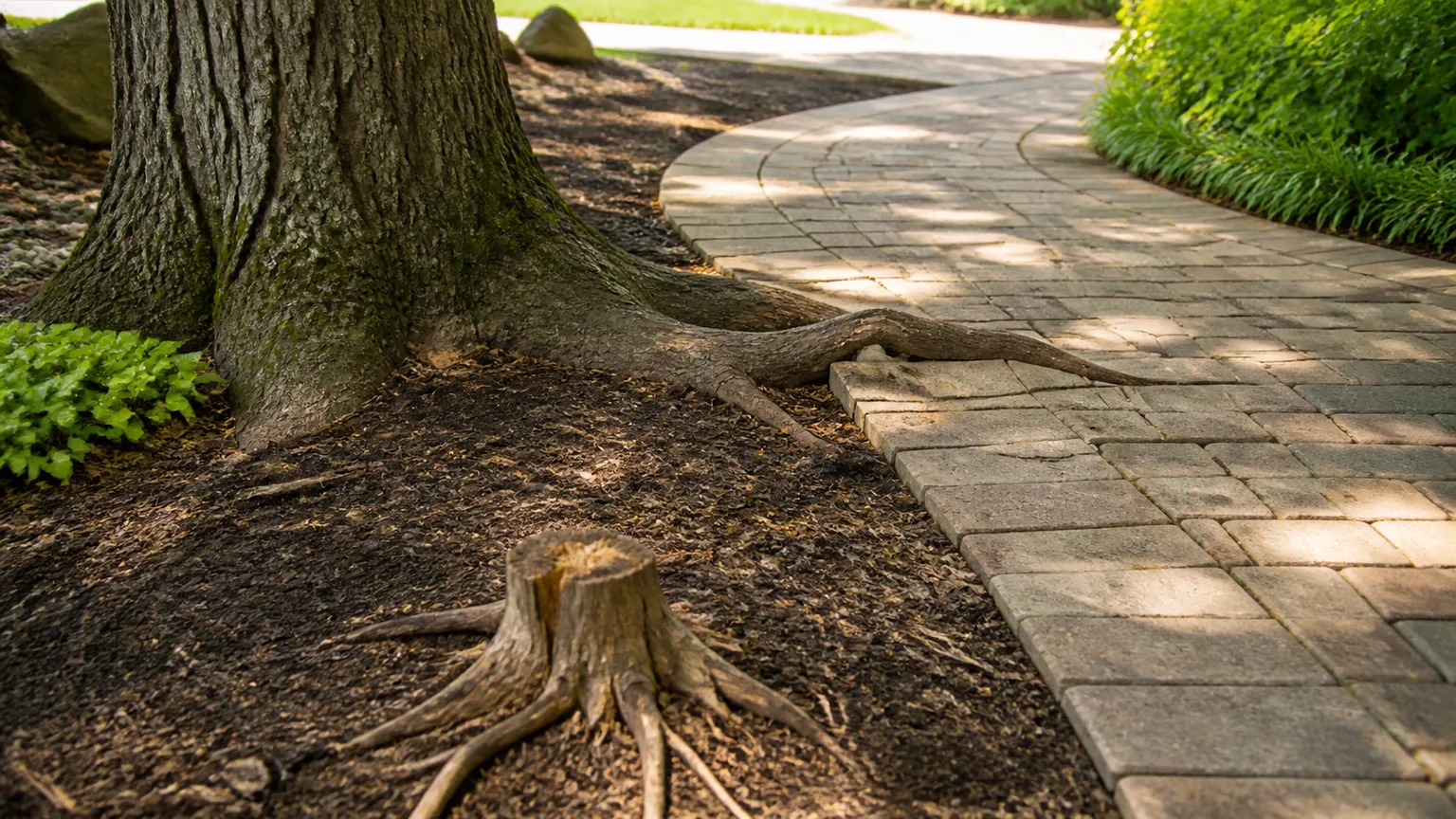
After cutting, a living stump or remaining roots can send up new shoots. If you do not need immediate turf or planting in that spot, keep young shoots cut low and monitor the area rather than digging out a large root system yourself. Grinding can reduce the stump and make the surface usable, but roots remain belowground to decay; full root extraction is disruptive and may damage nearby paving, utilities, or other trees.
Removal also does not create an instant juglone-free bed. Wisconsin Extension notes that decaying root pieces can continue to affect sensitive plants for some time, and Penn State Extension cautions that impacts may persist after a tree is cut. Garden Myths challenges how confidently gardeners attribute field effects to juglone alone. With that uncertainty, do not promise yourself a specific waiting period: start with tolerant species or a physically isolated container/raised bed, and observe how the actual site responds before investing in sensitive crops.
Do not apply a stump chemical by guesswork or copy an online recipe. If a legal stump treatment is being considered, identify the product and follow its current label and local rules exactly; for a yard tree near ornamentals, roots, water, children, or pets, ask the arborist about mechanical options first. Local requirements can differ, and the cheapest method can create a larger problem if it harms nearby plants or leaves an unstable stump.
Conclusion
Black walnut is a large native hardwood with unmistakable clues once you combine its compound leaves, round husked nuts, dark furrowed bark, and aromatic foliage. It offers shade, edible nuts, valuable wood, and wildlife habitat, but its size, fruit drop, staining, and possible effects on sensitive plants require a realistic site plan.
Keep a healthy tree when its benefits and location work for you, and design the garden around the real light, water, and root conditions. Move sensitive crops or test tolerant plants before considering removal solely for juglone. Pull seedlings while they are small, and leave mature-tree assessment and removal to a qualified arborist. Most of all, treat the tree as one factor in a complex site rather than assuming it explains every plant problem.