Choose Compost Carefully When Topdressing the Lawn
Learn how to choose compost for lawn topdressing, check a test sheet for salts and nutrients, calculate the volume, and spread a safe, even layer.
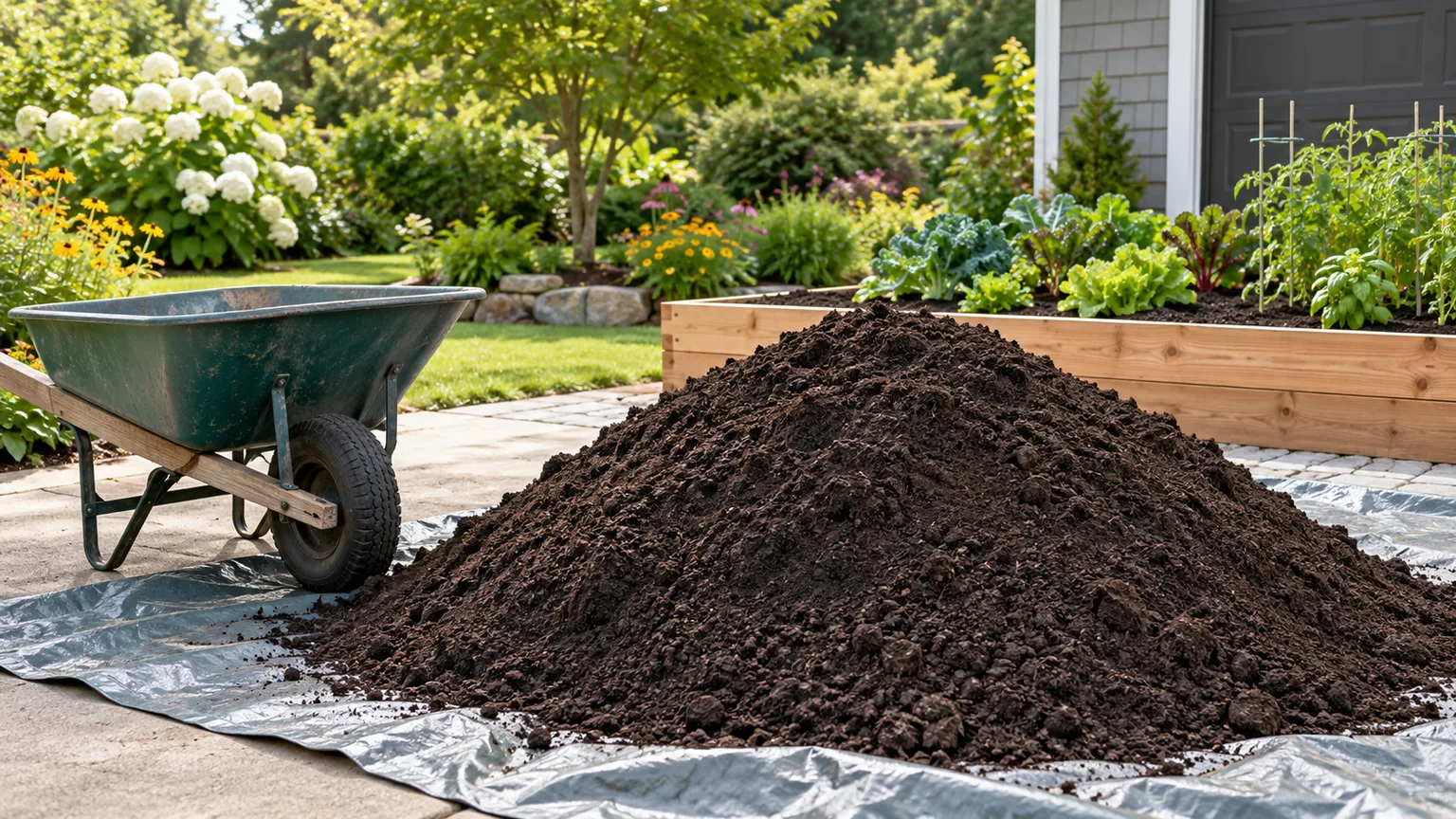
The best compost for lawn topdressing is mature, finely screened, easy to spread in a thin layer, and sold with clear information about its feedstock and quality. A clean, earthy smell and dark, crumbly texture are useful first clues, but they do not establish that the material has suitable salt or nutrient levels, is free of persistent herbicide residues, or is appropriate for your soil. Before ordering, decide what the lawn needs, ask for a recent test report or technical data sheet, and calculate only the volume you can spread while leaving grass blades visible.
For routine care, start with about 1/4 inch of compost. A layer up to 1/2 inch may suit a healthy, actively growing lawn in some programs, but it is not a universal target. Use a thinner application when the grass is short, the product is unfamiliar, or the lawn is stressed. Compost is a soil amendment: it can add organic matter and some slowly available nutrients, but its nutrient content varies, and it cannot by itself repair a drainage problem, correct a severe grade, or replace a soil-test-based fertilizer plan.
What Compost Topdressing Changes—and What It Cannot
Topdressing means distributing a shallow layer of material over an existing lawn. Compost can add organic matter near the soil surface, improve the conditions for soil organisms, and contribute nutrients as it continues to decompose. Its effects depend on the compost, soil, grass, climate, depth, and frequency of application. For example, UF/IFAS guidance for Hillsborough County describes compost as a relatively low-concentration, slow-release source of nutrients and cautions that repeated overapplication can contribute to nutrient imbalance, including phosphorus buildup.
Those benefits do not make every compost interchangeable. A yard-waste compost, manure compost, municipal compost, and blended product can differ in nutrient concentration, soluble salts, pH, texture, and contaminants. Even two batches made from similar materials may differ. Compost is therefore best treated as a material with a measurable composition, not as a generic, harmless soil conditioner that can be applied by the truckload.
Topdressing can support a lawn when the grass is established and the surface needs a modest organic-matter amendment or an even layer around overseeding. It may also help provide conditions for natural thatch breakdown when a thin layer contacts the soil and turf remains healthy. But compost does not magically digest a thick thatch layer, loosen deep compaction in place of aeration, or fix water that is flowing from a downspout or pooling because the grade is wrong. Identifying the actual problem first prevents a reasonable product from being used for the wrong job.
Diagnose the Lawn Before Buying Material
Walk the area when the grass is dry and look for a specific goal. Is the soil visibly exposed between healthy grass plants? Are you overseeding thin turf? Do you want a small organic-matter addition to support routine lawn care? Or are you trying to fill shallow depressions? Those situations may call for different materials or repair steps. A broad blanket of compost is rarely the right first response to every brown, thin, or uneven lawn.
Check for stress and underlying causes. Thin growth can result from shade, poor drainage, drought, traffic, pests, disease, incorrect mowing, or a grass species that is poorly suited to the site. Compost cannot replace shade-tolerant turf, reduce foot traffic, or correct irrigation coverage. If the lawn is dormant from heat or cold, drought-stressed, or actively diseased, postpone topdressing until the grass can recover and you know the cause.
Use a soil test when you need to make decisions about nutrients or pH. A soil test does not tell you whether a compost lot contains herbicide residues, and a compost report does not tell you the complete condition of the lawn’s soil. They answer different questions. Together, they can help you decide whether adding a material with measurable phosphorus, salts, or a particular pH fits the site. For a lawn with a long history of compost applications or nearby water-sensitive areas, that extra check is especially worthwhile.
Before ordering in bulk, inspect a sample and confirm the delivery amount, texture, and intended use. Ask whether the seller can provide a sample from the current batch rather than a display jar from another product. Look for debris, a range of particle sizes, and any odor that suggests incomplete processing. If you have never used the material, trial a small area first and observe the turf before covering the entire lawn.
Compare Compost With Topsoil and Sand Blends
Choose a material based on the job, not a label that sounds premium. Straight compost is appropriate when the goal is a thin organic-matter topdressing and the compost is suitable for turf. A compost-and-topsoil blend has more mineral soil and body, which can be useful for small surface corrections or seeding, but its composition still needs to be known. Topsoil alone is generally the better choice when the task is adding soil to a shallow low spot, provided the grade and drainage design are sound.
A blend that looks dark is not necessarily mostly compost. Ask for the approximate percentage of compost, topsoil, sand, or other ingredients. If the product is sold as a lawn blend, find out whether it was formulated for a specific use and whether it is screened enough to work through the grass. A bulky, cloddy blend can sit on top of a dense lawn rather than settle around the crowns and soil surface.
Sand is sometimes included in topdressing programs, but that does not make sand a universal fix for clay soil. Repeatedly adding a small amount of sand to clay without a deliberate, locally appropriate soil-management plan may produce an undesirable texture rather than a well-structured root zone. Sand topdressing is most defensible when it matches the turf system, the existing soil, and a recommendation from a qualified local source. For most homeowners seeking organic matter, use screened compost or a clearly described compost blend instead of buying a sand-heavy mix by assumption.
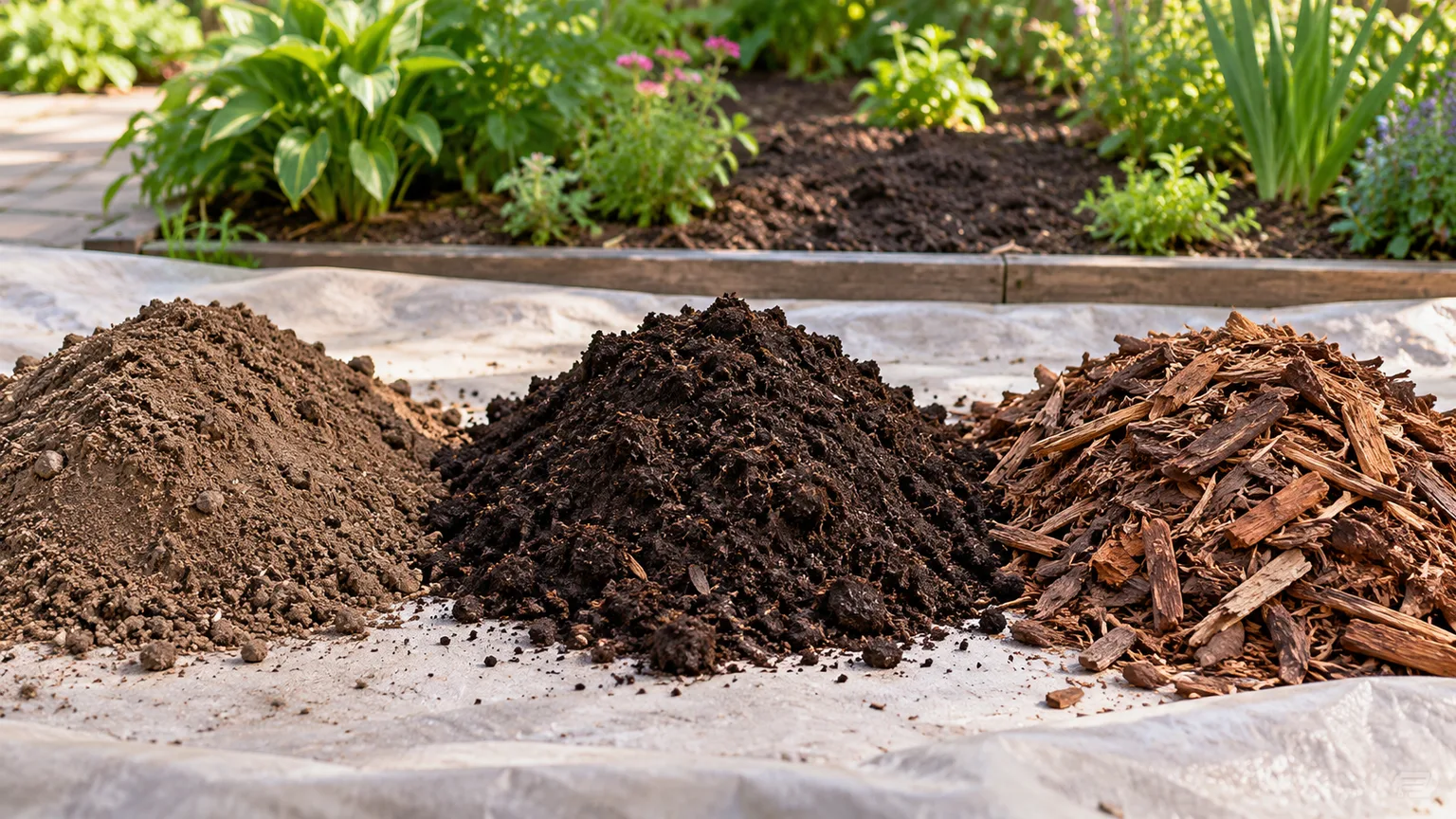
Ask What Went Into the Compost
Ask the supplier to identify the principal feedstocks and how the material was processed. Common feedstocks include leaves, grass clippings, brush, food scraps, manure, municipal green waste, and biosolids. Blended products can use several of these. Feedstock is not a simple ranking from “good” to “bad”: a well-managed product can be made from different materials, but the source affects the questions worth asking about nutrients, salts, and contaminants.
Yard-trimming or leaf compost is often a straightforward option for general lawn topdressing, but it is not automatically low in every nutrient or salt. Manure-based compost can contribute more nutrients, particularly phosphorus, than a yard-waste product. In a local comparison of six compost samples, University of Minnesota Extension found substantial variation in pH, electrical conductivity, nutrient content, and carbon-to-nitrogen ratio; one poultry-manure sample in that small group had much more phosphorus than the other tested materials. That result illustrates why testing matters; it should not be read as a universal nutrient ratio for all poultry compost.
Municipal compost can be made from collected organics and yard materials, and some products may include biosolids. Ask the seller to state the actual feedstock and disclose how the material is screened and tested. If the supplier cannot explain what is in the compost or will not provide basic product data, choose a seller who can. A clear source description gives you a starting point for deciding which measurements to compare with your soil test.
The feedstock question also helps you judge whether a product is suited to a lawn near edible beds, sensitive ornamentals, or a waterway. It is not necessary to assume that any particular feedstock is unsafe. Instead, match the evidence and intended use to the site, and avoid treating an unexplained blend as a known quantity.
Check Maturity and Particle Size
Mature compost is generally dark, crumbly, and earthy-smelling. A few recognizable small leaves, twigs, or woody fibers do not automatically mean the compost is unfinished. UF/IFAS’s compost guidance explains that finished compost can still contain recognizable organic fragments and recommends screening coarse particles when a finer texture is wanted. The practical lawn question is whether the material is stable and fine enough to spread without leaving piles or burying grass.
Avoid material that is hot in the pile, smells strongly of ammonia or decay, contains recognizable fresh food or raw manure, or is dominated by large chunks. Unpleasant odor can have several causes and should prompt a pause and a question to the supplier rather than a guess. Compost that heats after delivery or has very uneven, damp clumps is difficult to apply evenly and may not be ready for a fine lawn layer.
Screening improves consistency and ease of spreading, but “screened” has no single particle size unless the seller specifies it. Ask what screen size was used or request a sample. For established turf, a fine, reasonably uniform texture can sift between grass blades and fill small gaps. Very coarse compost may lodge on top of the turf, while powder-fine material can be dusty and compact when wet. You want a crumbly texture with enough structure to distribute evenly.
Ask for a Test Report or STA Technical Data Sheet
Request a recent analysis from the current product or batch. Useful information may include pH, electrical conductivity (a measure related to soluble salts), nitrogen, phosphorus, potassium, carbon-to-nitrogen ratio, moisture, maturity or stability indicators, and physical contaminant limits. Which values matter most depends on your soil, the feedstock, the planned rate, and local guidance. For example, repeated applications of nutrient-rich compost call for special attention to phosphorus, while a high electrical conductivity may be a concern for sensitive plants or a stressed lawn.
A report is most useful when it shows the lab method, units, sampling date, and a representative sample. Ask the seller how often it is tested and whether the data applies to the exact product you will receive. A product name alone is not enough if its recipe or feedstocks vary between batches. Compare nutrient numbers in the same units; do not infer that a larger number is better. Your goal is a material that fits the intended application and soil condition, not the richest compost available.
The U.S. Composting Council’s Seal of Testing Assurance program is a voluntary industry program that uses test data and a Compost Technical Data Sheet (CTDS) to help buyers compare compost and its recommended uses. An STA CTDS can make product information easier to review, but the seal is not a government guarantee, a universal safety certification, or proof that every product is suitable for every lawn. Read the sheet, confirm the current product, and make the selection using your own site’s needs.
Screen for Contamination and Herbicide Risks
Do a visual inspection for glass, plastic, wire, stones, trash, and other foreign material. A small amount of unavoidable fine grit may occur in some products, but obvious or repeated physical contaminants are a reason to reject a batch or ask for clarification. Confirm that the supplier screens the material and has written quality controls. Visual inspection cannot reveal all chemical contaminants, so pair it with feedstock information and testing where the risk profile calls for it.
Persistent herbicide residues are a particular concern when compost includes manure or hay from forage treated with certain long-lasting broadleaf herbicides. Residues can survive passage through livestock and composting and then affect susceptible plants. UF/IFAS cautions gardeners about manure from animals fed forage treated with persistent herbicides. That guidance is especially relevant if the topdressing could move into nearby vegetable beds or contact broadleaf ornamentals. Ask the supplier what feedstocks were used and whether they have information about herbicide history or testing. If the source cannot be verified and the risk is plausible, do not apply the material across the lawn while you are still investigating.
A visually clean product and a normal earthy smell do not rule out herbicide residues. Nor does a nutrient test usually answer that question. If the material is from an unknown source, has manure or hay in its feedstock, or is intended for an area connected to sensitive plants, ask for traceability and an appropriate test before use. A supplier’s reassurance is useful only to the extent it is backed by knowledge of the feedstock and process.
Use a Small Bioassay if the Source Is Uncertain
A small plant-growth test can provide a warning when the concern is a suspected herbicide residue, but it is not a comprehensive safety test. If you have a sample and a suitable place to isolate it, mix a portion of the compost into a potting medium and grow a susceptible indicator such as peas or beans beside a control grown in known-clean medium. Follow a reliable local extension protocol if available, keep the pots labeled and separate, and watch for abnormal curling, cupping, twisting, or distorted new growth over several weeks.
A normal-looking plant does not prove the compost is free of all contaminants, and a damaged plant does not identify the cause by itself. Seed quality, watering, disease, and other factors can produce similar symptoms. Use the test only as a screening step; do not use it to overrule a credible concern or a supplier’s missing records. When the outcome is uncertain, choose a traceable alternative rather than distributing the material over a large area.
Calculate Volume Before Ordering
Measure the lawn area you actually intend to topdress. For a rectangle, multiply length by width. Divide an irregular lawn into simple rectangles or triangles, calculate each part, and add them. Exclude patios, beds, paths, and areas you will not cover. Planning the application area first prevents a delivery estimate based on the whole property when only part of the turf needs treatment.
Use this formula when ordering by cubic yards:
Cubic yards = area in square feet × depth in inches ÷ 324.
The divisor comes from 27 cubic feet in one cubic yard multiplied by 12 inches in a foot. At a quarter-inch depth, 1,000 square feet needs about 0.77 cubic yard; 5,000 square feet needs about 3.86 cubic yards; and 10,000 square feet needs about 7.72 cubic yards. One cubic yard spread 1/4 inch deep covers about 1,296 square feet. These are theoretical volumes; uneven lawns, settling, material moisture, and handling loss can change the amount needed.
For a half-inch depth, double those quantities. But do not choose the depth simply because more material is available or because a calculator makes a larger order look convenient. Confirm that the turf and local guidance support that depth, and that your spreading method can leave grass visible throughout. If selling by the bag, check whether the label states cubic feet or volume by weight. One cubic yard equals 27 cubic feet, so you can convert a cubic-foot bag count by dividing the needed cubic feet by the bag volume.
If your calculation lands between delivery sizes, ask whether the supplier can deliver a smaller amount or whether the product can be stored safely until a second application. Do not dump excess material in a deep mound over the grass. Compost can be stored only if it remains appropriately managed and does not create runoff, odor, or nuisance concerns; follow local requirements for a large pile.
Choose Timing That Fits the Grass Type
Apply compost when the grass is actively growing and conditions are mild enough for recovery. For many cool-season lawns, that often means early fall, when temperatures ease and the turf can recover before winter. For warm-season grasses, active growth in late spring or early summer is often a better window. These are broad seasonal patterns, not calendar rules: elevation, local climate, grass species, water availability, and regional extension advice should guide the final date.
Avoid topdressing a lawn in heat stress, drought, deep dormancy, saturated soil, or just before heavy rain. A wet surface can smear and compact under foot traffic, while heavy rain can wash fine compost into drains or beds. Frozen ground and periods when the grass cannot grow also make recovery less likely. If you are overseeding, coordinate the timing with the seed’s germination conditions and keep the seedbed moist without causing runoff.
Gardeners’ World’s lawn topdressing guide recommends working while grass is actively growing, preparing a dry lawn, spreading evenly, and brushing material so the grass remains visible. That advice is a useful practical principle, though its seasonal examples are based on UK conditions. Use local turf guidance for your grass type, then use the same observable rule: turf should be able to grow through and recover from the layer.
Prepare and Spread a Thin, Even Layer
Inspect a small test patch before treating the whole lawn. Mow the lawn a little shorter than usual without scalping it, collect the clippings if they would mix with compost piles, and remove loose debris. If the soil is compacted, core aeration may be useful before topdressing, because the cores create channels and the material can work into the surface. Aeration is not mandatory for every lawn; do it when compaction or the intended overseeding method warrants it, and follow local turf recommendations.
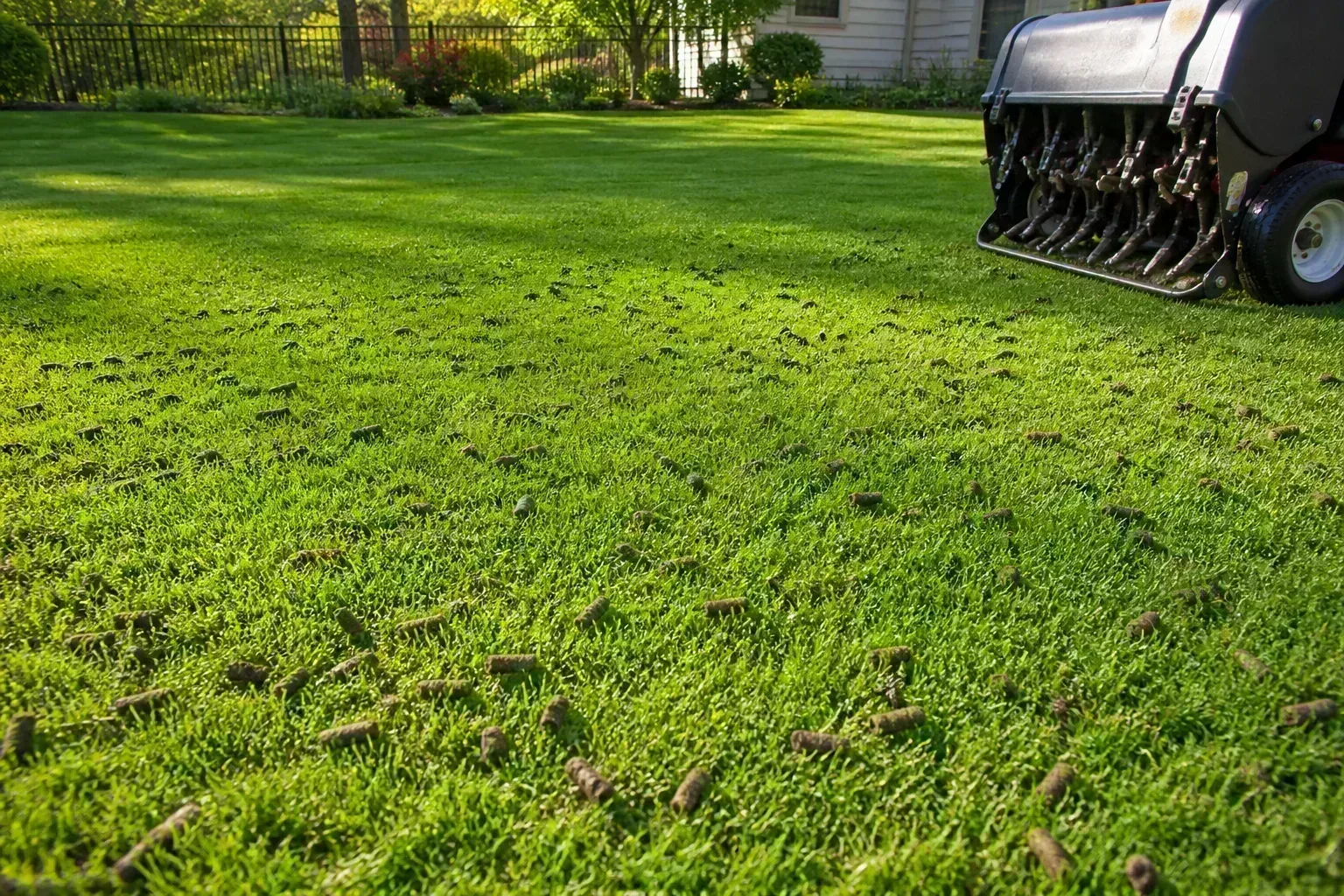
Spread the material when the lawn surface is dry enough to walk on without making ruts. Move small amounts at a time, distribute them in several light passes, and rake or drag the compost so it settles between blades rather than forming a continuous blanket. Use a shovel, wheelbarrow, compost spreader, or a suitable topdressing tool for the area. The method matters less than even coverage and the final depth. A test patch helps reveal whether the texture is too coarse, the compost is dusty, or the chosen application rate is too heavy.
Keep the layer shallow enough that the grass blades and crowns remain visible. If leaves are covered, reduce the amount and work the compost through the canopy. A few thin passes are easier to control than trying to distribute one thick pile evenly. Do not leave large mounds, especially over low areas, because the grass beneath them may be buried and the surface can remain wet or uneven.
Adjust the Method for Seeding or Low Spots
For overseeding, prepare seed according to the grass species and local recommendations, then use only enough compost to help maintain contact and moisture around the seed. Seed should not be buried under a deep compost layer. Keep the surface consistently moist during germination, but avoid standing water and runoff. A compost that is too coarse may leave seed exposed; a very fine material applied too thickly may crust or block light, depending on the seed and conditions.
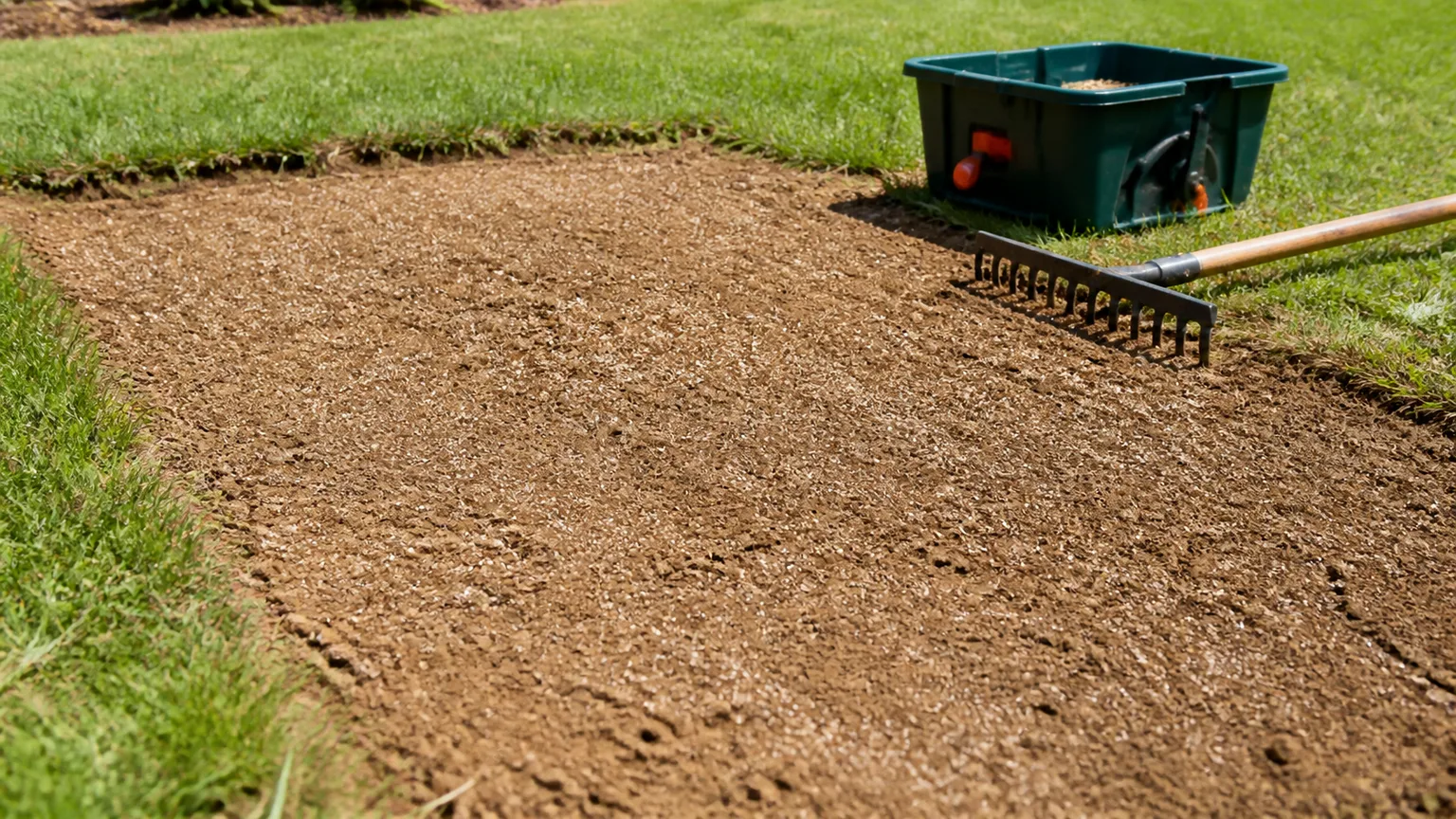
Use a compost-and-topsoil blend or suitable topsoil for modest shallow depressions where adding mineral soil is appropriate. Fill a low place in several thin applications over time so grass can continue to grow between treatments. A deep depression, recurring puddle, or abrupt slope may reflect a drainage or grading problem. Filling it with compost alone can create a soft, organic pocket that settles, so diagnose the cause and choose a durable repair before adding material.
When working around established ornamental beds, keep the product from spilling into areas where an unverified compost could contact sensitive plants. If the lawn meets a vegetable garden, consider a physical barrier or a different, traceable material. A thin layer is easier to keep in place and less likely to create a sudden nutrient load where runoff carries it.
Water, Mow, and Fertilize After Application
After spreading, lightly water only if needed to settle dust and help fine particles contact the soil. Do not flood the lawn; runoff can carry compost and nutrients into sidewalks, storm drains, beds, or waterways. If rain is expected soon, judge the forecast and the slope rather than using irrigation automatically. On an overseeded area, follow the seed-care plan, which may call for frequent light moisture while seedlings establish.
Avoid mowing until the material has settled and the grass blades are clearly exposed. If the mower would throw compost or smear a wet surface, wait for drier conditions. There is no single waiting period for every lawn; inspect the canopy and use the mower’s normal height setting once the surface is firm. Resume ordinary mowing without removing more than the recommended portion of the grass blade.
Do not automatically add fertilizer because compost was applied, and do not assume compost completely replaces fertilizer. Compost nutrient release is variable and often slow. Review the soil test, compost analysis, grass species, and local fertilizer guidance to determine whether additional nutrients are needed. Applying a nutrient-rich compost and a full fertilizer dose on autopilot can add more phosphorus or nitrogen than the lawn uses.
Correct Common Topdressing Problems
Grass is hidden under compost. Remove or rake excess material away as soon as possible, especially over crowns and low areas. Recheck the remainder of the lawn and continue in thinner passes. If the grass is entirely buried in a section, expose it rather than hoping it will grow through a dense cover.
The compost clumps instead of spreading. The material may be too wet, coarse, or unevenly screened. Let a manageable amount dry enough to crumble, break up clods, or screen it before applying. If the product remains lumpy or contains substantial debris, contact the seller before spreading more.
A crust forms after watering. Fine particles can settle and seal a surface, particularly when applied too heavily or to bare soil. Gently rake or brush the crust to open it, reduce further watering intensity, and avoid another thick application. For seeded areas, loosen carefully so you do not dislodge germinating seed.
The lawn yellows or grows unevenly. Do not assume that compost caused the change, but pause additional applications. Review moisture, mowing, disease, heat, and nutrient conditions; compare the product data with the soil test; and ask a local extension office or turf professional if symptoms persist. A nutrient or salt issue is possible, but appearance alone cannot diagnose it.
A nearby bean or tomato plant has distorted new growth. If this follows application of compost containing manure or hay, stop using the batch and document the product and symptoms. Move or protect sensitive plants if practical, contact the seller for feedstock and testing information, and seek local extension advice. Do not spread the same material elsewhere while you are investigating.
Compost washes into a path or drain. Sweep up material before it reaches a storm drain, and avoid further application before heavy rain. Reduce the depth, keep product away from hard edges, and use a buffer or erosion-control measure where the lawn slopes. Nutrients belong in the soil and turf, not in the drainage system.
Know When Compost Is the Wrong Solution
Skip compost topdressing when you cannot establish a credible product source, the batch has obvious contaminants or strong foul odor, or you have unresolved concern about herbicide residues. Do not use a deep layer to level a severe grade or solve chronic water pooling. A drainage correction, soil grading, core aeration, reseeding, sod repair, or a suitable topsoil amendment may be the more direct response, depending on what is wrong.
Compost may also be the wrong choice when the lawn already receives repeated organic amendments and a soil test shows accumulating phosphorus or an undesirable pH or salt condition. In that case, additional compost can compound the problem rather than improve the soil. Take a sample, ask for analysis of the compost under consideration, and follow local recommendations before making another application.
If the grass is newly seeded, stressed, dormant, or very short, wait until it can tolerate the work or follow a species-specific establishment plan. Topdressing involves foot traffic and can cover tender plants. If you cannot spread the material evenly at a shallow depth with the equipment and time available, hire a qualified lawn-care provider or choose a smaller test area first.
Conclusion
Choose compost for a lawn by checking its feedstock, maturity, texture, test information, and fit with the soil and turf problem. Finished, screened compost with a clear source and recent product data is easier to evaluate and spread than an anonymous mix. A dark color or earthy smell is helpful, but neither can substitute for a report or a known supply chain when nutrient balance or contaminants are a concern.
Calculate the volume from the lawn area and a conservative depth, then topdress during active grass growth when the weather and soil are suitable. Begin around 1/4 inch, rake it evenly through the canopy, and keep grass blades visible. Use compost as an amendment with variable nutrients, not as an automatic fertilizer or a cure for drainage and grade problems. Those checks make the material choice more deliberate and help the lawn receive a useful layer without burying the turf.



