Potassium in Lawn Fertilizer: When Grass Needs It
Potassium in lawn fertilizer supports essential grass functions, but more isn’t always better. Learn to read NPK, use a soil test, compare sources, and time applications.
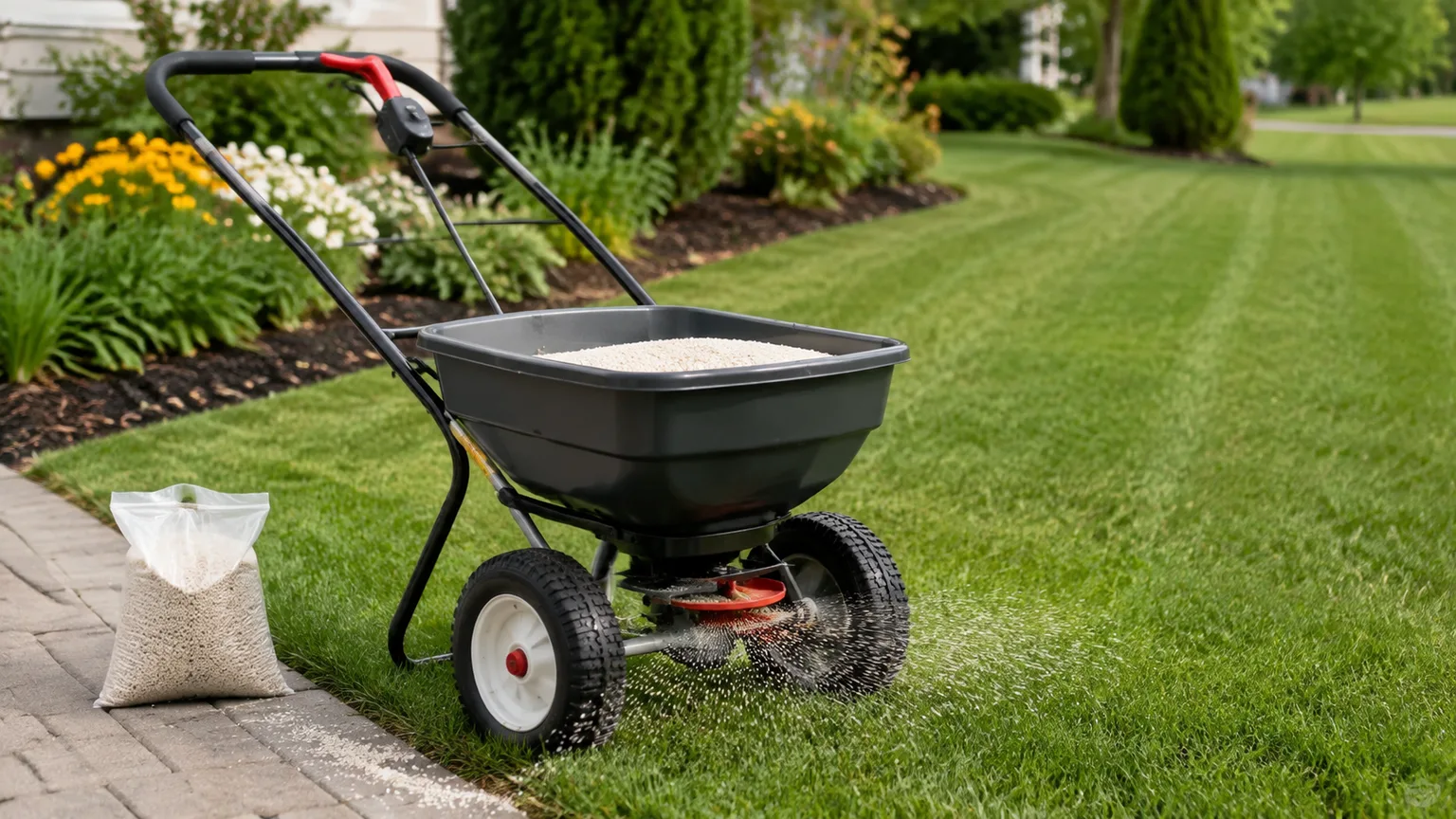
A fertilizer bag that highlights “winterizer” or “high potash” can make potassium sound like a seasonal insurance policy for every lawn. It is an essential nutrient, but the useful question is whether your soil and grass need more of it; adding potassium to a lawn that already has enough may waste money and can sometimes work against turf quality.
Potassium is the third number in the N-P-K analysis on a fertilizer label. It supports important plant processes, including water regulation, but it does not function as a stand-alone drought treatment, disease cure, or guarantee against winter injury. A soil test, interpreted for your region and grass type, is the best starting point for deciding whether to apply it.
The short answer: test before adding potassium
Potassium belongs in lawn fertilizer when a soil test and a turf-management plan call for it. If the test rates soil potassium as low, a measured application can help supply a nutrient the grass is short on; if the result is sufficient or above the local target, extra K is unlikely to make the lawn greener or stronger. The University of Massachusetts Extension explains that plant response is more likely when a soil-test level is low, while adding a nutrient already above the optimum may bring no performance gain and can have adverse effects. (UMass Extension)
A healthy lawn may need nitrogen regularly, but nitrogen, phosphorus, and potassium are not interchangeable and do not all need to be applied on the same schedule. Many established lawns do not need phosphorus, and not every fertilizer application must contain potassium. If your grass is thin, yellow, or browning, check water, mowing height, compaction, shade, pests, disease, and pH before assuming it is hungry for K.
What potassium does inside a grass plant
Plants absorb potassium as the positively charged ion K+. Unlike nitrogen and phosphorus, potassium is not built into a large structural molecule such as protein or DNA; it activates enzymes and helps regulate processes that let a plant grow, use energy, and move water. Turfgrass guidance describes K as a major nutrient involved in metabolism, internal water management, stress response, and wear tolerance. (Penn State Extension; Kansas State University)
The nutrient also matters in the soil around the roots. A test does not measure every atom of potassium in the ground; it estimates a plant-available fraction using a laboratory method calibrated for regional soils and crops. That is why two laboratories can report different numbers or recommendations for the same lawn, and why a soil-test “low” rating should be interpreted using the lab’s own category rather than a generic internet chart.
How K helps regulate water and metabolism
Potassium helps maintain osmotic balance and turgor: the water pressure that keeps plant cells firm. It also affects stomatal movement and enzyme activity, linking K status to water use and basic metabolism. When turf is genuinely short of potassium, it may be less able to cope with heat, drought, wear, disease pressure, or cold than adequately nourished turf. (Penn State Extension)
That relationship is conditional. Adequate K supports normal plant function; it does not replace irrigation during drought, sound mowing, good drainage, disease diagnosis, or appropriate grass selection. A patch that wilts because its soil is hydrophobic or compacted is not automatically a potassium problem, and fertilizer cannot correct the physical condition stopping water from reaching roots.
Why more K is not automatic stress protection
Marketing often turns a true plant function into a bigger promise: if K is associated with stress tolerance, a high-potassium product must prepare every lawn for winter. That conclusion does not follow. A turf specialist at the University of Delaware cautions that where soil K is sufficient, extra fall potassium is wasteful and research does not support routine K applications as a way to increase root mass, rooting depth, or winter hardiness at standard recommended rates; excessive applications can also reduce turf quality and promote disease in some species. (University of Delaware Cooperative Extension)
Other turf guidance recommends keeping K adequate through the growing season and notes that K can be important to cold tolerance. Those statements can coexist: correcting a measured deficiency is different from adding extra potassium to a soil already in the optimum range. General autumn lawn advice may still recommend an autumn feed for a lawn that needs a boost, but the word “autumn” on the package is not a soil diagnosis. (Kansas State University; Gardening Know How; Royal Horticultural Society)
Read the third number on a fertilizer label
In the United States, the fertilizer analysis lists percentages by product weight in a fixed order: nitrogen (N), phosphate equivalent (P2O5), then potash equivalent (K2O). A 10-0-20 product contains 10 percent nitrogen, no phosphate, and 20 percent potash equivalent by weight. The third number is not the percentage of elemental potassium metal; it is the conventional K2O equivalent used on fertilizer labels. (University of Georgia Cooperative Extension)
The numbers are not a recipe that every lawn should follow, and a “complete” product is not automatically better because it contains all three nutrients. If a soil report says phosphorus is already high but K is low, a fertilizer with a large middle number may add a nutrient the lawn does not need. Look at the analysis and the soil-test recommendation together, then compare how much N, P2O5, and K2O a full application would deliver.
A quick N-P-K calculation
Take a hypothetical 40-pound bag labeled 16-0-8. The product is 8 percent K2O, so the whole bag contains 3.2 pounds of potash equivalent: 40 × 0.08. It also contains 6.4 pounds of nitrogen, which means the bag rate that meets a potassium target may deliver more nitrogen than you want at that time.
A label ratio describes the relative shares of N, P2O5, and K2O; it does not tell you the correct pounds per lawn. The rate comes from the soil test, the treated area, the product’s analysis, and its label. If your lab reports elemental K while a fertilizer rate is expressed as K2O, do not compare the numbers as if they used identical units; ask the lab which form its recommendation uses.
Why lawn appearance cannot confirm low potassium
Unlike nitrogen deficiency, which often produces a gradual loss of green color and slower growth, potassium deficiency in turf can be difficult to diagnose by looking. Lower stress tolerance, weak growth, or increased disease and winter injury can accompany low K, but none is unique to potassium. Drought, mowing too short, heat, poor rooting, compaction, shade, insects, fungal disease, salt exposure, and pH-related nutrient availability can produce overlapping symptoms.
A quick visual “leaf-edge scorch” diagnosis is particularly unreliable on a lawn. Brown or yellow grass is a clue to investigate, not proof that the soil lacks potash; adding fertilizer before identifying the cause can intensify salt stress or push growth at the wrong time. Pennsylvania turf guidance notes the link between K deficiency and stress susceptibility, while Delaware Extension advises ruling out biotic problems such as pathogens and abiotic problems such as heat or drought before reaching for fertilizer. (Penn State Extension; University of Delaware Cooperative Extension)
If the lawn is declining in distinct patches, compare affected and healthy spots: Is the soil dry at root depth? Does water bead or run off? Are there signs of grubs or fungal growth? Was fertilizer applied recently? These observations help decide whether to test nutrients, inspect roots, improve irrigation, or submit a turf sample to a local extension service; they are not substitutes for a potassium test.
Get a useful soil test before choosing fertilizer
A lab soil test is more useful than a shelf kit for setting a nutrient rate because it measures and interprets available nutrients with a method calibrated for your region. Many lawn tests report pH, phosphorus, and potassium, along with organic matter or other soil properties; standard soil tests often omit nitrogen because soil nitrogen changes quickly. (Purdue Extension) Test every distinct management area separately, such as a front lawn that has been fertilized regularly and a backyard that has not.
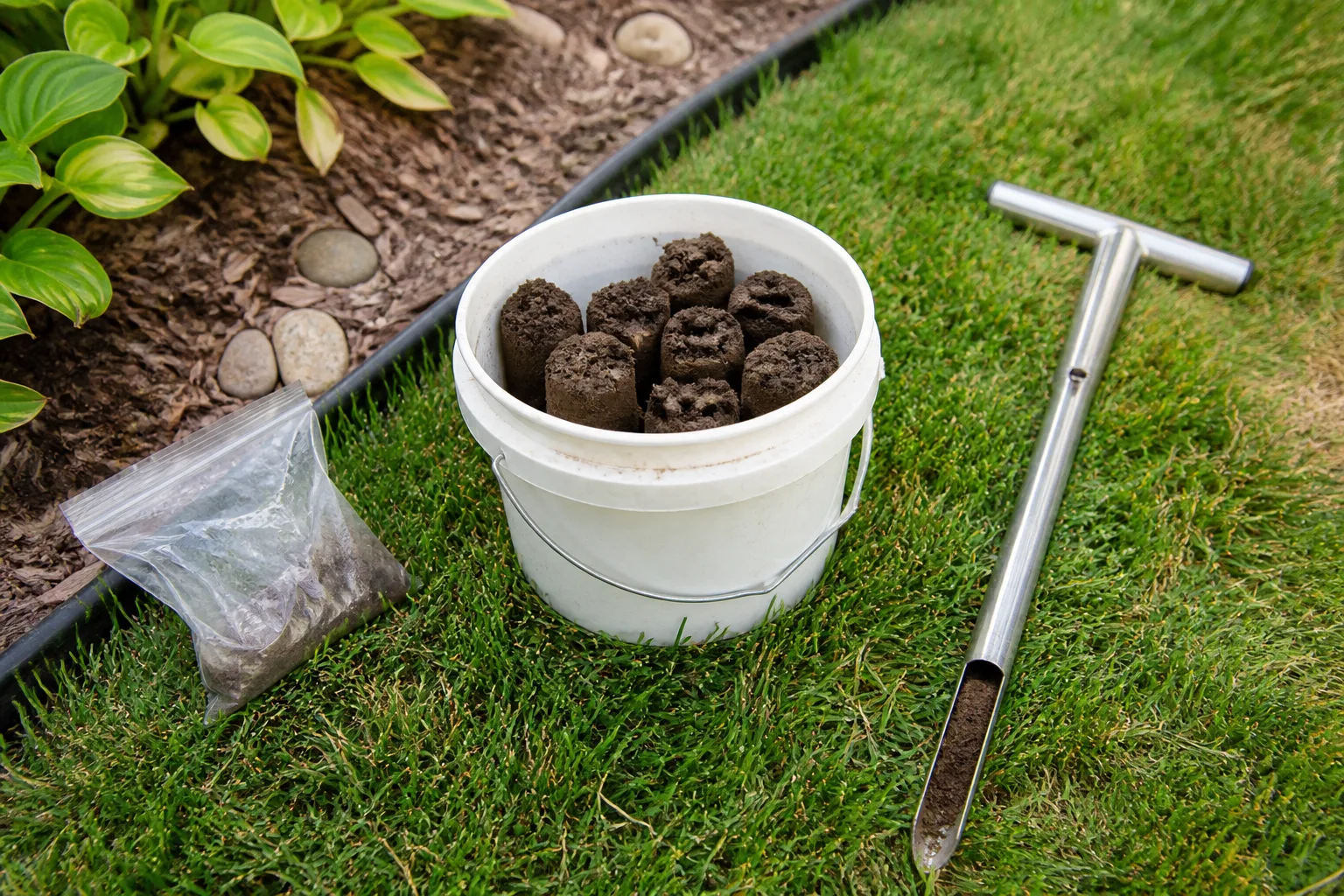
Follow the laboratory’s sampling instructions, because recommended depth and test method vary. In general, take multiple cores from a uniform lawn area at the same depth, mix them in a clean bucket, and send the composite sample; keep a problem patch separate if you want to compare it with healthy turf. Avoid unusual spots such as compost piles, pet-waste areas, fertilizer spills, road edges, and recently amended soil unless one of those spots is itself what you are investigating. (Purdue Extension)
Collect a representative lawn sample
Use a soil probe, corer, or clean trowel and take cores from across the area rather than collecting a single scoop. A composite sample smooths out natural variation, but it only describes the zone you sampled, so do not combine shaded and sunny lawn sections or separate soil types if they are managed differently. Purdue Extension recommends careful collection and preparation because an unrepresentative sample can lead to inappropriate fertilizer or lime decisions. (Purdue Extension)
Tell the lab that the sample is for an established lawn and identify the grass type if known. Use the report’s K category and its recommendation, not another state’s table: labs may use different extractants, units, thresholds, and assumptions about whether you return clippings or intensively manage the turf. Retest on the schedule the lab recommends; sandy soils with substantial rainfall or irrigation may need closer monitoring because potassium can move below the root zone more readily there. (Missouri Extension; Kansas State University)
Choose a potassium source that fits the test
If the lab calls for K, compare products by nutrient analysis, accompanying nutrients, cost, and application risk rather than by words like “premium,” “winter,” or “natural.” The two common concentrated sources for lawns are potassium chloride, often called muriate of potash, and potassium sulfate, often called sulfate of potash. A fertilizer containing K can also carry nitrogen, phosphorus, sulfur, or other ingredients, so read the complete analysis and ingredient statement.
| Source | Typical lawn analysis | What else it supplies | Practical trade-off |
|---|---|---|---|
| Potassium chloride (muriate of potash) | 0-0-60 | Chloride | Concentrated and commonly less expensive; its higher salt load raises burn risk if overapplied or poorly watered in. |
| Potassium sulfate (sulfate of potash) | 0-0-50 | Sulfur | Lower salt index than potassium chloride in UMass’s comparison, but often costs more; still follow the test and label rate. |
| Potassium nitrate | 13-0-44 | Nitrogen | Adds N along with K, so it may not fit a plan that calls for K alone or little additional N. |
The listed analyses are common examples, not promises that every product has the same grade; check the local bag. UMass compares common K sources and their salt indices, while Missouri Extension warns that K fertilizers can injure turf, especially when rates are excessive or the material is not watered in as directed. (UMass Extension; Missouri Extension)
Potassium chloride versus potassium sulfate
Potassium chloride is efficient when the soil test calls for potash and chloride is not a concern. It delivers more K2O per pound of product than many alternatives, so the bag weight needed to meet a target may be smaller; its chloride and salt load also make accurate spreading important, particularly on heat-stressed turf or where irrigation water is already salty.
Potassium sulfate supplies sulfur as well as potassium and has a lower salt index in the UMass comparison, but that does not make it the right choice for every lawn. If your soil does not need sulfur, or your test does not call for K, buying a lower-burn source still adds a nutrient without a demonstrated need. Ask your local extension lab or turf specialist about chloride, soil texture, irrigation-water quality, and product selection when these factors matter. (UMass Extension)
Organic sources and grass clippings
Organic does not mean nutrient-free, exact, or automatically low-risk. Wood ash can contain potassium, but its nutrient concentration varies and it also raises soil pH; use it only when a test supports both the potassium addition and the pH effect. Compost and manure also have variable analyses and may add phosphorus or salts along with K, so they should be counted as fertilizer inputs rather than treated as a free, precisely measured substitute.
Grass clippings return potassium and other nutrients to the soil as they decompose. Missouri Extension reports that returned clippings can contribute up to 25 percent of a lawn’s total fertilizer needs, while Oregon State Extension notes that recycling clippings can reduce fertilizer needs substantially in some situations. The amount varies with lawn growth, mowing, clipping removal, and soil conditions, so do not subtract a fixed percentage from your lab recommendation without local guidance. (Missouri Extension; Oregon State University Extension)
Banana peels are not a dependable lawn treatment for low soil K: they release nutrients slowly as they decompose, are difficult to spread evenly across turf, and do not provide a calibrated dose. For an actual deficiency, use a known-grade fertilizer at the test’s rate; for ongoing soil quality, focus on practices such as returning normal clippings, maintaining suitable mowing height, and avoiding unnecessary nutrient applications.
Time K to grass growth, not just the season name
Potassium is needed while the grass is growing, but there is no universal date when every lawn needs a high-K product. The useful timing depends on whether your grass is cool-season or warm-season, whether it is actively growing, the soil-test level, clipping removal, soil texture, irrigation, and the amount of N that comes with the chosen fertilizer. Apply only at the rate and under the conditions on the label and local guidance.
Cool-season lawns and fall feeding
Kentucky bluegrass, perennial ryegrass, and tall fescue are cool-season grasses that generally grow most actively in cooler parts of the year. If a soil test finds low K, a lab may recommend correcting it before a period of stress; fall can be a practical time for cool-season turf when it is still actively growing, the ground is not frozen, and the product is allowed for that use. It is not a blanket rule that every cool-season lawn needs a special potassium-heavy “winterizer.”
The autumn advice found in horticulture publications usually reflects a broader turf-care approach: avoid stimulating tender top growth late in the season and feed only lawns that need a boost. Turf specialists differ on how much extra K improves winter performance when soil K is already sufficient; Delaware Extension emphasizes that extra K should not be assumed to improve roots or winter hardiness, while other regional guidance focuses on maintaining adequate levels. Use the current recommendation from your local soil-testing lab and extension turf program to resolve that difference for your grass and soil. (Gardening Know How; Royal Horticultural Society; University of Delaware Cooperative Extension; Kansas State University)
Warm-season lawns and dormancy
Bermudagrass, zoysiagrass, St. Augustinegrass, and centipedegrass grow most actively in warm weather and slow or go dormant as temperatures fall. A fertilizer applied after the lawn stops growing cannot be assumed to build the same reserves as an application taken up during active growth, and late nitrogen can be especially poorly timed for dormant or soon-to-dormant turf. If a test recommends potassium, follow a schedule written for your grass and region rather than copying a cool-season calendar.
In hot or dry weather, first check that grass is growing and has enough moisture to use nutrients. Adding soluble salts to wilted turf, or fertilizing immediately before intense heat, can add stress; water management, mowing height, drainage, and pest or disease checks may matter more than another nutrient. University of California’s lawn guidance recommends applying fertilizer when grass is actively growing, while regional timing varies with grass species and climate. (UC Statewide IPM Program)
Turn a soil-test recommendation into a bag rate
A fertilizer label gives a percentage, while a soil report may recommend pounds of K2O per 1,000 square feet. To estimate product needed for a known area, divide the recommended pounds of K2O by the fertilizer’s K2O fraction, then multiply by the number of 1,000-square-foot units in the lawn. For example, if the lab recommends 1 pound of K2O per 1,000 square feet and the product is 0-0-50, divide 1 by 0.50: you need 2 pounds of product per 1,000 square feet.
For a 4,000-square-foot lawn at that same example recommendation, the arithmetic would be 2 pounds × 4, or 8 pounds of product total. That is only an illustration of the math, not a universal application recommendation; follow your own report and the product label, and check whether the report says K, K2O, pounds per acre, or another unit before calculating. The label’s percentage is a fraction of product weight, not the amount to spread on each square foot. (University of Georgia Cooperative Extension)
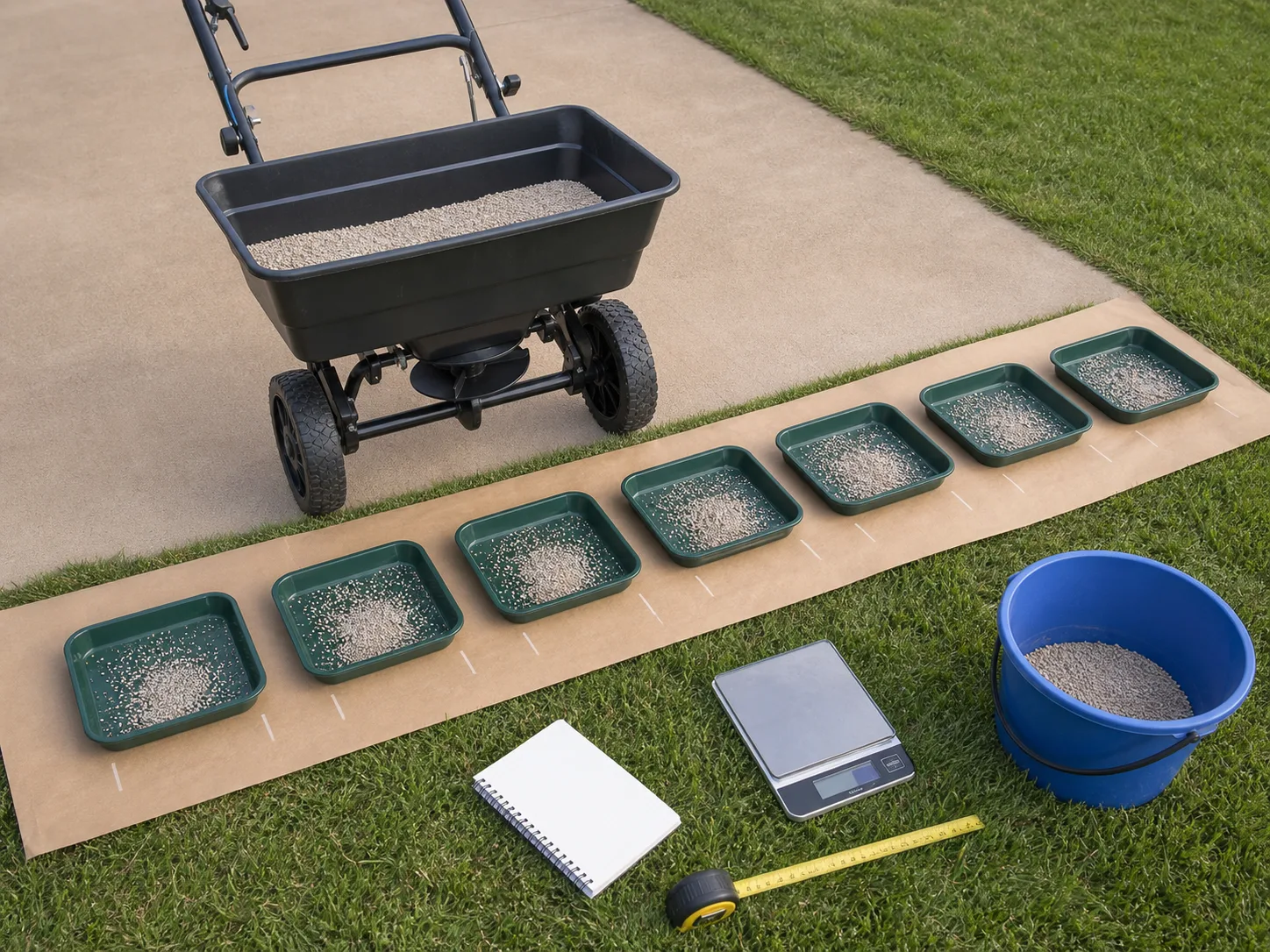
If the soil test calls for both K and N, select a product that meets both targets without exceeding the label’s per-application limit. If one product cannot match the recommendation cleanly, do not force a ratio by applying extra P or N; ask the lab for a suitable analysis or whether the recommendation can be split into separate applications. On coarse sandy soils, extension advice may favor smaller, more frequent applications to reduce loss below the root zone, but the local rate and label always take precedence. (Kansas State University)
Apply carefully and protect soil and water
Before spreading, measure the lawn area, set the spreader according to the product instructions, and avoid overlapping passes that double the dose. Shut off the spreader near sidewalks, driveways, bare soil, drains, ponds, and streams; sweep any granules off pavement back onto the lawn rather than hosing them toward the gutter. The EPA warns that stormwater can carry fertilizer from paved surfaces into storm drains and waterways, especially when rain is forecast. (U.S. Environmental Protection Agency)
Follow the bag about whether to water after a granular application. Many turf products are watered in to move particles off leaf blades and into the soil, but heavy irrigation can cause runoff or move nutrients beyond the root zone, especially where soil is sandy, compacted, or sloped. Do not fertilize frozen ground, waterlogged turf, or immediately before a heavy storm, and follow state, county, or watershed restrictions: fertilizer rules vary by location, and phosphorus restrictions are common in some jurisdictions.
Potassium is not generally treated like phosphorus as a primary driver of algae growth, but that does not make careless application harmless. Extra nutrients can wash or leach from the lawn, chloride can accumulate in sensitive situations, and any fertilizer displaced from turf is wasted input. Use the amount the grass can use, keep it on rooted areas, and check local environmental guidance where the lawn borders a water body or drains directly to a storm sewer. (Colorado State University Extension; U.S. Environmental Protection Agency)
Conclusion
Potassium helps grass regulate water, activate enzymes, and manage normal growth and stress. Those benefits depend on adequate—not endlessly increasing—soil K: a low soil-test result can justify a measured application, while an optimum or high result is a reason to skip the extra potash and investigate other causes of a weak lawn.
Start with a representative soil sample and your local lab’s recommendation. Read the third fertilizer number as K2O, choose a source whose accompanying nutrients fit the report, calculate the product rate for the measured lawn area, and apply it only when the grass and conditions are right. That approach answers whether your lawn needs potassium far more reliably than a seasonal label or a brown patch can.



