Colorado Blue Spruce Care: Planting, Growth, and Problems
Plan and care for Colorado blue spruce with clear planting steps, cultivar sizes, watering guidance, and realistic advice on heat, humidity, and needle cast.
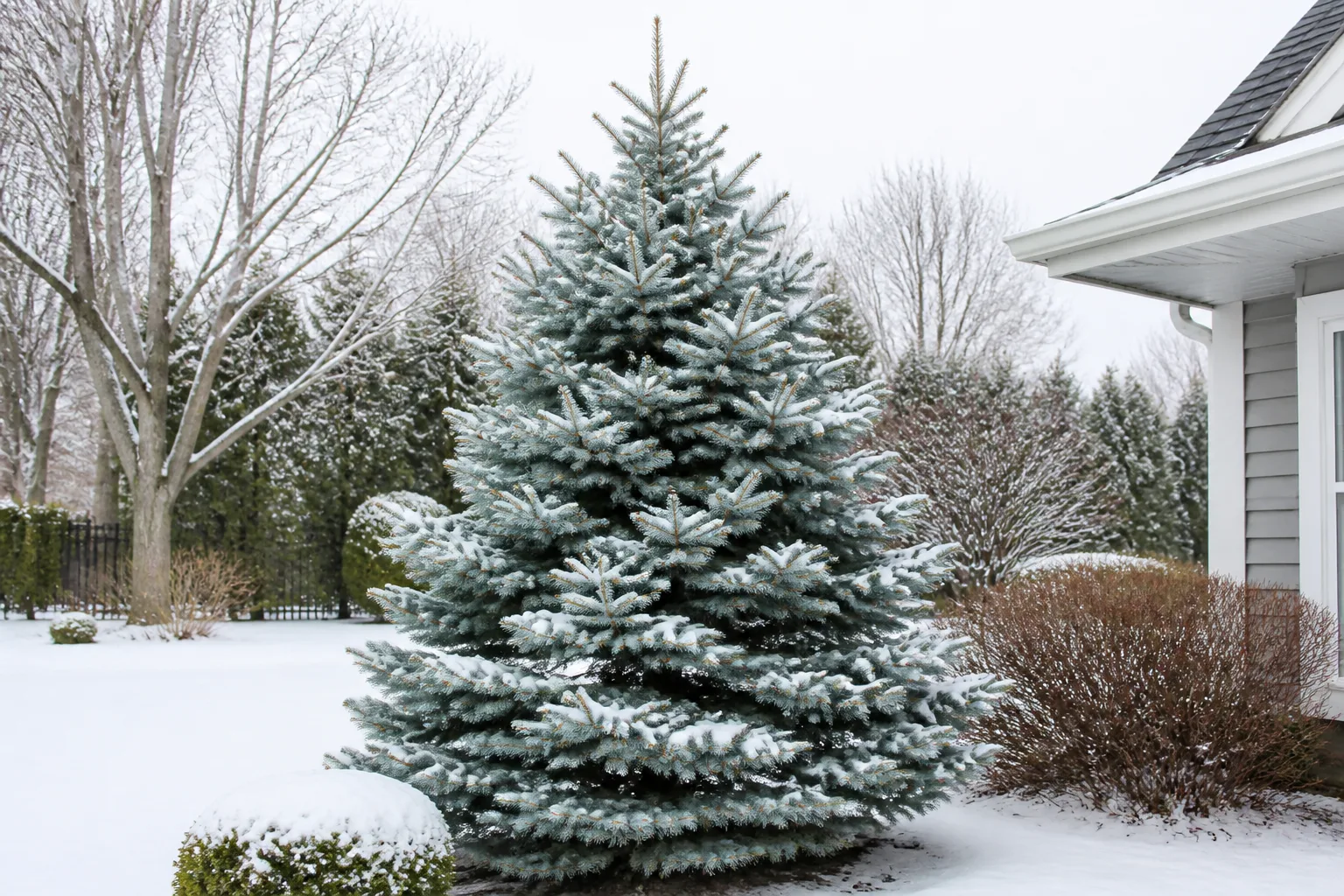
Colorado blue spruce is best where cold winters, open sun, well-drained soil, and room for a large evergreen come together. Its stiff, prickly blue-green needles can make a striking year-round specimen, but winter hardiness alone does not make it a good choice for a hot, humid, compact, or drought-prone yard.
The first decision is not how often to water. It is whether the mature tree and your local summer climate fit the site. If they do, thoughtful planting and moisture management can reduce stress; if they do not, a smaller cultivar or a locally adapted conifer will usually be easier to live with.
Is Colorado Blue Spruce a Good Fit for Your Yard?
Colorado blue spruce, or Colorado spruce, is the species Picea pungens, a Rocky Mountain native. The species can grow roughly 30 to 60 feet tall, with exceptional trees much taller.
Its outline is typically a dense pyramid with stiff branches, so a young nursery tree that looks narrow can occupy a substantial amount of sky and ground as it matures. Oregon State University’s Landscape Plants profile describes the species’ size, sun preference, native range, and variation in needle color.
Use this spruce when you can accommodate its mature dimensions and give it airflow. It works as a specimen, an informal windbreak, or a large property-edge evergreen in climates where it stays healthy.
It is a poor choice for a narrow foundation bed, beneath power lines, or in a location that stays wet after rain. Its sharp needles also make it less comfortable beside a narrow walkway or play area.
Be honest about the climate, too. Colorado blue spruce is cold-hardy, but it is not a universal evergreen for every USDA hardiness zone.
USDA zones describe average annual winter lows; they do not capture summer heat, humidity, extended needle wetness, reflected heat from pavement, or drought. Those factors can be decisive for a tree adapted to high-elevation conditions.
Know the Tree and Choose a Cultivar
The common name “blue spruce” can suggest that every tree will have the same silver-blue color and shape. It will not. Picea pungens seedlings vary from green to intensely blue, and many ornamental blue forms are cultivars selected and propagated to retain particular traits. Look for a cultivar name on the plant tag, then check its expected dimensions and habit rather than relying on a small pot label that only describes its size at sale.
Compare mature habits before choosing
| Type | What to expect | Best use |
|---|---|---|
| Species form | A large, dense, pyramidal tree; Oregon State lists a common range of about 30–60 feet tall, with larger exceptional trees. Needle color varies. | Large yards, open sites, and landscape-scale screening |
| ’Fat Albert’ | A broad, upright, blue-green cultivar; Oregon State lists about 10–15 feet tall and 10–12 feet wide at 10 years, not as a guaranteed final size. | A smaller but still substantial focal tree |
| ’Baby Blueeyes’ | An upright, semi-dwarf, broad-pyramidal selection that holds blue color. The original tree was about 10 feet tall at 21 years, so it is not a tiny shrub. | A smaller site that still has room for a tree |
| ’Montgomery’ | A compact spruce that starts rounded and can form a leader as it ages. Oregon State estimates roughly 4.5 by 3 feet at 10 years and an eventual garden size near 8 by 6 feet. | Rock gardens, foundation-free beds, and small landscapes |
| ’Glauca Globosa’ | A dwarf, rounded blue form; nursery names and shape can overlap with ‘Montgomery’. | A low accent when the tag confirms the expected mature form |
The figures are useful planning estimates, not promises: climate, graft, nursery stock, and time change the result. Oregon State’s profiles for ‘Fat Albert’, ‘Baby Blueeyes’, and ‘Montgomery’ make it clear that “compact” can still mean a tree several feet wide or tall. The separate Gardening Know How guide to Montgomery spruce likewise describes it as a slow-growing dwarf selection that needs sun and well-drained soil.
Cultivar choices also affect color and silhouette. ‘Hoopsii’ is valued for very blue foliage, while weeping forms such as ‘Glauca Pendula’ need space for their cascading branches and may be trained to a support.
The Fine Gardening plant profile for ‘Glauca Pendula’ describes its slow growth and spreading habit. For any cultivar, ask the nursery whether listed dimensions refer to 10 years or mature size, and whether the plant is grafted. A graft union should remain above ground after planting.
Give the Tree Room to Mature
A useful spacing rule is to plan for the mature canopy, not the tree’s current pot. Check the label for height and width, then leave at least the expected mature radius between the trunk and a building, fence, or other large plant; increase that distance where roof overhangs, maintenance access, or snow shedding matter.
For full-size forms, that often means a setback measured in many feet, not a few feet. Do not plant a standard Colorado blue spruce where future pruning would have to keep it smaller than its natural form.
For a row or windbreak, space trees according to their eventual spread and the air circulation they need. Close planting may make a screen look full sooner, but overlapping crowns and damp, still air can increase disease pressure and make inspection and pruning harder. A row of tightly packed blue spruces is also a long-term commitment: if one tree declines, replacing it can leave an obvious gap for years.
For trees that will be full-size, plan so mature branches do not overlap. Wisconsin Extension specifically recommends adequate spacing because a drier, airier canopy is less favorable for Cytospora canker and easier to maintain.
Before digging, locate underground utilities and check for overhead wires, drainage lines, and irrigation. Consider where snow from a roof will fall, whether road salt reaches the site, and whether heat radiates from a south- or west-facing wall. A promising spot in spring can become harsh in midsummer when paving, reflected light, or an exposed wind corridor dries the root zone.
Plant in Spring or Early Fall
Plant when the soil is workable and weather is mild enough for roots to begin growing before summer heat or a hard freeze. Spring is a reliable choice in cold-winter regions.
Early fall can also work if the tree has enough time to establish roots before the ground freezes; avoid planting late in the season where winter arrives early. In a mild-winter climate, follow local nursery and extension timing rather than assuming a calendar date works everywhere.
Set the root flare at soil level
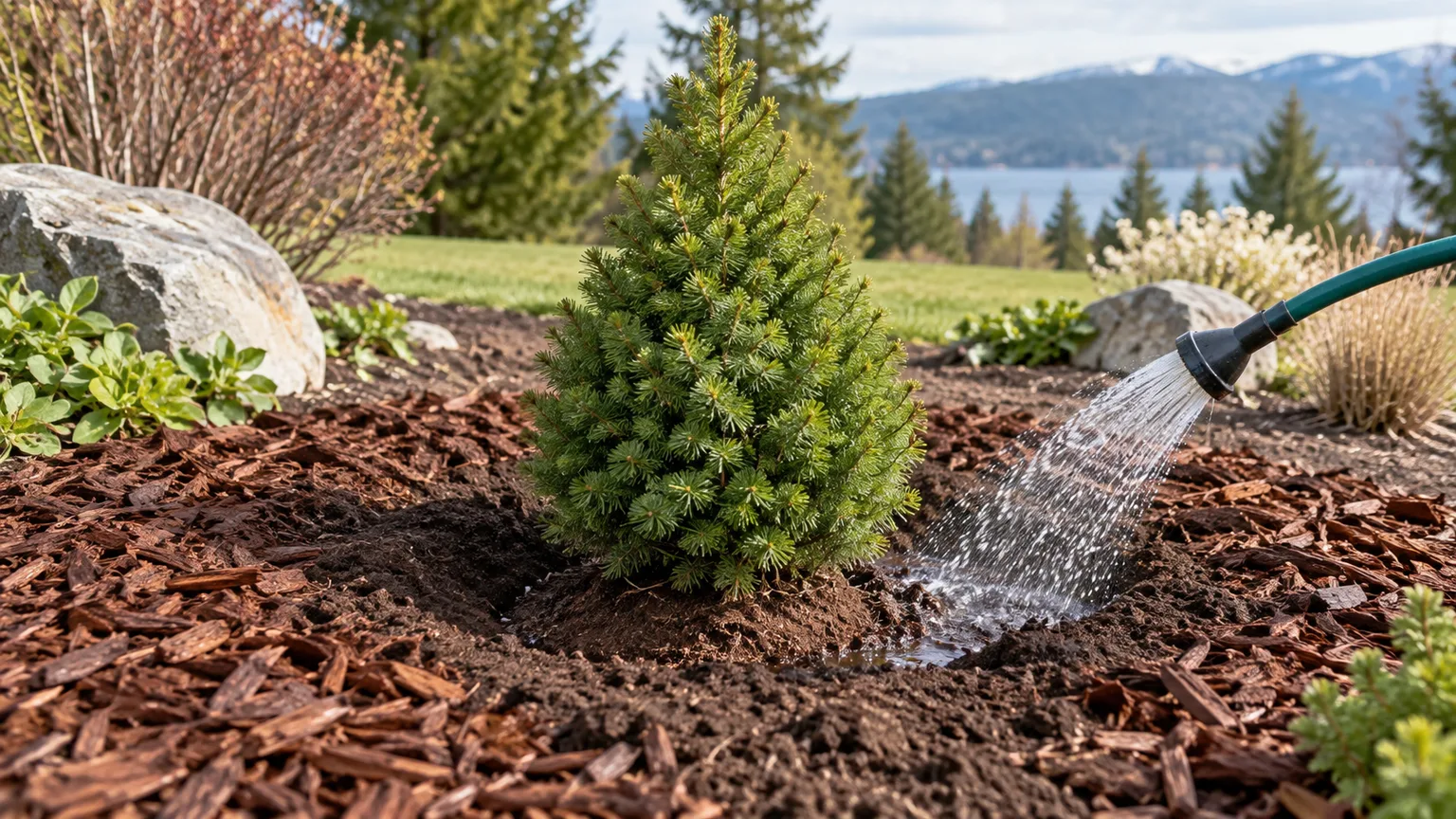
The planting method is straightforward, but depth matters. Dig a hole two to three times as wide as the root ball and no deeper than its measured height.
Find the root flare—the point where the trunk widens into the first structural roots—and set it at or just above finished soil level. If the flare is buried in the nursery pot, remove excess soil from the top of the ball before you set the tree.
Backfill with the soil you removed, breaking up large clods without turning the hole into a pocket of rich compost. Do not put fertilizer or a thick layer of amendments under the root ball.
Water slowly as you backfill to settle soil around roots and close air gaps; then check the tree from several directions to make sure the trunk is upright and the root flare remains visible. Stake only if the root ball cannot stay stable, and remove supports once the tree holds itself.
Water for Establishment, Not by the Calendar
A newly planted spruce needs consistent moisture while fine roots grow into surrounding soil, but “regularly” should not mean frequent shallow sprinkling. Check moisture in the original root ball and the surrounding soil, because a porous nursery mix can dry at a different rate from heavy garden soil.
If the root ball is drying several inches down, apply water slowly enough to soak it and the adjacent soil; if it is still damp, wait. The point is to keep roots from drying out without leaving them in saturated ground.
During the first growing season, inspect the root zone more often during warm, windy, or rainless weather. A smaller container-grown tree can dry faster than a large balled-and-burlapped tree, while compacted clay may remain wet long after the surface looks dry.
By the second and sometimes third year, stretch the interval between waterings as roots establish, but continue checking through drought. Tree establishment depends on soil and weather, not a fixed “one inch every week” recipe.
Established trees tolerate some dry periods better than many spruces, yet that does not make them desert plants. During a prolonged drought, water slowly over the root zone rather than only at the trunk.
In fall, a deep watering before the ground freezes can help when the season has been unusually dry, especially for an evergreen exposed to winter wind. Never compensate for a poorly drained site by watering on a rigid schedule.
Match Sun, Soil, and Climate
Full sun gives Colorado blue spruce its best dense form and often its strongest blue color. Choose a site with at least six hours of direct light and open air around the crown.
It can tolerate some light shade, but sustained shade can produce a thinner, less balanced tree and leave foliage damp longer after rain. Do not try to solve a hot-site problem by placing the tree in deep shade; that changes light without fixing the underlying climate or drainage.
The soil should drain well and hold enough moisture for steady root growth. Oregon State describes the species as adaptable but notes its preference for rich, moist soil.
It can grow in different textures, but heavy, compacted soil that stays saturated is a different problem from ordinary clay: oxygen-starved roots decline, and standing water encourages root damage. If a test hole remains full of water long after rain, choose another site or a different tree rather than adding a handful of sand or gravel to the planting hole.
A soil test is more useful than guessing that the soil needs acid, fertilizer, or a particular amendment. Colorado blue spruce is not a plant that needs a complicated custom mix. Improve the broader soil structure where feasible, protect the root zone from compaction, and avoid piling mulch against the trunk.
Treat heat and humidity as separate limits
Blue spruce is well suited to cold regions with moderate summers, but performance becomes less reliable in places with hot summers, high humidity, or both. Heat increases water demand; humidity and long periods of wet foliage can favor needle diseases.
A tree can be hardy enough to survive local winter lows and still decline because summer conditions keep stressing it. Purdue Extension identifies drought, excessive heat, humidity, and compacted or heavy clay soil as common sources of environmental stress for blue spruce in Indiana landscapes in its blue spruce landscape update.
Dry heat is not automatically safe either. In the high-desert Southwest, Colorado blue spruce can need more water than a landscape can sustainably provide and suffer through hot, dry summers.
Landscape designer Mark Brotton makes that regional distinction in Fine Gardening’s guidance on blue-spruce alternatives for the Southwest. Use your local summer climate, water availability, and site exposure as part of the planting decision, not just the winter hardiness rating on a tag.
If neighbors’ mature blue spruces repeatedly lose lower branches or thin out, treat that as useful local evidence. A tree thriving in a cool, breezy mountain town does not prove it will perform beside a humid lawn or a sun-baked driveway. When in doubt, ask a local extension office or a qualified arborist which spruce or conifer is dependable in your county.
Mulch, Feed, and Protect Without Overdoing It
Apply a broad, thin mulch layer over the root zone to reduce temperature swings and conserve moisture. Keep mulch several inches away from the trunk and root flare; a mulch volcano traps moisture against bark and conceals a buried flare. Replenish only when the layer has decomposed or thinned, not because a calendar says it is time.
Do not fertilize every blue spruce annually by default. If growth is weak, first look at drainage, root depth, drought, needle disease, salt, and planting depth.
A soil test or local extension recommendation can show whether nutrients are actually deficient. Extra nitrogen cannot restore needles that have already fallen, and fertilizer salts can further stress roots when applied incorrectly.
Protect a young tree from animal rubbing and road salt where those are local problems. Colorado blue spruce is often less attractive to deer than many broadleaf plants, but “deer-resistant” is not deer-proof, especially in winter or when other food is scarce. A physical guard or temporary barrier is more predictable than relying on taste.
Prune for Health, Not Height Control
A blue spruce usually needs little routine pruning. Remove dead, broken, or clearly diseased branches with clean, sharp tools, cutting just outside the branch collar rather than leaving a long stub or cutting flush against the trunk. For an uncertain disease, avoid pruning in wet weather and do not move suspect material through the canopy; bag or dispose of it according to local extension guidance.
To lightly shape a young tree, shorten only a portion of the current season’s new growth while it is still soft. Never remove the top leader to control height: topping destroys the formal outline, can trigger poorly attached replacement leaders, and does not keep the tree permanently small.
Spruce generally does not resprout reliably from bare, old wood, so a branch that has lost its green needles is unlikely to fill in after a hard cut. If the tree is outgrowing the location, remove or replace it before structural pruning becomes an annual battle.
Grow From Seed or Buy a Named Cultivar
Seed is a reasonable way to grow the species if you enjoy raising trees and can wait. Seeds collected from cones may germinate into plants with variable needle color and form, so a seedling is not a dependable way to reproduce a named blue cultivar. Cold stratification can improve germination; use a seed-starting guide from a botanical garden or extension service for timing and sanitation details, then keep young seedlings evenly moist and protected from drying wind.
Named cultivars are typically maintained by vegetative propagation, such as grafting or cuttings, which is why nursery stock costs more than a seedling. Oregon State notes that ornamental blue forms are often propagated by grafting; its ‘Fat Albert’ profile also identifies grafting or cuttings as propagation methods. For most home landscapes, buying a labeled cultivar is the practical route: you can choose a known habit and estimate the space it will need instead of waiting years to learn whether a seedling fits.
Read Browning Before Treating
One brown branch does not identify a cause. Look at where symptoms begin, whether the newest needles are affected, how quickly damage is spreading, and what happened to the tree in the previous season. Check soil moisture below the surface, inspect for salt exposure or mechanical injury, and compare several branches rather than diagnosing from a single close-up.
Normal needle shedding tends to affect older inner needles while the newest growth stays green and the crown remains dense. An ongoing problem more often causes premature loss across multiple years of growth, thinning from the lower canopy, or dead branch tips.
Colorado blue spruce holds several years of needles; a branch that carries only its newest growth may have lost more than its normal seasonal complement. Purdue’s needle-cast guidance describes why pattern and timing matter when examining a declining tree.
Recognize Rhizosphaera needle cast
Rhizosphaera needle cast is a fungal disease that commonly affects Colorado blue spruce. Infected needles may turn purple-brown and fall, often after a delay of one or more growing seasons.
Symptoms commonly begin on lower interior branches and can move upward as the canopy thins. If you inspect a needle closely, small black fruiting bodies may appear in rows along it; a hand lens helps, but lookalike disorders mean a lab or extension diagnosis may be worthwhile before treatment.
A blue spruce that is thinning from below may also be dealing with crowded branches, poor airflow, drought, or a different needle disease. Purdue notes that fungal fruiting structures appear on infected needles and that fungicide protection is aimed at new growth, not at turning brown needles green again.
Large trees require full canopy coverage and correctly timed applications, so consult a certified arborist or your local extension plant clinic before using a fungicide. Follow the product label and local rules; do not spray simply because a tree has brown needles.
Check for canker, mites, galls, and other stress
Cytospora canker often begins on lower branches of older blue spruces, although individual upper branches can also be affected. Needles on an infected branch may turn purple and then brown before falling; the branch dies, and a bluish-white sap can ooze along the wood. These signs are clues, not a diagnosis: Wisconsin Extension’s Cytospora canker guidance explains that the disease is common on Colorado blue spruce and that it can make a tree unsightly enough to warrant removal.
When a qualified diagnosis confirms canker, prune infected branches during dry weather and disinfect tools between cuts. Fungicide does not control Cytospora canker, and no treatment will refill a branch that has died. If multiple scaffold branches or the leader are dying, ask an arborist to inspect the whole tree and its root zone before deciding whether removal is the safest option.
Spruce spider mites can cause fine stippling, bronzing, and sometimes delicate webbing. Tap a branch over white paper and watch for tiny moving specks; do not mistake harmless silk or dust for mites.
Cooley spruce gall adelgids can create cone-like galls on new shoots, while aphids and sawfly larvae can damage tender growth. Identify the pest first, then use the least disruptive control that the diagnosis supports. Broad-spectrum spraying can kill beneficial insects and may fail if the actual problem is fungal or environmental.
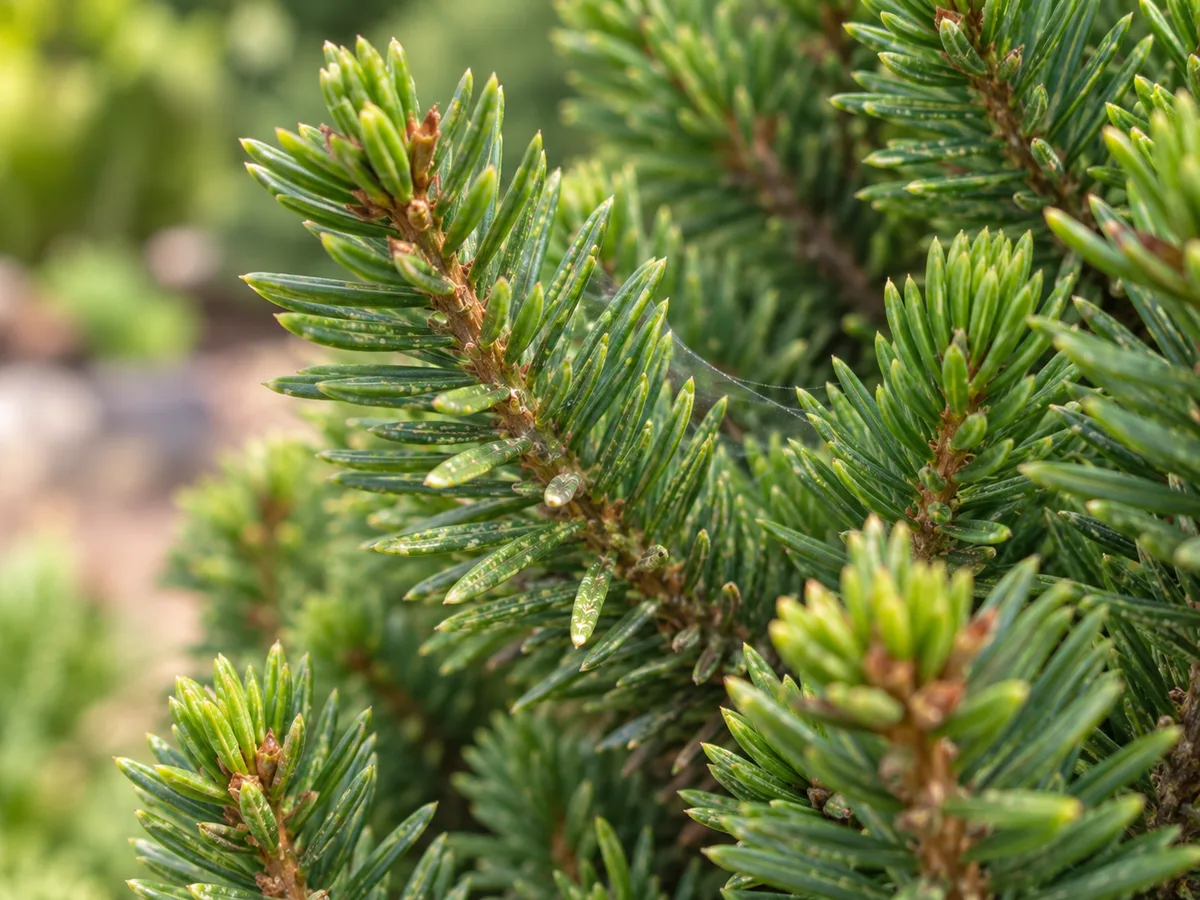
Heat and drought stress, root rot, needle diseases, and insect activity can overlap. A useful diagnosis records the date symptoms began, whether the current-year needles are affected, recent irrigation and rainfall, and whether damage is limited to the lower crown or scattered throughout it.
Take a small sample of affected and healthy growth to a local extension diagnostic service when the cause is uncertain. For a mature tree near a target, a certified arborist can assess structural risk as well as plant health.
Plan for Winter and Seasonal Care
Established trees do not need to be wrapped against cold. In exposed locations, a temporary burlap screen on the windward side can reduce winter desiccation without binding fabric tightly around the crown.
Do not use plastic wrap, and do not wrap the entire tree so tightly that branches are compressed or airflow is blocked. Water during a dry fall before the ground freezes; once the soil is frozen, watering will not reach active roots.
After a heavy, wet snowfall, gently brush snow upward from branches only if they are bending under the load and are within safe reach. Frozen branches snap easily, so do not shake or strike the tree.
Leave routine snow alone when branches are not strained. Keep road salt and snow-storage piles away from the root zone, and check for trunk injury or broken limbs after storms.
Choose Alternatives When the Site Is a Poor Match
A smaller cultivar solves a space problem, not a heat or humidity problem. If your garden has the right cool climate but not room for a 30-foot tree, a verified dwarf or semi-dwarf cultivar may work.
If summers are persistently hot, humid, or very dry, first ask a local extension office about conifers adapted to that region. In some Midwest landscapes, Purdue advises considering white spruce or Norway spruce because they are more resistant to Rhizosphaera needle cast than Colorado blue spruce, though those species differ in color and form.
For the arid Southwest, Fine Gardening’s regional alternatives include Rocky Mountain juniper and Arizona cypress cultivars that tolerate the conditions better than blue spruce. Those plants are not universal substitutes: winter hardiness, irrigation needs, mature size, and local pest pressure still matter. Choose for the climate you actually have, and compare the alternative’s mature width and water needs with the role you want it to fill.
Conclusion
Colorado blue spruce can be a long-lived, distinctive evergreen when a planting site offers full sun, good drainage, enough room, and summers it can tolerate. Choose a cultivar by its mature size and form, set the root flare at soil level, water according to root-zone moisture while the tree establishes, and avoid routine fertilizer or severe pruning.
If the climate is hot or humid, the soil stays wet, or the tree would need regular shearing to fit, choose another evergreen before planting. If an established spruce is thinning, diagnose the pattern first: brown needles are a symptom, not a treatment plan.



